

Written By: Jeffrey Atlas, Health Content Writer
Medically Reviewed By: Dr. Gopal Grandhige, MD, FACS, Board-Certified Surgeon
Last Reviewed: August 7, 2026
Sauerkraut helps some people with acid reflux and makes it worse for others. Anyone handing you a clean yes or no is guessing.
Fermented cabbage carries live bacteria and fiber that may settle the gut over several weeks. It also sits at a pH of roughly 3.4 to 3.9 and delivers 661 mg of sodium per 100 grams, according to USDA FoodData Central. That’s a serious acid and salt load to drop on an irritated esophagus. Which side wins depends entirely on why you’re refluxing.
I’m Dr. Gopal Grandhige, a board-certified surgeon, and I’ve been repairing reflux in Tampa since 2010. What follows is what the evidence supports, what it doesn’t, and how to test a jar on yourself without losing a week to heartburn.
Sauerkraut for acid reflux means eating fermented cabbage to add live lactic acid bacteria and fiber to your diet, hoping to reduce heartburn. No controlled trial has ever tested sauerkraut in GERD patients. The case for it rests on probiotic studies, irritable bowel research, and fiber data. All of it indirect.
Reflux Starts With a Valve, Not With Extra Acid
Acid reflux happens when the muscle ring at the bottom of your esophagus stops sealing, letting stomach contents wash back up. Most people assume the problem is too much acid. It usually isn’t.
That muscle ring, the lower esophageal sphincter, should open for food and shut behind it. When it weakens, or when part of the stomach slides up through the diaphragm as a hiatal hernia, the seal fails. Fluid that belongs below the valve ends up above it. Big meals, late meals, extra abdominal weight, and smoking all make the failure more likely.
Symptoms most people recognize
Burning behind the breastbone. A sour or bitter taste rising into the throat. Chest pain that can be mistaken for a heart problem. Food that feels stuck going down.
Some people get none of that. They get a hoarse voice, a cough that won’t quit, or constant throat clearing. That pattern is silent reflux, and it changes the sauerkraut math considerably. More on that shortly.
Where heartburn ends and GERD begins
Occasional heartburn is normal. Symptoms two or more days a week point toward GERD, which is the chronic version and the one that damages tissue.
The scale is bigger than most people realize. A national survey of 71,812 adults published in Gastroenterology found 44.1% had experienced reflux symptoms and 30.9% had them in the past week. The same survey found about half of everyone taking a proton pump inhibitor still had breakthrough symptoms. Left alone for years, GERD can inflame the esophagus, scar it into a narrowing, or produce Barrett’s esophagus, a cell change that carries cancer risk.
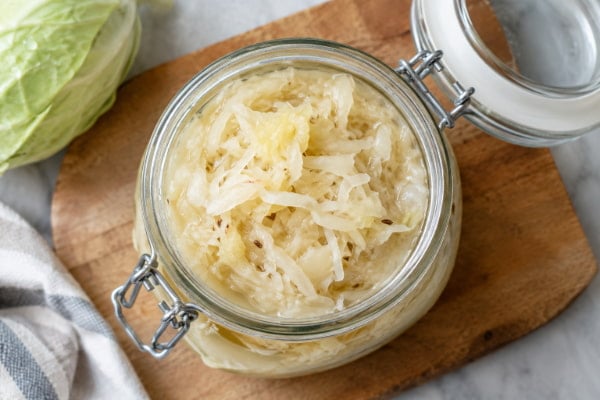
What’s Actually Inside the Jar
Sauerkraut is shredded cabbage packed with salt and left to ferment. Bacteria already living on the leaves eat the sugars and produce lactic acid, which sours the cabbage and preserves it.
That lactic acid is the whole story, good and bad. It’s what makes sauerkraut a probiotic food, and it’s what drops the pH from cabbage’s neutral 5.9 down to 3.4 or lower.
| Per 100 g (about ⅔ cup) | Amount |
| Calories | 19 |
| Fiber | 2.9 g |
| Sodium | 661 mg (29% DV) |
| Vitamin C | 15 mg |
| Vitamin K | 13 mcg |
| Typical pH | 3.4 to 3.9 |
Look at the sodium line again. One modest serving covers nearly a third of a day’s allowance. Most reflux articles print this table and say nothing about it.
Is Sauerkraut Good for Acid Reflux?
For mild reflux without structural damage, small amounts may help over weeks. For anyone with a sensitive esophagus or throat symptoms, it frequently makes things worse. There is no trial in GERD patients either way.
The strongest case comes from adjacent research. A 2020 systematic review in Nutrients pooled 13 prospective probiotic studies and found 11 of 14 comparisons reported some benefit for upper gut symptoms. Read the fine print, though: only five of those 13 studies rated high quality. That’s a promising signal sitting on shaky evidence, and I’d rather say so than dress it up.
For sauerkraut specifically, a 2018 randomized pilot in Food & Function gave 34 irritable bowel patients 75 g a day for six weeks. Symptom scores improved in both arms. Those were IBS patients, not reflux patients, and the two conditions aren’t the same thing.
Fiber is the piece I find most convincing, and it gets almost no attention. Research published in Clinical Gastroenterology and Hepatology found that every 5 g per day drop in fiber intake came with a 14% higher risk of reflux symptoms. A separate trial adding psyllium to the diet of non-erosive reflux patients cut the share reporting heartburn from 93.3% to 40% in ten days, and raised minimum resting LES pressure from 5.41 to 11.3 mmHg. Fiber appears to tighten the valve. Sauerkraut has fiber.
Why It Backfires, and Who It Backfires On
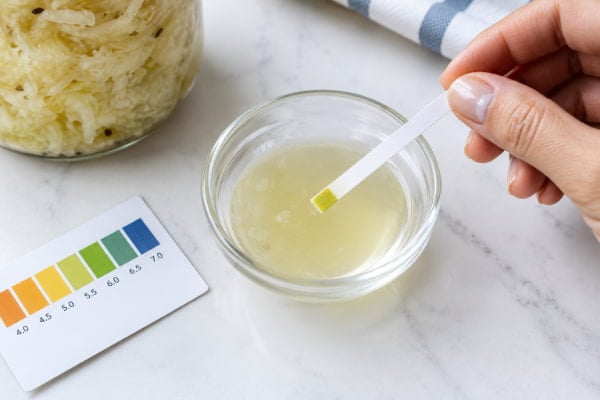
Sauerkraut’s acidity is not a rounding error. At pH 3.4 to 3.9, it lands in the same range as the vinegar-brined pickles most reflux patients already avoid, though lactic acid tends to sit easier than acetic acid.
For silent reflux, the acidity is the whole problem. Pepsin, the stomach enzyme that rides up with reflux, parks in throat tissue and stays there dormant for hours. Landmark work in The Laryngoscope established that pepsin reactivates at any pH below about 6.5, and that 79% of its activity comes back when pH drops. Your larynx normally sits around 6.8. A forkful of sauerkraut at pH 3.5 doesn’t need to cause a new reflux episode to hurt you. It just wakes up the enzyme already sitting there. This is why LPR patients get told to stay above pH 5, and why I steer them away from kraut.
Three other problems nobody mentions:
Sodium. Salt drives fluid retention and bloating, which raises pressure under the valve.
Histamine. Fermentation generates biogenic amines, and sauerkraut ranks among the highest-histamine foods in the grocery store. If ferments reliably give you headaches, flushing, or a stuffy nose alongside gut symptoms, histamine intolerance is worth investigating before you blame the acid.
Mannitol. Monash University testing puts sauerkraut at low FODMAP only up to 20 g, about one tablespoon. At 30 g, mannitol climbs to moderate. At a full cup, it’s high. Mannitol ferments in the colon, produces gas, and gas pushes upward.
I should correct something the wellness internet repeats constantly. You’ll read that sauerkraut’s “vitamin U” protects against ulcers, so it must help heartburn. That research is real, but it came from the 1940s and 50s, used a liter of raw cabbage juice daily, and studied peptic ulcers rather than reflux. Fermented cabbage in a jar is not that intervention.
Raw or Pasteurized: Which Jar Should You Buy?
Buy refrigerated if you want live cultures. Shelf-stable jars and every canned version have been heat-treated, which kills the bacteria the whole probiotic argument depends on.
Read the label for “raw,” “unpasteurized,” or “live cultures,” and check the ingredients. Cabbage, salt, maybe caraway. If vinegar appears, you’re buying a pickle wearing a sauerkraut label. Some brands refrigerate pasteurized product to look fresher, so location alone isn’t proof.
Now the part that surprised me. I used to tell patients raw or nothing. The data doesn’t back that.
In the 2018 IBS pilot, the pasteurized group improved nearly as much as the raw group, and researchers concluded prebiotic fiber probably mattered more than the live bacteria. Then a 2025 crossover trial in Microbiome put 87 healthy adults on 100 g of fresh or pasteurized sauerkraut daily for four weeks each. Live bacteria from the raw version showed up in stool, then vanished during washout. Only the pasteurized arm raised short-chain fatty acids in blood.
So if pasteurized is what your stomach tolerates, that’s a legitimate choice, not a consolation prize.
How Much Should You Actually Eat?
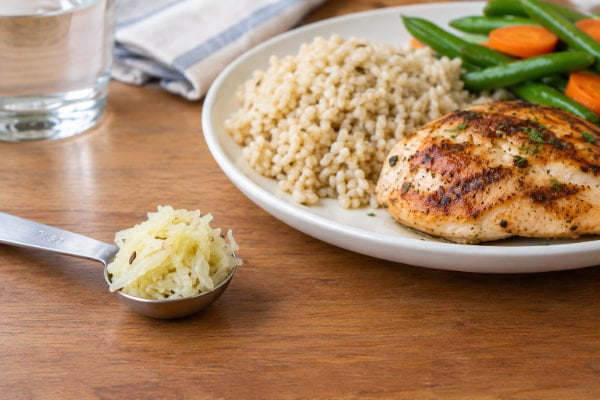
Start at one teaspoon with a meal, not on an empty stomach, and hold that for three days before increasing.
I’ve watched too many patients read “sauerkraut is good for gut health,” eat half a jar at dinner, spend the night sitting upright, and write off fermented food forever. The dose that failed them wasn’t a dose. It was an experiment with no control.
- Days 1 to 3: One teaspoon, mid-day meal. Log symptoms for the next 24 hours.
- Days 4 to 10: One tablespoon if the first stage was quiet. This is Monash’s low-FODMAP ceiling.
- Week 2 onward: Two tablespoons maximum, still with food, never within three hours of bed.
- Any flare: Drop back one level. Two flares at the same amount means that amount is your limit.
Rinsing the kraut washes off some brine and surface salt. It won’t remove the lactic acid soaked into the cabbage, so don’t count on it as a fix.
Which Fermented Foods Are Gentler Than Sauerkraut?
Plain yogurt is the mildest entry point. Kombucha is the harshest, and I’d skip it entirely if you have reflux.
| Food | Typical pH | Live cultures | Main reflux problem |
| Plain yogurt | 4.0 to 4.6 | Yes | Fat content in full-fat versions |
| Kimchi | 4.2 to 4.5 | Yes | Chili heat, sodium |
| Kefir | 3.5 to 4.5 | Yes | Acidity, fat, lactose |
| Sauerkraut (raw) | 3.4 to 3.9 | Yes | Acid, sodium, mannitol |
| Sauerkraut (pasteurized) | 3.4 to 4.1 | No | Acid, sodium |
| Kombucha | 2.7 to 2.9 | Yes | Acidity plus carbonation |
Kimchi has better direct evidence than sauerkraut does. A 2019 trial had 20 people with digestive complaints eat 75 g twice daily for two weeks, and heartburn, acid regurgitation, bloating, and belching all dropped. Its chili content is the catch. Mild or white kimchi made without pepper flakes gets you the same bacteria without the capsaicin.
Kombucha fails on two counts at once. It’s the most acidic thing on the list, and carbonation distends the stomach and pushes contents against the valve. Fizzy plus pH 2.8 is a bad combination for a leaky sphincter.
The Habits That Outperform Any Jar in 2026
Weight, meal timing, and sleep position move reflux symptoms more than any fermented food will. That isn’t close.
Losing even a modest amount helps measurably. Published data shows a BMI reduction of 2 kg/m² or more raised the odds of symptom improvement by 32%. For patients where weight is the main driver, we offer incisionless weight loss procedures that address the pressure problem directly.
Stop eating three hours before you lie down. Raise the head of your bed six inches, using blocks under the frame rather than stacked pillows, which bend you at the waist and make things worse. Sleep on your left side. Walk after dinner instead of collapsing on the couch.
Here’s where I part company with most reflux content. Every article publishes the same list of forbidden foods: coffee, chocolate, citrus, tomatoes, mint, alcohol, spice. The 2022 ACG clinical guideline reviewed that evidence and specifically does not recommend routine global elimination of those foods. Cutting all of them costs you a normal life and buys most people very little. Find your two or three actual triggers with a food log and keep the rest.
When Food Stops Being the Answer
If you’ve been careful with diet for eight weeks and you’re still burning, the problem is probably mechanical. Bacteria can’t tighten a stretched valve or pull a hiatal hernia back below the diaphragm.
Delayed stomach emptying is another one food won’t solve. When gastroparesis leaves a meal sitting for hours, pressure builds and reflux follows regardless of what you ate.
Get evaluated now, not later, if you have trouble swallowing, unexplained weight loss, vomiting, black stools, or symptoms that keep breaking through medication. Those aren’t dietary problems.
Proper testing means pH monitoring, manometry, and endoscopy, which tell us whether you have acid reflux, non-acid reflux, or a motility disorder. Those three need different treatments. When the anatomy is the issue, options like the LINX reflux management system repair the valve itself. Tampa Bay Reflux Institute helps you eliminate reflux and GERD rather than manage it forever with groceries.
What I Tell Patients About Sauerkraut for Acid Reflux
Try it if your reflux is mild, you have no throat symptoms, and you can stick to a teaspoon. Skip it if you have silent reflux, an inflamed esophagus, or a history of reacting to acidic foods.
I’m not against fermented food. I eat it. But sauerkraut for acid reflux is a small lever, and the people who need help most are usually the ones it hurts. If a month of careful testing hasn’t moved your symptoms, the answer isn’t a different jar. It’s finding out what’s actually broken. Book a consultation and let’s get you a real answer.
This article doesn’t cover home fermentation methods or how to come off acid-suppressing medication. Both need their own discussion, and the second one needs your physician.
FAQs
Is sauerkraut good for acid reflux if I already have GERD?
It depends on whether your GERD is mild and non-structural. Sauerkraut’s live bacteria and fiber may help over several weeks, but its pH of 3.4 to 3.9 can irritate an already-inflamed esophagus. No clinical trial has tested sauerkraut in GERD patients, so the honest answer is that you have to test it on yourself in small amounts.
Can sauerkraut make acid reflux worse?
Yes, and it does for a meaningful share of people. The lactic acid produced during fermentation drops the pH well below the level that irritates a sensitive esophagus, and 661 mg of sodium per 100 grams adds bloating and abdominal pressure. Mannitol in fermented cabbage also produces gas, which pushes stomach contents upward.
How much sauerkraut for acid reflux is safe to start with?
Start with one teaspoon eaten alongside a meal, never on an empty stomach. Monash University testing shows sauerkraut stays low FODMAP only up to 20 grams, roughly one tablespoon, with mannitol climbing to moderate levels at 30 grams. Most people who tolerate it well settle at one to two tablespoons daily.
Does pasteurized sauerkraut still do anything?
More than most people assume. A 2018 randomized pilot found pasteurized sauerkraut improved irritable bowel symptoms nearly as much as the raw version, and a 2025 crossover trial in 87 adults found only the pasteurized arm raised short-chain fatty acids in blood. The fiber and fermentation byproducts appear to matter alongside the live bacteria.
Is sauerkraut safe if I have silent reflux or LPR?
It’s a poor choice for LPR. Pepsin lodged in throat tissue reactivates at any pH below roughly 6.5, and research in The Laryngoscope found 79% of its activity returns when pH drops. Sauerkraut at pH 3.5 can restart that enzyme without any new reflux episode occurring.
Can sauerkraut replace my reflux medication?
No. No controlled evidence supports sauerkraut as a substitute for acid suppression, and about half of people on proton pump inhibitors still have breakthrough symptoms even with medication. If a hiatal hernia or weakened valve is causing your reflux, no food will correct the anatomy.
Is sauerkraut brine better than eating cabbage?
Brine carries lactic acid bacteria without the fiber, so you lose the component that research most consistently links to fewer reflux symptoms. It’s also more concentrated in salt and acid per spoonful. For reflux specifically, the cabbage itself makes more sense than the liquid.


An endoscopy cannot tell you if you have reflux. It can only tell you if you have complications of GERD.
If you are unhappy with your reflux symptoms, come in and we can discuss testing and treatments that can accurately diagnose your problem.
#reflux #gerd #hiatalhernia #gastroparesis #linx

CALL US AT 813-922-2920
www.tampareflux.com
If you have a hiatal hernia and fit one of these categories, you should know your options.
Dr. Grandhige is an expert in his field and performs 200 of these surgeries a year. He is the only surgeon in the Tampa Bay Area who offers all surgical options - LINX, Fundoplications, TIF and will be one of 20 surgeons in America introducing the latest procedure RefluxStop in 2026.
We accept most insurances but will verify yours before you come in. These procedures are considered medically necessary and covered by your insurance. You can expect to pay your in-network deductibles and nothing else.
#hiatalhernia #reflux #GERD #LINX #refluxstop
What causes reflux ?
1. Weak lower esophageal sphincter
2. Hiatal hernia
3. Flattening of the Angle of His
4. Poor esophageal motility
5. Gastroparesis (slow stomach)
NOT increased acid production
Don’t let GERD get in the way of living your life. Request your appointment with us today on the link below.
.
.
.
.
https://tampareflux.com/contact-us/
Anyone can be victim to GERD and though weight loss can help reduce GERD symptoms. Many athletes with high impact workouts may continue to have these symptoms. This may be a symptom of a hiatal hernia or other issue. We are more then happy to assist you in finding your solution, just click the link below.
.
.
.
https://tampareflux.com/contact-us/
##healthylifestyle #workout #athletereflux #PPIs #heartburn #LINX #fundoplication #TIF #GERD#tampaheartburn #linx #TIF #fundoplication #tampabayreflux #GERD #acidreflux #acidrefluxsurgery #stopreflux
#nonsurgicalweightloss #ESG #gastricballoon #weightlossjourney #vsg #vsgjourney #spatz3 #orbera #orberaballoon #grandhige #DrG
#tampabayrefluxinstitute #guthealth #roboticsurgery
Heartburn may seem like an annoyance. But if you find yourself having symptoms on a daily basis, it may be time to to talk to Dr. Grandhige as it could be a symptom of something worse.
.
.
.
#chronicheartburn #gerdsymptoms #heartburnrelief #reflux #PPIs #heartburn #LINX #fundoplication #TIF #GERD#tampaheartburn #linx #TIF #fundoplication #tampabayreflux #GERD #acidreflux #acidrefluxsurgery #stopreflux
#nonsurgicalweightloss #ESG #gastricballoon #weightlossjourney #vsg #vsgjourney #spatz3 #orbera #orberaballoon #grandhige #DrG
#tampabayrefluxinstitute #guthealth #roboticsurgery
If you are tired of avoiding your favorite foods or taking daily medications, we can help.
We are the Tampa experts in reflux ! With years of experience and thousands of patients treated successfully, we offer all FDA approved anti-reflux procedures.
Call 813-922-2920 to schedule your appointment
All major insurances accepted.
Not all patients need surgical intervention. Many patients are living a heartburn free life with their PPIs. However 40% of patients taking PPIs are not getting the relief they need. If you are one of those, you have options! Come in and find out more.
.
.
.
.
#letushelpyou #medsnotworking #reflux #PPIs #heartburn #LINX #fundoplication #TIF #GERD#tampaheartburn #linx #TIF #fundoplication #tampabayreflux #GERD #acidreflux #acidrefluxsurgery #stopreflux
#nonsurgicalweightloss #ESG #gastricballoon #weightlossjourney #vsg #vsgjourney #spatz3 #orbera #orberaballoon #grandhige #DrG
#tampabayrefluxinstitute #guthealth #roboticsurgery
#heartburn #stopreflux #hiatalherniarepair #severeheartburn #reflux #tampabayreflux #acidrefluxsurgery #tampaheartburn #GERD #PPIs #achalasia #LINX #TIF #tampareflux #fundoplication #stomach #digestivehealth #ESG #obesity #overweight #weightlossjourney #gastricballoon


