

Written By: Jeffrey Atlas, Health Content Writer
Medically Reviewed By: Dr. Gopal Grandhige, MD, FACS, Board-Certified Surgeon
Last Reviewed: February 8, 2026
Hiatal hernia surgery becomes necessary when medications fail to control acid reflux after several months, or when patients experience difficulty swallowing, breathing problems, persistent chest pain, or gastrointestinal bleeding. Research shows that 42% of laparoscopic hiatal hernia repairs fail, requiring revision surgeries that are significantly more complex due to scar tissue formation. Getting the repair done correctly during the first surgery by an experienced, high-volume surgeon is critical to avoiding multiple operations and long-term complications.
By age 60, approximately 50% of people develop hiatal hernias, which occur when the hiatus, the opening between the chest and abdominal cavity, enlarges, allowing the stomach to push upward into the chest. While minor hernias often respond to medication and lifestyle modifications, larger hernias or those causing persistent symptoms despite treatment typically require surgical intervention. This guide explains when surgery is necessary, what diagnostic tests to expect, and why choosing an experienced robotic surgeon specializing in hiatal hernia repair significantly impacts your outcomes, recovery time, and risk of recurrence.
Understanding Hiatal Hernias
This condition develops when the hiatus, the passage connecting your chest cavity and abdominal area, becomes enlarged, permitting your stomach or other digestive organs to migrate upward into your chest region. Patients may experience various manifestations including acid reflux, chest discomfort, respiratory difficulties, or the sensation of food becoming lodged during swallowing.
Minor hernias producing limited symptoms often respond well to pharmaceutical intervention and modifications to daily habits. Conversely, patients whose symptoms persist despite medication or those with substantial hernias typically need surgical repair for symptom control.
The Consequences of Inadequate Initial Repairs
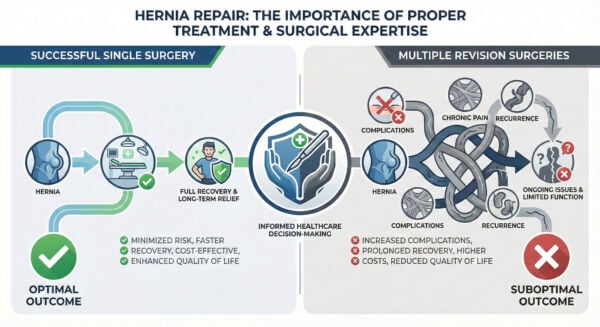
Evidence demonstrates that achieving successful correction during the initial procedure is critically important. Research indicates that laparoscopic hernia repairs fail in 42% of cases, necessitating additional operations.
Revision procedures require surgeons to navigate through dense adhesions created during the primary surgery. This complicates the operation, prolongs healing periods, and elevates the possibility of developing persistent discomfort.
Selecting a specialist with extensive hernia repair experience can help you avoid multiple operations and associated complications.
Indicators That Surgical Intervention Is Necessary
Surgery isn’t required for every hiatal hernia patient, but specific warning signs suggest an operation might be your optimal choice:
Ongoing Acid Reflux Unresponsive to Treatment
When prescription drugs fail to provide relief after several months, your hernia may exceed the threshold for non-surgical management. Continuous acid exposure deteriorates your esophageal tissue and elevates cancer risk with time. Prolonged gastric acid contact with the esophagus can trigger Barrett’s esophagus, a condition requiring regular monitoring due to its potential cancer progression. While surgical correction won’t eliminate existing Barrett’s esophagus, it prevents further advancement toward malignancy.
Swallowing or Breathing Complications
As hernias enlarge sufficiently to constrict your esophagus or limit lung capacity, you might encounter swallowing difficulties or breathlessness, particularly following meals. These manifestations seldom resolve without operative treatment.
Intense Chest Discomfort Resembling Cardiac Conditions
These hernias can trigger severe chest pain extending to your shoulders, neck region, or back. Discomfort typically intensifies when reclining and may be confused with heart-related problems. When cardiac evaluation yields negative results, your hernia could be responsible.
Food Coming Back Up Hours Post-Meal
When stomach portions become stuck above your diaphragm, accumulated food and fluids can later surge back into your throat. Patients frequently report sensations of chest obstruction, severe burning following meals or when lying horizontally. Advanced reflux may cause “silent aspiration,” characterized by vocal alterations like hoarseness, roughness, or nighttime coughing that worsens when flat, symptoms often associated with silent reflux or LPR.
Gastrointestinal Blood Loss
When stomach tissue protrudes into the chest cavity, continuous diaphragmatic movement around the herniated area can produce internal ulcerations. These Cameron’s ulcers trigger abdominal pain and bleeding. Affected individuals might observe blood in vomit or stools (appearing bright red or black). Others remain unaware of bleeding until experiencing breathlessness, lightheadedness, exhaustion, or chest pain. Laboratory testing reveals significantly reduced hemoglobin levels, frequently requiring blood replacement therapy. Surgical intervention remains the sole effective treatment for Cameron’s ulcers. Medication alone proves insufficient.
Pre-Surgical Evaluation Requirements
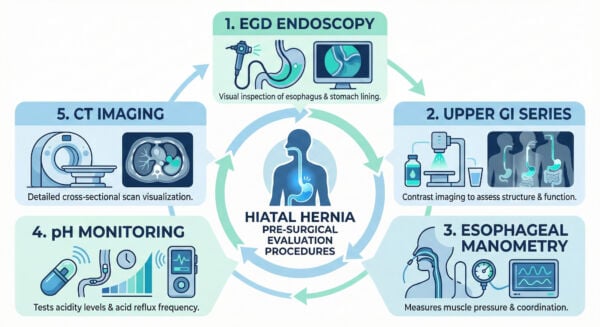
Complete pre-operative assessment typically involves one or more diagnostic procedures. Individual workup plans vary based on presenting symptoms and medical background. Dr. Grandhide determines which studies are necessary depending on your specific symptoms and clinical history.
EGD
This is one of the primary procedures Dr. Grandhide requires when evaluating patients with hiatal hernias or gastric reflux. This upper endoscopy procedure involves advancing a camera through your mouth into your stomach to visualize your esophagus, stomach, and duodenum. The procedure allows Dr. Grandhide to identify potential masses, ulcerations, or narrowing while determining hernia size. Detecting any growths before surgery is essential, as different operations would be required.
Upper GI Series
This examination requires consuming contrast material while X-ray images track how your esophagus moves food and beverages toward your stomach. The study reveals reflux severity. For patients with esophageal motility disorders, Dr. Grandhide customizes the fundoplication technique based on dysfunction severity. No universal approach exists. Selecting the wrong procedure can result in complete swallowing inability.
Esophageal Manometry
This diagnostic tool measures esophageal pressure levels and aids in identifying conditions like achalasia that mimic hiatal hernias but require entirely different treatments.
pH Monitoring
This study documents reflux timing and intensity, helping determine whether medical therapy alone suffices or surgery becomes necessary. Some individuals attribute symptoms to reflux when cardiac or pulmonary issues are actually responsible. This testing clarifies whether reflux truly causes your symptoms.
CT Imaging
This radiological study visualizes chest and abdominal anatomy. While not universally required, patients with massive hernias often need this imaging as multiple organs may have migrated into the chest. CT scans facilitate Dr. Grandhide’s surgical strategy development.

The Value of Surgical Expertise
Hiatal hernia correction represents a complex operation requiring work in both abdominal and chest cavities. Improper execution can prove catastrophic, resulting in permanent complications including chronic uncontrollable diarrhea, delayed gastric emptying, or swallowing impossibility. Dr. Grandhide is a high-volume robotic hiatal hernia surgeon with extensive experience in this operation. He possesses the technical proficiency, knowledge, and expertise to ensure excellent short-term and long-term patient outcomes. He delivers comprehensive pre-operative guidance that helps patients understand precisely what to expect following surgery. Dr. Grandhide also advises patients on which beverages and foods to avoid immediately post-operatively to minimize discomfort during the first 4-6 weeks after the procedure.
Successful repairs depend on multiple technical elements:
- Comprehensive surgical planning ensuring appropriate fundoplication technique selection
- Technical accuracy preventing injury to the esophagus, lung lining, vagus nerves, spleen, and stomach
- Proper tissue tension during repair minimizing recurrence risk
- Correct fundoplication sizing. Insufficient tightness fails to control reflux while excessive tightness causes post-surgical swallowing difficulty. Optimal tension addresses reflux while preserving normal eating and drinking ability.
Surgeons performing this operation frequently demonstrate superior results with reduced complication and failure rates. Choosing an experienced specialist is absolutely vital. Your wellbeing depends on it!

Achieve Proper Correction Initially
Hiatal hernias don’t self-resolve without treatment. If symptoms are compromising your quality of life, there’s no reason to delay. Schedule a consultation with Dr. Grandhide at Tampa Bay Reflux Institute to learn if surgery is the right option for you.
Contact our Tampa, Florida, office today or request an appointment online to experience lasting relief from your hiatal hernia symptoms.
Conclusion
Hiatal hernia repair is a complex surgical procedure where expertise and precision matter significantly. By choosing an experienced specialist like Dr. Grandhide at Tampa Bay Reflux Institute for your initial surgery, you can avoid the complications, extended recovery times, and risks associated with revision procedures. Don’t wait until your symptoms become unbearable. Early intervention with the right surgeon ensures the best possible outcome. If you’re experiencing persistent reflux, breathing difficulties, or other concerning symptoms, schedule a consultation today to explore your treatment options and take the first step toward lasting relief.
For more information on hiatal hernias and treatment options, visit our comprehensive blog or learn about advanced procedures like the LINX Reflux Management System, TIF EsophyX, or incisionless weight loss procedures that may be appropriate for certain patients. Additional resources on hiatal hernias are also available through MedlinePlus.
FAQs
How do I know if my hiatal hernia needs surgery?
Surgery becomes necessary when medications fail to control acid reflux after several months, or when you experience difficulty swallowing, breathing problems, persistent chest pain, or gastrointestinal bleeding. Minor hernias with mild symptoms often respond well to medication and lifestyle changes alone.
What makes the first surgery so important?
Research shows that laparoscopic hiatal hernia repairs fail in 42% of cases, requiring revision surgeries that are significantly more complex due to scar tissue. Getting the repair done correctly the first time by an experienced surgeon helps you avoid additional operations and complications.
What tests will I need before hiatal hernia surgery?
Pre-operative testing typically includes an EGD (upper endoscopy) to visualize your stomach and esophagus, and may include an upper GI series, esophageal manometry, pH monitoring, or CT imaging. Dr. Grandhide determines which studies are necessary based on your specific symptoms and medical history.
Can hiatal hernias cause bleeding?
Yes, when stomach tissue protrudes into the chest, continuous diaphragm movement can create Cameron’s ulcers that cause internal bleeding. This may appear as blood in vomit or stools, or cause symptoms like breathlessness, fatigue, and low hemoglobin levels requiring blood transfusions.
What happens if my fundoplication is too tight or too loose?
If the fundoplication is too loose, it won’t adequately control acid reflux and symptoms will persist. If it’s too tight, you may experience difficulty swallowing and be unable to eat or drink normally, which is why selecting an experienced surgeon is crucial.


An endoscopy cannot tell you if you have reflux. It can only tell you if you have complications of GERD.
If you are unhappy with your reflux symptoms, come in and we can discuss testing and treatments that can accurately diagnose your problem.
#reflux #gerd #hiatalhernia #gastroparesis #linx

CALL US AT 813-922-2920
www.tampareflux.com
If you have a hiatal hernia and fit one of these categories, you should know your options.
Dr. Grandhige is an expert in his field and performs 200 of these surgeries a year. He is the only surgeon in the Tampa Bay Area who offers all surgical options - LINX, Fundoplications, TIF and will be one of 20 surgeons in America introducing the latest procedure RefluxStop in 2026.
We accept most insurances but will verify yours before you come in. These procedures are considered medically necessary and covered by your insurance. You can expect to pay your in-network deductibles and nothing else.
#hiatalhernia #reflux #GERD #LINX #refluxstop
What causes reflux ?
1. Weak lower esophageal sphincter
2. Hiatal hernia
3. Flattening of the Angle of His
4. Poor esophageal motility
5. Gastroparesis (slow stomach)
NOT increased acid production
Don’t let GERD get in the way of living your life. Request your appointment with us today on the link below.
.
.
.
.
https://tampareflux.com/contact-us/
Anyone can be victim to GERD and though weight loss can help reduce GERD symptoms. Many athletes with high impact workouts may continue to have these symptoms. This may be a symptom of a hiatal hernia or other issue. We are more then happy to assist you in finding your solution, just click the link below.
.
.
.
https://tampareflux.com/contact-us/
##healthylifestyle #workout #athletereflux #PPIs #heartburn #LINX #fundoplication #TIF #GERD#tampaheartburn #linx #TIF #fundoplication #tampabayreflux #GERD #acidreflux #acidrefluxsurgery #stopreflux
#nonsurgicalweightloss #ESG #gastricballoon #weightlossjourney #vsg #vsgjourney #spatz3 #orbera #orberaballoon #grandhige #DrG
#tampabayrefluxinstitute #guthealth #roboticsurgery
Heartburn may seem like an annoyance. But if you find yourself having symptoms on a daily basis, it may be time to to talk to Dr. Grandhige as it could be a symptom of something worse.
.
.
.
#chronicheartburn #gerdsymptoms #heartburnrelief #reflux #PPIs #heartburn #LINX #fundoplication #TIF #GERD#tampaheartburn #linx #TIF #fundoplication #tampabayreflux #GERD #acidreflux #acidrefluxsurgery #stopreflux
#nonsurgicalweightloss #ESG #gastricballoon #weightlossjourney #vsg #vsgjourney #spatz3 #orbera #orberaballoon #grandhige #DrG
#tampabayrefluxinstitute #guthealth #roboticsurgery
If you are tired of avoiding your favorite foods or taking daily medications, we can help.
We are the Tampa experts in reflux ! With years of experience and thousands of patients treated successfully, we offer all FDA approved anti-reflux procedures.
Call 813-922-2920 to schedule your appointment
All major insurances accepted.
Not all patients need surgical intervention. Many patients are living a heartburn free life with their PPIs. However 40% of patients taking PPIs are not getting the relief they need. If you are one of those, you have options! Come in and find out more.
.
.
.
.
#letushelpyou #medsnotworking #reflux #PPIs #heartburn #LINX #fundoplication #TIF #GERD#tampaheartburn #linx #TIF #fundoplication #tampabayreflux #GERD #acidreflux #acidrefluxsurgery #stopreflux
#nonsurgicalweightloss #ESG #gastricballoon #weightlossjourney #vsg #vsgjourney #spatz3 #orbera #orberaballoon #grandhige #DrG
#tampabayrefluxinstitute #guthealth #roboticsurgery
#heartburn #stopreflux #hiatalherniarepair #severeheartburn #reflux #tampabayreflux #acidrefluxsurgery #tampaheartburn #GERD #PPIs #achalasia #LINX #TIF #tampareflux #fundoplication #stomach #digestivehealth #ESG #obesity #overweight #weightlossjourney #gastricballoon


