
Written By: Jeffrey Atlas, Health Content Writer
Medically Reviewed By: Dr. Gopal Grandhige, MD, FACS, Board-Certified Surgeon
Last Reviewed: July 1, 2026
Thinking about a Nissen fundoplication? Honest answer first. It’s the most proven surgery we have for stubborn acid reflux, and for the right person it works well. But it gets sold too easily, done too early, and comes with side effects that almost never make it into the pitch.
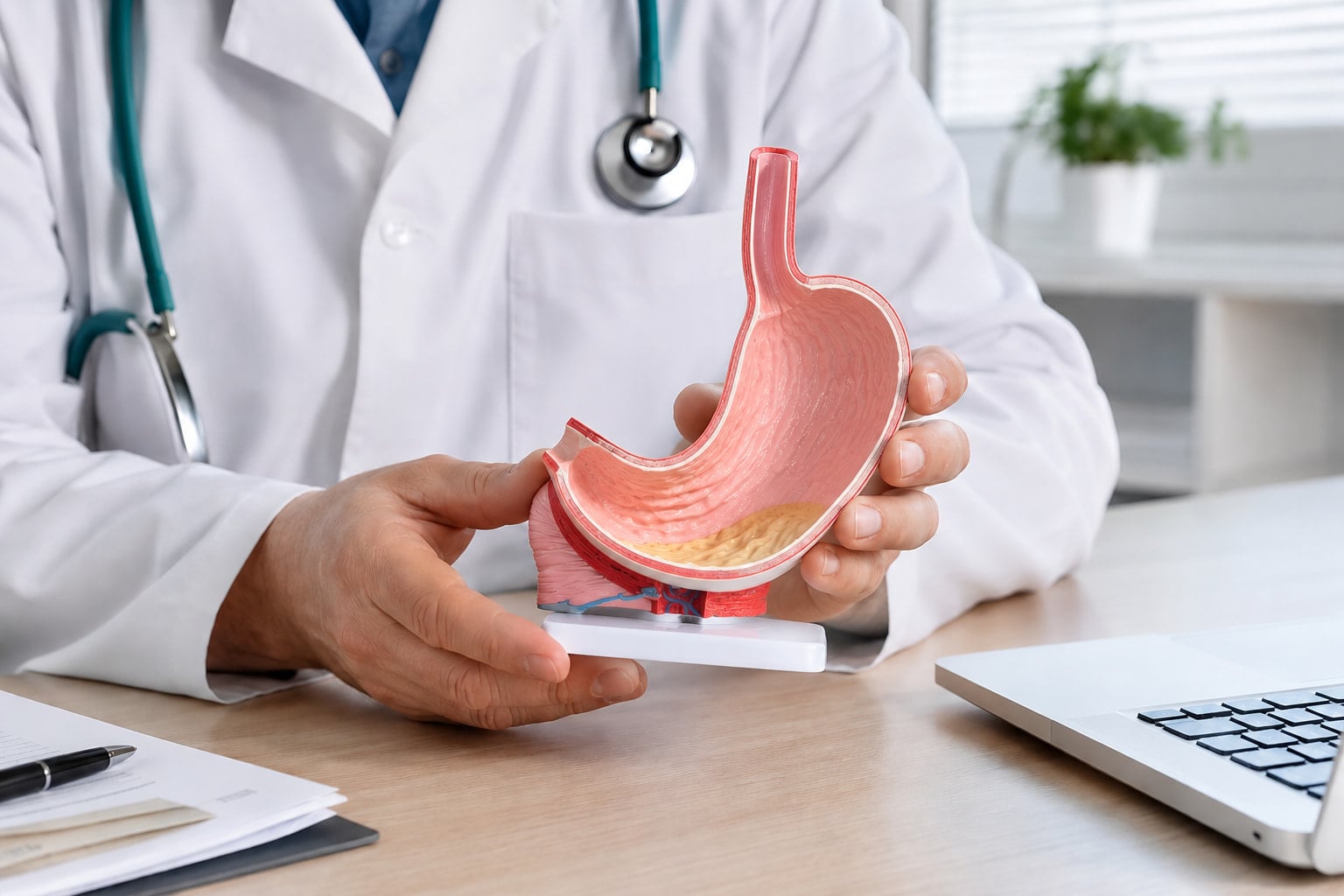
A Nissen fundoplication is a keyhole operation that treats long-term acid reflux by wrapping the top of the stomach a full 360 degrees around the lower esophagus. That rebuilds the weak valve that lets acid escape, and it repairs a hiatal hernia at the same time when one is present. Pills only mask the acid. This fixes the actual mechanics.
I’ve looked at plenty of cases where someone got pushed toward the operating room before anyone confirmed they needed it. So this piece does two jobs. It explains what the surgery really is, and it hands you the questions that separate a good result from a bad one.
How Does a Nissen Fundoplication Work?
The surgeon wraps part of your stomach around the bottom of your esophagus to tighten a leaky valve. That’s the whole idea.
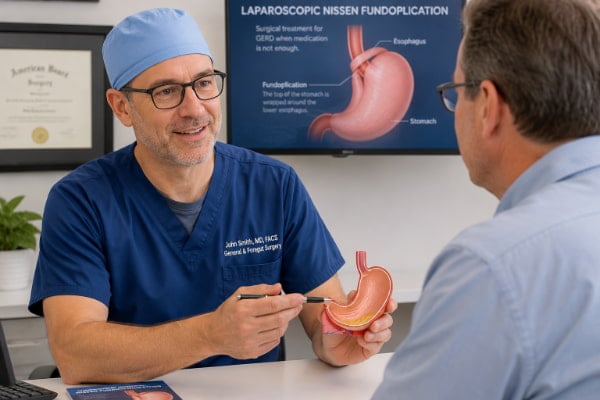
Between your stomach and esophagus sits a ring of muscle called the lower esophageal sphincter, or LES. When it works, it keeps acid down where it belongs. When it fails, acid washes up and burns. During a Nissen fundoplication, the surgeon takes the upper part of the stomach, wraps it all the way around the esophagus, and stitches it in place. The new collar props the valve shut.
Years ago this meant opening the whole chest. Today it’s almost always done laparoscopically, through a few small cuts with a camera and thin instruments. Recovery is faster and there are fewer wound problems. The core steps haven’t changed much since the German surgeon Dr. Rudolf Nissen designed the operation in the 1950s.
Why Is Nissen Still the Most Common Reflux Surgery?
Because it has the longest track record and the most surgeons who know it cold. Newer isn’t automatically better.
Reflux is everywhere. Somewhere between 18% and 28% of people in North America deal with it, and about a fifth get heartburn on a regular basis. That demand has produced decades of research and a large pool of surgeons who do this one operation often.
Decades of Real Data
The Nissen has been studied more than any other anti-reflux surgery, so you’re not a test subject. Long-term follow-up data on more than a thousand patients tracked for about 13 years shows the share with heartburn dropping from roughly 94% before surgery to about 34% afterward, with close to 87% satisfied with their result. Those are real numbers from real follow-up, not a brochure.
Experience You Can Actually Find
The more often a surgeon does one specific operation, the better the results. That’s not opinion, it’s what the volume-outcome research shows again and again. High-volume surgeons, often the ones doing 20 to 50 or more of these a year, have fewer complications and shorter hospital stays.
Newer options exist too, like a magnetic sphincter device or an incisionless procedure done through the mouth. They’re solid choices for the right patient. But far fewer surgeons have deep experience with them, and experience is the thing that quietly drives your outcome.
Now the part almost nobody asks about. Patients grill the surgeon on technique and never ask the one question that matters most: how many of these do you do a year? Dr. Gopal Grandhige is a board-certified surgeon who does this work at volume, which is exactly the kind of track record you should be checking for in anyone you trust with your esophagus.
Can a Hiatal Hernia Be Fixed at the Same Time?
Yes. If you have a hiatal hernia, the surgeon can repair it during the same operation, and most do.
A hiatal hernia is when part of the stomach slips up through the diaphragm into the chest. It weakens the valve and makes reflux worse. Since the surgeon is already working in that exact spot, fixing the hernia and building the wrap in one sitting is the normal approach.
Most hernias are small. I mention that because I get asked constantly whether diet alone will fix reflux when a hernia is involved. Usually it won’t. A large hernia is a mechanical problem, and no eating plan re-stitches a stretched diaphragm. Diet helps the other pieces. It doesn’t undo the hernia.
Does a Nissen Fundoplication Help With Silent Reflux (LPR)?
Sometimes. It can help airway reflux, but the success rate is lower and less predictable than it is for classic heartburn.
Airway reflux, also called silent reflux or LPR, shows up as a hoarse voice, a nagging cough, throat clearing, or asthma-like symptoms instead of burning. The Nissen is the only reflux surgery with a decent body of research behind it for these airway cases.
One study in The American Surgeon found a Nissen improved airway reflux symptoms in about 75% of patients. Read that carefully. Improved, not cured. Three in four felt better to some degree. Another study tracked symptom scores dropping from around 32, which is severe, down to about 10, which is mild.
So the honest read: it works for a good chunk of airway reflux patients, but nowhere near as cleanly as it does for heartburn. I’d reserve it for severe, well-tested cases. For most people with silent reflux, other steps come first.

Complications Happen More Often Than the Sales Pitch Suggests
The Nissen is safe in skilled hands, but “low complication rate” oversells it. Wrapping a stomach around an esophagus is not a natural setup, and the body pushes back. Three complications are worth planning for.
Gas Bloat and Trouble Burping
Bloating is one of the most common side effects. The new wrap can be tight enough that burping becomes hard or impossible.
Your gut makes gas all day, and you swallow a little air whenever you eat. Normally you just burp it out. After a Nissen, that gas can get trapped, and your belly balloons. In long-term studies, as many as half of patients report some gas or bloating, though for many it eases over time. It’s the trade-off for a valve tight enough to stop acid.
Trouble Swallowing (Dysphagia)
Some people have trouble swallowing afterward. That makes sense. The valve is tighter now, the area is swollen from surgery, and your body isn’t used to pushing food through it.
For most, this fades within a few weeks or months. About a quarter of patients report some swallowing difficulty in long-term studies. If it doesn’t settle, the wrap may be too tight, and a visit to your surgeon or a gastroenterologist can sort out what’s going on. This is also why surgeons keep you on small, soft meals for the first month or so.
Vagus Nerve Injury
The vagus nerve runs your digestive system, including that valve. During the wrap, the surgeon has to work carefully around it.
Officially, vagus injury during this surgery is called rare. I’m not convinced the number is that low. Published estimates swing wildly, from about 10% to over 40%, and one review flat-out called it a neglected complication that happens more than assumed.
That’s a huge spread, and it tells you how little certainty there is here.
So what does it mean for you? Even if the nerve takes a hit, your reflux will very likely still be better after surgery. That’s the good news. The catch is longer term. A damaged vagus raises the odds your reflux creeps back, and it can cause its own trouble, like delayed stomach emptying, diarrhea, or nausea.
Actually, I’m putting that badly. The point isn’t to scare you off. It’s that this risk barely gets mentioned, so you should ask about it directly and make sure your surgeon operates carefully and often.

Does a Nissen Fundoplication Last Forever?
No. A Nissen can loosen or fail over time, and reflux can return. It’s durable, not permanent. There are two main ways it breaks down.
When the Wrap Slips or Comes Undone
The wrap has to stay put around the valve to keep working. Sometimes it slips, a stitch tears, or it unwraps entirely. Sometimes that’s a technical miss in the OR. Sometimes it’s plain bad luck.
Heavy lifting is a classic trigger. Straining under a heavy load spikes the pressure inside your abdomen and yanks on the wrap, which is built from your own stomach tissue. That’s why people who lift heavy for a living or in the gym run a higher chance of a failed wrap, and why surgeons tell you to skip lifting anything over about 10 pounds for the first couple of weeks.
When the Wrap Stretches Out
Every time you swallow, the wrap stretches a little. Overeating makes it worse by cramming the stomach and stressing the whole repair.
Over months and years, that repeated pressure can loosen the wrap. So no, a Nissen is not a free pass to eat like the surgery never happened. Big meals push acid up in anyone, and after surgery they also strain the repair. Smaller, more frequent meals protect both the valve and the wrap. Roughly 1 in 4 patients ends up back on acid-blocking medication within about a decade, and 6% or more need a second operation, closer to 16% by the ten-year mark in some reviews.
Nissen vs. Toupet: Which Wrap Is Right for You?
Two wraps cover most patients: the full Nissen and the partial Toupet. The Nissen controls reflux better. The Toupet causes fewer side effects. Which one fits depends on your body and your testing.
| Feature | Nissen (360° wrap) | Toupet (270° wrap) |
| Wrap coverage | Full, all the way around | Partial, about three-quarters |
| Reflux control | Strongest | Good, slightly less |
| Gas, bloating, swallowing issues | More common | Fewer |
| Often best for | Severe reflux, normal swallowing | Weaker swallowing muscles, side-effect concerns |
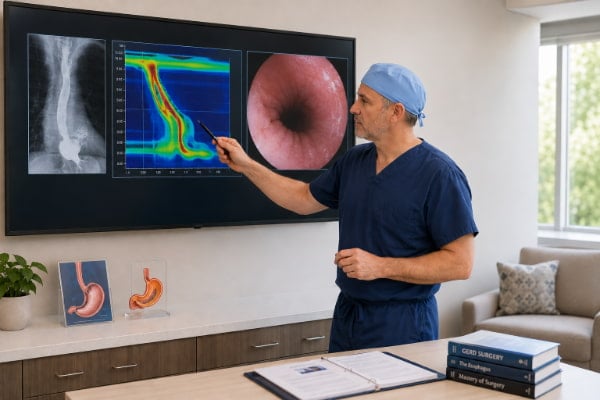
Neither is “better” across the board. A patient with severe reflux and normal swallowing muscles often does great with a Nissen. Someone whose pre-op tests show weak esophageal muscles may do better with a Toupet, because a full wrap could leave them unable to swallow comfortably.
The Nissen: A Full 360° Wrap
The Nissen is the most common version. The stomach goes a full 360 degrees around the valve, making it the tightest and the most effective at stopping reflux.
How Well Does It Work for Heartburn?
Very well, at least early on. Most patients wake up with their heartburn gone. Over 10 years, though, about a quarter see it return, usually because the wrap has loosened. A second surgery can often fix that. The strong reflux control is also why the Nissen carries more gas and swallowing side effects than a partial wrap.
The Nissen for Silent Reflux
For airway reflux, the Nissen is the best-studied surgical option, though results are less reliable than for heartburn. It suits severe, well-tested cases far better than mild ones, which is why proper diagnosis before surgery matters so much here.
The Toupet: A Gentler 270° Wrap
Think of the Toupet as the Nissen’s easier-going sibling. The wrap goes only about three-quarters of the way around, so it’s looser. Looser means it doesn’t block reflux quite as well, but it also means less gas and fewer swallowing problems. Surgeons choose it when a patient can’t tolerate a full wrap, and they sometimes convert a Nissen to a Toupet in a second operation to relieve bad bloating or swallowing trouble.
Surgery Should Be Your Last Move, Not Your First
A Nissen fundoplication can rescue the worst reflux cases. It’s proven, and in the right hands it changes lives. But it gets sold as low-risk, and that’s not the full truth. It carries real side effects, it doesn’t always hold, and it sometimes needs a redo.
Too many people get rushed into surgery before trying the boring stuff that works for a lot of them. A Harvard study following tens of thousands of people found that sticking to a handful of anti-reflux habits, things like keeping a healthy weight, not eating right before bed, and staying active, cut reflux symptoms by close to 37%. The major surgical guidelines agree. They only back an operation after medication and lifestyle changes have failed and testing confirms the reflux is real.
That’s the whole philosophy at Tampa Bay Reflux Institute. The goal is to eliminate your reflux and GERD with the least invasive path that works, and to reserve a Nissen fundoplication for when it’s truly the right call. If you’ve done the work and you’re still suffering, talk it through with our team and get properly tested before anyone picks up a scalpel.
FAQs
How long does a Nissen fundoplication last?
A Nissen fundoplication is durable but not permanent. Long-term studies show about 87% of patients are still satisfied 10 to 13 years later, though roughly 1 in 4 need acid-blocking medication again and about 6% need a repeat operation, rising to around 16% by the ten-year mark. Choosing a high-volume surgeon improves how long the repair holds.
Is a Nissen fundoplication better than LINX or TIF?
It depends on your anatomy. A Nissen fundoplication gives the strongest control of acid exposure, which is why it is often preferred for large hiatal hernias and severe reflux. Newer options like magnetic sphincter devices or incisionless procedures are less invasive and better preserve the ability to belch, but they suit a narrower group of patients.
What are the side effects of a Nissen fundoplication no one talks about?
The most underplayed side effects are gas and bloating, trouble belching or vomiting, and temporary difficulty swallowing. As many as half of patients report some gas or bloating, and about a quarter notice swallowing trouble that usually fades within weeks. A tighter wrap stops reflux better but makes these effects more likely.
Can you still vomit after a fundoplication?
Often not easily, especially after a full 360-degree Nissen wrap, which tightens the valve enough that belching and vomiting can become difficult. Partial wraps like the Toupet preserve these functions better. If this concerns you, raise it with your surgeon before choosing the type of wrap.
Why do some GERD surgeries fail?
Most failures trace back to a few causes: an inadequate workup before surgery, a low-volume surgeon, a large hernia that was not fully repaired, or the wrap loosening over time. About 16% of patients need a revision within ten years in some reviews. Specialized centers can usually diagnose and repair a failed wrap.
Is surgery or medication better for silent reflux (LPR)?
For refractory cases, surgery can outperform medication because it fixes the mechanical valve problem that pills only mask. One study found a Nissen improved airway reflux symptoms in about 75% of patients, though improvement is not the same as a cure. Proper testing should come first, since many airway symptoms have other causes.
How important is the surgeon’s experience for a fundoplication?
It is one of the biggest factors in your outcome. Volume-outcome research shows that high-volume surgeons, often those performing 20 to 50 or more of these operations a year, have fewer complications and shorter hospital stays. Always ask a surgeon how many of these procedures they perform annually.


An endoscopy cannot tell you if you have reflux. It can only tell you if you have complications of GERD.
If you are unhappy with your reflux symptoms, come in and we can discuss testing and treatments that can accurately diagnose your problem.
#reflux #gerd #hiatalhernia #gastroparesis #linx

CALL US AT 813-922-2920
www.tampareflux.com
If you have a hiatal hernia and fit one of these categories, you should know your options.
Dr. Grandhige is an expert in his field and performs 200 of these surgeries a year. He is the only surgeon in the Tampa Bay Area who offers all surgical options - LINX, Fundoplications, TIF and will be one of 20 surgeons in America introducing the latest procedure RefluxStop in 2026.
We accept most insurances but will verify yours before you come in. These procedures are considered medically necessary and covered by your insurance. You can expect to pay your in-network deductibles and nothing else.
#hiatalhernia #reflux #GERD #LINX #refluxstop
What causes reflux ?
1. Weak lower esophageal sphincter
2. Hiatal hernia
3. Flattening of the Angle of His
4. Poor esophageal motility
5. Gastroparesis (slow stomach)
NOT increased acid production
Don’t let GERD get in the way of living your life. Request your appointment with us today on the link below.
.
.
.
.
https://tampareflux.com/contact-us/
Anyone can be victim to GERD and though weight loss can help reduce GERD symptoms. Many athletes with high impact workouts may continue to have these symptoms. This may be a symptom of a hiatal hernia or other issue. We are more then happy to assist you in finding your solution, just click the link below.
.
.
.
https://tampareflux.com/contact-us/
##healthylifestyle #workout #athletereflux #PPIs #heartburn #LINX #fundoplication #TIF #GERD#tampaheartburn #linx #TIF #fundoplication #tampabayreflux #GERD #acidreflux #acidrefluxsurgery #stopreflux
#nonsurgicalweightloss #ESG #gastricballoon #weightlossjourney #vsg #vsgjourney #spatz3 #orbera #orberaballoon #grandhige #DrG
#tampabayrefluxinstitute #guthealth #roboticsurgery
Heartburn may seem like an annoyance. But if you find yourself having symptoms on a daily basis, it may be time to to talk to Dr. Grandhige as it could be a symptom of something worse.
.
.
.
#chronicheartburn #gerdsymptoms #heartburnrelief #reflux #PPIs #heartburn #LINX #fundoplication #TIF #GERD#tampaheartburn #linx #TIF #fundoplication #tampabayreflux #GERD #acidreflux #acidrefluxsurgery #stopreflux
#nonsurgicalweightloss #ESG #gastricballoon #weightlossjourney #vsg #vsgjourney #spatz3 #orbera #orberaballoon #grandhige #DrG
#tampabayrefluxinstitute #guthealth #roboticsurgery
If you are tired of avoiding your favorite foods or taking daily medications, we can help.
We are the Tampa experts in reflux ! With years of experience and thousands of patients treated successfully, we offer all FDA approved anti-reflux procedures.
Call 813-922-2920 to schedule your appointment
All major insurances accepted.
Not all patients need surgical intervention. Many patients are living a heartburn free life with their PPIs. However 40% of patients taking PPIs are not getting the relief they need. If you are one of those, you have options! Come in and find out more.
.
.
.
.
#letushelpyou #medsnotworking #reflux #PPIs #heartburn #LINX #fundoplication #TIF #GERD#tampaheartburn #linx #TIF #fundoplication #tampabayreflux #GERD #acidreflux #acidrefluxsurgery #stopreflux
#nonsurgicalweightloss #ESG #gastricballoon #weightlossjourney #vsg #vsgjourney #spatz3 #orbera #orberaballoon #grandhige #DrG
#tampabayrefluxinstitute #guthealth #roboticsurgery
#heartburn #stopreflux #hiatalherniarepair #severeheartburn #reflux #tampabayreflux #acidrefluxsurgery #tampaheartburn #GERD #PPIs #achalasia #LINX #TIF #tampareflux #fundoplication #stomach #digestivehealth #ESG #obesity #overweight #weightlossjourney #gastricballoon


