
Written By: Jeffrey Atlas, Health Content Writer
Medically Reviewed By: Dr. Gopal Grandhige, MD, FACS, Board-Certified Surgeon
Last Reviewed: August 23, 2026
The link between peanut butter and acid reflux is weaker than most health articles let on. No study has ever isolated peanut butter as a trigger on its own. It doesn’t appear on any major guideline’s list of foods to cut. Most people with heartburn eat it without trouble.
Some people do react. In my practice that’s patients with severe reflux or throat symptoms, rarely those with occasional heartburn.
When it does, the spread often isn’t the culprit. The portion is. Or the timing. Or the bread it came on.
Below I’ll cover the mechanism, what the evidence supports, and how to test your own tolerance in two weeks. You won’t find another list of forbidden foods here.
Peanut Butter and Acid Reflux: What’s Actually Happening?
Fat is the mechanism people point to, not acid. And the amount matters far more than the food itself.
Peanut butter and acid reflux are linked through fat rather than acidity. A two-tablespoon serving holds roughly 16 grams of fat and about 190 calories, according to USDA nutrition data. High-fat meals can slow stomach emptying and lower pressure at the lower esophageal sphincter, the valve that keeps acid where it belongs. That effect is real. It also depends heavily on how much you eat.
What does the research actually say?
Almost nothing directly. No randomized trial has tested peanut butter against GERD outcomes.
A 2007 study in Clinical Gastroenterology and Hepatology separated the two. Researchers fed 15 reflux patients 1,000-calorie and 500-calorie meals with fat held steady, then high-fat and low-fat meals with calories held steady. Acid exposure climbed on the high-calorie days, from 5.2% of the day to 8.6%. Fat percentage didn’t move that number. It moved how often patients felt symptoms, roughly 11 episodes versus 6.
Read that twice. The industry keeps getting it backwards. Calorie load drove the acid. Fat drove the feeling.
The American College of Gastroenterology’s 2022 guideline puts trigger food avoidance in the conditional category, backed by low-quality evidence. It pushes clinicians toward finding your personal triggers instead of banning foods across the board.
So the rule everyone repeats, high fat loosens the valve so skip the peanut butter, flattens a mixed evidence base. Two tablespoons is about 190 calories. A sandwich with jelly and a glass of milk lands closer to 600. I’d bet on the sandwich long before I’d blame the spoonful.
Who needs to be more careful
Not everyone sits in the same bucket. This is where I push back on my own opening.
Dr. Jamie Koufman, who has spent decades on throat-based reflux, reports peanut butter sets off symptoms in roughly half her patients with severe disease and one in ten with mild disease. That’s clinical observation, not trial data. It matches what I see. Patients with silent reflux, chronic cough, or hoarseness react to foods that heartburn patients handle fine.
If your symptoms live in your throat, not your chest, treat peanut butter with more suspicion.

What Happens After You Swallow It
Peanut butter affects your body several ways at once. Only some touch reflux.
Heartburn and the valve at the bottom of your esophagus
Fatty meals can trigger hormone release that softens the lower esophageal sphincter and slows how fast your stomach clears.
Actually, that framing isn’t quite right. Fat contributes to a process that already runs during normal digestion. Your valve relaxes after every meal. In healthy people that’s fine. In someone whose valve is weak, or who has a hiatal hernia stretching the opening, those ordinary relaxations turn into reflux.
The peanut butter didn’t break your valve. It found the weakness already there.
Why does peanut butter make swallowing harder?
Two reasons, and people mix them up.
The first is texture. Peanut butter is sticky and dense, so it drags against an inflamed or narrowed esophagus. That’s why creamy versions appear on esophageal soft diets. It’s a swallowing recommendation, not a reflux one. Half the internet cites it as proof that chunky peanut butter causes acid reflux, which it never claimed.
The second is eosinophilic esophagitis, an immune condition that inflames the esophagus and makes food feel stuck.
The numbers floating around on this are out of date. Older articles claim 70% of adults improve on a six-food elimination diet. A 2023 meta-analysis in Clinical Gastroenterology and Hepatology put histologic remission at 61.3%. A randomized trial in The Lancet Gastroenterology & Hepatology found six-food elimination reached 40.3% versus 34.3% for cutting milk alone.
The foods driving that condition are milk, wheat, and egg. Nuts play a marginal role. Cutting peanut butter to treat it is usually the wrong lever.
The inflammation angle
Peanuts contain omega-6 fatty acids, and you’ll see claims that this promotes inflammation.
That argument is theoretical. It rests on population-level omega-6 to omega-3 ratios, not on anything measured in reflux patients. I don’t raise it.
What it does for your heart
Most of the fat in peanut butter is monounsaturated, the kind tied to better cholesterol. The International Foundation for Gastrointestinal Disorders suggests people managing reflux include sources of it, peanut butter among them.
That’s what the trigger-food lists forget. Cutting it costs you something.
Calories climb faster than you think
A level two-tablespoon serving runs about 190 calories. Nobody eats a level serving.
This matters more than the fat debate. Weight carries the strongest evidence of any lifestyle change. In a study of 15,295 participants, dropping 2 or more BMI points raised the odds of symptom improvement by 2.34 times. No food swap comes close.
How Much Peanut Butter Can You Eat With Reflux?
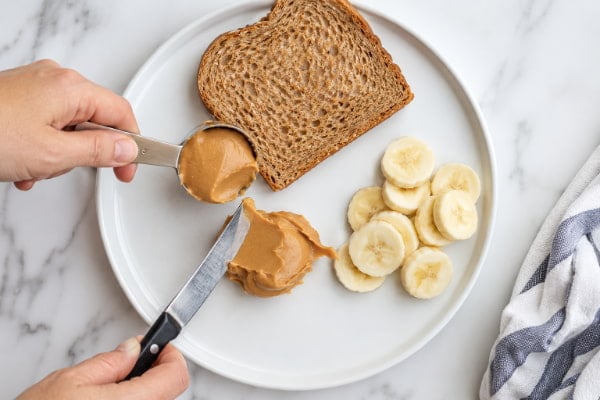
Start at one tablespoon and build up. The test takes about two weeks.
- Buy a natural version with peanuts and salt on the label. Added oils and sugar muddy the results.
- Eat one level tablespoon, measured, at breakfast. Not at night.
- Log symptoms for three days.
- If nothing happens, move to two tablespoons and repeat.
- If symptoms show up, drop back and retest with a smaller meal.
- Keep three hours between your last food and lying down, which the NIDDK and the ACG both recommend.
One note on substitutes, because this swap gets pushed constantly and doesn’t hold up.
| Spread, 2 tbsp | Total fat | Saturated fat | What it means for reflux |
| Smooth peanut butter | ~16 g | ~2.5 g | Standard serving, roughly 190 calories |
| Chunky peanut butter | ~16 g | ~2.6 g | Same fat, rougher texture on an inflamed esophagus |
| Almond butter | ~18 g | ~1.4 g | More total fat, not less |
Switching to almond butter to calm reflux makes no sense if fat is what worries you. It has more. Better saturated fat for your heart, sure. For your valve, nothing changes.
When Diet Stops Being the Answer
If you’re rearranging your life around a spoonful of peanut butter, the food isn’t your problem. The barrier is.
Occasional heartburn clears on its own. Antacids handle mild cases, though daily use past two weeks is a signal to get evaluated. For persistent symptoms the ACG recommends an eight-week proton pump inhibitor trial first.
Too often I see patients who spent three years cutting foods and swallowing pills, with nobody measuring their esophagus. GERD affects about 20% of people in the United States, and plenty of those cases involve a mechanical problem no diet fixes. A stretched hiatal hernia. A valve that no longer closes. A stomach that empties too slowly.
Testing answers that. pH monitoring and manometry show whether acid is reaching your esophagus and whether the muscle still works. When the barrier has failed, surgical repair treats the cause.
Dr. Gopal Grandhige is a board-certified surgeon, and the work at Tampa Bay Reflux Institute is built on eliminating reflux and GERD rather than managing it forever. If you’ve spent years chasing food triggers, the better question isn’t whether peanut butter and acid reflux are connected in your case. It’s why your esophagus reacts to a spoonful of anything at all.
FAQs
Is there a proven link between peanut butter and acid reflux?
No randomized trial has ever tested peanut butter against reflux outcomes. The connection is inferred from research on high-fat meals in general. A 2007 study in Clinical Gastroenterology and Hepatology found that calorie density, not fat percentage, drove esophageal acid exposure in reflux patients.
Does peanut butter cause heartburn in everyone?
No. Most people with occasional heartburn tolerate it without any reaction. Fat can lower pressure at the lower esophageal sphincter, but a two-tablespoon serving carries only about 190 calories, which is a small load compared to a full meal.
How much peanut butter can you eat with acid reflux?
Start with one level tablespoon at breakfast and log symptoms for three days before moving up to two. Two tablespoons is the standard serving at roughly 16 grams of fat and 190 calories. Avoid eating it within three hours of lying down.
Is smooth or chunky peanut butter better for reflux?
Smooth is recommended on esophageal soft diets, but that guidance is about swallowing comfort, not acid. Both types carry about 16 grams of fat per two-tablespoon serving. Chunky pieces can irritate an esophagus that’s already inflamed or narrowed.
Is almond butter better than peanut butter for acid reflux?
Not for reflux purposes. Almond butter contains roughly 18 grams of fat per two tablespoons compared to 16 grams in peanut butter. It has less saturated fat, which benefits heart health, but swapping it in does nothing for the fat mechanism behind reflux.
Can you eat peanut butter with silent reflux?
Approach it with more caution. Throat-based reflux specialists report peanut butter triggering symptoms in about half of patients with severe disease versus roughly one in ten with mild disease. If your symptoms include cough or hoarseness rather than heartburn, test small portions carefully.
When should you see a specialist about peanut butter and acid reflux?
If you’re eliminating foods and still having symptoms, or using antacids daily for more than two weeks. GERD affects about 20% of people in the United States, and many of those cases involve a mechanical failure that diet cannot correct. pH monitoring and manometry identify whether that’s happening.


An endoscopy cannot tell you if you have reflux. It can only tell you if you have complications of GERD.
If you are unhappy with your reflux symptoms, come in and we can discuss testing and treatments that can accurately diagnose your problem.
#reflux #gerd #hiatalhernia #gastroparesis #linx

CALL US AT 813-922-2920
www.tampareflux.com
If you have a hiatal hernia and fit one of these categories, you should know your options.
Dr. Grandhige is an expert in his field and performs 200 of these surgeries a year. He is the only surgeon in the Tampa Bay Area who offers all surgical options - LINX, Fundoplications, TIF and will be one of 20 surgeons in America introducing the latest procedure RefluxStop in 2026.
We accept most insurances but will verify yours before you come in. These procedures are considered medically necessary and covered by your insurance. You can expect to pay your in-network deductibles and nothing else.
#hiatalhernia #reflux #GERD #LINX #refluxstop
What causes reflux ?
1. Weak lower esophageal sphincter
2. Hiatal hernia
3. Flattening of the Angle of His
4. Poor esophageal motility
5. Gastroparesis (slow stomach)
NOT increased acid production
Don’t let GERD get in the way of living your life. Request your appointment with us today on the link below.
.
.
.
.
https://tampareflux.com/contact-us/
Anyone can be victim to GERD and though weight loss can help reduce GERD symptoms. Many athletes with high impact workouts may continue to have these symptoms. This may be a symptom of a hiatal hernia or other issue. We are more then happy to assist you in finding your solution, just click the link below.
.
.
.
https://tampareflux.com/contact-us/
##healthylifestyle #workout #athletereflux #PPIs #heartburn #LINX #fundoplication #TIF #GERD#tampaheartburn #linx #TIF #fundoplication #tampabayreflux #GERD #acidreflux #acidrefluxsurgery #stopreflux
#nonsurgicalweightloss #ESG #gastricballoon #weightlossjourney #vsg #vsgjourney #spatz3 #orbera #orberaballoon #grandhige #DrG
#tampabayrefluxinstitute #guthealth #roboticsurgery
Heartburn may seem like an annoyance. But if you find yourself having symptoms on a daily basis, it may be time to to talk to Dr. Grandhige as it could be a symptom of something worse.
.
.
.
#chronicheartburn #gerdsymptoms #heartburnrelief #reflux #PPIs #heartburn #LINX #fundoplication #TIF #GERD#tampaheartburn #linx #TIF #fundoplication #tampabayreflux #GERD #acidreflux #acidrefluxsurgery #stopreflux
#nonsurgicalweightloss #ESG #gastricballoon #weightlossjourney #vsg #vsgjourney #spatz3 #orbera #orberaballoon #grandhige #DrG
#tampabayrefluxinstitute #guthealth #roboticsurgery
If you are tired of avoiding your favorite foods or taking daily medications, we can help.
We are the Tampa experts in reflux ! With years of experience and thousands of patients treated successfully, we offer all FDA approved anti-reflux procedures.
Call 813-922-2920 to schedule your appointment
All major insurances accepted.
Not all patients need surgical intervention. Many patients are living a heartburn free life with their PPIs. However 40% of patients taking PPIs are not getting the relief they need. If you are one of those, you have options! Come in and find out more.
.
.
.
.
#letushelpyou #medsnotworking #reflux #PPIs #heartburn #LINX #fundoplication #TIF #GERD#tampaheartburn #linx #TIF #fundoplication #tampabayreflux #GERD #acidreflux #acidrefluxsurgery #stopreflux
#nonsurgicalweightloss #ESG #gastricballoon #weightlossjourney #vsg #vsgjourney #spatz3 #orbera #orberaballoon #grandhige #DrG
#tampabayrefluxinstitute #guthealth #roboticsurgery
#heartburn #stopreflux #hiatalherniarepair #severeheartburn #reflux #tampabayreflux #acidrefluxsurgery #tampaheartburn #GERD #PPIs #achalasia #LINX #TIF #tampareflux #fundoplication #stomach #digestivehealth #ESG #obesity #overweight #weightlossjourney #gastricballoon


