

Written By: Jeffrey Atlas, Health Content Writer
Medically Reviewed By: Dr. Gopal Grandhige, MD, FACS, Board-Certified Surgeon
Last Reviewed: October 27, 2026
Sleep on your left side. Raise the head of your entire bed by six to eight inches. Finish dinner three hours before you lie down. Those three changes carry more research behind them than anything else written about nighttime reflux, and not one of them costs a dollar.
Sleeping better with acid reflux comes down to cutting how long stomach acid sits in your esophagus overnight. The three moves with the strongest evidence are left-side sleeping, elevating the head of the bed six to eight inches, and leaving at least three hours between your last meal and bedtime. Everything else is secondary.
I’ve sat across from hundreds of people who spent years treating reflux as a food problem when it was a gravity problem. They quit tomatoes. They quit coffee. They stack four pillows and still wake at 2 a.m. with acid in the back of the throat.
This article skips the forbidden-foods list. I’ll explain why, and the reason may annoy you.
The Difference Between Acid Reflux and GERD
Acid reflux is an event. GERD is what we call it once that event happens often enough to damage tissue or ruin your sleep.
A ring of muscle at the bottom of your esophagus should stay closed between swallows. When it weakens, or relaxes at the wrong moment, stomach contents travel the wrong direction. Everybody refluxes sometimes. Big meal, lie down too soon, you feel it.
The 2025 NIDDK Burden of Digestive Diseases report put claims-based prevalence at roughly 11% of privately insured adults and nearly 24% of Medicare beneficiaries, with the highest rates in the South. Once symptoms show up weekly and start wearing down the lining of your esophagus, you’ve moved from heartburn into chronic reflux disease.
Why does the distinction matter at bedtime? Because occasional reflux responds to habits. Established disease often doesn’t, and waiting five years to find that out is the expensive mistake.
What Causes Acid Reflux at Night?
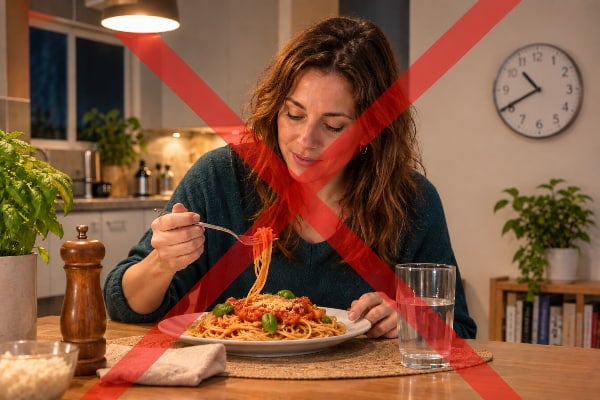
At night, reflux gets help. Gravity stops working in your favor, you swallow far less, and saliva production drops during deeper sleep stages. Saliva is your built-in acid neutralizer, so losing it matters.
Several things raise your baseline risk before you ever lie down:
- Extra weight around the middle. The American College of Gastroenterology graded weight loss as a strong recommendation on moderate-quality evidence, the firmest lifestyle grade in its entire 2022 guideline.
- Smoking. Both major GI societies recommend stopping.
- A weakened opening in the diaphragm. When part of the stomach slides up through that gap, the valve loses its mechanical backup. This is anatomy, and no bedtime routine corrects it.
- Certain medications. Talk to your prescriber before changing anything.
- Pregnancy. Usually resolves after delivery.
Now the food question, where I part ways with nearly every article on this topic.
Standard advice says cut chocolate, coffee, citrus, tomatoes, spicy food, mint, carbonated drinks, and fat. The ACG’s own evidence review found that alcohol across 16 trials, coffee and caffeine across 14 trials, fatty foods across 9 trials, citrus across 3 trials, and spicy food across 2 trials produced no measurable effect on lower esophageal sphincter pressure. That same review found no study showing that cutting coffee, chocolate, citrus, carbonated drinks, fatty food, or mint improved symptoms or complications.
The two biggest GI societies land in different places. The ACG guideline suggests avoiding trigger foods, but grades it a conditional recommendation on low-quality evidence. The American Gastroenterological Association states outright that routine global elimination of foods that can trigger reflux is not recommended as treatment.
Actually, that’s stated too bluntly. The evidence doesn’t say these foods never bother anyone. It says blanket elimination fails as a strategy. If a glass of red wine reliably lights you up at midnight, skip the wine. Just stop eating a joyless diet of plain chicken and rice while your anatomy quietly gets worse.

Nighttime Reflux Symptoms That Pull You Out of Sleep
The classic signs are burning behind the breastbone and the taste of acid or food coming back up. Plenty of people get neither.
Watch for a cough that only shows up at night, a hoarse voice in the morning, chronic throat clearing, a lump-in-the-throat sensation, trouble swallowing, or chest pain that spreads to the neck, jaw, or back. When those appear without heartburn, you may be dealing with reflux that stays silent, which gets missed constantly because patients report it to an ENT instead of a GI specialist.
Chest pain needs one direct warning. If it’s new, severe, or comes with shortness of breath or sweating, assume it’s your heart until a physician says otherwise.
Why Does Reflux Get Worse the Second You Lie Down?
Upright, gravity pulls refluxed material back down in seconds. Flat, it pools.
Researchers at Amsterdam University Medical Centers measured this directly. Median esophageal acid clearance took 35 seconds on the left side, 76 seconds flat on the back, and 90 seconds on the right. Same reflux event. Nearly three times the contact time depending on which way you’re turned.
The Damage That Builds While You Sleep
Years of overnight acid exposure can inflame the esophagus, create scar tissue that narrows it, erode tooth enamel, worsen asthma, and in some cases push the lining toward Barrett’s esophagus, the main precursor to esophageal cancer.
Nighttime reflux does more damage per episode than daytime reflux. The acid stays put longer.
How Does Acid Reflux Affect Your Sleep?
Badly, and more often than most people assume. Up to 80% of patients with reflux disease report burdensome nighttime symptoms, a figure the Amsterdam group published in the American Journal of Gastroenterology.
Traffic runs both ways. A pooled analysis of 22 studies found that insomnia, sleep disturbance, or short sleep duration roughly doubled the odds of developing reflux disease (OR 2.02, 95% CI 1.64–2.49). Bad sleep worsens reflux, reflux worsens sleep, and people stay stuck in that loop for a decade.
Reflux and Sleep Apnea Travel Together
The data here conflict, and anyone telling you otherwise hasn’t read it closely.
A 2023 meta-analysis presented in SLEEP pooled six studies covering 2,950 patients and found a statistically significant association between reflux disease and obstructive sleep apnea (OR 1.67, 95% CI 1.18–2.37, P = 0.004). A larger 2025 systematic review in Nature and Science of Sleep pulled in 49 studies and landed on a pooled relative risk of 1.23 that missed statistical significance (95% CI 1.00–1.52, P = 0.056). It did find reflux clearly tied to reduced sleep efficiency.
A 2026 prospective cohort found reflux symptom scores climbed steadily with apnea severity, from 6.8 in patients without apnea to 10.3 in severe cases.
My read: the causal arrow is unsettled, but the overlap is real enough that if you’re waking up gasping, snoring loudly, or dragging through afternoons, get screened for both. Treating one and ignoring the other wastes a year.
How to Sleep Better With Acid Reflux Starting Tonight
Four changes, ranked by how much evidence supports them.
Should You Sleep on Your Left Side?
Yes, and the difference isn’t subtle.
Researchers tracked 57 patients using simultaneous acid monitoring and sleep position sensors. Median acid exposure time was 0.0% on the left side, 0.6% flat on the back, and 1.2% on the right. A follow-up double-blind, sham-controlled trial of 100 patients used a wearable device to push people onto their left side and cut nighttime symptoms compared to sham treatment.
Right side down is the worst position for reflux. If you change one thing tonight, change that.
Raise the Bed Frame, Not the Pillows
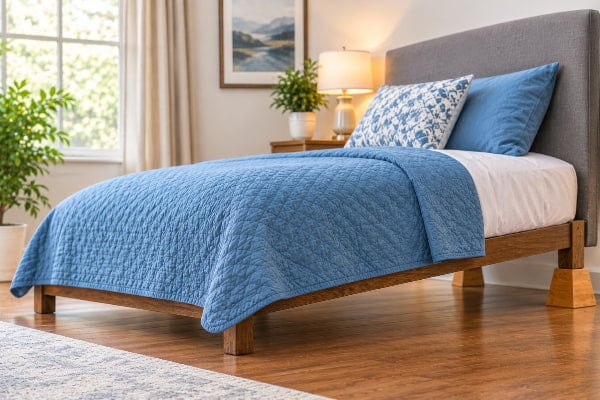
This is the step people get wrong most often. Stacking pillows bends you at the waist, raises pressure on your stomach, and can make the problem worse.
Put risers under the two legs at the head of the bed, or use a wedge that supports your entire torso from the hips up. Six to eight inches. A 2021 systematic review in BMC Family Practice found every included study reporting on symptoms showed improvement with head-of-bed elevation, and sleep disturbance improved in about 65% of participants.
The societies disagree on how hard to push it. The ACG calls bed elevation a conditional recommendation on low-quality evidence, while the 2024 ASGE guideline grades the same lifestyle bundle as a strong recommendation despite rating the evidence low. Same data, different confidence.
Does Eating Three Hours Before Bed Really Matter?
More than any food on your avoid list.
A matched case-control study of 147 patients with reflux disease and 294 controls found that a dinner-to-bed gap under three hours came with 7.45 times the odds of reflux disease compared to four hours or more (95% CI 3.38–16.4). That’s one of the largest effect sizes in the lifestyle literature, and it’s a scheduling change, not a sacrifice.
Both societies recommend it. Eat earlier, and keep the late meal smaller.
Medication Buys Relief, Not a Fix
Acid-reducing drugs work on acid. They don’t tighten a failing valve, close a hernia, or stop non-acid material from coming up.
Most people never get told this. The ACG gives a strong recommendation, on moderate evidence, to take proton pump inhibitors 30 to 60 minutes before a meal rather than at bedtime. Swallowing your pill as you climb into bed is a common and costly habit.
If you’ve taken daily acid suppression for six months and still wake up symptomatic, the medication isn’t failing you. It’s telling you something mechanical is going on.
When Better Sleep Habits Aren’t Enough
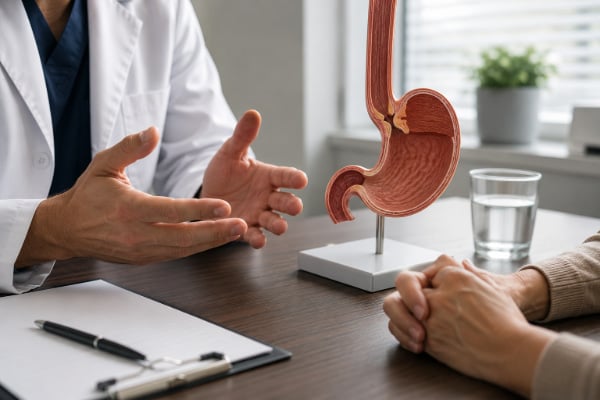
Give the three changes six weeks. If you’re still waking up, stop adjusting pillows and get objective testing.
That means pH-impedance monitoring to measure what’s actually refluxing and high-resolution manometry to check how your esophagus moves. Too many people take acid suppression for a decade without anyone checking the anatomy underneath. I’ve reviewed charts going back years where nobody ordered a single objective test.
When testing confirms a mechanical problem, the options are real. Surgical valve repair rebuilds the barrier, and incisionless reflux repair suits selected patients with a small hernia and leaves no external incisions at all. Neither is a last resort, and treating them that way is how Barrett’s esophagus sneaks up on people.
Sleeping better with acid reflux starts tonight with your left side, a raised bed frame, and an earlier dinner. If six weeks of that leaves you still staring at the ceiling, talk to a board-certified surgeon about testing. Tampa Bay Reflux Institute exists to get rid of reflux, not to help you cope with it for another ten years.
FAQs
How can I sleep better with acid reflux tonight?
Lie on your left side, raise the head of your bed six to eight inches using risers or a full-torso wedge, and avoid eating within three hours of bedtime. These three changes have more supporting evidence than any food restriction. Research from Amsterdam University Medical Centers found median acid exposure time of 0.0% in the left-side position compared with 1.2% on the right.
Is sleeping on your left side better for acid reflux?
Yes. A study of 57 patients using simultaneous acid and sleep-position monitoring found esophageal acid cleared in a median of 35 seconds on the left side, versus 76 seconds on the back and 90 seconds on the right. A separate double-blind, sham-controlled trial of 100 patients confirmed that promoting left-side sleep reduced nighttime symptoms.
How many inches should I raise my bed for acid reflux?
Six to eight inches at the head of the bed, raised from the frame rather than with pillows. Pillows bend the body at the waist and can increase abdominal pressure. A 2021 systematic review in BMC Family Practice reported symptom improvement across every study measuring it, with sleep disturbance improving in roughly 65% of participants.
How long before bed should I stop eating if I have acid reflux?
At least three hours, and four is better. A matched case-control study of 147 patients found that eating within three hours of bed carried 7.45 times the odds of reflux disease compared with a four-hour gap. Both the American College of Gastroenterology and the American Society for Gastrointestinal Endoscopy recommend avoiding meals close to bedtime.
Why does acid reflux get worse at night?
Lying flat removes gravity’s help, swallowing slows, and saliva production drops during deeper sleep stages. Acid that comes up stays in contact with the esophagus far longer, which is why nighttime reflux causes more tissue damage per episode than daytime reflux.
Can acid reflux cause sleep apnea?
The direction of cause is still debated. A 2023 meta-analysis of 2,950 patients found a significant association between the two conditions (OR 1.67), while a larger 2025 review of 49 studies found a weaker link that missed statistical significance. Symptom scores do rise with apnea severity, so screening for both is reasonable if you snore heavily or wake up gasping.
When should I see a specialist about sleeping better with acid reflux?
If six weeks of left-side sleeping, bed elevation, and earlier meals leave you still waking up, or if you’ve taken daily acid-reducing medication for six months without relief, it’s time for objective testing. pH-impedance monitoring and high-resolution manometry identify whether a mechanical problem such as a hiatal hernia is driving your symptoms.


An endoscopy cannot tell you if you have reflux. It can only tell you if you have complications of GERD.
If you are unhappy with your reflux symptoms, come in and we can discuss testing and treatments that can accurately diagnose your problem.
#reflux #gerd #hiatalhernia #gastroparesis #linx

CALL US AT 813-922-2920
www.tampareflux.com
If you have a hiatal hernia and fit one of these categories, you should know your options.
Dr. Grandhige is an expert in his field and performs 200 of these surgeries a year. He is the only surgeon in the Tampa Bay Area who offers all surgical options - LINX, Fundoplications, TIF and will be one of 20 surgeons in America introducing the latest procedure RefluxStop in 2026.
We accept most insurances but will verify yours before you come in. These procedures are considered medically necessary and covered by your insurance. You can expect to pay your in-network deductibles and nothing else.
#hiatalhernia #reflux #GERD #LINX #refluxstop
What causes reflux ?
1. Weak lower esophageal sphincter
2. Hiatal hernia
3. Flattening of the Angle of His
4. Poor esophageal motility
5. Gastroparesis (slow stomach)
NOT increased acid production
Don’t let GERD get in the way of living your life. Request your appointment with us today on the link below.
.
.
.
.
https://tampareflux.com/contact-us/
Anyone can be victim to GERD and though weight loss can help reduce GERD symptoms. Many athletes with high impact workouts may continue to have these symptoms. This may be a symptom of a hiatal hernia or other issue. We are more then happy to assist you in finding your solution, just click the link below.
.
.
.
https://tampareflux.com/contact-us/
##healthylifestyle #workout #athletereflux #PPIs #heartburn #LINX #fundoplication #TIF #GERD#tampaheartburn #linx #TIF #fundoplication #tampabayreflux #GERD #acidreflux #acidrefluxsurgery #stopreflux
#nonsurgicalweightloss #ESG #gastricballoon #weightlossjourney #vsg #vsgjourney #spatz3 #orbera #orberaballoon #grandhige #DrG
#tampabayrefluxinstitute #guthealth #roboticsurgery
Heartburn may seem like an annoyance. But if you find yourself having symptoms on a daily basis, it may be time to to talk to Dr. Grandhige as it could be a symptom of something worse.
.
.
.
#chronicheartburn #gerdsymptoms #heartburnrelief #reflux #PPIs #heartburn #LINX #fundoplication #TIF #GERD#tampaheartburn #linx #TIF #fundoplication #tampabayreflux #GERD #acidreflux #acidrefluxsurgery #stopreflux
#nonsurgicalweightloss #ESG #gastricballoon #weightlossjourney #vsg #vsgjourney #spatz3 #orbera #orberaballoon #grandhige #DrG
#tampabayrefluxinstitute #guthealth #roboticsurgery
If you are tired of avoiding your favorite foods or taking daily medications, we can help.
We are the Tampa experts in reflux ! With years of experience and thousands of patients treated successfully, we offer all FDA approved anti-reflux procedures.
Call 813-922-2920 to schedule your appointment
All major insurances accepted.
Not all patients need surgical intervention. Many patients are living a heartburn free life with their PPIs. However 40% of patients taking PPIs are not getting the relief they need. If you are one of those, you have options! Come in and find out more.
.
.
.
.
#letushelpyou #medsnotworking #reflux #PPIs #heartburn #LINX #fundoplication #TIF #GERD#tampaheartburn #linx #TIF #fundoplication #tampabayreflux #GERD #acidreflux #acidrefluxsurgery #stopreflux
#nonsurgicalweightloss #ESG #gastricballoon #weightlossjourney #vsg #vsgjourney #spatz3 #orbera #orberaballoon #grandhige #DrG
#tampabayrefluxinstitute #guthealth #roboticsurgery
#heartburn #stopreflux #hiatalherniarepair #severeheartburn #reflux #tampabayreflux #acidrefluxsurgery #tampaheartburn #GERD #PPIs #achalasia #LINX #TIF #tampareflux #fundoplication #stomach #digestivehealth #ESG #obesity #overweight #weightlossjourney #gastricballoon


