
What the 2025 national guideline changed
In September 2025 the American Gastroenterological Association published its first clinical practice guideline devoted to gastroparesis. All 12 of its recommendations are conditional, and two of them speak directly to the procedures that get marketed hardest online.
Read the full set of AGA recommendations before your consultation. And read them correctly: “against routine use” is not “never.” It means the evidence is not strong enough to make a procedure the automatic next step, and the panel put the weight on shared decision-making instead. A surgeon who tells you the guideline endorses these procedures has not read it. A surgeon who tells you the guideline forbids them has not read it either.
Dr. Grandhige’s position on this predates the guideline and matches it. In his words: the most important skill in this work is knowing when not to operate, and which version not to do. He has run a foregut-focused practice in Tampa Bay since 2009, and a meaningful share of his consultations end with a plan that involves no surgery at all.
The procedures, and what each one actually does
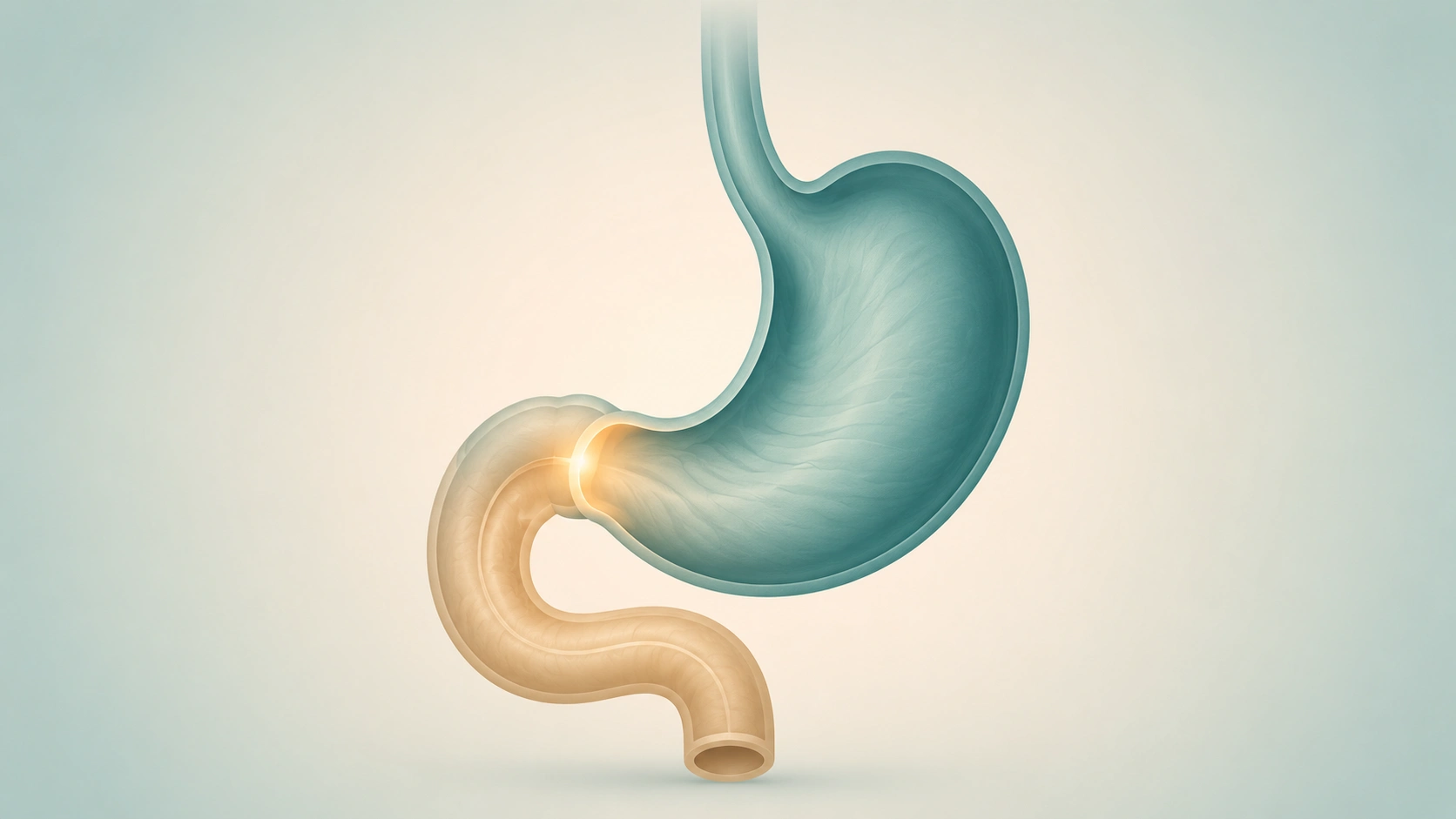
Every procedure for gastroparesis targets one of two things: the pylorus, or your ability to take in nutrition. None of them cure the disease. They manage it.
Endoscopic pyloromyotomy (POP or G-POEM). Performed through the mouth with a flexible endoscope. A tunnel is created under the pyloric muscle and the muscle is divided with an endoscopic knife. No abdominal incisions. Dr. Grandhige is one of a small number of physicians performing this in Tampa Bay.
Robotic or laparoscopic pyloroplasty. Small abdominal incisions under general anesthesia. The pyloric sphincter muscles are divided and the valve is reconstructed to stay open long term. This is the option the AGA declined to rule on, which reflects a thin evidence base rather than a poor track record.
Both share the same trade-off, and it should be said out loud: once the pylorus is permanently open, stomach contents drain quickly, and some patients get reflux of small intestine contents back into the stomach, or diarrhea with certain meals.
Gastric electrical stimulation. An implanted device. The AGA suggests against routine use. Dr. Grandhige does not implant these, and patients who want to pursue that route are pointed toward the right specialist rather than talked out of it.
Feeding and venting tubes. For people who have lost enough weight that they are not safe candidates for anything definitive yet. Nutrition first, procedure later.
Subtotal gastrectomy. Rare, and reserved for people whose disease has taken over their life despite everything else.
One thing worth watching. Metoclopramide is still the only drug the FDA has approved for gastroparesis, which is why this list leans so heavily on procedures. In May 2026 the Phase 2b MOVE-IT trial of naronapride, an oral prokinetic, reported that its 20 mg and 40 mg three-times-daily doses beat placebo across 328 adults with at least moderate idiopathic or diabetic gastroparesis. The 10 mg dose did not. In June 2026 the developers moved into late-stage Phase 3 studies with an FDA filing planned. It is not available to prescribe, and nobody should delay treatment waiting for it, but it is the first serious movement in this space in years.
Who should not have a pyloric procedure
Most pyloric procedures that disappoint were not technical failures. They were performed on people whose symptoms were never coming from delayed emptying in the first place.
Conditions that mimic gastroparesis closely enough to get mislabeled as it include rumination syndrome, esophageal hypersensitivity, functional heartburn, functional chest pain, and achalasia, where the lower esophageal sphincter fails to relax and the treatment is completely different. None of these improve when the pylorus is opened.
Three more situations that change the calculation:
Opioids. Opioid pain medication slows the stomach directly. AGA expert guidance on G-POEM advises weaning patients off opioids where possible and re-measuring gastric emptying before offering the procedure, because the delay may resolve on its own.
Post-infectious gastroparesis. The same guidance advises against offering G-POEM to most patients whose gastroparesis followed a viral illness, since a portion of these cases improve over months without intervention.
Large hiatal hernias. A hiatal hernia larger than 3 cm tends to progress, and the bigger it gets, the more likely the stomach becomes atonic. That stomach may or may not recover after the hernia is repaired, and that uncertainty has to be part of the conversation before anything is scheduled.
Dr. Grandhige is direct about the cost of this approach. The patients he declines to operate on are often the most frustrated people who walk out of his office. They are also the same patients who would be far unhappier after an unnecessary operation that left every symptom in place. At the consultation he separates your symptoms into three groups out loud: the ones he expects to improve, the ones that may improve partly, and the ones unlikely to be related at all.
About Dr. Gopal Grandhige
Gopal Grandhige, MD, is a board-certified general surgeon and a Fellow of the American College of Surgeons. He earned a Bachelor of Science in Biology from Johns Hopkins University and his medical degree from the University of Michigan, Ann Arbor. He completed his General Surgery Residency at Yale New Haven Hospital, followed by fellowships there in Burn and Critical Care and in Foregut Surgery and Minimally Invasive Surgery.
He is a Founding Member of the American Foregut Society, a member of the Society of American Gastrointestinal and Endoscopic Surgeons, and has practiced foregut surgery in Tampa Bay since 2009. He founded Tampa Bay Reflux Center in 2009 and Tampa Bay Reflux Institute in 2022.
His practice is limited to benign disease of the esophagus, diaphragm, and stomach: GERD, hiatal hernias, achalasia, laryngopharyngeal reflux, and gastroparesis. He does not treat esophageal or gastric cancer, and he refers out anything outside that scope. More on his background and how the practice is structured is worth reading before you book, and his written explanations of foregut conditions and testing cover a lot of what patients ask in consultation.
You can verify his standing independently through the American Board of Surgery physician lookup, the American College of Surgeons directory, and the Florida Department of Health license lookup.

Frequently asked questions
Take the first step
If diet changes and medication have stopped working and nobody has given you a four-hour emptying number or a clear reason your symptoms are happening, that is the place to start. Call 813.922.2920 or request an appointment below.


An endoscopy cannot tell you if you have reflux. It can only tell you if you have complications of GERD.
If you are unhappy with your reflux symptoms, come in and we can discuss testing and treatments that can accurately diagnose your problem.
#reflux #gerd #hiatalhernia #gastroparesis #linx


CALL US AT 813-922-2920
www.tampareflux.com
If you have a hiatal hernia and fit one of these categories, you should know your options.
Dr. Grandhige is an expert in his field and performs 200 of these surgeries a year. He is the only surgeon in the Tampa Bay Area who offers all surgical options - LINX, Fundoplications, TIF and will be one of 20 surgeons in America introducing the latest procedure RefluxStop in 2026.
We accept most insurances but will verify yours before you come in. These procedures are considered medically necessary and covered by your insurance. You can expect to pay your in-network deductibles and nothing else.
#hiatalhernia #reflux #GERD #LINX #refluxstop

What causes reflux ?
1. Weak lower esophageal sphincter
2. Hiatal hernia
3. Flattening of the Angle of His
4. Poor esophageal motility
5. Gastroparesis (slow stomach)
NOT increased acid production


Don’t let GERD get in the way of living your life. Request your appointment with us today on the link below.
.
.
.
.
https://tampareflux.com/contact-us/

Anyone can be victim to GERD and though weight loss can help reduce GERD symptoms. Many athletes with high impact workouts may continue to have these symptoms. This may be a symptom of a hiatal hernia or other issue. We are more then happy to assist you in finding your solution, just click the link below.
.
.
.
https://tampareflux.com/contact-us/
##healthylifestyle #workout #athletereflux #PPIs #heartburn #LINX #fundoplication #TIF #GERD#tampaheartburn #linx #TIF #fundoplication #tampabayreflux #GERD #acidreflux #acidrefluxsurgery #stopreflux
#nonsurgicalweightloss #ESG #gastricballoon #weightlossjourney #vsg #vsgjourney #spatz3 #orbera #orberaballoon #grandhige #DrG
#tampabayrefluxinstitute #guthealth #roboticsurgery

Heartburn may seem like an annoyance. But if you find yourself having symptoms on a daily basis, it may be time to to talk to Dr. Grandhige as it could be a symptom of something worse.
.
.
.
#chronicheartburn #gerdsymptoms #heartburnrelief #reflux #PPIs #heartburn #LINX #fundoplication #TIF #GERD#tampaheartburn #linx #TIF #fundoplication #tampabayreflux #GERD #acidreflux #acidrefluxsurgery #stopreflux
#nonsurgicalweightloss #ESG #gastricballoon #weightlossjourney #vsg #vsgjourney #spatz3 #orbera #orberaballoon #grandhige #DrG
#tampabayrefluxinstitute #guthealth #roboticsurgery

If you are tired of avoiding your favorite foods or taking daily medications, we can help.
We are the Tampa experts in reflux ! With years of experience and thousands of patients treated successfully, we offer all FDA approved anti-reflux procedures.
Call 813-922-2920 to schedule your appointment
All major insurances accepted.

Not all patients need surgical intervention. Many patients are living a heartburn free life with their PPIs. However 40% of patients taking PPIs are not getting the relief they need. If you are one of those, you have options! Come in and find out more.
.
.
.
.
#letushelpyou #medsnotworking #reflux #PPIs #heartburn #LINX #fundoplication #TIF #GERD#tampaheartburn #linx #TIF #fundoplication #tampabayreflux #GERD #acidreflux #acidrefluxsurgery #stopreflux
#nonsurgicalweightloss #ESG #gastricballoon #weightlossjourney #vsg #vsgjourney #spatz3 #orbera #orberaballoon #grandhige #DrG
#tampabayrefluxinstitute #guthealth #roboticsurgery

#heartburn #stopreflux #hiatalherniarepair #severeheartburn #reflux #tampabayreflux #acidrefluxsurgery #tampaheartburn #GERD #PPIs #achalasia #LINX #TIF #tampareflux #fundoplication #stomach #digestivehealth #ESG #obesity #overweight #weightlossjourney #gastricballoon
