
Why gastroparesis symptoms get treated as reflux for years
Gastroparesis and reflux produce overlapping symptoms, and gastroparesis is the one that usually gets missed. A slow stomach holds food and pressure longer, which pushes stomach contents upward. The patient reports heartburn and regurgitation. They are started on acid suppression, the heartburn improves slightly, and the nausea, fullness and bloating continue for years without anyone testing how fast the stomach empties.
Patients with gastroparesis are frequently carrying a diagnosis of GERD, IBS, anxiety or another overlapping condition instead. Dr. Grandhige corrects this in nearly every consultation by separating three groups of symptoms: the ones very likely to be caused by the condition being treated, the ones unlikely to be related, and the ones that may have more than one cause. Patients often want a single diagnosis to explain everything. That is rarely how the foregut behaves.
There is a second overlap that almost never appears on gastroparesis pages. A large hiatal hernia can itself produce a stomach that has lost tone. In Dr. Grandhige’s experience, the larger the hernia, the more likely an atonic stomach develops, and that stomach may or may not recover after the hernia is repaired. A patient in that situation has two mechanical problems layered on each other, and treating only one of them produces a partial result and a frustrated patient. This is a specific reason to have the anatomy read by a surgeon who works on the diaphragm and the stomach rather than one or the other.
You may recognize yourself in this list:
- You vomit food you ate several hours earlier
- You feel full after a few bites and cannot finish a normal meal
- Nausea is present most days with no clear trigger
- Bloating is severe after ordinary portions
- Reflux medication has never fully worked, at any dose
- An endoscopy found food still in your stomach after an overnight fast
- You are losing weight without trying, or cannot keep weight on
- A two-hour gastric emptying study came back normal while your symptoms continued
- Symptoms started or got worse after beginning a GLP-1 medication
- You have been told it is anxiety, IBS, or just reflux
The testing that separates gastroparesis from what imitates it
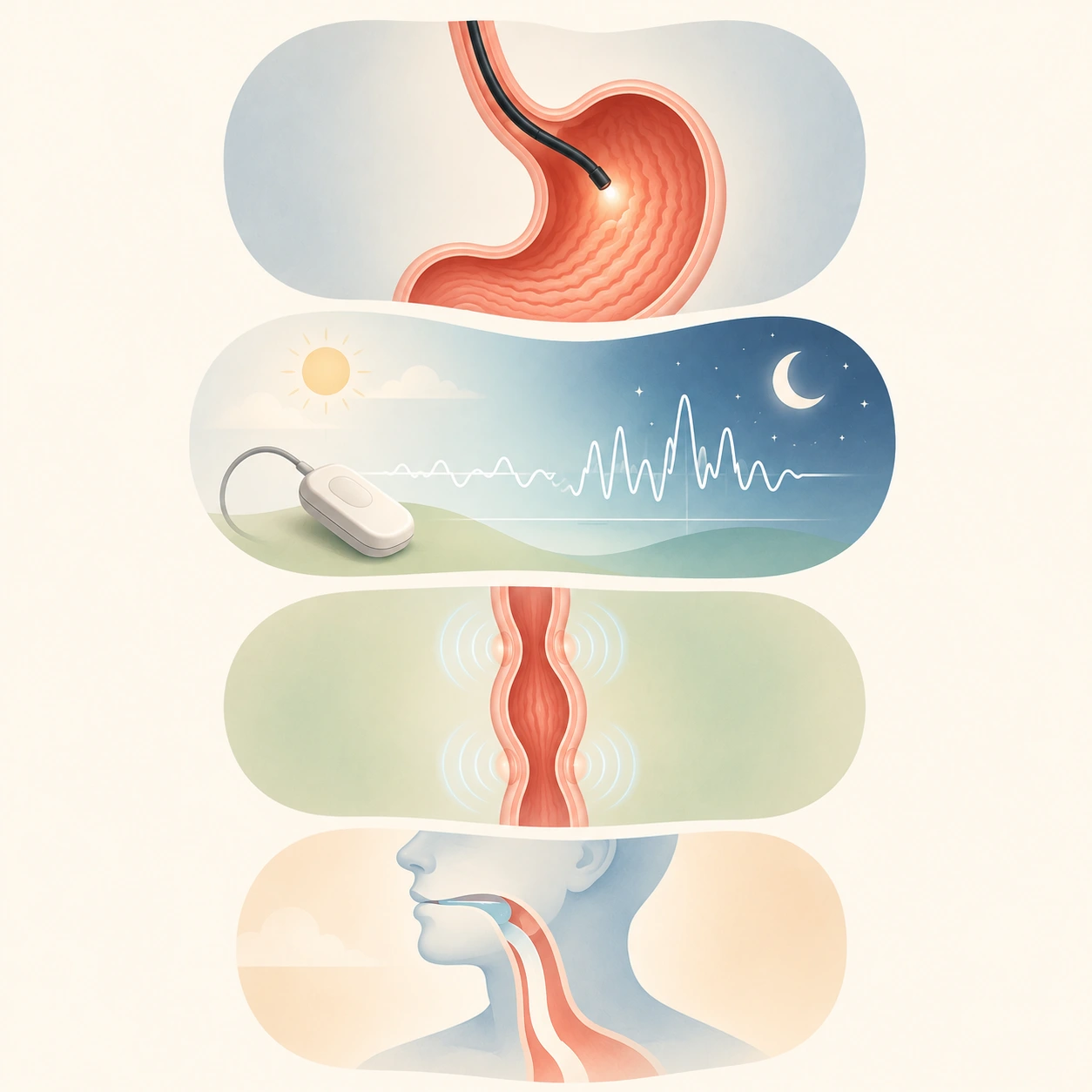
The four-hour gastric emptying study is the test that establishes the diagnosis. You eat a light standardized meal containing a small amount of radioactive tracer, usually eggs and toast or oatmeal, and a scanner tracks how much leaves the stomach over four full hours.
The four-hour duration is not a formality. In September 2025 the American Gastroenterological Association published its first clinical practice guideline on gastroparesis, and one of its twelve conditional recommendations is specifically against using a two-hour or shorter study. Data from more than 4,000 patients showed the two-hour test had a sensitivity of about 57 percent. A short study misses real gastroparesis and also labels people who do not have it. If your study was two hours, your result is not reliable in either direction.
Upper endoscopy is not a gastroparesis test, but it contributes. When food is still sitting in the stomach after an overnight fast, that finding raises suspicion on its own, and endoscopy rules out a mechanical blockage that would explain the same symptoms.
Where symptoms do not line up cleanly, Dr. Grandhige adds targeted studies rather than repeating the same one. Esophageal manometry distinguishes gastroparesis from achalasia and other motility disorders that present with regurgitation and chest discomfort. EndoFLIP measures the behavior of the valve itself. A barium swallow shows what happens during an actual swallow, which matters because patients localize the problem correctly only about 60 percent of the time. When throat symptoms dominate, a dual-channel pH impedance probe measures reflux above both the lower and the upper esophageal sphincter, the approach described on the silent reflux page.
What changed in gastroparesis care during 2025 and 2026
Two developments since late 2025 are not yet reflected on most pages covering this topic, and both change the conversation you should be having.
The first is the AGA guideline itself, published in Gastroenterology on September 19, 2025. Beyond the four-hour testing recommendation, it sets clearer boundaries than the older guidance. Metoclopramide and erythromycin both received conditional recommendations in favor of use, with explicit cautions: metoclopramide carries an FDA black box warning for tardive dyskinesia, and erythromycin carries warnings for QT prolongation, liver toxicity and drug interactions. Conditional recommendations were issued against domperidone, prucalopride, aprepitant, nortriptyline and buspirone. The guideline also tells clinicians to review current medications for drugs that delay emptying, naming opioids and GLP-1 receptor agonists directly. On the procedural side, the panel noted that evidence for surgical pyloromyotomy and pyloroplasty comes from observational studies carrying a high risk of bias, and that these interventions belong with carefully selected patients after medical therapy has been fully tried, not as a first move. The AGA’s summary of all twelve recommendations is published in full for clinicians and patients, and the peer-reviewed guideline is indexed on PubMed.
The second is drug development. At Digestive Disease Week in Chicago on May 3, 2026, results were presented from MOVE-IT, a global Phase 2b trial of naronapride, an oral prokinetic with a dual mechanism that combines 5-HT4 receptor agonism with dopamine D2 receptor antagonism. The trial enrolled 328 adults with moderate to severe idiopathic or diabetic gastroparesis and objective evidence of delayed emptying, and ran 12 weeks against placebo. The 20 mg and 40 mg three-times-daily doses both met the primary endpoint on the ANMS GCSI-DD core symptom score, at p=0.0046 and p=0.0156. The 10 mg dose did not. On June 1, 2026, the developers announced they were advancing into late-stage registration studies aimed at approval in the United States and Europe.
Naronapride is investigational. It is not approved, it is not available by prescription, and Phase 3 is planned rather than complete. It is worth knowing about because the honest summary of gastroparesis medication has been “two imperfect options” for a long time, and that may not be permanent.
How Dr. Grandhige decides whether to operate
He works through a six-step sequence before any procedure is offered, and the sixth step includes choosing not to operate.
First, confirm the problem objectively, because symptoms alone do not establish a diagnosis in the foregut. Second, read the anatomy in detail, including hernia size, esophageal length and the relationship between stomach, diaphragm and esophagus. Third, evaluate function, since motility findings determine which procedures are safe and which will cause more harm than they resolve. Fourth, match symptoms to physiology and state plainly which symptoms are expected to improve, which may improve partially, and which are unlikely to change. Fifth, account for what the patient actually cares about, within the boundaries of what is safe. Sixth, choose among procedures, or choose none.
As he puts it to patients: the operation is the last step, and the decision-making is the surgery.
That restraint has a cost, and it is worth stating openly. The patients he declines to operate on are often the least satisfied at the time, because they arrived hoping for a definitive fix and left without one. They are also the patients who would have been far more unhappy after an operation that did not address their actual problem. He does not treat malignant disease of the esophagus or stomach, and he refers directly to gastroenterology, ENT, pulmonology and allergy colleagues when symptoms point outside the foregut. Details on his training and hospital affiliations are on the about the practice page.
What the process looks like from Wesley Chapel
The office is at 1315 South Howard Ave., Suite 101, Tampa, FL 33606, roughly 30 miles south of Wesley Chapel by way of I-75 and I-275. Office hours are 9 AM to 6 PM Monday through Friday, and the phone number is 813.922.2920.
Before your visit, email your records to info@tampareflux.com. Dr. Grandhige personally reviews everything ahead of time rather than reading it in the room. Send prior endoscopy and pathology reports, any gastric emptying study including the number of hours it ran, pH or manometry results, imaging, office notes from gastroenterology, ENT, pulmonology or allergy, a current and prior medication list, and a list of previous surgeries. Records requests through signed releases routinely stall, so patients who bring their own files get a more definitive first visit.
Consultations are typically scheduled within two weeks and always within four. If your testing is already complete, one visit is usually enough to confirm the diagnosis and set the plan. If testing is needed, the first visit covers education and test planning, a second visit about four weeks later reviews results, and the full path from first consultation to treatment generally runs four to eight weeks. Where a study can be done closer to home in Pasco County, the office arranges that rather than requiring another trip south, and remaining studies are grouped onto the fewest possible days.
After a procedure, you are not handed to a stranger. The same physician assistant who assisted in your case is reachable directly, and Dr. Grandhige is available after hours and on weekends. His office medical assistants have worked with him for over a decade and can answer most questions without escalation.
Gastroparesis questions from Wesley Chapel patients
If nausea, early fullness or vomiting undigested food has been treated as reflux for years without a four-hour gastric emptying study, the diagnosis has not been established yet. Dr. Grandhige’s stated goal for every consultation is clarity, including the clarity that a procedure is not the right answer for you. Send your records ahead, and find out what your anatomy and physiology actually show.


An endoscopy cannot tell you if you have reflux. It can only tell you if you have complications of GERD.
If you are unhappy with your reflux symptoms, come in and we can discuss testing and treatments that can accurately diagnose your problem.
#reflux #gerd #hiatalhernia #gastroparesis #linx


CALL US AT 813-922-2920
www.tampareflux.com
If you have a hiatal hernia and fit one of these categories, you should know your options.
Dr. Grandhige is an expert in his field and performs 200 of these surgeries a year. He is the only surgeon in the Tampa Bay Area who offers all surgical options - LINX, Fundoplications, TIF and will be one of 20 surgeons in America introducing the latest procedure RefluxStop in 2026.
We accept most insurances but will verify yours before you come in. These procedures are considered medically necessary and covered by your insurance. You can expect to pay your in-network deductibles and nothing else.
#hiatalhernia #reflux #GERD #LINX #refluxstop

What causes reflux ?
1. Weak lower esophageal sphincter
2. Hiatal hernia
3. Flattening of the Angle of His
4. Poor esophageal motility
5. Gastroparesis (slow stomach)
NOT increased acid production


Don’t let GERD get in the way of living your life. Request your appointment with us today on the link below.
.
.
.
.
https://tampareflux.com/contact-us/

Anyone can be victim to GERD and though weight loss can help reduce GERD symptoms. Many athletes with high impact workouts may continue to have these symptoms. This may be a symptom of a hiatal hernia or other issue. We are more then happy to assist you in finding your solution, just click the link below.
.
.
.
https://tampareflux.com/contact-us/
##healthylifestyle #workout #athletereflux #PPIs #heartburn #LINX #fundoplication #TIF #GERD#tampaheartburn #linx #TIF #fundoplication #tampabayreflux #GERD #acidreflux #acidrefluxsurgery #stopreflux
#nonsurgicalweightloss #ESG #gastricballoon #weightlossjourney #vsg #vsgjourney #spatz3 #orbera #orberaballoon #grandhige #DrG
#tampabayrefluxinstitute #guthealth #roboticsurgery

Heartburn may seem like an annoyance. But if you find yourself having symptoms on a daily basis, it may be time to to talk to Dr. Grandhige as it could be a symptom of something worse.
.
.
.
#chronicheartburn #gerdsymptoms #heartburnrelief #reflux #PPIs #heartburn #LINX #fundoplication #TIF #GERD#tampaheartburn #linx #TIF #fundoplication #tampabayreflux #GERD #acidreflux #acidrefluxsurgery #stopreflux
#nonsurgicalweightloss #ESG #gastricballoon #weightlossjourney #vsg #vsgjourney #spatz3 #orbera #orberaballoon #grandhige #DrG
#tampabayrefluxinstitute #guthealth #roboticsurgery

If you are tired of avoiding your favorite foods or taking daily medications, we can help.
We are the Tampa experts in reflux ! With years of experience and thousands of patients treated successfully, we offer all FDA approved anti-reflux procedures.
Call 813-922-2920 to schedule your appointment
All major insurances accepted.

Not all patients need surgical intervention. Many patients are living a heartburn free life with their PPIs. However 40% of patients taking PPIs are not getting the relief they need. If you are one of those, you have options! Come in and find out more.
.
.
.
.
#letushelpyou #medsnotworking #reflux #PPIs #heartburn #LINX #fundoplication #TIF #GERD#tampaheartburn #linx #TIF #fundoplication #tampabayreflux #GERD #acidreflux #acidrefluxsurgery #stopreflux
#nonsurgicalweightloss #ESG #gastricballoon #weightlossjourney #vsg #vsgjourney #spatz3 #orbera #orberaballoon #grandhige #DrG
#tampabayrefluxinstitute #guthealth #roboticsurgery

#heartburn #stopreflux #hiatalherniarepair #severeheartburn #reflux #tampabayreflux #acidrefluxsurgery #tampaheartburn #GERD #PPIs #achalasia #LINX #TIF #tampareflux #fundoplication #stomach #digestivehealth #ESG #obesity #overweight #weightlossjourney #gastricballoon
