
Hiatal Hernia Surgeons In Clearwater, FL

Objective testing before any repair. Four anti-reflux procedures under one surgeon. About 25 miles from Clearwater.

Tampa Bay Reflux Institute treats hiatal hernias and reflux only. Dr. Gopal Grandhige reviews your prior records himself before you arrive, proves whether reflux is actually causing your symptoms, then matches the repair to your anatomy. Sometimes that means no operation at all.

Choosing a hiatal hernia surgeon from Clearwater

Distance is the wrong first question. The right one is whether the surgeon will prove reflux is causing your symptoms before operating, and whether they perform more than one repair.

Clearwater and Pinellas County do have general surgeons who perform LINX and Nissen fundoplication, and there’s a university-affiliated foregut program across the bay in Tampa. Those are real options, and any page that pretends otherwise is selling you something. What almost none of them publish is the part that decides your outcome: how many different repairs the surgeon performs, and what testing they require before they’ll recommend one.

That matters because a surgeon who performs a single operation will find a reason to perform it. A surgeon who performs four has to choose. Dr. Grandhige has performed over 600 fundoplications, over 600 LINX procedures and over 200 TIF procedures, and he sees over 600 reflux patients a year. Beginning in 2026 he adds RefluxStop, which the practice’s position is will make him the only surgeon in Tampa Bay performing all four anti-reflux procedures with regularity.

Ask any surgeon you’re considering these four questions:

  1. How will you confirm reflux is actually causing my symptoms, rather than assuming it?
  2. What testing do you require before you’ll recommend an operation?
  3. How many different anti-reflux procedures do you perform, and how do you choose between them?
  4. How often do you decide not to operate?

The fourth one tells you the most. A surgeon who never advises against surgery isn’t exercising judgment. Dr. Grandhige’s answer depends on the symptom pattern: among patients with silent reflux, roughly 50 to 60 percent have testing that supports an operation. The rest are told no.

And here’s the part that costs us patients. If you have a small hernia, typical heartburn that’s well controlled on a once-daily medication, and you’re not trying to come off it, you probably don’t need a surgeon at all. If a Clearwater surgeon runs full physiologic testing and offers the specific procedure your physiology calls for, the drive to Tampa buys you nothing. Read how a hiatal hernia breaks the reflux barrier before you book anything.

When a hiatal hernia actually needs repair

Dr. Grandhige recommends surgical repair in four situations: any hiatal hernia larger than 3 centimeters, any hernia paired with meaningful reflux symptoms (regurgitation especially), any hernia found alongside severe esophagitis, Barrett’s esophagus or a peptic stricture, and any hernia identified during a workup for reflux surgery.

The 3 centimeter threshold isn’t arbitrary. At that size the hernia almost always contributes mechanically to reflux, medication can’t correct it, and it tends to grow. Larger hernias also carry the risk of gastric volvulus, which is a surgical emergency. The bigger the hernia, the more likely the stomach becomes atonic, and that may or may not improve after repair. National guidance from the Society of American Gastrointestinal and Endoscopic Surgeons covers the surgical decision points in more depth.

Smaller hernias still matter. Almost every reflux patient has one, even when it’s too small to be seen on endoscopy. Dr. Grandhige explains the reflux barrier as a two-part door: one part is the lower esophageal sphincter, the other is the diaphragm. If either fails, reflux happens. If both fail, reflux is close to inevitable. Repairing one part when both are involved is why so many reflux treatments underperform.

Hernias develop from ordinary wear on the diaphragm, not from anything you did wrong. Pregnancy, weight changes, chronic cough, straining, heavy lifting and repetitive core work all raise pressure inside the abdomen over years.
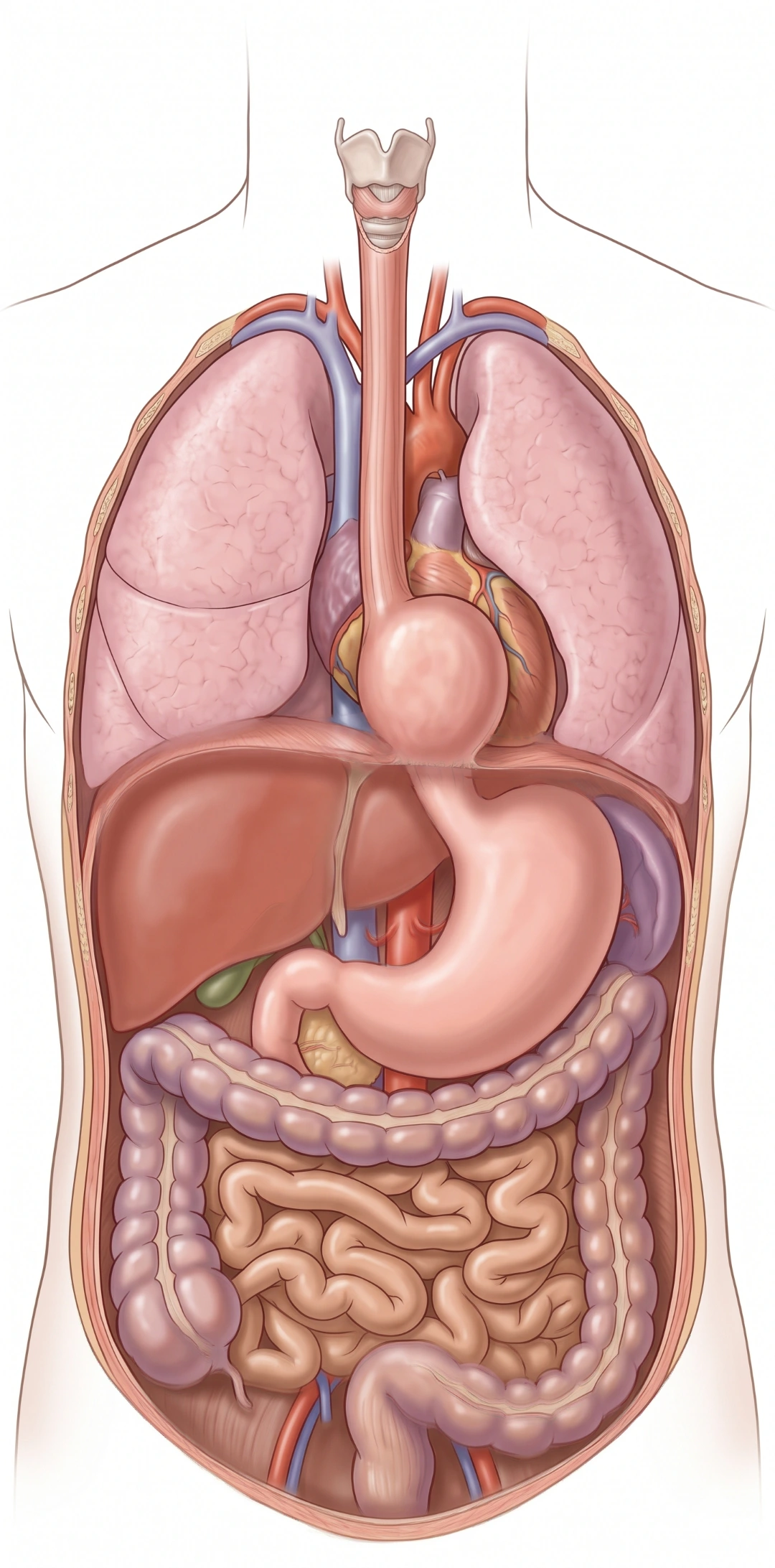
Large hiatal hernia stomach diaphragm

The Six-Step Reflux Decision Path

Every surgical recommendation at Tampa Bay Reflux Institute runs through the same six steps, in order. Nothing gets skipped, and the procedure is chosen last.

Step 1: Prove reflux is present. Objective pH testing, correlation of reflux events with your symptoms, and a determination of whether the reflux is acid, non-acid or bile-related. If reflux isn’t objectively proven, surgery isn’t recommended, regardless of how convincing your symptoms are.

Step 2: Understand the anatomy. Presence and size of the hernia, esophageal length and position, and the relationship between stomach, diaphragm and esophagus. Anatomy determines which procedures are even feasible and how durable a repair is likely to be.

Step 3: Evaluate esophageal function. Manometry measures contraction strength, swallowing coordination and whether spasm or a motility disorder is present. Motility decides whether a full or partial wrap is safe and whether a magnetic device is appropriate. Ignoring it produces dysphagia and regret.

Step 4: Match symptoms to physiology. Dr. Grandhige states plainly which of your symptoms he expects to improve, which may improve partially, and which are unlikely to change at all.

Step 5: Weigh your priorities. Durability, medication elimination, the ability to burp and vomit, minimizing side effects, reversibility. Preference refines the decision once medical appropriateness is settled. It never overrides anatomy or function.

Step 6: Choose a procedure, or choose none. Observation and continued medical management are real outcomes of this process, not failures of it.

His own summary: “The operation is the last step. The decision-making is the surgery.”

The four repairs, and who each one fits

There’s no best reflux operation. There’s the right operation for a specific patient, and in many cases the right answer is no operation.

Fundoplication

Fundoplication uses the upper part of your own stomach to rebuild the reflux barrier, and it repairs the diaphragm at the same time. It’s the most durable option, it handles large hernias, and it has decades of outcome data behind it. It comes in four configurations: Nissen (a full 360 degree wrap), Toupet (posterior 270), Watson (anterior 270) and Dor (anterior partial). Manometry decides which. Weaker esophageal motility points toward a partial wrap. Operative time runs 1.5 to 2 hours, longer with large hernias or significant scarring. The honest tradeoff: a wrap can limit your ability to burp or vomit and can produce gas-bloat, and how much depends on the configuration and the tension. Full detail on the four fundoplication configurations is worth reading before your consult.

TIF (EsophyX)

TIF is performed entirely through the mouth with an endoscope, no abdominal incisions, 45 to 60 minutes under general anesthesia. It folds part of the stomach around the lower esophagus from the inside and secures it with fasteners. It’s the best endoscopic anti-reflux procedure that exists, and it’s also the most misused. TIF cannot repair a hiatal hernia and doesn’t touch the diaphragm. Dr. Grandhige quotes a failure rate of 2 percent per year, roughly 20 percent per decade, and tells patients to treat the TIF procedure as a durable temporary solution rather than a permanent one. He declines it for patients who are obese or who have more than a minimal hernia, even when they want it, because outcomes outside those criteria are unreliable.

LINX

LINX is a ring of magnetic titanium beads placed around the lower esophagus. It doesn’t raise resting sphincter pressure. It resists opening when stomach pressure rises and opens when you swallow, so most patients keep the ability to burp and vomit once early inflammation settles. Stomach anatomy stays intact and the device can be removed if it ever needs to be. Hernia size doesn’t disqualify you, as long as the hernia is repaired at the same operation. The requirement is good esophageal motility, because your esophagus has to push food through the device. Two honest limits: dysphagia rates are higher than with fundoplication, and current devices are MRI compatible up to 1.5 Tesla. One more, from experience rather than the literature: patients who are unusually aware of internal sensation tend to feel the device. Anyone who felt their Bravo pH capsule while it was in place will likely feel their LINX magnetic sphincter augmentation.

RefluxStop

RefluxStop joins the practice in 2026 as the fourth option. Details are on the RefluxStop page.

The testing that changes the answer

Upper endoscopy does not diagnose reflux. It looks for damage caused by reflux. A normal endoscopy is one of the most common reasons Clearwater patients arrive here after years of being told nothing is wrong, and small hiatal hernias frequently don’t show up on it at all.

Four tests answer four different questions. Endoscopy shows anatomy and complications. pH monitoring, run over 48 to 72 hours while you eat, sleep, work and exercise normally, shows whether reflux is happening, how often, how long and whether it lines up with your symptoms. Manometry shows whether your esophagus has the strength and coordination to handle a repair. A barium swallow shows what happens during an actual swallow, and it’s more useful than patients expect: when someone points to where food feels stuck, that’s the correct anatomic location only about 60 percent of the time. People routinely feel an obstruction in the throat that the esophagram proves is sitting in the distal esophagus.

For throat symptoms, the testing is different, and this is where most practices fall short. Standard reflux studies measure only above the lower esophageal sphincter. Dr. Grandhige uses a customized 24-hour pH impedance dual-channel probe that measures above the lower sphincter and above the upper sphincter, and it captures non-acid reflux, meaning bile, pepsin and trypsin, which impedance detects and pH alone misses. The distinction matters because the esophagus can tolerate 40 to 50 reflux episodes a day while the larynx and pharynx can develop symptoms from one.

The consequence is measurable. Patients with silent reflux are typically quoted around a 50 percent chance that surgery helps. With dual-channel testing narrowing the group to patients whose reflux is documented reaching the throat, that figure rises to roughly 80 percent. This testing is technically demanding and poorly reimbursed, which is why most centers don’t perform it and accept the lower number instead. More on silent reflux and how it’s diagnosed.

What repair will and will not fix

For patients with typical heartburn and regurgitation, objectively documented reflux, workable anatomy and good esophageal function, Dr. Grandhige reports greater than 90 percent achieving significant symptom relief and coming off daily reflux medication. That figure applies to that group. It doesn’t apply to everyone, and he says so directly.

Outcomes shift with reduced esophageal motility, long-standing disease, large or recurrent hernias, prior foregut surgery or prior bariatric surgery. In those cases the procedure is modified to prioritize safety, and expectations are adjusted before anything is scheduled.

The bigger risk isn’t a technically imperfect operation. It’s an operation performed on the assumption that one diagnosis explains every symptom. Heartburn and regurgitation may resolve completely while throat symptoms improve only partially and bloating persists from a different mechanism entirely. If nobody set that expectation, the surgery feels like a failure even when it fixed exactly what it was built to fix. Silent reflux symptoms also run on a slower clock, taking four to six months to improve, where typical reflux symptoms often resolve the night of surgery. His standing instruction is to give it six months, then address whatever remains, which sometimes means a referral to ENT, pulmonology or allergy.

Some patients are told no. Esophageal hypersensitivity, functional chest pain, rumination and untreated severe motility disorders can all look like reflux and none of them are corrected by reflux surgery. Dr. Grandhige is candid that these are often his least satisfied patients, and equally candid that they’d be far less satisfied after an unnecessary operation that changed nothing.

You can verify all of this independently. Board certification is confirmable through the American Board of Surgery certification lookup, and active Florida licensure and any disciplinary history through the Florida Department of Health license verification portal. Training and practice history are on the Tampa Bay Reflux Institute about page.

Coming from Clearwater: how the process runs

Send your records before you drive over. Email prior endoscopy and pathology reports, pH studies, manometry results, barium swallow or imaging, office notes from your gastroenterologist, ENT, pulmonologist or allergist, and your medication and surgical history to info@tampareflux.com. Dr. Grandhige reviews everything personally before your appointment, which turns the visit into a decision-making conversation instead of a data-collection session. Signed record releases get started immediately, but fax-based systems and incompatible electronic records mean patient-supplied records arrive faster and more complete. Studies from years ago still help, because they show progression.

Consultations are usually scheduled within two weeks and always within four. If your testing is already complete, one visit is typically enough to confirm the diagnosis and discuss options. If testing is still needed, plan on two visits about four weeks apart, with the studies coordinated between them.

For Pinellas patients, testing that can be done near you gets done near you. The practice routinely arranges studies locally so the trip across the bay is reserved for the parts that require it. That’s the same coordination used for out-of-area patients, including scheduling, travel timing and follow-up logistics.

Consultation to surgery generally runs four to eight weeks. Four weeks is realistic when testing is finished, eight when it isn’t. Insurance authorization runs in parallel and can add four to six weeks on complex cases, and the office handles that submission and follow-up rather than sending you to do it.

All surgeries are performed at HCA South Tampa Hospital with the same anesthesia team, nurses, surgical technologists and physician assistant every time. Dr. Grandhige previously operated at four hospitals, including Bayfront in St. Petersburg, and consolidated to one facility deliberately. Familiarity across a fixed team shortens operative time and catches problems earlier. Most patients go home the same day. Diet progresses over two to three months. After hours, you reach Dr. Grandhige directly, not an answering service.


Dr.Grandhige in a medical setting
Tampa Bay Reflux Institute

Frequently asked questions

There are general surgeons with Clearwater offices who perform LINX and Nissen fundoplication. The question worth asking is what testing they require before recommending an operation and how many different repairs they perform. If a local surgeon runs full physiologic testing and offers the procedure your anatomy calls for, staying in Pinellas is reasonable. Patients cross the bay when they want a surgeon who does nothing but foregut work and can choose among all four procedures.

Any hernia larger than 3 centimeters is recommended for repair, because at that size it almost always contributes mechanically to reflux, tends to grow, and carries a risk of gastric volvulus. Smaller hernias are repaired when they’re paired with significant reflux symptoms, particularly regurgitation, or when complications like severe esophagitis, Barrett’s esophagus or a stricture are present.

Yes, but it’s usually the wrong call when reflux is present. The reflux barrier has two parts, the lower esophageal sphincter and the diaphragm. Repairing the diaphragm alone leaves the sphincter untreated, which is a common reason reflux returns after a hernia repair.

Fundoplication and LINX run about 1.5 to 2 hours, longer with large hernias or scarring. TIF takes 45 to 60 minutes. Most patients go home the same day. An overnight stay is occasionally recommended for observation.

It depends on the procedure, and this question drives procedure choice for a lot of patients. A fundoplication can limit both, temporarily or permanently depending on the configuration. LINX usually preserves both once early swelling resolves. TIF generally preserves them.

No. Endoscopy looks for damage caused by reflux. It doesn’t measure reflux events, assess sphincter function or reliably detect small hiatal hernias, and normal findings are especially common in patients already taking acid-suppressing medication. pH monitoring is the test that answers whether reflux is happening.

Four to eight weeks. Four is realistic if your testing is already complete, eight if studies still need to be done and reviewed at a second visit. Insurance authorization can extend that on complex cases.

Where possible, yes. The practice works with a small number of testing sites and arranges local studies for out-of-area patients so trips across the bay are limited to the visits that require an in-person evaluation.

get help today

Contact Us for an Appointment

An endoscopy cannot tell you if you have reflux. It can only tell you if you have complications of GERD. 

If you are unhappy with your reflux symptoms, come in and we can discuss testing and treatments that can accurately diagnose your problem. 

#reflux #gerd #hiatalhernia #gastroparesis #linx

3 0
CALL US AT 813-922-2920
www.tampareflux.com

If you have a hiatal hernia and fit one of these categories, you should know your options. 

Dr. Grandhige is an expert in his field and performs 200 of these surgeries a year.  He is the only surgeon in the Tampa Bay Area who offers all surgical options - LINX, Fundoplications, TIF and will be one of 20 surgeons in America introducing the latest procedure RefluxStop in 2026. 

We accept most insurances but will verify yours before you come in.  These procedures are considered medically necessary and covered by your insurance.  You can expect to pay your in-network deductibles and nothing else. 

#hiatalhernia #reflux #GERD #LINX #refluxstop

13 8
What causes reflux ?

1.  Weak lower esophageal sphincter
2.  Hiatal hernia
3.  Flattening of the Angle of His
4.  Poor esophageal motility
5.  Gastroparesis (slow stomach)

NOT increased acid production

10 0
Don’t let GERD get in the way of living your life.  Request your appointment with us today on the link below. 
.
.
.
.

https://tampareflux.com/contact-us/

3 2
Anyone can be victim to GERD and though weight loss can help reduce GERD symptoms. Many athletes with high impact workouts may continue to have these symptoms. This may be a symptom of a hiatal hernia or other issue. We are more then happy to assist you in finding your solution, just click the link below. 
.
.
.

https://tampareflux.com/contact-us/

##healthylifestyle #workout #athletereflux #PPIs #heartburn #LINX #fundoplication #TIF #GERD#tampaheartburn #linx #TIF #fundoplication #tampabayreflux #GERD #acidreflux #acidrefluxsurgery #stopreflux 
#nonsurgicalweightloss #ESG #gastricballoon #weightlossjourney #vsg #vsgjourney #spatz3 #orbera #orberaballoon #grandhige #DrG 
#tampabayrefluxinstitute #guthealth #roboticsurgery

3 1
Heartburn may seem like an annoyance. But if you find yourself having symptoms on a daily basis, it may be time to to talk to Dr. Grandhige as it could be a symptom of something worse. 
.
.
.

#chronicheartburn #gerdsymptoms #heartburnrelief #reflux #PPIs #heartburn #LINX #fundoplication #TIF #GERD#tampaheartburn #linx #TIF #fundoplication #tampabayreflux #GERD #acidreflux #acidrefluxsurgery #stopreflux 
#nonsurgicalweightloss #ESG #gastricballoon #weightlossjourney #vsg #vsgjourney #spatz3 #orbera #orberaballoon #grandhige #DrG 
#tampabayrefluxinstitute #guthealth #roboticsurgery

1 0
If you are tired of avoiding your favorite foods or taking daily medications, we can help. 

We are the Tampa experts in reflux !  With years of experience and thousands of patients treated successfully, we offer all FDA approved anti-reflux procedures. 

Call 813-922-2920 to schedule your appointment
All major insurances accepted.

1 2
Not all patients need surgical intervention.  Many patients are living a heartburn free life with their PPIs. However 40% of patients taking PPIs are not getting the relief they need.  If you are one of those, you have options!  Come in and find out more. 
.
.
.
.
#letushelpyou #medsnotworking #reflux #PPIs #heartburn #LINX #fundoplication #TIF #GERD#tampaheartburn #linx #TIF #fundoplication #tampabayreflux #GERD #acidreflux #acidrefluxsurgery #stopreflux 
#nonsurgicalweightloss #ESG #gastricballoon #weightlossjourney #vsg #vsgjourney #spatz3 #orbera #orberaballoon #grandhige #DrG 
#tampabayrefluxinstitute #guthealth #roboticsurgery

3 1
#heartburn #stopreflux #hiatalherniarepair #severeheartburn #reflux #tampabayreflux #acidrefluxsurgery #tampaheartburn #GERD #PPIs #achalasia #LINX #TIF #tampareflux #fundoplication #stomach #digestivehealth #ESG #obesity #overweight #weightlossjourney #gastricballoon

3 0

get help today

Contact Us
for an Appointment