
The Six-Step Reflux Decision Sequence
Dr. Grandhige runs the same six steps, in the same order, before recommending any hiatal hernia repair. The sequence exists so that the decision is driven by anatomy and physiology rather than by how loud the symptoms are or which operation a surgeon happens to prefer.
Step 1: Confirm reflux is actually happening. Objective pH testing, correlation of reflux events with your symptoms, and identification of whether reflux is acid, non-acid or bile-related. If reflux is not proven, no procedure is offered, regardless of symptoms.
Step 2: Map the anatomy. Hernia size and type, esophageal length and position, and the relationship between stomach, diaphragm and esophagus. Anatomy decides which procedures are technically possible and how durable a repair will be.
Step 3: Measure esophageal function. Manometry shows contraction strength, swallow coordination, and whether spasm or a motility disorder is present. This single result determines whether a full wrap is safe, whether a magnetic device is appropriate, or whether surgery should be avoided.
Step 4: Match each symptom to the physiology. Dr. Grandhige states plainly which symptoms he expects to improve, which may improve partially, and which are unlikely to be reflux-related at all.
Step 5: Factor in your priorities. Durability, getting off medication, keeping the ability to burp and vomit, minimizing side effects, reversibility. Preferences refine the choice once medical appropriateness is settled. They never override anatomy or motility.
Step 6: Choose a procedure, or choose none. Observation and continued medical management are real outcomes of this sequence, not failures of it.
His own description of it: “The operation is the last step. The decision-making is the surgery.”
This sequence also produces the least popular conversation in the practice. Patients who are told surgery will not help them are frequently the most frustrated people who walk out of the office. They would be considerably more frustrated after an operation that corrected something that was never the problem.
What each test answers, and why a normal endoscopy proves nothing
Each test answers one question. Skipping one means guessing at that question.
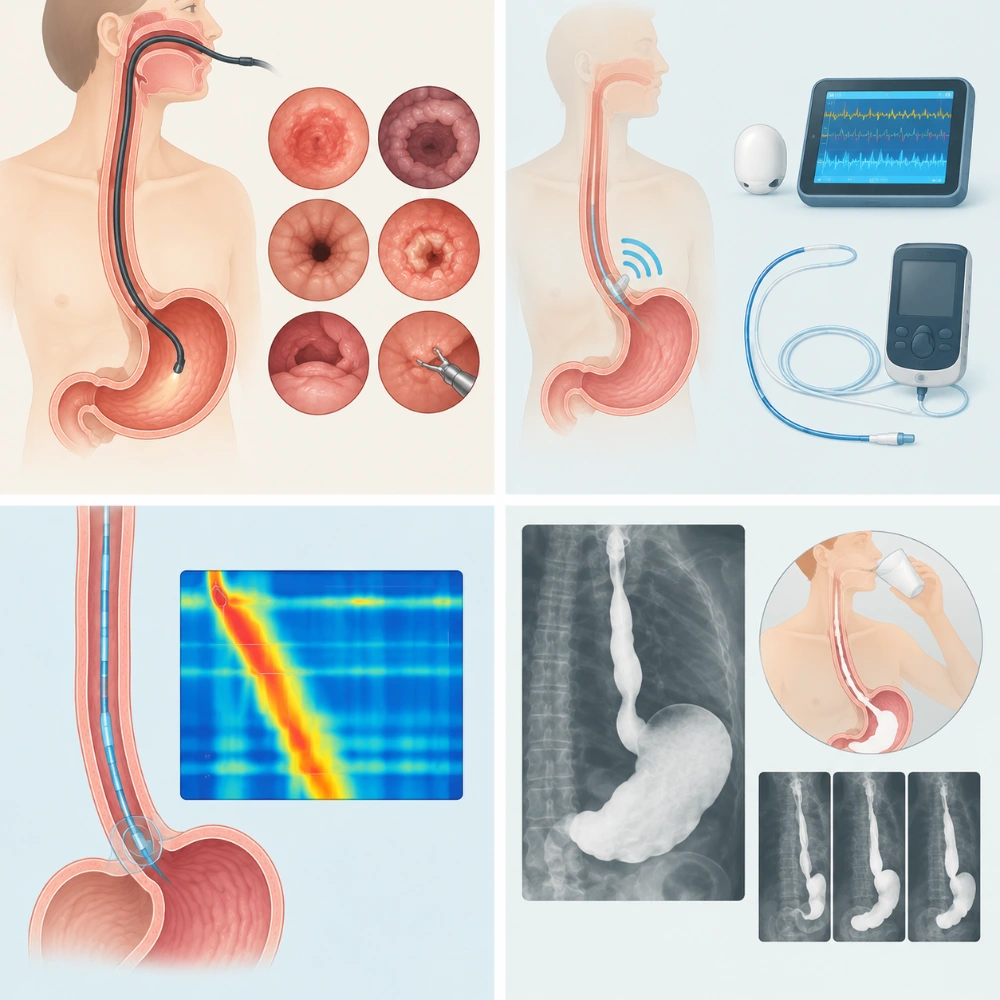
Upper endoscopy shows damage and anatomy: esophagitis, Barrett’s esophagus, strictures, and hiatal hernia when it is large enough to see. It is also how a pH probe gets placed. It cannot tell you whether reflux is occurring, how often, or why.
Esophageal pH monitoring is the test that actually diagnoses GERD. Using a wireless Bravo capsule or a catheter-based probe, it records reflux frequency, episode duration, acidity, timing across day and night, and whether your symptoms line up with real reflux events. Data is collected over 48 to 72 hours while you eat, sleep, work and exercise normally, because reflux is a moving target and a snapshot in a clinic misses it.
Esophageal manometry measures how well the esophagus pushes. It identifies achalasia, esophageal spasm, ineffective motility, jackhammer and nutcracker patterns, and hypertensive sphincter. All of these can look like reflux from the outside and none of them improve with a wrap. Manometry is also what decides between a full and a partial fundoplication.
Barium swallow is used selectively, mainly for difficulty swallowing, suspected narrowing, unclear anatomy, or after previous foregut surgery. It shows the esophagus working in real time, with pills or food, and can reproduce the exact symptom you feel. That matters more than it sounds: when patients point to where food is sticking, they are anatomically correct only about 60 percent of the time. People routinely feel an obstruction in the throat that a swallow study locates in the lower esophagus.
Dual-channel pH impedance testing for throat symptoms. Standard reflux testing measures acid exposure above the lower esophageal sphincter only. For silent reflux, or LPR, that is the wrong altitude. Dr. Grandhige uses a customized 24-hour pH impedance dual-channel probe that measures acid and non-acid reflux at two levels: above the lower sphincter and above the upper sphincter, where the larynx and pharynx sit.
The tolerance difference between those tissues is the reason this matters. The esophagus can absorb 40 to 50 reflux episodes a day. The larynx and pharynx can produce symptoms from a single episode. Bile, pepsin and trypsin do not register on acid-only testing at all, and they reach the throat just as readily as acid does.
Patients with throat symptoms are commonly quoted roughly a 50 percent chance that surgery helps, because selection without dual-level data is close to a coin flip. With this testing, Dr. Grandhige reports symptom improvement near 80 percent in the patients he selects, and roughly 50 to 60 percent of LPR patients who are tested turn out to have findings that warrant a procedure at all. The rest are told so. Fewer operations, on better-matched patients.
When a hiatal hernia gets repaired, and how the procedure is chosen
Repair is recommended in four situations: any hiatal hernia larger than 3 centimeters, any hernia combined with significant reflux symptoms and especially regurgitation, any hernia accompanied by severe esophagitis, Barrett’s esophagus or a peptic stricture, and any hernia found during a work-up where reflux surgery is already indicated.
The 3 centimeter threshold is not arbitrary. At that size the hernia is almost always contributing mechanically, medication rarely controls it, and the hernia tends to enlarge over time. Larger hernias carry a risk of gastric volvulus, which is a surgical emergency, and the larger they get the more likely the stomach becomes atonic, which may or may not recover after repair.
Every repair here restores the diaphragm, not just the sphincter. The stomach is returned below the diaphragm, the hiatal opening is closed, and normal anatomic relationships are rebuilt. A procedure that addresses only the valve while leaving the diaphragmatic defect open is treating half the problem, and it is one of the most common reasons reflux treatment fails over time.
How Brandon patients are evaluated: office, hospital, and timeline
Consultations for Brandon patients are held at 1315 South Howard Avenue, Suite 101, in South Tampa, and all foregut surgery is performed at HCA Florida South Tampa Hospital. Dr. Grandhige holds surgical privileges at HCA Florida Brandon Hospital and previously operated there, along with St. Joseph’s Main and St. Joseph’s South, but every reflux and hiatal hernia case is now done at the South Tampa facility.
That consolidation is deliberate and worth understanding before you drive past a closer hospital. Foregut surgery outcomes depend on tension on the repair, instrument selection, positioning and anesthesia management, and small differences in any of them change swallowing and reflux control years later. At South Tampa, Dr. Grandhige works with the same operating room team, the same anesthesiologists who understand foregut physiology, and his own employed physician assistant who assists on every case. That PA knows your specific anatomy and operation, is reachable during office hours, and Dr. Grandhige is reachable directly after hours and on weekends. You are not routed to a call service or a provider meeting your chart for the first time.
The timeline for a Brandon patient looks like this. New patients are usually seen within two weeks and always within four. If you arrive with endoscopy, pH testing, manometry and relevant imaging already completed, one consultation is often enough, and surgery can be scheduled as soon as about four weeks out. If testing is still needed, the first visit covers education and test planning, a second visit about four weeks later reviews results and finalizes the plan, and the target from first visit to surgery is roughly eight weeks. Insurance authorization is handled entirely by the office and runs in parallel.
Testing is deliberately routed through a small number of trusted sites for scheduling speed and consistent quality, and wherever a study can be performed closer to home, the office arranges it there so Brandon patients make fewer trips across the county.
Send your records to info@tampareflux.com before your appointment. Dr. Grandhige personally reviews everything in advance, which is what turns a first visit into a decision-making visit instead of a data-gathering one. Useful items include prior endoscopy and pathology reports, any pH testing including Bravo or catheter studies, manometry results, barium swallow or other imaging, office notes from gastroenterology, ENT, pulmonology or allergy, a current medication list, and a list of prior surgeries. Studies from years ago still help, because they show how the disease has moved.
Dr. Gopal Grandhige is a board-certified general surgeon who completed his general surgery residency and his fellowship in foregut and minimally invasive surgery at Yale-New Haven Hospital. He is a Fellow of the American College of Surgeons, a member of SAGES, and a founding member of the American Foregut Society. His full training and hospital affiliations are listed on the practice site, and his Florida medical license and disciplinary history can be checked independently through the Florida Department of Health license verification portal.

Tampa Bay Reflux Institute
1315 South Howard Avenue, Suite 101, Tampa, FL 33606
Yellow brick building next to Sally O’Neill’s Pizza, parking behind the restaurant
Phone: 813.922.2920
Hours: 9:00 AM to 6:00 PM, Monday through Friday
Questions Brandon patients ask
Schedule your evaluation
If you have been on acid-suppressing medication for years without a complete work-up, the next step is finding out whether reflux is actually causing your symptoms and which part of the barrier is failing. That answer sometimes leads to surgery and sometimes leads away from it. Either way you leave knowing what is happening in your body.
Call 813.922.2920 or request an appointment online. Send your records to info@tampareflux.com ahead of the visit so Dr. Grandhige can review them before you arrive.
Medically reviewed by Gopal Grandhige, MD, FACS. Board-certified general surgeon. Fellowship-trained in foregut and minimally invasive surgery, Yale-New Haven Hospital. Founding member, American Foregut Society. Last reviewed October 2026.


An endoscopy cannot tell you if you have reflux. It can only tell you if you have complications of GERD.
If you are unhappy with your reflux symptoms, come in and we can discuss testing and treatments that can accurately diagnose your problem.
#reflux #gerd #hiatalhernia #gastroparesis #linx


CALL US AT 813-922-2920
www.tampareflux.com
If you have a hiatal hernia and fit one of these categories, you should know your options.
Dr. Grandhige is an expert in his field and performs 200 of these surgeries a year. He is the only surgeon in the Tampa Bay Area who offers all surgical options - LINX, Fundoplications, TIF and will be one of 20 surgeons in America introducing the latest procedure RefluxStop in 2026.
We accept most insurances but will verify yours before you come in. These procedures are considered medically necessary and covered by your insurance. You can expect to pay your in-network deductibles and nothing else.
#hiatalhernia #reflux #GERD #LINX #refluxstop

What causes reflux ?
1. Weak lower esophageal sphincter
2. Hiatal hernia
3. Flattening of the Angle of His
4. Poor esophageal motility
5. Gastroparesis (slow stomach)
NOT increased acid production


Don’t let GERD get in the way of living your life. Request your appointment with us today on the link below.
.
.
.
.
https://tampareflux.com/contact-us/

Anyone can be victim to GERD and though weight loss can help reduce GERD symptoms. Many athletes with high impact workouts may continue to have these symptoms. This may be a symptom of a hiatal hernia or other issue. We are more then happy to assist you in finding your solution, just click the link below.
.
.
.
https://tampareflux.com/contact-us/
##healthylifestyle #workout #athletereflux #PPIs #heartburn #LINX #fundoplication #TIF #GERD#tampaheartburn #linx #TIF #fundoplication #tampabayreflux #GERD #acidreflux #acidrefluxsurgery #stopreflux
#nonsurgicalweightloss #ESG #gastricballoon #weightlossjourney #vsg #vsgjourney #spatz3 #orbera #orberaballoon #grandhige #DrG
#tampabayrefluxinstitute #guthealth #roboticsurgery

Heartburn may seem like an annoyance. But if you find yourself having symptoms on a daily basis, it may be time to to talk to Dr. Grandhige as it could be a symptom of something worse.
.
.
.
#chronicheartburn #gerdsymptoms #heartburnrelief #reflux #PPIs #heartburn #LINX #fundoplication #TIF #GERD#tampaheartburn #linx #TIF #fundoplication #tampabayreflux #GERD #acidreflux #acidrefluxsurgery #stopreflux
#nonsurgicalweightloss #ESG #gastricballoon #weightlossjourney #vsg #vsgjourney #spatz3 #orbera #orberaballoon #grandhige #DrG
#tampabayrefluxinstitute #guthealth #roboticsurgery

If you are tired of avoiding your favorite foods or taking daily medications, we can help.
We are the Tampa experts in reflux ! With years of experience and thousands of patients treated successfully, we offer all FDA approved anti-reflux procedures.
Call 813-922-2920 to schedule your appointment
All major insurances accepted.

Not all patients need surgical intervention. Many patients are living a heartburn free life with their PPIs. However 40% of patients taking PPIs are not getting the relief they need. If you are one of those, you have options! Come in and find out more.
.
.
.
.
#letushelpyou #medsnotworking #reflux #PPIs #heartburn #LINX #fundoplication #TIF #GERD#tampaheartburn #linx #TIF #fundoplication #tampabayreflux #GERD #acidreflux #acidrefluxsurgery #stopreflux
#nonsurgicalweightloss #ESG #gastricballoon #weightlossjourney #vsg #vsgjourney #spatz3 #orbera #orberaballoon #grandhige #DrG
#tampabayrefluxinstitute #guthealth #roboticsurgery

#heartburn #stopreflux #hiatalherniarepair #severeheartburn #reflux #tampabayreflux #acidrefluxsurgery #tampaheartburn #GERD #PPIs #achalasia #LINX #TIF #tampareflux #fundoplication #stomach #digestivehealth #ESG #obesity #overweight #weightlossjourney #gastricballoon
