
What the 2024 SAGES guidelines actually say about hiatal hernia repair
In 2024 the Society of American Gastrointestinal and Endoscopic Surgeons published updated guidelines for the surgical treatment of hiatal hernias (Daly et al., Surgical Endoscopy, September 2024). Almost no local page publishes what they concluded, so here it is plainly.
On adding a fundoplication: the panel suggested routinely performing a fundoplication during hiatal hernia repair. That is a conditional recommendation based on low-certainty evidence, not a strong one. It reflects the reality that repairing the diaphragm without addressing the sphincter leaves half the reflux barrier unfixed.
On mesh: the panel declined to make a recommendation either for or against routine mesh use. The evidence was equivocal. If a surgeon tells you mesh is standard, or that mesh is never appropriate, they are stating a preference, not guideline consensus. Ask why.
On asymptomatic hernias: the evidence was too thin to support an evidence-based recommendation. The panel offered expert opinion only, that select asymptomatic patients may be offered repair against defined criteria.
On recurrent hernias: again expert opinion only, that converting certain recurrent cases to Roux-en-Y may be appropriate.
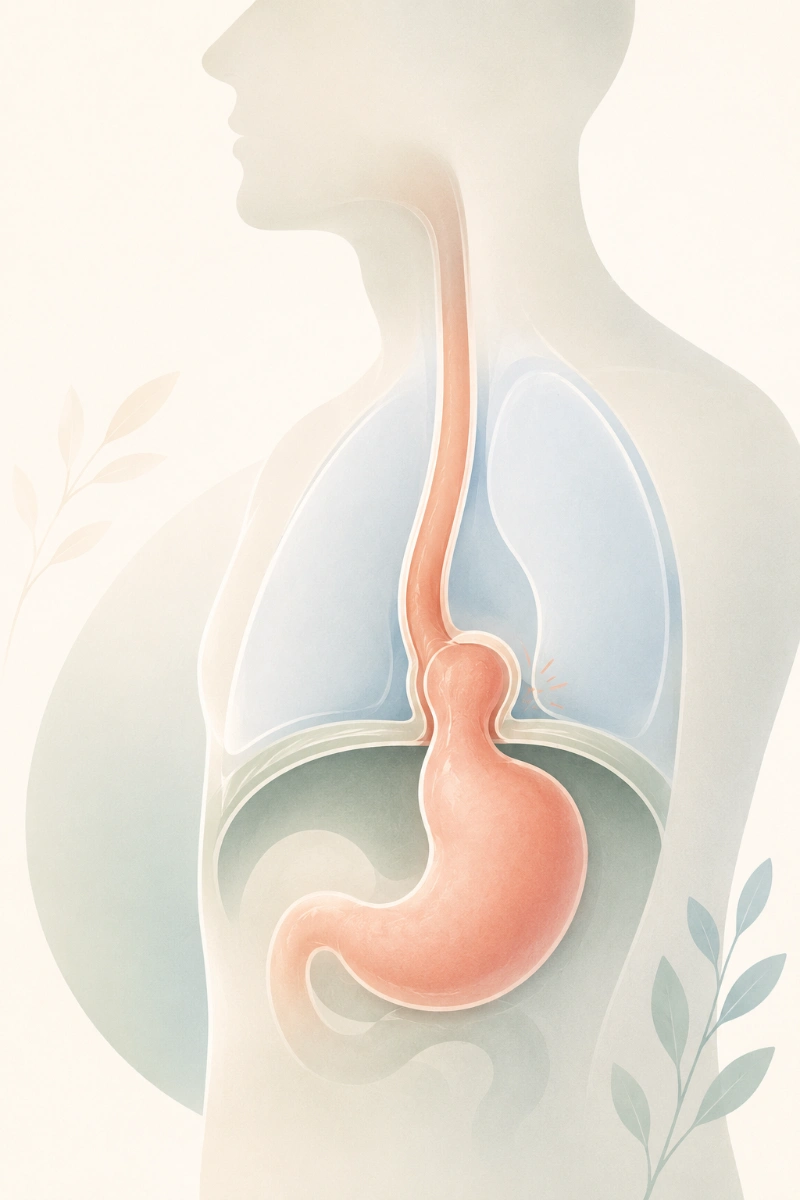
Two things follow for a patient in Clearwater. First, several of the decisions that will be made about your body sit in territory where the national society itself would not commit. That is an argument for a surgeon who spends every day in this specific problem. Second, you should ask any surgeon their mesh policy and their reasoning, because there is no guideline to hide behind.
Dr. Grandhige repairs hiatal hernias robotically and laparoscopically, and adds an anti-reflux procedure in nearly every case because most hernia patients also have reflux. The full step-by-step sequence of the repair, from freeing the stomach out of the chest to closing the hiatus, is laid out on our hiatal hernia page.
The 6-Step Selection Path Dr. Grandhige runs before recommending anything
This is the actual decision process, in order. It is why two patients with identically sized hernias can leave with different plans.
Step 1: Prove the reflux is real. Objective pH testing, correlation of reflux events with symptoms, and identification of whether reflux is acid, non-acid, or bile-related. If reflux is not objectively proven, surgery is not recommended, regardless of how convincing the symptoms are.
Step 2: Map the anatomy. Hernia presence and size, esophageal length and position, and the relationship between stomach, diaphragm, and esophagus. Anatomy determines which procedures are technically possible and how durable each is likely to be.
Step 3: Measure esophageal function. Manometry assesses contraction strength, swallow coordination, and any spasm or motility disorder. This is the most overlooked step and the one most responsible for postoperative dysphagia when it is skipped.
Step 4: Match symptoms to physiology. Which symptoms are very likely reflux-related, which are unlikely, and which may be multifactorial. Patients want one diagnosis to explain everything. Bodies rarely cooperate.
Step 5: Weigh your priorities. Durability, medication elimination, ability to burp and vomit, minimizing side effects, reversibility. Preference refines the decision inside the boundaries set by anatomy and function. It never overrides them.
Step 6: Choose a procedure, or choose none. Because four procedures are on the table, the choice is driven by fit rather than by what is familiar.
Dr. Grandhige’s summary of it: “The operation is the last step. The decision-making is the surgery.”
Four anti-reflux procedures, and how the right one gets chosen
Published case volume at Tampa Bay Reflux Institute: over 600 fundoplications, over 600 LINX procedures, and over 200 TIF procedures. Dr. Grandhige has been the only board-certified surgeon in the Tampa Bay area performing all three with regularity.
Recovery, and the parts nobody puts on a landing page
Repair takes about 1.5 to 2 hours for fundoplication or LINX, longer with a large hernia, significant scarring, or complex anatomy. TIF runs 45 to 60 minutes.
Diet advances in stages over two to three months, from liquids through soft foods to regular textures. This is not optional. Breaking the diet early can compromise a healing repair. After TIF, heavy lifting and core strain are restricted for six weeks.
Now the honest parts.
Swallowing changes early are expected. After LINX in particular, early dysphagia is common, and swallowing frequently during recovery is part of the protocol. A small number of patients have longer-lasting difficulty.
Burping and vomiting change. Fundoplication can limit both, temporarily or permanently depending on the wrap. LINX usually preserves them once inflammation resolves. Adults tend to heave rather than vomit, and being unable to bring solids back up is uncomfortable rather than dangerous.
Silent reflux takes far longer to improve. Typical heartburn and regurgitation often resolve almost immediately. LPR symptoms like throat clearing, cough, and hoarseness generally take four to six months.
These are functional operations. Like a joint replacement, they work well, they wear, and some patients need revision over a lifetime. Durability varies by procedure, hernia size, and age.
Surgery fixes reflux, not every symptom. Heartburn and regurgitation may resolve completely while throat symptoms improve only partially and bloating persists from a different mechanism. When expectations are not set correctly, patients call a technically successful operation a failure.
Some patients are told no. Dr. Grandhige is candid that the patients he declines to operate on are often the most frustrated ones. They are also the ones who would have been far unhappier after an unnecessary operation that left their symptoms in place.
In appropriately selected patients with typical symptoms, objective reflux, suitable anatomy, and good esophageal function, the practice reports greater than 95 percent achieving significant symptom relief, elimination of daily reflux medication, and high satisfaction. Outcomes are lower in patients with reduced motility, large or recurrent hernias, prior foregut surgery, or previous bariatric surgery, and those cases are discussed individually before any decision.
Dr. Gopal Grandhige, and how to check every claim on this page

Gopal Grandhige, MD, is a board-certified general surgeon and the founder and medical director of Tampa Bay Reflux Institute. He founded Tampa Bay Reflux Center in 2009 and reorganized it as the Institute in 2022. He earned his BS in biology at Johns Hopkins University and his medical degree at the University of Michigan, Ann Arbor, then completed general surgery residency at Yale New Haven Hospital along with fellowships in burn and critical care and in foregut and minimally invasive surgery, also at Yale.
He is a Fellow of the American College of Surgeons, a member of the Society of American Gastrointestinal and Endoscopic Surgeons, and a founding member of the American Foregut Society. He has practiced foregut surgery in Tampa Bay for more than 16 years and holds privileges at St. Joseph’s Main, St. Joseph’s South, HCA Brandon, and HCA Florida South Tampa, where all of his surgeries are performed.
You do not have to take any of that on faith. Board certification is verifiable through the American Board of Surgery physician lookup and the American College of Surgeons directory. Active Florida licensure and any disciplinary history are public through the Florida Department of Health license verification portal. A surgeon should welcome that check.
Most patients arrive by referral from gastroenterologists, ENT physicians, pulmonologists, allergists, and primary care doctors, several of whom refer specifically because their patients come back educated whether or not an operation happened.
Tampa Bay Reflux Institute 1315 South Howard Avenue, Suite 101, Tampa, FL 33606 Phone: 813.922.2920 Hours: 9:00 AM to 6:00 PM, Monday through Friday
The office is the yellow brick building next to Sally O’Neill’s Pizza. Park behind the restaurant. From Clearwater, it is a straight run down the Courtney Campbell to Kennedy, or across the Howard Frankland to the Selmon.
Questions Clearwater patients ask
Get a straight answer about your hiatal hernia
You have probably been told your endoscopy was normal, or to stay on medication, or both. Neither answers whether a hiatal hernia is driving your symptoms and whether repairing it would help.
Send your records, get tested properly, and find out. If surgery is not the answer, you will be told that too.


An endoscopy cannot tell you if you have reflux. It can only tell you if you have complications of GERD.
If you are unhappy with your reflux symptoms, come in and we can discuss testing and treatments that can accurately diagnose your problem.
#reflux #gerd #hiatalhernia #gastroparesis #linx


CALL US AT 813-922-2920
www.tampareflux.com
If you have a hiatal hernia and fit one of these categories, you should know your options.
Dr. Grandhige is an expert in his field and performs 200 of these surgeries a year. He is the only surgeon in the Tampa Bay Area who offers all surgical options - LINX, Fundoplications, TIF and will be one of 20 surgeons in America introducing the latest procedure RefluxStop in 2026.
We accept most insurances but will verify yours before you come in. These procedures are considered medically necessary and covered by your insurance. You can expect to pay your in-network deductibles and nothing else.
#hiatalhernia #reflux #GERD #LINX #refluxstop

What causes reflux ?
1. Weak lower esophageal sphincter
2. Hiatal hernia
3. Flattening of the Angle of His
4. Poor esophageal motility
5. Gastroparesis (slow stomach)
NOT increased acid production


Don’t let GERD get in the way of living your life. Request your appointment with us today on the link below.
.
.
.
.
https://tampareflux.com/contact-us/

Anyone can be victim to GERD and though weight loss can help reduce GERD symptoms. Many athletes with high impact workouts may continue to have these symptoms. This may be a symptom of a hiatal hernia or other issue. We are more then happy to assist you in finding your solution, just click the link below.
.
.
.
https://tampareflux.com/contact-us/
##healthylifestyle #workout #athletereflux #PPIs #heartburn #LINX #fundoplication #TIF #GERD#tampaheartburn #linx #TIF #fundoplication #tampabayreflux #GERD #acidreflux #acidrefluxsurgery #stopreflux
#nonsurgicalweightloss #ESG #gastricballoon #weightlossjourney #vsg #vsgjourney #spatz3 #orbera #orberaballoon #grandhige #DrG
#tampabayrefluxinstitute #guthealth #roboticsurgery

Heartburn may seem like an annoyance. But if you find yourself having symptoms on a daily basis, it may be time to to talk to Dr. Grandhige as it could be a symptom of something worse.
.
.
.
#chronicheartburn #gerdsymptoms #heartburnrelief #reflux #PPIs #heartburn #LINX #fundoplication #TIF #GERD#tampaheartburn #linx #TIF #fundoplication #tampabayreflux #GERD #acidreflux #acidrefluxsurgery #stopreflux
#nonsurgicalweightloss #ESG #gastricballoon #weightlossjourney #vsg #vsgjourney #spatz3 #orbera #orberaballoon #grandhige #DrG
#tampabayrefluxinstitute #guthealth #roboticsurgery

If you are tired of avoiding your favorite foods or taking daily medications, we can help.
We are the Tampa experts in reflux ! With years of experience and thousands of patients treated successfully, we offer all FDA approved anti-reflux procedures.
Call 813-922-2920 to schedule your appointment
All major insurances accepted.

Not all patients need surgical intervention. Many patients are living a heartburn free life with their PPIs. However 40% of patients taking PPIs are not getting the relief they need. If you are one of those, you have options! Come in and find out more.
.
.
.
.
#letushelpyou #medsnotworking #reflux #PPIs #heartburn #LINX #fundoplication #TIF #GERD#tampaheartburn #linx #TIF #fundoplication #tampabayreflux #GERD #acidreflux #acidrefluxsurgery #stopreflux
#nonsurgicalweightloss #ESG #gastricballoon #weightlossjourney #vsg #vsgjourney #spatz3 #orbera #orberaballoon #grandhige #DrG
#tampabayrefluxinstitute #guthealth #roboticsurgery

#heartburn #stopreflux #hiatalherniarepair #severeheartburn #reflux #tampabayreflux #acidrefluxsurgery #tampaheartburn #GERD #PPIs #achalasia #LINX #TIF #tampareflux #fundoplication #stomach #digestivehealth #ESG #obesity #overweight #weightlossjourney #gastricballoon
