
What a normal endoscopy does not rule out
Endoscopy does not diagnose reflux. It looks for damage from reflux. A normal endoscopy tells you that reflux has not yet caused visible injury; it does not tell you whether reflux is happening, how often, how long each episode lasts, or whether your symptoms line up with those episodes. Small hiatal hernias are also missed on endoscopy routinely. If you were told your scope was clean and nothing was wrong, you were evaluated with an incomplete tool.
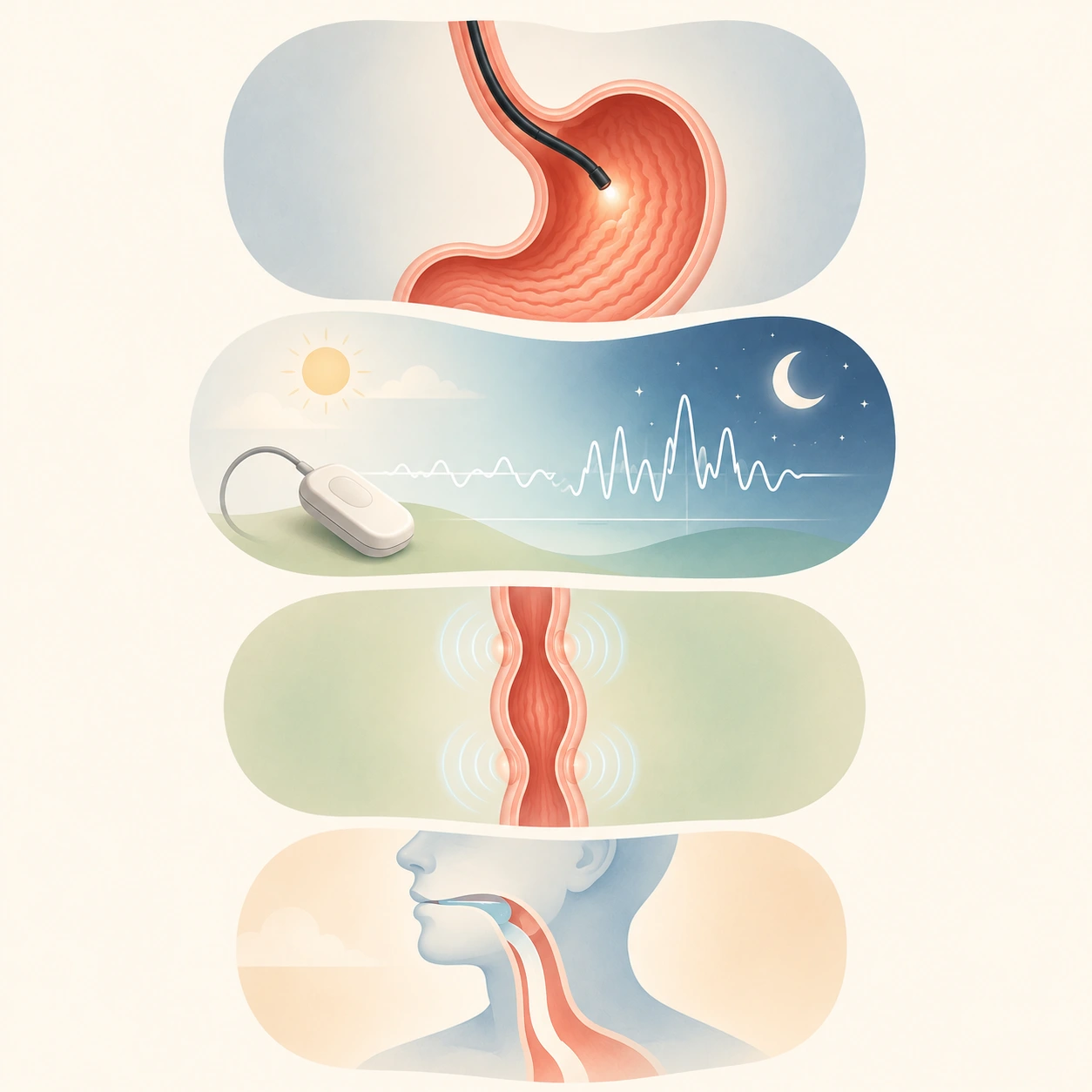
Four tests answer four different questions, and Dr. Grandhige personally reviews every study before you sit down with him:
- pH monitoring is the reference standard for proving reflux. Using a wireless Bravo capsule or a catheter probe, it records 48 to 72 hours while you eat, sleep, exercise, and work.
- Esophageal manometry measures whether your esophagus is strong and coordinated enough to handle added resistance at the junction. It also identifies achalasia, esophageal spasm, ineffective motility, jackhammer esophagus, and a hypertensive LES, all of which can mimic reflux and none of which improve with reflux surgery.
- Barium esophagram shows how you swallow in real time, including pill and food studies that reproduce your symptoms. One finding from this test is worth knowing: where a patient feels food sticking matches the actual anatomic location only about 60% of the time. Patients regularly point at their throat when the delay is in the distal esophagus.
- Upper endoscopy maps anatomy, finds complications, and provides the access point for placing a pH probe.
If you have throat symptoms rather than heartburn, standard testing will probably miss the problem. For silent reflux, Dr. Grandhige uses a customized 24-hour pH impedance dual-channel probe that measures reflux above the lower esophageal sphincter and above the upper esophageal sphincter, including non-acid reflux like bile, pepsin, and trypsin. The distinction is physiologic: the esophagus tolerates 40 to 50 reflux episodes a day, while the larynx and pharynx can become symptomatic from one. Patients evaluated with standard testing are typically quoted a 50% chance that surgery helps their throat symptoms. With dual-channel testing to select the right candidates, that figure rises to roughly 80%. The tradeoff is that only about 50% to 60% of LPR patients turn out to have testing that justifies an operation. Fewer operations, better matched.
The Six-Step Procedure Match
Repairing the hernia is one half of the operation. The other half is deciding what anti-reflux procedure goes with it, because most hiatal hernia patients also reflux. Dr. Grandhige works through the same six steps every time:
- Prove reflux objectively. No pH confirmation, no operation, regardless of how convincing the symptoms are.
- Map the anatomy. Hernia size, esophageal length and position, and the relationship between stomach, diaphragm, and esophagus determine what is technically possible and how durable a repair will be.
- Test esophageal function. Motility decides whether a full or partial wrap is safe and whether a magnetic device is appropriate. Ignoring it produces dysphagia.
- Match symptoms to physiology. He states plainly which of your symptoms he expects to resolve, which may improve partially, and which are unlikely to be reflux at all.
- Weigh your priorities. Durability, medication elimination, the ability to burp and vomit, and reversibility all shape the choice, but only inside the limits set by your anatomy.
- Choose the procedure, or choose none. Observation and medical management are real answers.
His own summary: the operation is the last step, and the decision-making is the surgery.
The options that pair with a laparoscopic repair are fundoplication in four configurations (Nissen 360-degree, Toupet posterior 270-degree, Watson anterior 270-degree, and Dor anterior partial) and the LINX magnetic sphincter system. Hernia size does not disqualify you from LINX as long as the hernia is repaired during the same operation. Current LINX devices are MRI compatible up to 1.5 Tesla.
One option cannot be paired with a hernia repair at all. TIF is performed through the mouth, so the diaphragm is never addressed. Dr. Grandhige quotes a 2% annual failure rate for TIF, roughly 20% per decade, and does not offer it to patients with moderate or large hernias or to patients who are obese.
RefluxStop is not yet available in the United States
If you have read that RefluxStop is coming to Tampa Bay in 2026, here is the current status. The device has held a European CE mark since 2018 with published five-year outcomes, but it is still in the FDA Premarket Approval process in the US. Implantica submitted its final response to FDA on Module 3 of the PMA application in May 2026, and a decision remains pending. The manufacturer states the device is not available for sale in the US.
Dr. Grandhige intends to add RefluxStop once it clears FDA review. Until then, no surgeon in Florida can implant it outside a trial, and any page telling you otherwise is ahead of the regulator. Your realistic surgical choices today are fundoplication and LINX.
Laparoscopic or robotic, and what the comparisons actually show
Dr. Grandhige performs hiatal hernia repair both laparoscopically and robotically, and the choice depends on your anatomy and your preference. Both are minimally invasive: several small abdominal incisions, high-definition visualization, no open incision.
Recent comparative research is more mixed than the marketing suggests. Some retrospective analyses have linked the robotic approach to lower rates of postoperative ileus, fewer ICU stays, and less symptom recurrence at one year. Other comparative studies and meta-analyses have found the two approaches similar on mortality, overall complications, and length of stay, with robotic cases sometimes running longer. The honest read is that platform choice matters less than whether the right operation was selected for the right patient.
Operative time runs 1.5 to 2 hours under general anesthesia. Longer cases happen with large hernias, prior scarring, and complex anatomy.
Recovery, side effects, and what will not improve
Hiatal hernia repair is an outpatient operation. Most patients walk, drink liquids, and go home the same day, with an overnight stay in select cases. Diet progresses over two to three months. When patients are selected carefully and standard anti-reflux procedures are used, the practice reports symptom resolution and elimination of daily reflux medication in more than 90% of cases.
The side effects are worth knowing before you agree to anything. Bloating and difficulty vomiting are the most common concerns after fundoplication, and depending on the wrap type they may be temporary or permanent. LINX generally preserves burping and vomiting once early inflammation settles, but carries a higher rate of early dysphagia. Vomiting in the early postoperative period is associated with early failure of the hernia repair, which is one reason anesthesia management is not interchangeable in foregut surgery.
Two more honest points. LPR symptoms usually take four to six months to improve, while typical heartburn and regurgitation often resolve within days. And these are functional operations, closer to a joint replacement than a cure: they work well, they are subject to wear, and revision is possible over a lifetime. Dr. Grandhige asks patients to give it six months, then addresses whatever remains, sometimes with an ENT physician, pulmonologist, or allergist. Success means the reflux-related symptoms resolve, not every symptom you walked in with.
Coming from Clearwater: the visits, the drive, and the timeline
Clearwater is already one of the areas patients regularly come from, and the practice is built to keep your trips across the bay to a minimum. When testing can be done near you in Pinellas County, the office arranges it locally. When it has to happen in Tampa, studies are grouped onto the fewest days possible, and the team coordinates scheduling, travel timing, follow-up logistics, and hotels for patients who need them.
Send your records to info@tampareflux.com before your appointment: prior endoscopy and pathology reports, pH studies, manometry, barium swallow or imaging, notes from your gastroenterologist, ENT, pulmonologist, or allergist, and your medication and surgical history. Dr. Grandhige reads all of it before you arrive. Patients who send records get a decision-making visit instead of a data-gathering visit.
The timeline is predictable. New patients are usually seen within two weeks and always within four. If your testing is already complete, one consultation is typically enough and surgery can be scheduled as early as four weeks out. If testing is still needed, expect two consultations about four weeks apart and surgery within roughly eight weeks of your first visit. Authorization runs in parallel and takes four to six weeks on its own, which the office handles for you.
The drive is 25 miles or so, 30 to 40 minutes outside of rush hour, via the Courtney Campbell Causeway (SR 60) or the Howard Frankland Bridge. The office is at 1315 South Howard Avenue, Suite 101, in a yellow brick building next to Sally O’Neill’s Pizza. Park behind the restaurant.
Your surgeon, your team, and where the operation happens
Gopal Grandhige, MD is a board-certified general surgeon who has practiced foregut and anti-reflux surgery in Tampa Bay since 2009. He earned a BS in biology from Johns Hopkins University and his MD from the University of Michigan, Ann Arbor, then completed general surgery residency and fellowships in burn and critical care and in foregut and minimally invasive surgery at Yale-New Haven Hospital. He is a Founding Member of the American Foregut Society, a Fellow of the American College of Surgeons, and a member of the Society of American Gastrointestinal and Endoscopic Surgeons. He founded Tampa Bay Reflux Center in 2009 and Tampa Bay Reflux Institute in 2022 to work only on benign disease of the esophagus, diaphragm, and stomach. He evaluates and treats more than 600 reflux patients a year and has performed over 600 fundoplications, over 600 LINX procedures, and over 200 TIF procedures. You can verify all of it through the American Board of Surgery physician lookup, the American College of Surgeons directory, and the Florida Department of Health license search.

He holds privileges at St. Joseph’s Main, St. Joseph’s South, HCA Brandon, and HCA South Tampa, and performs every foregut operation at HCA South Tampa Hospital only. That is deliberate. The same anesthesiologists, nurses, surgical technologists, and his own employed physician assistant work every case, so equipment is set up the same way each time and problems are anticipated rather than discovered. His physician assistant assists in every operation, knows your specific anatomy and procedure, and is reachable afterward. So is he, directly, after hours.
Not every patient is offered surgery, and he is candid that the patients he declines are often the most frustrated. He also considers that the point: the same patients would be unhappier after an operation that did not fix anything. If GERD-like symptoms turn out to be esophageal hypersensitivity, functional chest pain, or a motility disorder, he says so and refers you to the physician who can actually help.
Frequently asked questions


An endoscopy cannot tell you if you have reflux. It can only tell you if you have complications of GERD.
If you are unhappy with your reflux symptoms, come in and we can discuss testing and treatments that can accurately diagnose your problem.
#reflux #gerd #hiatalhernia #gastroparesis #linx


CALL US AT 813-922-2920
www.tampareflux.com
If you have a hiatal hernia and fit one of these categories, you should know your options.
Dr. Grandhige is an expert in his field and performs 200 of these surgeries a year. He is the only surgeon in the Tampa Bay Area who offers all surgical options - LINX, Fundoplications, TIF and will be one of 20 surgeons in America introducing the latest procedure RefluxStop in 2026.
We accept most insurances but will verify yours before you come in. These procedures are considered medically necessary and covered by your insurance. You can expect to pay your in-network deductibles and nothing else.
#hiatalhernia #reflux #GERD #LINX #refluxstop

What causes reflux ?
1. Weak lower esophageal sphincter
2. Hiatal hernia
3. Flattening of the Angle of His
4. Poor esophageal motility
5. Gastroparesis (slow stomach)
NOT increased acid production


Don’t let GERD get in the way of living your life. Request your appointment with us today on the link below.
.
.
.
.
https://tampareflux.com/contact-us/

Anyone can be victim to GERD and though weight loss can help reduce GERD symptoms. Many athletes with high impact workouts may continue to have these symptoms. This may be a symptom of a hiatal hernia or other issue. We are more then happy to assist you in finding your solution, just click the link below.
.
.
.
https://tampareflux.com/contact-us/
##healthylifestyle #workout #athletereflux #PPIs #heartburn #LINX #fundoplication #TIF #GERD#tampaheartburn #linx #TIF #fundoplication #tampabayreflux #GERD #acidreflux #acidrefluxsurgery #stopreflux
#nonsurgicalweightloss #ESG #gastricballoon #weightlossjourney #vsg #vsgjourney #spatz3 #orbera #orberaballoon #grandhige #DrG
#tampabayrefluxinstitute #guthealth #roboticsurgery

Heartburn may seem like an annoyance. But if you find yourself having symptoms on a daily basis, it may be time to to talk to Dr. Grandhige as it could be a symptom of something worse.
.
.
.
#chronicheartburn #gerdsymptoms #heartburnrelief #reflux #PPIs #heartburn #LINX #fundoplication #TIF #GERD#tampaheartburn #linx #TIF #fundoplication #tampabayreflux #GERD #acidreflux #acidrefluxsurgery #stopreflux
#nonsurgicalweightloss #ESG #gastricballoon #weightlossjourney #vsg #vsgjourney #spatz3 #orbera #orberaballoon #grandhige #DrG
#tampabayrefluxinstitute #guthealth #roboticsurgery

If you are tired of avoiding your favorite foods or taking daily medications, we can help.
We are the Tampa experts in reflux ! With years of experience and thousands of patients treated successfully, we offer all FDA approved anti-reflux procedures.
Call 813-922-2920 to schedule your appointment
All major insurances accepted.

Not all patients need surgical intervention. Many patients are living a heartburn free life with their PPIs. However 40% of patients taking PPIs are not getting the relief they need. If you are one of those, you have options! Come in and find out more.
.
.
.
.
#letushelpyou #medsnotworking #reflux #PPIs #heartburn #LINX #fundoplication #TIF #GERD#tampaheartburn #linx #TIF #fundoplication #tampabayreflux #GERD #acidreflux #acidrefluxsurgery #stopreflux
#nonsurgicalweightloss #ESG #gastricballoon #weightlossjourney #vsg #vsgjourney #spatz3 #orbera #orberaballoon #grandhige #DrG
#tampabayrefluxinstitute #guthealth #roboticsurgery

#heartburn #stopreflux #hiatalherniarepair #severeheartburn #reflux #tampabayreflux #acidrefluxsurgery #tampaheartburn #GERD #PPIs #achalasia #LINX #TIF #tampareflux #fundoplication #stomach #digestivehealth #ESG #obesity #overweight #weightlossjourney #gastricballoon
