
When a hiatal hernia actually needs surgical repair
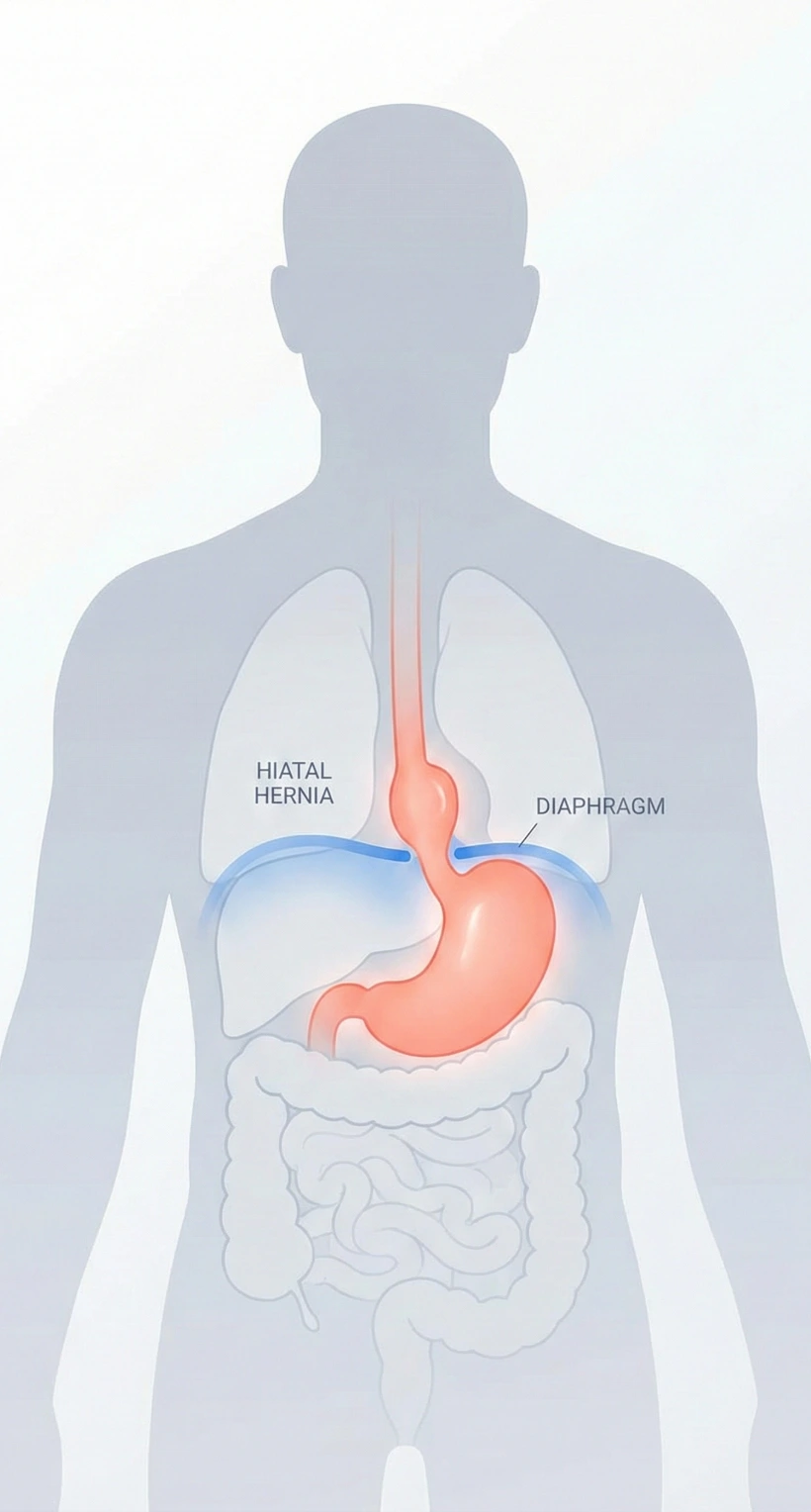
A hiatal hernia needs surgical repair when it’s large, when it’s causing symptoms medication can’t fix, or when it has already caused damage. A hiatal hernia is a weak or widened opening in the diaphragm that lets the stomach slide up into the chest, which breaks the mechanical barrier that normally keeps acid down. Medication lowers acid. It does nothing for the anatomy.
Dr. Grandhige recommends repair in a few clear situations. Any hernia larger than 3 centimeters almost always contributes mechanically to reflux, tends to grow, and carries a small risk of the stomach twisting, a condition called gastric volvulus. Any hernia paired with real reflux symptoms, especially regurgitation, is worth addressing even when it’s smaller. And any hernia tied to a complication of reflux, such as severe esophagitis, a stricture, or Barrett’s esophagus, points toward surgery. The reason is simple: reflux control depends on both the lower esophageal sphincter and the diaphragm, and repairing only one when both have failed produces weak, short-lived results.
How Dr. Grandhige decides whether you need surgery, and which one
There’s no single best reflux operation. There’s the right operation for your anatomy, and sometimes the right answer is no operation. Dr. Grandhige runs every candidate through the same six-step evaluation before he recommends anything:
As he puts it to patients, the operation is the last step. The decision-making is the real surgery.
The procedures he performs
Dr. Grandhige performs every major anti-reflux procedure, which is what lets the last step above be an honest choice rather than a default. In appropriately selected patients with typical reflux and good esophageal function, he reports symptom relief and freedom from daily medication in more than 95 percent of cases.
Fundoplication wraps the upper stomach around the lower esophagus to rebuild the barrier, in a full 360-degree (Nissen) or partial (Toupet, Dor, Watson) configuration chosen from your motility results. It’s the most durable option and the one that handles large hernias. Most fundoplications take about 1.5 to 2 hours, and most patients go home the same day.
The LINX device is a ring of magnetic titanium beads placed around the lower esophagus. It resists reflux under pressure but opens to let you swallow, burp, and vomit, so it preserves more normal anatomy than a wrap. Current LINX devices are MRI-compatible up to 1.5 Tesla. TIF, or transoral incisionless fundoplication, rebuilds the valve entirely through the mouth with no incisions, using the EsophyX device, in about 45 to 60 minutes. It fits a narrow group: mild to moderate reflux, little or no hiatal hernia, and no obesity. Dr. Grandhige is direct that TIF is not a lighter version of surgery, and he won’t offer it to patients who fall outside those criteria.
Beginning in 2026 he adds RefluxStop, which will make him the only surgeon in Tampa Bay offering all four anti-reflux procedures.
Recovery, recurrence, and the details most pages skip
Recovery from a laparoscopic hiatal hernia repair is faster than most people expect on paper and harder than most pages admit in the first two weeks. Most patients go home the same day. The honest first stretch involves bloating, a diet that steps up from liquids to soft foods, and real fatigue. Lighter work is usually back within a week or two, full energy takes longer, and diet progresses over roughly two to three months. Plan for two to six weeks depending on your job and your health. Typical heartburn and regurgitation often clear quickly. Throat symptoms from LPR can take four to six months.
Two things are worth asking any surgeon about, because generic pages gloss over them.
The first is your spine. Spinal curvature is a real recurrence risk factor, and almost no reflux page mentions it. In a study from surgeons at the University of South Florida and Tampa General reviewing 546 hiatal hernia repairs, patients with a spinal deformity like scoliosis or kyphosis had a recurrence rate of 47.7 percent versus 30.0 percent without one, and their hernias came back sooner, a median of about 10 months versus 19. If you have scoliosis, it should change how your repair is planned and how you’re counseled. This is local research, from the same bay you’d cross for care.
The second is mesh. Whether to reinforce the repair with mesh is a genuine trade-off, not a clear win. In a 13-year randomized trial published in JAMA Surgery, long-term recurrence was 38 percent with mesh versus 31 percent with sutures alone, a difference that was not statistically significant, while the mesh group reported more long-term swallowing trouble. Newer biosynthetic meshes show promise for larger hernias, but the evidence is still moving. The choice should be made for your anatomy, and you should hear the reasoning behind it.
Your surgeon and surgical team
Dr. Gopal Grandhige is a board-certified general surgeon who has focused on foregut and anti-reflux surgery since 2009, more than 16 years in this one subspecialty. He earned his biology degree at Johns Hopkins, his medical degree at the University of Michigan, and completed his general surgery residency and fellowships in foregut and minimally invasive surgery at Yale-New Haven Hospital. He’s a Fellow of the American College of Surgeons, a member of SAGES, and a founding member of the American Foregut Society. You can read more about his background on the about page, and verify his credentials independently through the American Board of Surgery and the Florida Department of Health license lookup.
He performs every surgery at HCA South Tampa Hospital, on purpose. The same operating room team, anesthesiologists, and his own dedicated physician assistant are in every case, so the people around you already know his techniques rather than learning them. That physician assistant also handles questions and after-hours concerns, so you’re not routed to a stranger during recovery. Several of his medical assistants have worked with him for over a decade. Referrals come from gastroenterologists, ENT physicians, pulmonologists, and allergists across Florida, who tend to send their most complicated cases here because patients come back informed, whether or not they had surgery.

From your first call to surgery
The path from consultation to surgery usually takes two visits at most, and about four to eight weeks overall. If you bring complete prior testing, a single visit is often enough to confirm the diagnosis and plan the operation, with surgery scheduled as soon as about four weeks out. If testing still needs to be done, the first visit is for review and planning, testing follows, and a second visit about four weeks later finalizes the plan. New patients are typically seen within two weeks, and always within four.
Bringing your records is the single biggest thing you can do to speed this up. Send prior endoscopy and pathology reports, any pH testing, manometry, imaging, notes from your other physicians, and your medication and surgical history to info@tampareflux.com before your visit, so the consultation is spent on answers instead of paperwork. The office is at 1315 South Howard Avenue, Suite 101, Tampa, FL 33606, about 30 minutes from St. Petersburg, and new patients can call 813.922.2920.
FAQS
Take the next step
If reflux is affecting your sleep, your diet, or your day, the first move isn’t surgery. It’s a clear answer about what’s actually happening. Dr. Grandhige and his team will review your history, run the right tests, and explain your options in plain language, then operate only if it’s the right call for you.


An endoscopy cannot tell you if you have reflux. It can only tell you if you have complications of GERD.
If you are unhappy with your reflux symptoms, come in and we can discuss testing and treatments that can accurately diagnose your problem.
#reflux #gerd #hiatalhernia #gastroparesis #linx


CALL US AT 813-922-2920
www.tampareflux.com
If you have a hiatal hernia and fit one of these categories, you should know your options.
Dr. Grandhige is an expert in his field and performs 200 of these surgeries a year. He is the only surgeon in the Tampa Bay Area who offers all surgical options - LINX, Fundoplications, TIF and will be one of 20 surgeons in America introducing the latest procedure RefluxStop in 2026.
We accept most insurances but will verify yours before you come in. These procedures are considered medically necessary and covered by your insurance. You can expect to pay your in-network deductibles and nothing else.
#hiatalhernia #reflux #GERD #LINX #refluxstop

What causes reflux ?
1. Weak lower esophageal sphincter
2. Hiatal hernia
3. Flattening of the Angle of His
4. Poor esophageal motility
5. Gastroparesis (slow stomach)
NOT increased acid production


Don’t let GERD get in the way of living your life. Request your appointment with us today on the link below.
.
.
.
.
https://tampareflux.com/contact-us/

Anyone can be victim to GERD and though weight loss can help reduce GERD symptoms. Many athletes with high impact workouts may continue to have these symptoms. This may be a symptom of a hiatal hernia or other issue. We are more then happy to assist you in finding your solution, just click the link below.
.
.
.
https://tampareflux.com/contact-us/
##healthylifestyle #workout #athletereflux #PPIs #heartburn #LINX #fundoplication #TIF #GERD#tampaheartburn #linx #TIF #fundoplication #tampabayreflux #GERD #acidreflux #acidrefluxsurgery #stopreflux
#nonsurgicalweightloss #ESG #gastricballoon #weightlossjourney #vsg #vsgjourney #spatz3 #orbera #orberaballoon #grandhige #DrG
#tampabayrefluxinstitute #guthealth #roboticsurgery

Heartburn may seem like an annoyance. But if you find yourself having symptoms on a daily basis, it may be time to to talk to Dr. Grandhige as it could be a symptom of something worse.
.
.
.
#chronicheartburn #gerdsymptoms #heartburnrelief #reflux #PPIs #heartburn #LINX #fundoplication #TIF #GERD#tampaheartburn #linx #TIF #fundoplication #tampabayreflux #GERD #acidreflux #acidrefluxsurgery #stopreflux
#nonsurgicalweightloss #ESG #gastricballoon #weightlossjourney #vsg #vsgjourney #spatz3 #orbera #orberaballoon #grandhige #DrG
#tampabayrefluxinstitute #guthealth #roboticsurgery

If you are tired of avoiding your favorite foods or taking daily medications, we can help.
We are the Tampa experts in reflux ! With years of experience and thousands of patients treated successfully, we offer all FDA approved anti-reflux procedures.
Call 813-922-2920 to schedule your appointment
All major insurances accepted.

Not all patients need surgical intervention. Many patients are living a heartburn free life with their PPIs. However 40% of patients taking PPIs are not getting the relief they need. If you are one of those, you have options! Come in and find out more.
.
.
.
.
#letushelpyou #medsnotworking #reflux #PPIs #heartburn #LINX #fundoplication #TIF #GERD#tampaheartburn #linx #TIF #fundoplication #tampabayreflux #GERD #acidreflux #acidrefluxsurgery #stopreflux
#nonsurgicalweightloss #ESG #gastricballoon #weightlossjourney #vsg #vsgjourney #spatz3 #orbera #orberaballoon #grandhige #DrG
#tampabayrefluxinstitute #guthealth #roboticsurgery

#heartburn #stopreflux #hiatalherniarepair #severeheartburn #reflux #tampabayreflux #acidrefluxsurgery #tampaheartburn #GERD #PPIs #achalasia #LINX #TIF #tampareflux #fundoplication #stomach #digestivehealth #ESG #obesity #overweight #weightlossjourney #gastricballoon
