
The Repair Options Actually Available After a Sleeve, and the Two That Usually Are Not
After a sleeve, the standard reflux operation is generally off the table, because it is built from the part of your stomach you no longer have.
A fundoplication works by wrapping the fundus around the lower esophagus to rebuild the reflux barrier. Your sleeve removed the fundus. Published surgical reviews of reflux after sleeve gastrectomy state this plainly: fundoplication is not an option in these patients because of the resected fundus. If a page or a consultation offers you a Nissen after a sleeve without explaining what is left of your fundus, that is a question worth asking directly.
TIF, the incisionless endoscopic procedure, is usually out too, for two separate reasons. It cannot repair a hiatal hernia at all, because it works entirely through the mouth and never reaches the diaphragm. And Dr. Grandhige does not offer it to patients with moderate or large hernias, or to patients who are obese. Both exclusions apply to most people reading this page.
Here is what is actually on the table.
The Testing That Decides It, and Why a Normal Endoscopy Proves Nothing
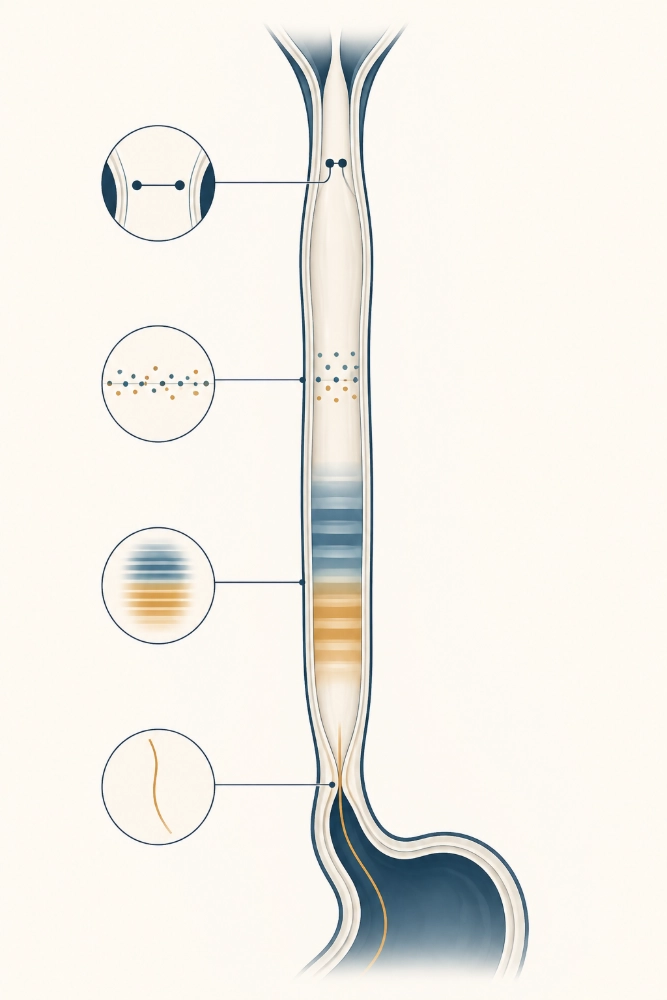
A normal endoscopy does not rule out reflux or a hernia. Endoscopy looks for damage that reflux has already caused. It does not measure whether reflux is happening, and small sliding hernias are not visible on every scope.
Four tests answer four different questions, and skipping one is how patients end up with the wrong operation.
Endoscopy shows anatomy and damage: esophagitis, Barrett’s esophagus, strictures, and hernias large enough to see. pH or pH impedance monitoring shows whether reflux is actually occurring, how often, how long each episode lasts, and whether your symptoms line up with the events. Manometry shows whether your esophagus has the strength and coordination to handle added resistance at the bottom, which is the single measurement that determines whether LINX is safe for you or whether it would leave you with lasting swallowing trouble. A barium esophagram shows what happens when you genuinely swallow, which is why it catches things the other three miss. A sliding hernia can measure differently on two studies weeks apart. And where you feel food get stuck is the actual anatomic location only about 60 percent of the time.
If your dominant complaints are cough, throat clearing, hoarseness, or a lump-in-the-throat sensation rather than heartburn, standard reflux testing will probably miss the cause. Dr. Grandhige uses a 24-hour dual-channel pH impedance probe that measures reflux above the upper esophageal sphincter, not just above the lower one, and measures non-acid reflux including bile and pepsin. With standard testing, patients with silent reflux are routinely quoted around a 50 percent chance that surgery helps. With this selection method he quotes roughly 80 percent, and roughly 50 to 60 percent of LPR patients test in a way that supports surgery at all. The other 40 to 50 percent are told no.
How Dr. Grandhige Chooses the Operation, and When He Tells You Not to Have One
The decision is made before the operating room, in six steps, and one of the available answers is no operation.
First, prove reflux is happening, and determine whether it is acid, non-acid, or bile. If reflux is not objectively proven, surgery is not recommended regardless of how bad your symptoms are. Second, map the anatomy: hernia size, esophageal length, the relationship between stomach, diaphragm, and esophagus. Third, measure esophageal function on manometry. Fourth, match each symptom to the physiology, and say out loud which ones he expects to improve, which may improve partially, and which are unlikely to be reflux-related at all. Fifth, weigh what you actually want: durability, getting off medication, keeping the ability to burp and vomit, reversibility. Sixth, pick the procedure, or pick none.
In his words: the operation is the last step, and the decision-making is the surgery.
That framework produces an uncomfortable number you should hear before you book. For straightforward cases, meaning objectively proven GERD, workable anatomy, and good esophageal function, the practice quotes greater than 95 percent for meaningful symptom relief and getting off daily medication. Prior bariatric surgery is one of the situations Dr. Grandhige specifically names where outcomes can be lower and expectations have to be set individually. Post-sleeve anatomy is not a straightforward case. You should be told what your realistic number is, not the practice average.
Durability deserves the same treatment. A 2026 multicenter analysis followed 108 patients for an average of 7.7 years after sleeve gastrectomy with hiatal hernia repair. Anatomical recurrence occurred in 13 percent. Freedom from recurrence was 98.1 percent at five years and fell to 68.9 percent at ten. Two things predicted recurrence: hernias 5 centimeters or larger, and reflux that persisted after the repair. About 10 percent needed a second operation, and every one of those patients had symptomatic reflux, not merely a finding on a scan. These are functional repairs. They work well, they are subject to wear, and some will be revised over a lifetime. Anyone who tells you otherwise is selling.
The side effects get the same directness. Early swallowing difficulty is common and expected. Gas and bloating vary by procedure. Revision risk is real. Patients who leave with accurate expectations report satisfaction even when results are partial. Patients who were promised everything do not.
Dr. Gopal Grandhige, MD, FACS

Dr. Grandhige is a board-certified general surgeon who has limited his practice to benign disease of the esophagus, diaphragm, and stomach since 2009.
He earned a Bachelor of Science in Biology from Johns Hopkins University and his medical degree from the University of Michigan, Ann Arbor. He completed general surgery residency at Yale-New Haven Hospital, followed by fellowship training at Yale-New Haven in foregut and minimally invasive surgery, and a separate fellowship in burn and critical care. He has performed over 600 fundoplications, over 600 LINX procedures, and over 200 TIF procedures.
He is a Fellow of the American College of Surgeons, a founding member of the American Foregut Society, and a member of the Society of American Gastrointestinal and Endoscopic Surgeons. Board certification is verifiable through the American Board of Surgery physician lookup, and Florida licensure through the Department of Health Medical Quality Assurance lookup. More detail on his training and approach is on the Tampa Bay Reflux Institute about page.
His office team has worked together for more than a decade, and the majority of the practice arrives by referral from gastroenterologists, ENT physicians, pulmonologists, allergists, and primary care doctors rather than from advertising.
Questions Post-Sleeve Patients Ask
If you had a sleeve, your reflux came back, and nobody has explained why, the next step is objective testing rather than another medication change. Bring your records, get the measurements, and find out whether a repair is the right answer for your anatomy before anyone schedules anything.


An endoscopy cannot tell you if you have reflux. It can only tell you if you have complications of GERD.
If you are unhappy with your reflux symptoms, come in and we can discuss testing and treatments that can accurately diagnose your problem.
#reflux #gerd #hiatalhernia #gastroparesis #linx


CALL US AT 813-922-2920
www.tampareflux.com
If you have a hiatal hernia and fit one of these categories, you should know your options.
Dr. Grandhige is an expert in his field and performs 200 of these surgeries a year. He is the only surgeon in the Tampa Bay Area who offers all surgical options - LINX, Fundoplications, TIF and will be one of 20 surgeons in America introducing the latest procedure RefluxStop in 2026.
We accept most insurances but will verify yours before you come in. These procedures are considered medically necessary and covered by your insurance. You can expect to pay your in-network deductibles and nothing else.
#hiatalhernia #reflux #GERD #LINX #refluxstop

What causes reflux ?
1. Weak lower esophageal sphincter
2. Hiatal hernia
3. Flattening of the Angle of His
4. Poor esophageal motility
5. Gastroparesis (slow stomach)
NOT increased acid production


Don’t let GERD get in the way of living your life. Request your appointment with us today on the link below.
.
.
.
.
https://tampareflux.com/contact-us/

Anyone can be victim to GERD and though weight loss can help reduce GERD symptoms. Many athletes with high impact workouts may continue to have these symptoms. This may be a symptom of a hiatal hernia or other issue. We are more then happy to assist you in finding your solution, just click the link below.
.
.
.
https://tampareflux.com/contact-us/
##healthylifestyle #workout #athletereflux #PPIs #heartburn #LINX #fundoplication #TIF #GERD#tampaheartburn #linx #TIF #fundoplication #tampabayreflux #GERD #acidreflux #acidrefluxsurgery #stopreflux
#nonsurgicalweightloss #ESG #gastricballoon #weightlossjourney #vsg #vsgjourney #spatz3 #orbera #orberaballoon #grandhige #DrG
#tampabayrefluxinstitute #guthealth #roboticsurgery

Heartburn may seem like an annoyance. But if you find yourself having symptoms on a daily basis, it may be time to to talk to Dr. Grandhige as it could be a symptom of something worse.
.
.
.
#chronicheartburn #gerdsymptoms #heartburnrelief #reflux #PPIs #heartburn #LINX #fundoplication #TIF #GERD#tampaheartburn #linx #TIF #fundoplication #tampabayreflux #GERD #acidreflux #acidrefluxsurgery #stopreflux
#nonsurgicalweightloss #ESG #gastricballoon #weightlossjourney #vsg #vsgjourney #spatz3 #orbera #orberaballoon #grandhige #DrG
#tampabayrefluxinstitute #guthealth #roboticsurgery

If you are tired of avoiding your favorite foods or taking daily medications, we can help.
We are the Tampa experts in reflux ! With years of experience and thousands of patients treated successfully, we offer all FDA approved anti-reflux procedures.
Call 813-922-2920 to schedule your appointment
All major insurances accepted.

Not all patients need surgical intervention. Many patients are living a heartburn free life with their PPIs. However 40% of patients taking PPIs are not getting the relief they need. If you are one of those, you have options! Come in and find out more.
.
.
.
.
#letushelpyou #medsnotworking #reflux #PPIs #heartburn #LINX #fundoplication #TIF #GERD#tampaheartburn #linx #TIF #fundoplication #tampabayreflux #GERD #acidreflux #acidrefluxsurgery #stopreflux
#nonsurgicalweightloss #ESG #gastricballoon #weightlossjourney #vsg #vsgjourney #spatz3 #orbera #orberaballoon #grandhige #DrG
#tampabayrefluxinstitute #guthealth #roboticsurgery

#heartburn #stopreflux #hiatalherniarepair #severeheartburn #reflux #tampabayreflux #acidrefluxsurgery #tampaheartburn #GERD #PPIs #achalasia #LINX #TIF #tampareflux #fundoplication #stomach #digestivehealth #ESG #obesity #overweight #weightlossjourney #gastricballoon
