
Why a normal endoscopy proves nothing
Upper endoscopy answers one question: has reflux caused visible damage. It does not measure whether reflux is happening, how often, how long each episode lasts, or whether your symptoms line up with reflux events.
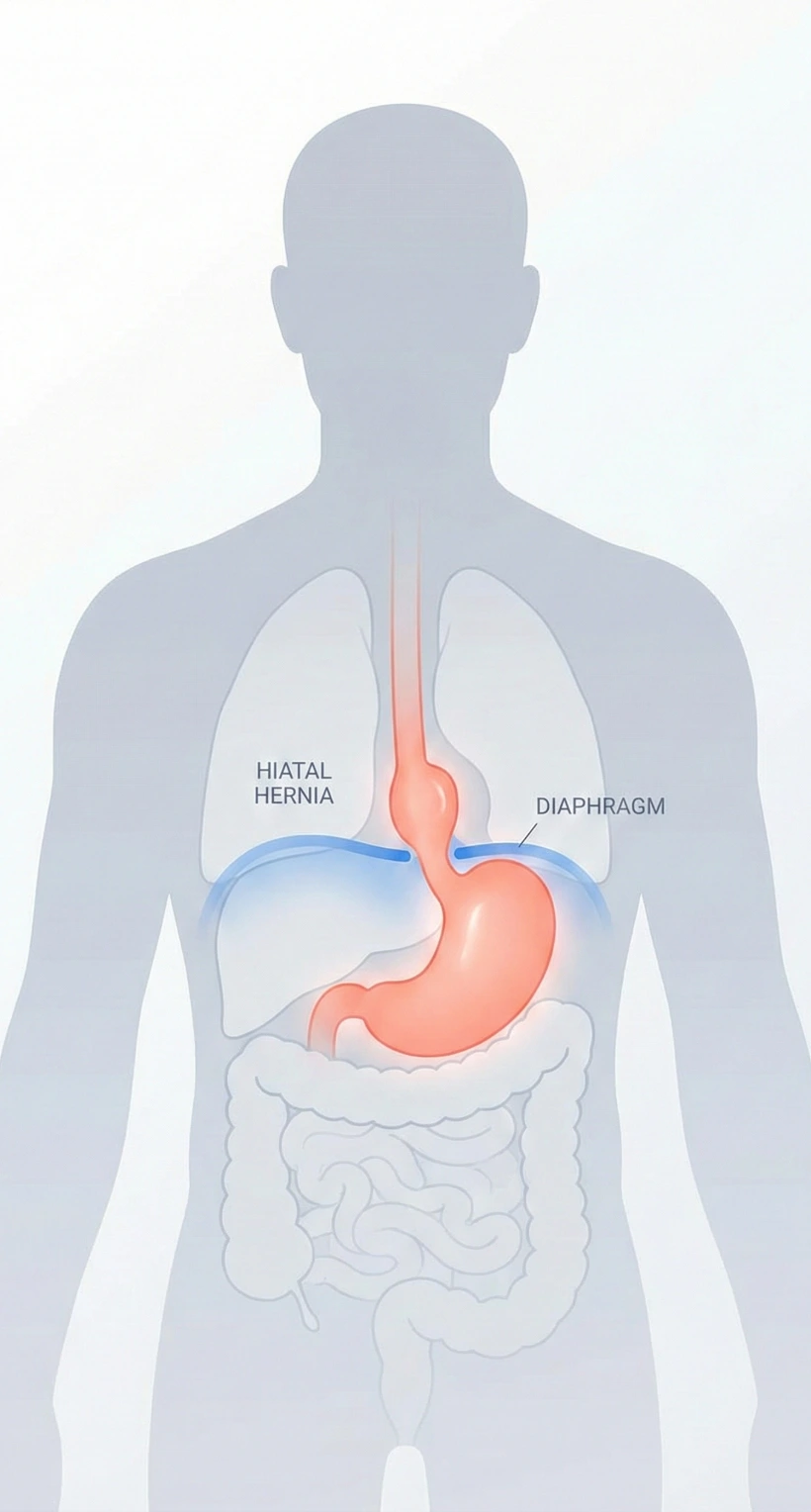
Almost every reflux patient has a hiatal hernia, and many are small enough that endoscopy misses them entirely. In the Tampa post-bariatric series, endoscopy identified the hernia in only 56 percent of cases. Upper GI contrast study found it in 80 percent and CT in 70 percent. If your workup so far has been an endoscopy and a prescription, you have not been evaluated.
Four studies do the real work, and each answers a different question. Endoscopy assesses anatomy and complications. Ambulatory pH monitoring, done over 48 to 72 hours with a Bravo capsule or catheter, measures whether reflux is actually occurring and whether it correlates with what you feel. High-resolution manometry measures whether your esophagus has the strength and coordination to push food past anything placed at the junction. A barium esophagram shows how you swallow in real time and measures hernia size, which endoscopy estimates poorly.
One detail from Dr. Grandhige’s practice that patients find useful: when a patient points to where food feels stuck, that location is correct only about 60 percent of the time. A patient who feels it in the throat is often obstructing in the distal esophagus. Watching the swallow settles it.
Testing is also what protects you from the wrong operation. Reflux-like symptoms after a sleeve can come from esophageal hypersensitivity, a motility disorder, functional chest pain, or rumination. None of those improve with an anti-reflux procedure, and some get worse. Details on how each condition presents are on our GERD page, and throat-dominant symptoms are covered under silent reflux.
What the outcome numbers actually show for post-sleeve patients
For appropriately selected patients with typical reflux symptoms, objective reflux, workable anatomy and good esophageal function, this practice reports greater than 95 percent success in symptom relief, elimination of daily reflux medication, and patient satisfaction.
You are not automatically in that group, and you should know that going in. Prior bariatric surgery is one of the factors Dr. Grandhige names as a reason outcomes may run below that figure and procedure choice may be modified to prioritize safety. Complex or long-standing disease, reduced motility, and large or recurrent hernias do the same.
The published post-sleeve data supports that caution rather than contradicting it. In the Tampa series, repair markedly improved the BARF cluster and helped patients maintain weight loss, but abdominal pain and heartburn were the symptoms most likely to persist afterward. Symptoms that come from mechanical obstruction respond well. Heartburn is less reliable.
Durability is a separate question from symptom relief. Long-term multicenter follow-up of concurrent sleeve and hernia repair reported anatomic recurrence around 13 percent, with most recurrences managed without another operation, and with large hernia size and ongoing reflux as the strongest predictors of failure.
Two things in this area are genuinely unsettled, and any page telling you otherwise is overselling. Whether small sliding hernias should be routinely repaired at the time of the original sleeve is contested, with at least one cohort finding no clear benefit. So is the choice between reduction with cruroplasty and conversion to bypass once a symptomatic hernia appears, where published series vary and conversion is more common for refractory reflux or large migration.
If throat symptoms are part of your picture, expect a different timeline. Typical heartburn and regurgitation often resolve within days. Throat-dominant symptoms take four to six months to settle.
When Dr. Grandhige recommends against surgery

Some patients leave this consultation without a surgical plan. He describes those patients as often the least happy in the short term, and as the patients who would have been considerably unhappier after an unnecessary operation.
Surgery is not recommended when pH testing is normal and symptoms are being driven by something other than reflux, when manometry shows motility too weak to tolerate a device or a wrap, when the sleeve anatomy itself is the problem and a bariatric revision is the correct answer, or when reflux is well controlled on a medication the patient simply prefers not to take.
Honest risks, since none of these operations are free of them: hernias recur, swallowing changes are expected during healing and occasionally persist, fundoplication can limit the ability to burp or vomit depending on configuration, and roughly 1 percent of LINX devices are eventually removed. Patients who report being unusually aware of internal sensations frequently sense the LINX device, and those who felt a Bravo capsule during testing usually will.
Dr. Grandhige asks patients to give any procedure six months. At that point, whatever symptoms remain get addressed, sometimes by referral to another specialist rather than by more surgery.
Doing this from Clearwater in as few trips as possible
Clearwater to the office is a straight run across the Courtney Campbell Causeway on State Road 60, then east to Howard Avenue. The practice sees patients from Clearwater and St. Petersburg regularly, along with patients from Orlando, Naples, Jacksonville and out of state, so out-of-area logistics are routine rather than an exception.
Two things compress the trip count.
First, testing gets done near you wherever that is possible. The team routinely arranges for studies that can be performed locally to be performed locally, so your visits here are spent on decisions rather than on procedures a Pinellas facility could have handled. What cannot be done locally is grouped onto the fewest days possible.
Second, send your records ahead to info@tampareflux.com. Dr. Grandhige personally reviews everything before you arrive. Send the operative report from your sleeve rather than the discharge summary, since the operative note documents how much fundus remains and whether the hiatus was addressed. Also send every endoscopy report with pathology, any barium study, any pH or manometry results, notes from your bariatric surgeon and gastroenterologist, and a list of current medications and prior surgeries. Signed record releases alone are unreliable and slow, so patients who gather their own records get a far more definitive first visit.
The timeline from there is predictable. Patients are usually seen within two weeks and always within four. If your testing is complete, one consultation is typically all that is needed, and surgery can follow as early as four weeks out. If testing is incomplete, the first visit covers education and test planning, a second visit about four weeks later reviews results, and surgery generally falls around eight weeks from the first appointment.
Insurance authorization is handled entirely by the office, which gathers documentation, submits it, and communicates with reviewers directly. Authorization is secured before surgery is scheduled. It can take four to six weeks on complex cases, which is one more reason to start records requests early.
Your surgeon, your team, and where surgery happens
Dr. Gopal Grandhige has limited his practice to benign disease of the esophagus, diaphragm and stomach since 2009. He earned his undergraduate degree at Johns Hopkins and his medical degree at the University of Michigan, completed general surgery residency at Yale-New Haven Hospital, and completed fellowships there in burn and critical care and in foregut and minimally invasive surgery. He is board certified in general surgery, a Fellow of the American College of Surgeons, a founding member of the American Foregut Society, and a member of SAGES. His full background is on the about page.
He has performed over 600 fundoplications, over 650 LINX procedures and over 200 TIF procedures, and is the only board-certified surgeon in the Tampa Bay area who performs all three with regularity.
All surgery is performed at HCA Florida South Tampa Hospital, under two miles from the office. He holds privileges at several area hospitals and operates at one on purpose, with the same anesthesia team, the same operating room staff, and his own employed physician assistant present for every case. That physician assistant also handles postoperative questions and knows your specific anatomy, so you are not routed to an unfamiliar provider. Most of the office team has been with the practice for more than a decade. Dr. Grandhige is reachable directly after hours and on weekends.
Frequently asked questions


An endoscopy cannot tell you if you have reflux. It can only tell you if you have complications of GERD.
If you are unhappy with your reflux symptoms, come in and we can discuss testing and treatments that can accurately diagnose your problem.
#reflux #gerd #hiatalhernia #gastroparesis #linx


CALL US AT 813-922-2920
www.tampareflux.com
If you have a hiatal hernia and fit one of these categories, you should know your options.
Dr. Grandhige is an expert in his field and performs 200 of these surgeries a year. He is the only surgeon in the Tampa Bay Area who offers all surgical options - LINX, Fundoplications, TIF and will be one of 20 surgeons in America introducing the latest procedure RefluxStop in 2026.
We accept most insurances but will verify yours before you come in. These procedures are considered medically necessary and covered by your insurance. You can expect to pay your in-network deductibles and nothing else.
#hiatalhernia #reflux #GERD #LINX #refluxstop

What causes reflux ?
1. Weak lower esophageal sphincter
2. Hiatal hernia
3. Flattening of the Angle of His
4. Poor esophageal motility
5. Gastroparesis (slow stomach)
NOT increased acid production


Don’t let GERD get in the way of living your life. Request your appointment with us today on the link below.
.
.
.
.
https://tampareflux.com/contact-us/

Anyone can be victim to GERD and though weight loss can help reduce GERD symptoms. Many athletes with high impact workouts may continue to have these symptoms. This may be a symptom of a hiatal hernia or other issue. We are more then happy to assist you in finding your solution, just click the link below.
.
.
.
https://tampareflux.com/contact-us/
##healthylifestyle #workout #athletereflux #PPIs #heartburn #LINX #fundoplication #TIF #GERD#tampaheartburn #linx #TIF #fundoplication #tampabayreflux #GERD #acidreflux #acidrefluxsurgery #stopreflux
#nonsurgicalweightloss #ESG #gastricballoon #weightlossjourney #vsg #vsgjourney #spatz3 #orbera #orberaballoon #grandhige #DrG
#tampabayrefluxinstitute #guthealth #roboticsurgery

Heartburn may seem like an annoyance. But if you find yourself having symptoms on a daily basis, it may be time to to talk to Dr. Grandhige as it could be a symptom of something worse.
.
.
.
#chronicheartburn #gerdsymptoms #heartburnrelief #reflux #PPIs #heartburn #LINX #fundoplication #TIF #GERD#tampaheartburn #linx #TIF #fundoplication #tampabayreflux #GERD #acidreflux #acidrefluxsurgery #stopreflux
#nonsurgicalweightloss #ESG #gastricballoon #weightlossjourney #vsg #vsgjourney #spatz3 #orbera #orberaballoon #grandhige #DrG
#tampabayrefluxinstitute #guthealth #roboticsurgery

If you are tired of avoiding your favorite foods or taking daily medications, we can help.
We are the Tampa experts in reflux ! With years of experience and thousands of patients treated successfully, we offer all FDA approved anti-reflux procedures.
Call 813-922-2920 to schedule your appointment
All major insurances accepted.

Not all patients need surgical intervention. Many patients are living a heartburn free life with their PPIs. However 40% of patients taking PPIs are not getting the relief they need. If you are one of those, you have options! Come in and find out more.
.
.
.
.
#letushelpyou #medsnotworking #reflux #PPIs #heartburn #LINX #fundoplication #TIF #GERD#tampaheartburn #linx #TIF #fundoplication #tampabayreflux #GERD #acidreflux #acidrefluxsurgery #stopreflux
#nonsurgicalweightloss #ESG #gastricballoon #weightlossjourney #vsg #vsgjourney #spatz3 #orbera #orberaballoon #grandhige #DrG
#tampabayrefluxinstitute #guthealth #roboticsurgery

#heartburn #stopreflux #hiatalherniarepair #severeheartburn #reflux #tampabayreflux #acidrefluxsurgery #tampaheartburn #GERD #PPIs #achalasia #LINX #TIF #tampareflux #fundoplication #stomach #digestivehealth #ESG #obesity #overweight #weightlossjourney #gastricballoon
