
How the Repair Is Chosen: A Six-Step Selection Process
Dr. Grandhige runs the same six steps on every patient before naming a procedure. The order matters, because each step can end the process.
Step 1. Prove reflux is actually happening. Objective pH testing, correlation between reflux events and symptoms, and whether the reflux is acid, non-acid or bile-related. If reflux is not objectively documented, no procedure is recommended, regardless of how convincing the symptoms are.
Step 2. Map the anatomy. Presence and size of the hernia, esophageal length and position, and the relationship between stomach, diaphragm and esophagus. Some procedures cannot address large hernias. Others are built for them.
Step 3. Measure esophageal function. Manometry shows contraction strength, swallow coordination, and any spasm or motility disorder. This is the most commonly skipped step and the one most responsible for bad outcomes.
Step 4. Match symptoms to physiology. Which symptoms should improve, which may improve partly, and which are unlikely to be reflux at all. Patients want one diagnosis to explain everything. That is usually not medically accurate.
Step 5. Weigh what the patient actually wants. Durability, getting off medication, keeping the ability to burp and vomit, minimizing side effects, reversibility. Preference refines the choice once the medicine allows it. It never overrides anatomy or motility.
Step 6. Choose a procedure, or choose none. Observation and medical management are real outcomes of this process, not failures of it.
“The operation is the last step. The decision-making is the surgery,” is how Dr. Grandhige puts it to patients. The practical consequence is that a meaningful share of people leave without an operation. Among patients whose dominant complaints are throat-based, roughly 50 to 60 percent have testing that supports surgery. Among patients with typical heartburn and regurgitation, most do. He is candid that the patients he turns down are often the least satisfied on the day, and also the ones who would have been far less satisfied after an operation that did not address their real problem. If throat clearing, hoarseness or cough drive your symptoms, read how silent reflux is diagnosed differently before booking anything.
The procedures Dr. Grandhige performs, and the honest status of RefluxStop
Dr. Grandhige performs fundoplication, LINX, TIF and RefluxStop. Each fixes a different part of the reflux barrier, and each carries a cost patients should hear before surgery rather than after.
Fundoplication
The upper stomach is wrapped around the lower esophagus to reinforce the weak sphincter, and the diaphragm is repaired in the same operation. There are four configurations: Nissen (360 degrees), Toupet (posterior 270), Watson (anterior 270) and Dor (anterior partial). Manometry decides which one. The procedure runs about 1.5 to 2 hours laparoscopically or robotically, and most patients go home the same day.
The trade-off is direct. Making it harder for acid to come up also makes it harder for air and food to come up. Bloating and reduced ability to vomit are the two common complaints, and depending on the wrap type they may be temporary or permanent. Dr. Grandhige frames it plainly: adults tend to heave rather than vomit the way children do, and being unable to bring up solid food is uncomfortable rather than dangerous, since it exits the other way in time. Patients with untreated severe motility disorders are not candidates. The four fundoplication types are explained in more detail here.
LINX
A ring of magnetic titanium beads placed around the lower esophagus. It does not raise resting sphincter pressure. It resists opening when stomach pressure rises, then opens for swallowing, which is why most patients keep the ability to burp and vomit once early inflammation settles, and why gas-bloat is less of an issue than with a wrap.
Hernia size does not disqualify a patient from LINX, contrary to a common assumption, as long as the hernia is repaired during the same operation. What does disqualify is weak esophageal motility, since the esophagus has to push food through the device. Early swallowing difficulty is common and a small number of patients have it longer term. Current devices are MRI compatible up to 1.5 Tesla, which rules out a 3T scan. The device can be removed if needed.
One selection detail that does not appear elsewhere: patients who are unusually attuned to internal sensation frequently sense the implant. In Dr. Grandhige’s experience, people who felt a Bravo pH capsule while it was in place often go on to feel their LINX.
TIF (EsophyX)
Performed entirely through the mouth with an endoscope, no abdominal incisions, under general anesthesia, in about 45 to 60 minutes. A portion of the stomach is folded around the lower esophagus from the inside and secured with fasteners, lengthening the reflux barrier and rebuilding a flap valve.
TIF cannot repair a hiatal hernia, because the diaphragm is not reachable from inside. That single limitation defines who it suits: no hernia or a very small one, mild to moderate reflux, no severe esophagitis, Barrett’s or stricture, and not obese. Dr. Grandhige quotes a failure rate of roughly 2 percent per year, about 20 percent per decade. He describes it as the best endoscopic anti-reflux procedure available and as a solution that works for many years rather than a permanent one. Recovery discomfort sits in the chest, left shoulder and upper abdomen from swelling and the fasteners, some patients get muscle spasms that are treated with medication, and heavy lifting and core strain are off limits for 6 weeks. He declines to perform TIF on patients outside those criteria even when they are drawn to the incisionless option.
RefluxStop
Added to the practice in 2026, which brings all four anti-reflux procedures under one surgeon. This matters more for out-of-town patients than it sounds: surgeons who offer fundoplication alone routinely refer patients here once those patients start asking about device-based alternatives.
The Testing That Decides the Answer
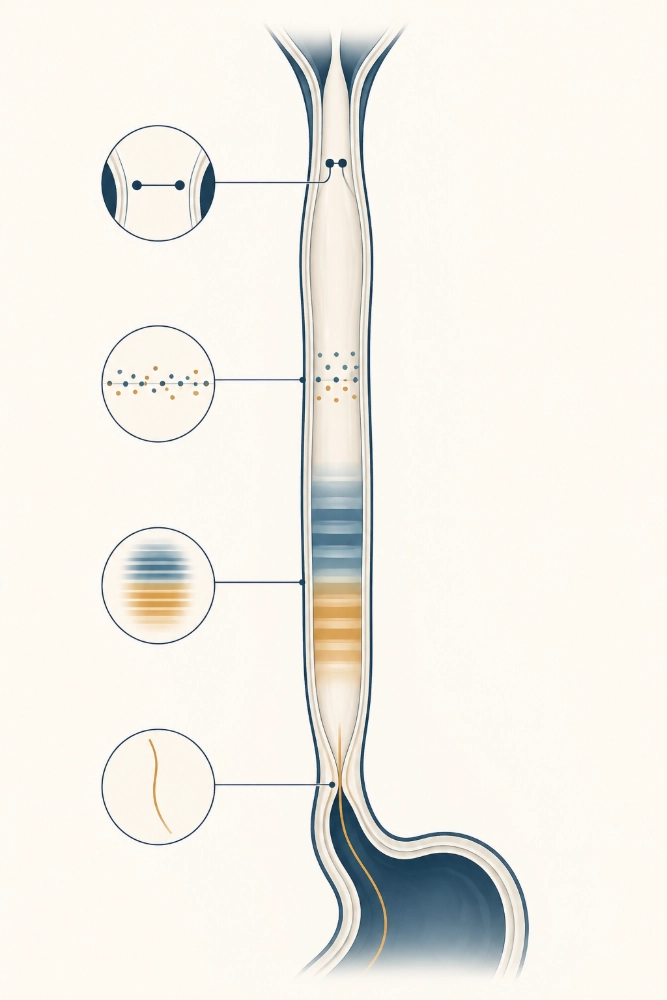
An upper endoscopy does not diagnose GERD. It looks for damage reflux has already caused. A normal endoscopy is common in people with significant reflux, especially anyone already on acid suppression, and small hiatal hernias are not visible on every study. Being told “your endoscopy was normal, so nothing is wrong” is the most frequent reason patients arrive here after years of unanswered symptoms.
Each test answers a different question. Endoscopy assesses anatomy and complications: esophagitis, Barrett’s, ulcers, strictures, and biopsies. pH monitoring is the test that actually diagnoses GERD, recording 48 to 72 hours of ordinary life through a Bravo capsule or catheter to capture how often reflux happens, how long each episode lasts, how acidic it is, when it occurs, and whether symptoms line up with the events. Manometry measures whether the esophagus can handle added resistance at all, and separates reflux from achalasia and spasm, which reflux surgery will not fix and can worsen.
A barium swallow is used selectively rather than routinely, because it shows the esophagus working rather than resting. Patients swallow a pill or food to reproduce the exact symptom. It produces one of the more useful corrections in the workup: when patients point to where food feels stuck, that is where the holdup actually is only about 60 percent of the time. Someone certain the problem sits in their throat frequently turns out to have delay in the lower esophagus.
For throat-dominant symptoms, Dr. Grandhige uses a customized 24-hour pH impedance dual-channel probe that measures reflux above the lower esophageal sphincter and above the upper esophageal sphincter. Standard testing looks only at the lower level. The difference in tissue sensitivity explains why that matters: the esophagus may tolerate 40 to 50 reflux episodes a day, while the larynx and pharynx can produce symptoms from a single episode. Bile, pepsin and trypsin show up only on impedance, not on acid testing. Patients evaluated with standard testing are commonly quoted a 50 percent chance that surgery helps their throat symptoms. Selecting candidates with dual-channel testing raises reported improvement to roughly 80 percent. Reimbursement for this study is poor and interpretation is demanding, which is a large part of why few practices run it.
Who Performs the Surgery, and Where
Gopal Grandhige, MD, is a board-certified general surgeon and the founder and Medical Director of Tampa Bay Reflux Institute, established in 2022. He founded and ran its predecessor, Tampa Bay Reflux Center, from 2009 to 2022, and has practiced foregut surgery in Tampa Bay since 2009.
His training: a Bachelor of Science in Biology from Johns Hopkins University, a medical degree from the University of Michigan, Ann Arbor, general surgery residency at Yale New Haven Hospital, and two fellowships at Yale New Haven Hospital, one in burn and critical care and one in foregut and minimally invasive surgery. He is a Founding Member of the American Foregut Society, a member of the Society of American Gastrointestinal and Endoscopic Surgeons, and a Fellow of the American College of Surgeons. Board certification can be confirmed independently through the American Board of Surgery certification lookup, and active Florida licensure and any disciplinary history through the Florida Department of Health license verification portal.
All foregut and reflux operations are performed at HCA South Tampa Hospital. He holds privileges at St. Joseph’s Main, St. Joseph’s South and HCA Brandon as well, and consolidated operating to one hospital on purpose, so that the operating room team, the anesthesia team and the specialized equipment stay constant across every case. One example of why that matters: vomiting after surgery is associated with early failure of a hiatal hernia repair, so anesthesia management aimed at preventing postoperative nausea is part of protecting the repair, not a comfort measure. A physician assistant employed by the practice assists in every case and stays reachable to patients through recovery. Several of the office medical assistants have been with the practice for over a decade. After hours, patients can reach Dr. Grandhige directly.

On results: among appropriately selected patients with typical reflux symptoms, objectively documented reflux, suitable anatomy and adequate esophageal motility, the practice reports greater than 90 percent achieving significant symptom relief and coming off daily reflux medication. Outcomes are lower and expectations are set individually for patients with reduced motility, large or recurrent hernias, prior foregut surgery or prior bariatric surgery. Timing differs by symptom type as well: heartburn and regurgitation often resolve almost immediately, while throat-based symptoms usually take 4 to 6 months to settle.
Tampa Bay Reflux Institute, 1315 South Howard Avenue, Tampa, FL 33629. Phone 813-922-2920. Office hours 9:00 AM to 6:00 PM, Monday through Friday. The office sits in a yellow brick building next to Sally O’Neill’s Pizza, with parking behind the restaurant.
Frequently Asked Questions
Book Your Consultation
Bring your prior testing, including endoscopy reports, pH studies and any imaging, or email it ahead to info@tampareflux.com so it can be reviewed before you arrive. You will leave the first visit understanding whether reflux is actually causing your symptoms, which of your symptoms surgery is likely to fix, and which it will not.


An endoscopy cannot tell you if you have reflux. It can only tell you if you have complications of GERD.
If you are unhappy with your reflux symptoms, come in and we can discuss testing and treatments that can accurately diagnose your problem.
#reflux #gerd #hiatalhernia #gastroparesis #linx


CALL US AT 813-922-2920
www.tampareflux.com
If you have a hiatal hernia and fit one of these categories, you should know your options.
Dr. Grandhige is an expert in his field and performs 200 of these surgeries a year. He is the only surgeon in the Tampa Bay Area who offers all surgical options - LINX, Fundoplications, TIF and will be one of 20 surgeons in America introducing the latest procedure RefluxStop in 2026.
We accept most insurances but will verify yours before you come in. These procedures are considered medically necessary and covered by your insurance. You can expect to pay your in-network deductibles and nothing else.
#hiatalhernia #reflux #GERD #LINX #refluxstop

What causes reflux ?
1. Weak lower esophageal sphincter
2. Hiatal hernia
3. Flattening of the Angle of His
4. Poor esophageal motility
5. Gastroparesis (slow stomach)
NOT increased acid production


Don’t let GERD get in the way of living your life. Request your appointment with us today on the link below.
.
.
.
.
https://tampareflux.com/contact-us/

Anyone can be victim to GERD and though weight loss can help reduce GERD symptoms. Many athletes with high impact workouts may continue to have these symptoms. This may be a symptom of a hiatal hernia or other issue. We are more then happy to assist you in finding your solution, just click the link below.
.
.
.
https://tampareflux.com/contact-us/
##healthylifestyle #workout #athletereflux #PPIs #heartburn #LINX #fundoplication #TIF #GERD#tampaheartburn #linx #TIF #fundoplication #tampabayreflux #GERD #acidreflux #acidrefluxsurgery #stopreflux
#nonsurgicalweightloss #ESG #gastricballoon #weightlossjourney #vsg #vsgjourney #spatz3 #orbera #orberaballoon #grandhige #DrG
#tampabayrefluxinstitute #guthealth #roboticsurgery

Heartburn may seem like an annoyance. But if you find yourself having symptoms on a daily basis, it may be time to to talk to Dr. Grandhige as it could be a symptom of something worse.
.
.
.
#chronicheartburn #gerdsymptoms #heartburnrelief #reflux #PPIs #heartburn #LINX #fundoplication #TIF #GERD#tampaheartburn #linx #TIF #fundoplication #tampabayreflux #GERD #acidreflux #acidrefluxsurgery #stopreflux
#nonsurgicalweightloss #ESG #gastricballoon #weightlossjourney #vsg #vsgjourney #spatz3 #orbera #orberaballoon #grandhige #DrG
#tampabayrefluxinstitute #guthealth #roboticsurgery

If you are tired of avoiding your favorite foods or taking daily medications, we can help.
We are the Tampa experts in reflux ! With years of experience and thousands of patients treated successfully, we offer all FDA approved anti-reflux procedures.
Call 813-922-2920 to schedule your appointment
All major insurances accepted.

Not all patients need surgical intervention. Many patients are living a heartburn free life with their PPIs. However 40% of patients taking PPIs are not getting the relief they need. If you are one of those, you have options! Come in and find out more.
.
.
.
.
#letushelpyou #medsnotworking #reflux #PPIs #heartburn #LINX #fundoplication #TIF #GERD#tampaheartburn #linx #TIF #fundoplication #tampabayreflux #GERD #acidreflux #acidrefluxsurgery #stopreflux
#nonsurgicalweightloss #ESG #gastricballoon #weightlossjourney #vsg #vsgjourney #spatz3 #orbera #orberaballoon #grandhige #DrG
#tampabayrefluxinstitute #guthealth #roboticsurgery

#heartburn #stopreflux #hiatalherniarepair #severeheartburn #reflux #tampabayreflux #acidrefluxsurgery #tampaheartburn #GERD #PPIs #achalasia #LINX #TIF #tampareflux #fundoplication #stomach #digestivehealth #ESG #obesity #overweight #weightlossjourney #gastricballoon
