
What laparoscopic hiatal hernia repair actually involves
The operation is performed under general anesthesia through several small incisions, with a camera and specialized instruments providing high-definition visualization. No large open incision. The sequence is the same every time.
First the hernia is reduced. The stomach is pulled back down into the abdomen, the esophagus is restored to its normal position below the diaphragm, and the hiatus is fully exposed.
Then the diaphragm is repaired. The opening is closed and tightened so it supports the esophagus again. This is the step most often shortchanged, and it is why some repairs fail early. A wrap built on top of an unrepaired diaphragm produces inferior results, because reflux cannot be controlled when the anatomy has not been restored.
Only then is the wrap constructed, if a wrap is right for you. The upper stomach is wrapped partially or completely around the lower esophagus in a specific configuration, and that configuration is decided before you enter the operating room, based on your manometry results. Before closing, the wrap is inspected for position and tension and checked to confirm it is not too tight.
Operative time typically runs 1.5 to 2 hours. Large hernias, scarring, and complex anatomy take longer, and the time is not rushed. Most patients go home the same day, walking and sipping liquids shortly after surgery.
When a hiatal hernia needs repair, and when it does not
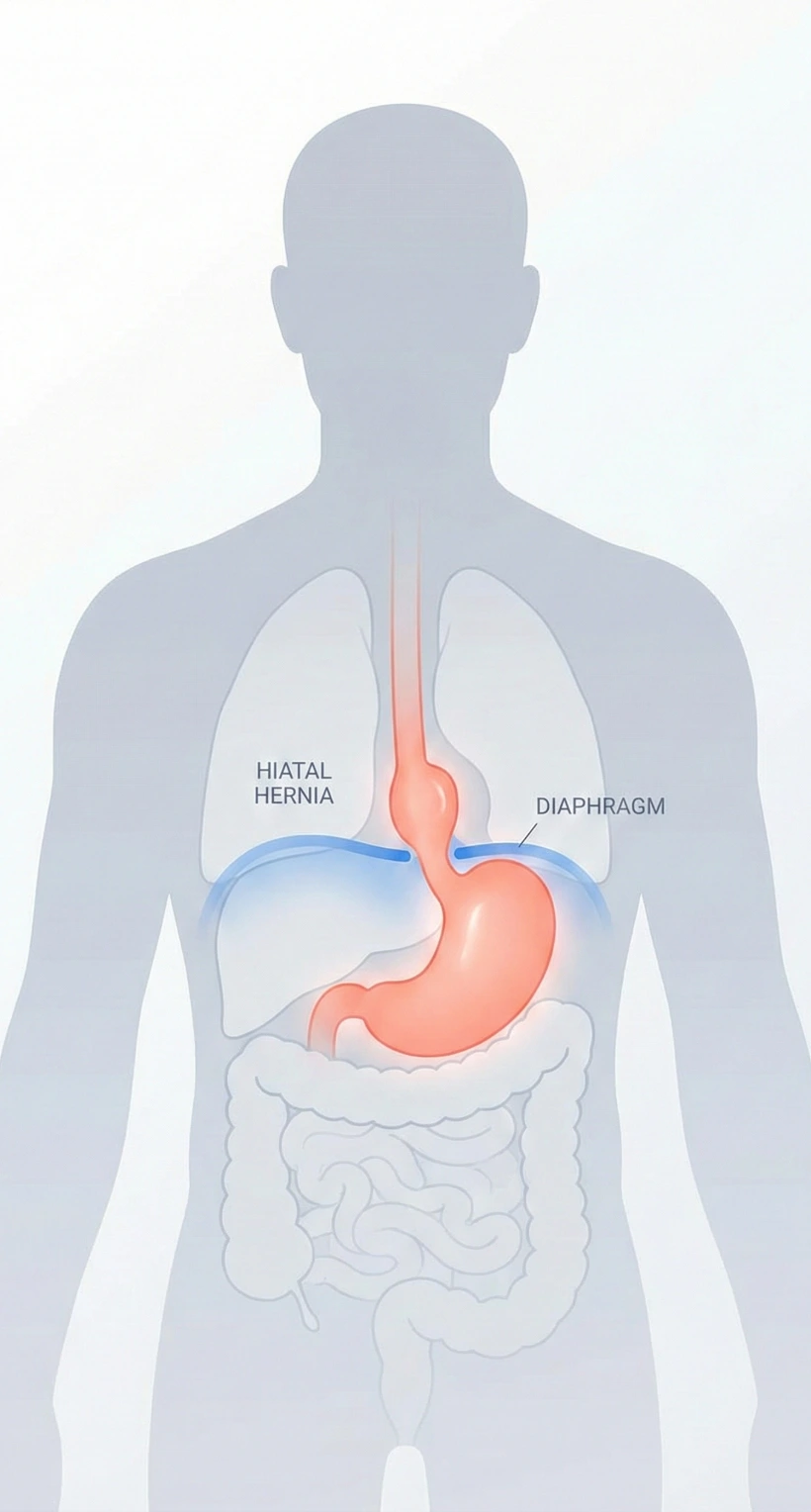
A hiatal hernia is a weakness in the diaphragm opening where the esophagus passes through to the stomach. When it stretches, the stomach slips upward into the chest, the alignment between diaphragm and lower esophageal sphincter is lost, and the angle of His opens up. The reflux barrier fails mechanically. Johns Hopkins Medicine describes the same anatomy.
Almost every patient with reflux has a hiatal hernia, even when it is small enough to be missed on endoscopy.
Repair is recommended in three situations.
The six-step process behind choosing your operation
There is no best reflux operation. There is only the right operation for the right patient, and sometimes the right answer is none. Dr. Grandhige works through the same six steps for everyone.
What can go wrong, and what you will be told beforehand
No reflux procedure has a 100 percent success rate, and the honest version of the risks is short.
After a fundoplication, bloating and difficulty vomiting are the most common complaints. Because the wrap makes it harder for acid to come up, it also makes it harder for air and food to come up. Depending on the wrap type, that may be temporary or permanent. Adults generally heave rather than vomit the way children do, and being unable to bring up solid food is not dangerous. It exits the other way in time.
Swallowing changes early are expected and are part of normal healing. Long term, most patients eat all foods, and many expand their diet to include things that used to trigger symptoms.
LINX carries a slightly higher long-term dysphagia risk than fundoplication, though it is usually manageable, and the device can be removed. Current devices are MRI compatible up to 1.5 Tesla. People highly attuned to internal sensation sometimes report feeling it.
TIF is the least durable option. Dr. Grandhige quotes a failure rate near 2 percent per year, roughly 20 percent per decade. It cannot repair a hiatal hernia because it does not address the diaphragm, and it is not offered to patients with moderate or large hernias, complications of reflux, or obesity.
These are functional operations, not permanent fixes. Like a joint replacement, they work well, they wear, and they may need revision over a lifetime. Durability depends on anatomy, hernia size, and age.
One post-operative detail matters more than it sounds: vomiting after surgery is associated with early failure of the hernia repair, which is why anesthesia technique and nausea control are treated as part of the operation.
For patients with typical reflux symptoms who have objective evidence of reflux, appropriate anatomy, and good esophageal function, greater than 95 percent achieve meaningful symptom relief, elimination of daily medication, and satisfaction with the result. Those three conditions are the point. Outcomes run lower with reduced motility, long-standing disease, large or recurrent hernias, prior foregut surgery, or previous bariatric surgery, and the procedure is often modified in those cases to prioritize safety.
If your symptoms are LPR rather than heartburn, expect a slower curve. Typical reflux symptoms often resolve almost immediately. Throat and voice symptoms commonly take 4 to 6 months.
Who performs your surgery, where, and with what team
Dr. Gopal Grandhige is a board-certified general surgeon and the founder and medical director of Tampa Bay Reflux Institute. He founded and ran Tampa Bay Reflux Center from 2009 to 2022, and the institute continues the same clinical focus.
His training: Bachelor of Science in Biology from Johns Hopkins University, medical degree from the University of Michigan, Ann Arbor, general surgery residency at Yale-New Haven Hospital, and two Yale-New Haven fellowships, one in Burn and Critical Care and one in Foregut Surgery and Minimally Invasive Surgery. He is a Founding Member of the American Foregut Society, a member of the Society of American Gastrointestinal and Endoscopic Surgeons, and a Fellow of the American College of Surgeons. You can verify all of it through the American Board of Surgery physician lookup, the American College of Surgeons directory, and the Florida Department of Health license search.
All surgeries are performed at HCA South Tampa Hospital. That is deliberate. He holds privileges at St. Joseph’s Main, St. Joseph’s South, and HCA Brandon as well, and previously operated at Bayfront, but consolidating to one facility means the anesthesiologists, nurses, and surgical technologists work with him routinely, the specialized foregut equipment is set up correctly every time, and complications get anticipated rather than reacted to.
He employs his own physician assistant, who assists in every case and handles post-operative care, so you are not handed off to someone unfamiliar with your anatomy. His medical assistants have worked with him for over a decade. After hours, patients reach him directly. You can meet the team here.
Tampa Bay Reflux Institute 1315 South Howard Avenue, Tampa, Florida 33629 Yellow brick building next to Sally O’Neill’s Pizza, parking behind the restaurant 813.922.2920


Common questions from Clearwater patients
Get a Real Answer About Your Hernia
You do not need another prescription refill and you do not need to be talked into an operation. You need to know whether reflux is actually causing your symptoms, whether your hernia is driving it, and which repair fits your anatomy. That is what the consultation is for. Patients who leave understanding their condition and choose not to have surgery count as a successful visit here.


An endoscopy cannot tell you if you have reflux. It can only tell you if you have complications of GERD.
If you are unhappy with your reflux symptoms, come in and we can discuss testing and treatments that can accurately diagnose your problem.
#reflux #gerd #hiatalhernia #gastroparesis #linx


CALL US AT 813-922-2920
www.tampareflux.com
If you have a hiatal hernia and fit one of these categories, you should know your options.
Dr. Grandhige is an expert in his field and performs 200 of these surgeries a year. He is the only surgeon in the Tampa Bay Area who offers all surgical options - LINX, Fundoplications, TIF and will be one of 20 surgeons in America introducing the latest procedure RefluxStop in 2026.
We accept most insurances but will verify yours before you come in. These procedures are considered medically necessary and covered by your insurance. You can expect to pay your in-network deductibles and nothing else.
#hiatalhernia #reflux #GERD #LINX #refluxstop

What causes reflux ?
1. Weak lower esophageal sphincter
2. Hiatal hernia
3. Flattening of the Angle of His
4. Poor esophageal motility
5. Gastroparesis (slow stomach)
NOT increased acid production


Don’t let GERD get in the way of living your life. Request your appointment with us today on the link below.
.
.
.
.
https://tampareflux.com/contact-us/

Anyone can be victim to GERD and though weight loss can help reduce GERD symptoms. Many athletes with high impact workouts may continue to have these symptoms. This may be a symptom of a hiatal hernia or other issue. We are more then happy to assist you in finding your solution, just click the link below.
.
.
.
https://tampareflux.com/contact-us/
##healthylifestyle #workout #athletereflux #PPIs #heartburn #LINX #fundoplication #TIF #GERD#tampaheartburn #linx #TIF #fundoplication #tampabayreflux #GERD #acidreflux #acidrefluxsurgery #stopreflux
#nonsurgicalweightloss #ESG #gastricballoon #weightlossjourney #vsg #vsgjourney #spatz3 #orbera #orberaballoon #grandhige #DrG
#tampabayrefluxinstitute #guthealth #roboticsurgery

Heartburn may seem like an annoyance. But if you find yourself having symptoms on a daily basis, it may be time to to talk to Dr. Grandhige as it could be a symptom of something worse.
.
.
.
#chronicheartburn #gerdsymptoms #heartburnrelief #reflux #PPIs #heartburn #LINX #fundoplication #TIF #GERD#tampaheartburn #linx #TIF #fundoplication #tampabayreflux #GERD #acidreflux #acidrefluxsurgery #stopreflux
#nonsurgicalweightloss #ESG #gastricballoon #weightlossjourney #vsg #vsgjourney #spatz3 #orbera #orberaballoon #grandhige #DrG
#tampabayrefluxinstitute #guthealth #roboticsurgery

If you are tired of avoiding your favorite foods or taking daily medications, we can help.
We are the Tampa experts in reflux ! With years of experience and thousands of patients treated successfully, we offer all FDA approved anti-reflux procedures.
Call 813-922-2920 to schedule your appointment
All major insurances accepted.

Not all patients need surgical intervention. Many patients are living a heartburn free life with their PPIs. However 40% of patients taking PPIs are not getting the relief they need. If you are one of those, you have options! Come in and find out more.
.
.
.
.
#letushelpyou #medsnotworking #reflux #PPIs #heartburn #LINX #fundoplication #TIF #GERD#tampaheartburn #linx #TIF #fundoplication #tampabayreflux #GERD #acidreflux #acidrefluxsurgery #stopreflux
#nonsurgicalweightloss #ESG #gastricballoon #weightlossjourney #vsg #vsgjourney #spatz3 #orbera #orberaballoon #grandhige #DrG
#tampabayrefluxinstitute #guthealth #roboticsurgery

#heartburn #stopreflux #hiatalherniarepair #severeheartburn #reflux #tampabayreflux #acidrefluxsurgery #tampaheartburn #GERD #PPIs #achalasia #LINX #TIF #tampareflux #fundoplication #stomach #digestivehealth #ESG #obesity #overweight #weightlossjourney #gastricballoon
