
What a hiatal hernia is, and why medication doesn’t fix it
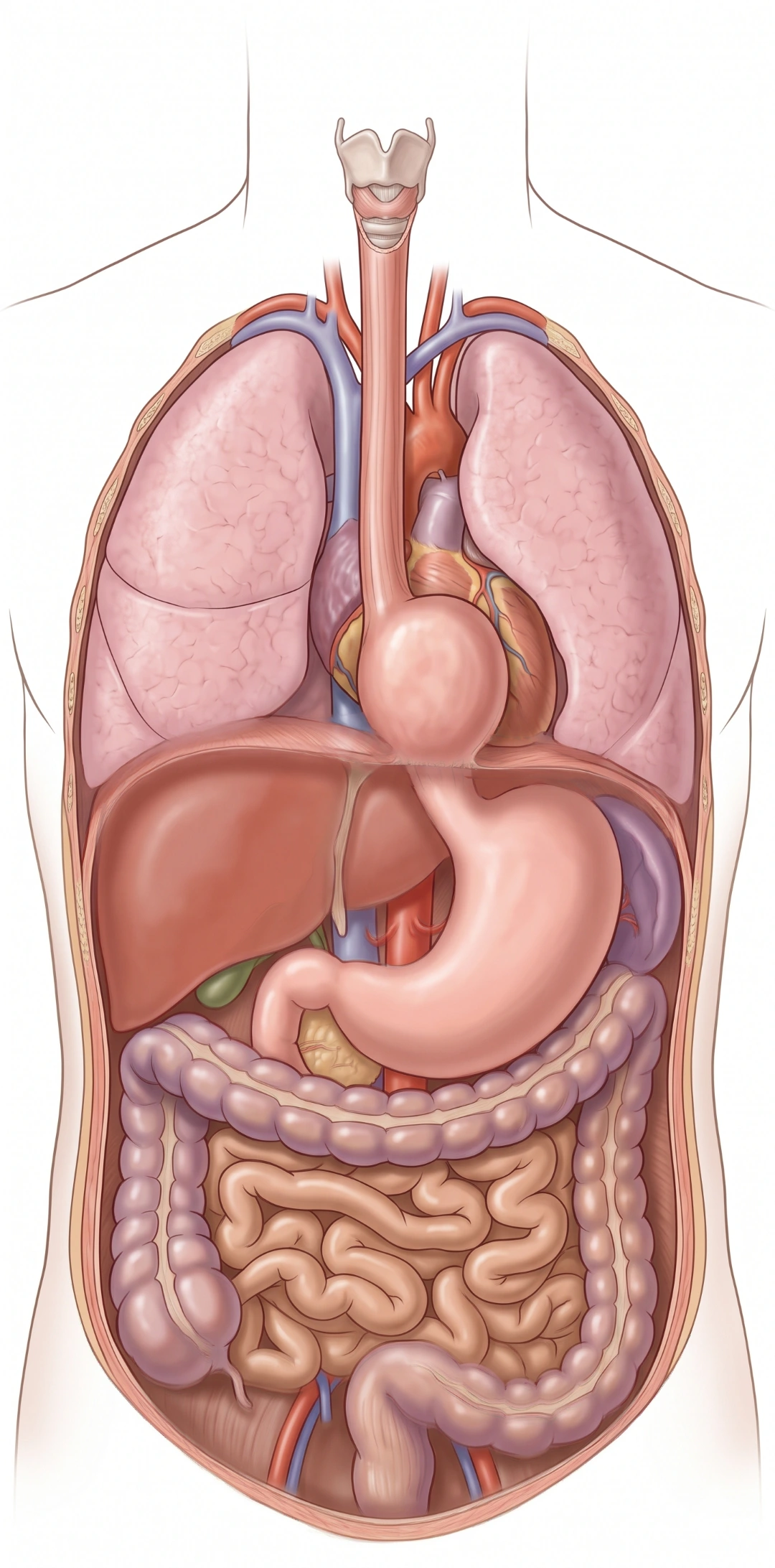
A hiatal hernia is a stretched or weakened opening in the diaphragm, the muscle that separates your chest from your abdomen. The esophagus normally passes through a snug gap in that muscle. When the gap widens, the upper stomach slips up into the chest, the alignment between the diaphragm and the lower esophageal sphincter is lost, and the reflux barrier fails mechanically. Almost every patient with reflux has some degree of hiatal hernia, even when it is small enough to be missed on endoscopy.
Reflux is a mechanical problem far more often than an acid problem. Think of the reflux barrier as a two-part door: one part is the lower esophageal sphincter, the other is the diaphragm. If either fails, reflux happens. If both fail, it is almost unavoidable. Acid-suppressing medications turn down how acidic the refluxed material is, but they do not strengthen the sphincter, repair the diaphragm, or stop reflux events. That is why regurgitation and nighttime symptoms often continue on daily medication, and why bile and other stomach contents can keep reaching the esophagus and throat even when acid is controlled.
This is also why a normal endoscopy does not clear you. Endoscopy looks for damage the reflux has already caused, such as inflammation or Barrett’s esophagus. It does not measure whether reflux is happening, how often, or why. Many people with significant reflux have a completely normal-looking endoscopy, especially while taking medication, and are wrongly told nothing is wrong.
The procedures Dr. Grandhige performs, and the honest status of RefluxStop
There is no single best reflux operation. There is the right operation for a specific anatomy, and sometimes the right answer is no operation at all. Dr. Grandhige performs three anti-reflux procedures, plus hiatal hernia repair as part of every reflux operation, because reflux control is not durable if the diaphragm is left unaddressed.
How the right procedure gets chosen for you
The decision is systematic, and it runs the same way every time. First, confirm that reflux is real and is what’s causing your symptoms, using objective testing rather than assumptions. Second, map the anatomy, including the size and type of any hiatal hernia. Third, measure how well the esophagus actually moves, because a weak esophagus tolerates some procedures and not others. Fourth, separate the symptoms likely to improve from the ones that probably won’t. Fifth, weigh your own priorities, such as durability, reversibility, or keeping the ability to burp. Only then does a specific procedure, or no procedure, get chosen.
Because Dr. Grandhige performs multiple procedures, the recommendation is driven by what fits your body rather than by the one operation a surgeon happens to favor. As he puts it, the operation is the last step; the decision-making is the real surgery.
Just as important is the willingness to say no. Symptoms that look like reflux are often caused by something reflux surgery cannot fix, such as esophageal hypersensitivity, a motility disorder, or functional chest pain. Operating on those patients produces poor results, so he doesn’t. That restraint is a large part of why gastroenterologists, ENT physicians, pulmonologists, and primary care doctors across the region refer to him, and why many patients arrive expecting an operation and leave with a diagnosis and a non-surgical plan instead.
Why Clearwater patients make the drive
The case for driving across the bay is depth and continuity. Dr. Grandhige has focused only on foregut surgery since 2009, more than sixteen years. He earned his medical degree at the University of Michigan, completed his general surgery residency and a fellowship in foregut and minimally invasive surgery at Yale-New Haven Hospital, and is a Fellow of the American College of Surgeons, a member of SAGES, and a founding member of the American Foregut Society. You can confirm his active license through the Florida Department of Health and his certification through the American Board of Surgery.
All surgeries are performed at HCA South Tampa Hospital, with the same operating room team and the same physician assistant on every case, several of whom have worked with him for over a decade. After surgery you have direct access to that physician assistant, and to Dr. Grandhige himself after hours, rather than a rotating on-call provider who doesn’t know your anatomy. In reflux surgery that continuity is not a nicety; vomiting after a hernia repair, for example, can undo it, so being able to reach someone who knows your case early actually protects the result.
The practice is built to keep the distance from being a burden. New patients are usually seen within two weeks, and always within four. When surgery is the right call, the path from consultation to operation typically runs four to eight weeks. For patients coming from Clearwater, the office coordinates testing to limit trips and, when possible, arranges studies closer to home. Before your visit, you can send prior records, including any endoscopy, pH testing, manometry, and imaging, to info@tampareflux.com so Dr. Grandhige can review everything in advance and spend your consultation on answers rather than paperwork.

Common questions from Clearwater patients
Schedule a Consultation
Tampa Bay Reflux Institute is at 1315 South Howard Avenue, Suite 101, Tampa, FL 33606, a yellow brick building next to Sally O’Neill’s Pizza, with parking behind the restaurant. Office hours are 9 AM to 6 PM, Monday through Friday. If you’re in Clearwater, St. Petersburg, or anywhere in Pinellas and want a straight answer about what’s causing your reflux and whether surgery is the right step, that’s the goal of the first visit, whether or not you end up needing an operation.


An endoscopy cannot tell you if you have reflux. It can only tell you if you have complications of GERD.
If you are unhappy with your reflux symptoms, come in and we can discuss testing and treatments that can accurately diagnose your problem.
#reflux #gerd #hiatalhernia #gastroparesis #linx


CALL US AT 813-922-2920
www.tampareflux.com
If you have a hiatal hernia and fit one of these categories, you should know your options.
Dr. Grandhige is an expert in his field and performs 200 of these surgeries a year. He is the only surgeon in the Tampa Bay Area who offers all surgical options - LINX, Fundoplications, TIF and will be one of 20 surgeons in America introducing the latest procedure RefluxStop in 2026.
We accept most insurances but will verify yours before you come in. These procedures are considered medically necessary and covered by your insurance. You can expect to pay your in-network deductibles and nothing else.
#hiatalhernia #reflux #GERD #LINX #refluxstop

What causes reflux ?
1. Weak lower esophageal sphincter
2. Hiatal hernia
3. Flattening of the Angle of His
4. Poor esophageal motility
5. Gastroparesis (slow stomach)
NOT increased acid production


Don’t let GERD get in the way of living your life. Request your appointment with us today on the link below.
.
.
.
.
https://tampareflux.com/contact-us/

Anyone can be victim to GERD and though weight loss can help reduce GERD symptoms. Many athletes with high impact workouts may continue to have these symptoms. This may be a symptom of a hiatal hernia or other issue. We are more then happy to assist you in finding your solution, just click the link below.
.
.
.
https://tampareflux.com/contact-us/
##healthylifestyle #workout #athletereflux #PPIs #heartburn #LINX #fundoplication #TIF #GERD#tampaheartburn #linx #TIF #fundoplication #tampabayreflux #GERD #acidreflux #acidrefluxsurgery #stopreflux
#nonsurgicalweightloss #ESG #gastricballoon #weightlossjourney #vsg #vsgjourney #spatz3 #orbera #orberaballoon #grandhige #DrG
#tampabayrefluxinstitute #guthealth #roboticsurgery

Heartburn may seem like an annoyance. But if you find yourself having symptoms on a daily basis, it may be time to to talk to Dr. Grandhige as it could be a symptom of something worse.
.
.
.
#chronicheartburn #gerdsymptoms #heartburnrelief #reflux #PPIs #heartburn #LINX #fundoplication #TIF #GERD#tampaheartburn #linx #TIF #fundoplication #tampabayreflux #GERD #acidreflux #acidrefluxsurgery #stopreflux
#nonsurgicalweightloss #ESG #gastricballoon #weightlossjourney #vsg #vsgjourney #spatz3 #orbera #orberaballoon #grandhige #DrG
#tampabayrefluxinstitute #guthealth #roboticsurgery

If you are tired of avoiding your favorite foods or taking daily medications, we can help.
We are the Tampa experts in reflux ! With years of experience and thousands of patients treated successfully, we offer all FDA approved anti-reflux procedures.
Call 813-922-2920 to schedule your appointment
All major insurances accepted.

Not all patients need surgical intervention. Many patients are living a heartburn free life with their PPIs. However 40% of patients taking PPIs are not getting the relief they need. If you are one of those, you have options! Come in and find out more.
.
.
.
.
#letushelpyou #medsnotworking #reflux #PPIs #heartburn #LINX #fundoplication #TIF #GERD#tampaheartburn #linx #TIF #fundoplication #tampabayreflux #GERD #acidreflux #acidrefluxsurgery #stopreflux
#nonsurgicalweightloss #ESG #gastricballoon #weightlossjourney #vsg #vsgjourney #spatz3 #orbera #orberaballoon #grandhige #DrG
#tampabayrefluxinstitute #guthealth #roboticsurgery

#heartburn #stopreflux #hiatalherniarepair #severeheartburn #reflux #tampabayreflux #acidrefluxsurgery #tampaheartburn #GERD #PPIs #achalasia #LINX #TIF #tampareflux #fundoplication #stomach #digestivehealth #ESG #obesity #overweight #weightlossjourney #gastricballoon
