
Understanding Hiatal Hernias: What Tampa Patients Need to Know
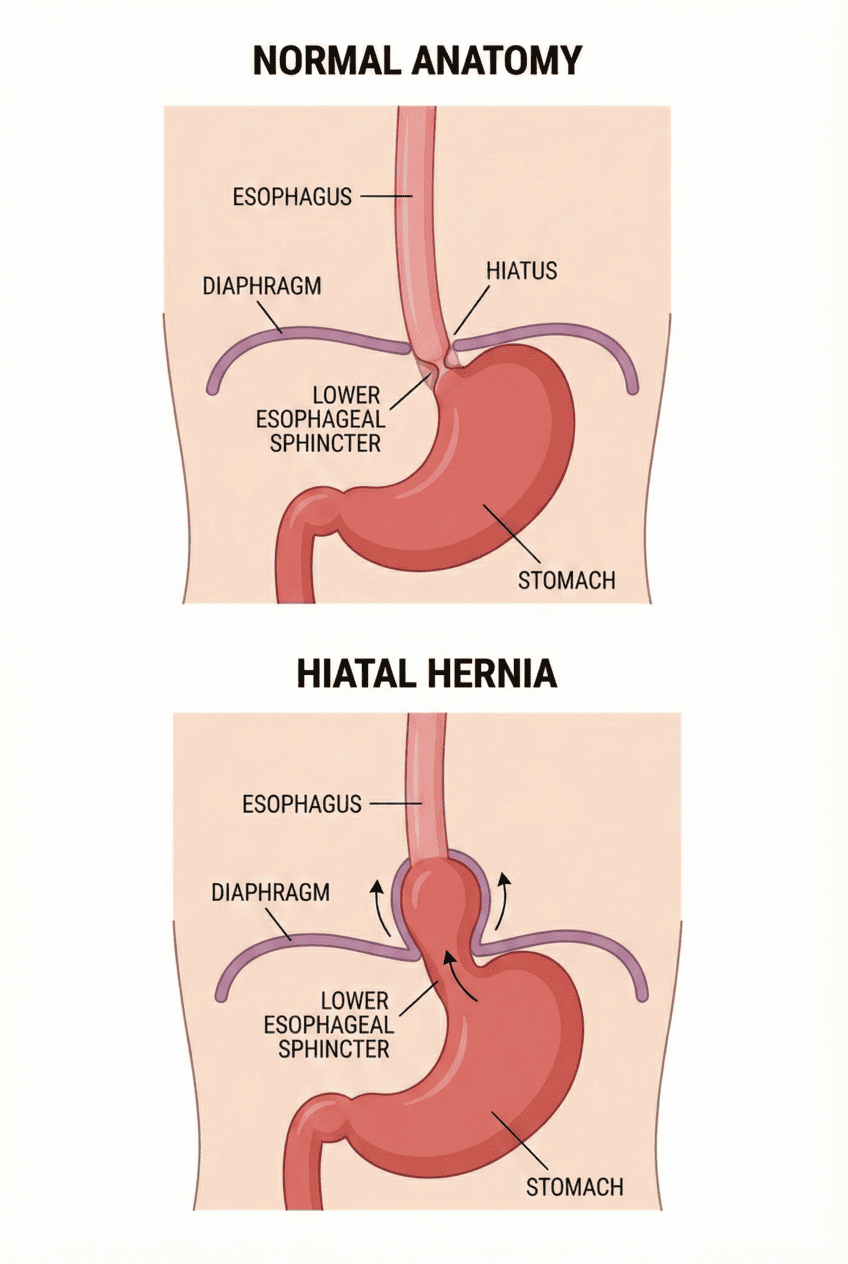
A hiatal hernia occurs when the natural opening in your diaphragm, the hiatus, becomes weakened or stretched, allowing part of your stomach to slip upward into your chest. This disrupts the alignment between your diaphragm and lower esophageal sphincter, causing the reflux barrier to fail mechanically. While many people believe reflux is simply an acid problem, the truth is that hiatal hernias create a structural issue that medications alone cannot fix.
At Tampa Bay Reflux Institute, Dr. Gopal Grandhige has spent over 16 years focusing exclusively on foregut surgery, which addresses benign conditions of the esophagus, diaphragm, and stomach. Unlike general surgeons who may perform hiatal hernia repair occasionally, Dr. Grandhige evaluates and treats these conditions daily, bringing pattern recognition and diagnostic precision that comes only from deep specialization.
Most Tampa residents with persistent heartburn, regurgitation, or difficulty swallowing have never received a complete evaluation to determine whether a hiatal hernia is contributing to their symptoms. Endoscopy alone often misses smaller hernias, and a normal endoscopy does not rule out the presence of a mechanically significant defect. This is why objective testing, including pH monitoring, esophageal manometry, and imaging studies, forms the foundation of every evaluation at our practice.
Hiatal hernias develop naturally over time due to increased abdominal pressure from pregnancy, obesity, chronic coughing, heavy lifting, or physically demanding work. You did not cause this condition, and it is not something you could have prevented. What matters now is understanding whether your hernia is contributing to your symptoms and whether repair would improve your quality of life. Our goal is to provide you with clarity, education, and a treatment plan tailored to your specific anatomy and goals.
Are You Experiencing Any of These Challenges?
- You have persistent heartburn or regurgitation despite taking daily acid suppressing medication
- Your endoscopy showed a hiatal hernia larger than three centimeters
- You wake up at night with acid in your throat or difficulty breathing
- You require more than one proton pump inhibitor per day to control symptoms
- You experience chronic throat clearing, hoarseness, or coughing that doctors cannot explain
- Food feels stuck in your chest, or you have difficulty swallowing certain textures
- You have been diagnosed with severe esophagitis or Barrett’s esophagus
- You want to stop taking reflux medications permanently but symptoms return when you try
- You have been told surgery might help but were never given a complete diagnostic evaluation
- You feel bloated, uncomfortable, or limited in your ability to exercise or bend over
If any of these sound familiar, you deserve a comprehensive evaluation by a hiatal hernia specialist who can determine the root cause of your symptoms and explain all available treatment options.
Our Proven Diagnostic Process: How We Confirm What’s Really Happening
At Tampa Bay Reflux Institute, we never recommend surgery based on symptoms alone. Every patient undergoes objective testing designed to confirm whether reflux is truly present, identify the mechanical cause, and determine which treatment approach will provide the most durable results. This methodical process is what separates a foregut specialist from a general surgeon.
Before you ever walk into our office, Dr. Grandhige personally reviews all available diagnostic studies, including prior endoscopy reports, pH testing, manometry, imaging, and notes from gastroenterologists, ENT physicians, and other specialists. This preparation allows your consultation to focus on education and decision making rather than simply gathering information. During your visit, Dr. Grandhige explains reflux using visual diagrams and images, correcting common misconceptions such as the belief that you make too much acid or that a normal endoscopy means nothing is wrong.
If additional testing is needed, we coordinate a streamlined evaluation that typically includes upper endoscopy to assess anatomy and complications, esophageal pH monitoring to measure how often reflux occurs and whether it correlates with your symptoms, and esophageal manometry to evaluate the strength and coordination of your esophagus. These tests answer different but equally important questions. Endoscopy shows us what the lining looks like. pH testing proves whether reflux is happening. Manometry tells us whether your esophagus can handle a surgical repair safely.
This comprehensive approach ensures that surgery is recommended only when it is truly appropriate, and that the procedure chosen matches your anatomy, esophageal function, and personal goals. Many patients who come expecting surgery leave with reassurance, clarity, and a non-surgical plan. Others finally understand why surgery makes sense after years of frustration. Either way, you will leave informed rather than confused.

Why Choose Tampa Bay Reflux Institute for Hiatal Hernia Repair
Choosing a hiatal hernia surgeon is one of the most important decisions you can make because outcomes depend far more on diagnostic judgment and procedure selection than on the technical act of surgery itself. Dr. Grandhige founded Tampa Bay Reflux Institute in 2022 after operating Tampa Bay Reflux Center since 2009, building a regional referral practice based on careful evaluation, conservative recommendations, and consistently excellent outcomes.
Dr. Grandhige completed his medical degree at the University of Michigan, his general surgery residency at Yale New Haven Hospital, and specialized fellowship training in foregut surgery and minimally invasive surgery at Yale. He is a Founding Member of the American Foregut Society, a Fellow of the American College of Surgeons, and a member of the Society of American Gastrointestinal and Endoscopic Surgeons. These credentials reflect not just training, but ongoing commitment to subspecialty practice and peer accountability.
What truly sets our practice apart is what happens before surgery. We focus exclusively on foregut disease, which means hiatal hernia repair, reflux surgery, achalasia treatment, and gastroparesis management are not occasional procedures but the core of what we do every single day. This specialization allows Dr. Grandhige to recognize subtle patterns, interpret borderline test results correctly, and identify patients who should not have surgery even when they arrive hoping for it. Pattern recognition and restraint come only from repetition and deep immersion in the same disease processes.
Our office team includes medical assistants who have worked with Dr. Grandhige for over a decade, and a dedicated physician assistant who assists in every surgical case and remains accessible to patients throughout recovery. This continuity means you are never handed off to unfamiliar providers, and concerns are addressed by someone who truly understands your operation. All surgeries are performed at HCA South Tampa Hospital with a consistent operating room team, anesthesiologists experienced in foregut surgery, and specialized equipment that allows for precise, efficient repairs.
Gastroenterologists, ENT physicians, pulmonologists, and primary care doctors across Tampa Bay refer to our practice exclusively because their patients return educated, satisfied, and confident in their treatment plan, whether that plan includes surgery or not. This referral trust has been built over 16 years of consistent judgment and outcomes.
Treatment Options for Hiatal Hernia Repair in Tampa
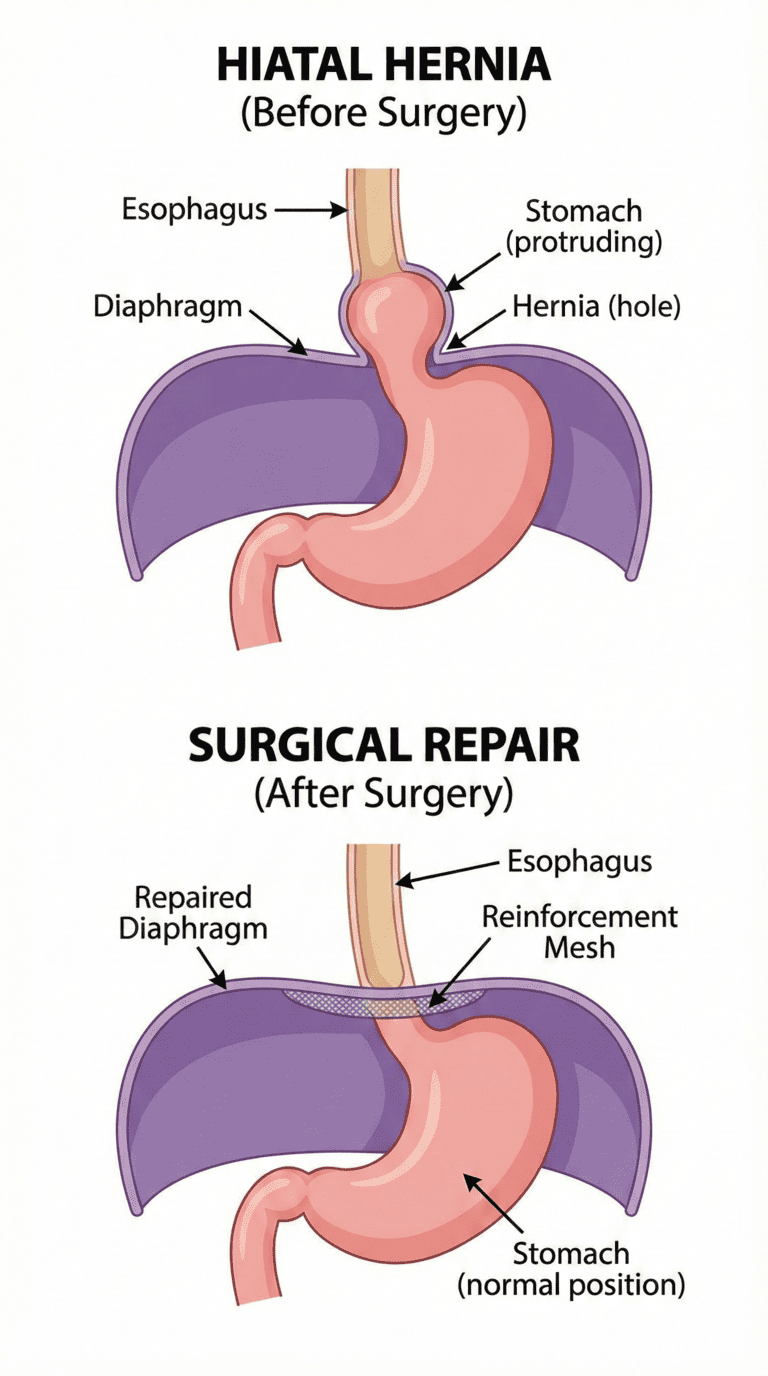
Not all hiatal hernias require surgery, but when repair is appropriate, Dr. Grandhige offers multiple approaches tailored to your specific anatomy and goals. We perform all procedures using minimally invasive techniques, which means smaller incisions, less pain, faster recovery, and lower complication rates compared to open surgery.
For patients with hiatal hernias combined with reflux, fundoplication remains one of the most durable and effective treatments. This procedure repairs the weakened opening in the diaphragm and reinforces the reflux barrier by wrapping a portion of the stomach around the lower esophagus. Dr. Grandhige performs multiple types of fundoplication, including Nissen, Toupet, Dor, and Watson configurations, each suited to different esophageal motility patterns. The choice depends on objective testing, not convenience or habit.
LINX Magnetic Sphincter Augmentation is another option for appropriately selected patients. LINX involves placing a ring of magnetic titanium beads around the lower esophagus to augment the sphincter while preserving the ability to burp and vomit. Unlike fundoplication, LINX does not involve wrapping the stomach, which means anatomy is preserved and the procedure is reversible if necessary. However, LINX requires adequate esophageal strength and is not appropriate for all patients.
For patients with mild to moderate reflux and minimal or no hiatal hernia, TIF, or Transoral Incisionless Fundoplication, may be an option. This endoscopic procedure is performed through the mouth without abdominal incisions and creates a partial internal valve to reduce reflux. While TIF offers faster recovery, it does not repair the diaphragm and is less durable than surgical options. Patient selection is critical for success.
Beginning in 2026, Dr. Grandhige will also offer RefluxStop, making Tampa Bay Reflux Institute the only practice in the Tampa area offering all four major anti-reflux procedures. This flexibility ensures that your treatment is driven by what is best for your body, not by what is most familiar or convenient for the surgeon.
When appropriately selected, greater than 95 percent of patients achieve significant symptom relief, eliminate daily reflux medications, and report high satisfaction. These outcomes are not accidental. They result from objective testing, careful patient selection, and matching the correct procedure to the correct anatomy and physiology.
Proudly Serving Tampa and Surrounding Communities
Tampa Bay Reflux Institute is conveniently located at 1315 South Howard Avenue in Tampa, Florida, in a yellow brick building next to Sally O’Neill’s Pizza. Parking is available behind Sally O’Neill’s Pizza, making access easy for patients coming from South Tampa, Hyde Park, Palma Ceia, Bayshore, Westchase, Carrollwood, Brandon, Riverview, Clearwater, and St. Petersburg.
While our office is located in Tampa, we routinely care for patients from across Florida, including Orlando, Sarasota, Naples, Fort Myers, Miami, Jacksonville, and Tallahassee. We have also received requests from patients across the United States and internationally who are seeking expert-level foregut evaluation. Our team is experienced in coordinating care for out of town patients, consolidating testing, streamlining schedules, and minimizing unnecessary travel.
Whether you live near Bayshore Boulevard or are traveling from outside the Tampa Bay area, our goal is to make your evaluation efficient, your care accessible, and your experience supported from consultation through long-term follow-up. We understand that reflux and hiatal hernia symptoms disrupt sleep, work, exercise, and daily life, and we work to minimize delays while ensuring that every decision is based on complete and accurate information.
FAQS
Take the First Step Toward Relief
If you are living with persistent reflux, regurgitation, difficulty swallowing, or have been told you have a hiatal hernia, you deserve a complete evaluation by a specialist who understands foregut disease deeply. At Tampa Bay Reflux Institute, we provide clarity, education, and treatment options tailored to your body and your goals.
Dr. Gopal Grandhige has dedicated his career to helping Tampa Bay residents understand and resolve reflux and hiatal hernia symptoms through comprehensive testing, conservative recommendations, and consistently excellent surgical outcomes. Whether you need surgery or simply need answers, we are here to help. Learn more about silent reflux and other conditions we treat, or explore our blog for additional educational resources about foregut conditions.
Contact Tampa Bay Reflux Institute today to schedule your consultation with a trusted hiatal hernia doctor specialist in Tampa, FL.