
What a hiatal hernia specialist does, and when you need one
A hiatal hernia specialist proves whether reflux is happening, measures whether your esophagus can tolerate a repair, and matches a procedure to those two findings. Nearly all of that work happens before an operating room is booked.
Search for a hiatal hernia doctor near Brandon and the directories return more than 200 physicians within twelve miles who list diaphragmatic and hiatal hernia among the conditions they treat. That is a listing count. It tells you who will see the diagnosis, not who sees it daily.
The distinction matters because reflux is rarely an acid problem. Patients with GERD usually produce a normal amount of acid. The failure is mechanical, and it happens in two places at once. Dr. Grandhige describes it to patients as a two-part door: one part is the lower esophageal sphincter, the other is the diaphragm. If either part fails, reflux occurs. If both fail, reflux is close to inevitable.
That is why hiatal hernias sit at the center of reflux disease rather than beside it. Almost every patient with reflux has one, even when it is small enough that an endoscopy never reports it.
Five findings that justify an evaluation rather than another prescription change
A hiatal hernia larger than 3 centimeters. Symptoms that persist on a daily proton pump inhibitor. Needing more than once-daily medication. Complications such as severe esophagitis, Barrett’s esophagus or a peptic stricture. Or wanting off acid suppression permanently, which is a legitimate reason to be evaluated even though it is not by itself a reason to operate.
The arithmetic behind all five is worth knowing. Proton pump inhibitors block acid production for roughly 12 to 16 hours of a 24-hour day. H2 blockers work for 4 to 6 hours and take about 30 minutes to start. Neither strengthens the sphincter, repairs a hernia, or prevents a single reflux event. Reflux continues, less acidic, still carrying bile, pepsin and trypsin upward. GERD that feels managed can still be doing damage at night.
If your symptoms are in your throat rather than your chest
Chronic throat clearing, hoarseness, cough, postnasal drainage, ear fullness and the sensation of a lump in the throat are the usual presentation of silent reflux (LPR), and most of these patients never get classic heartburn.
The reason comes down to tissue tolerance. The esophagus handles 40 to 50 reflux episodes a day without complaint. The larynx and pharynx can become symptomatic from a single episode a day. That is not milder reflux. It is reflux reaching tissue never built to tolerate it.
How your diagnosis gets confirmed before surgery is discussed
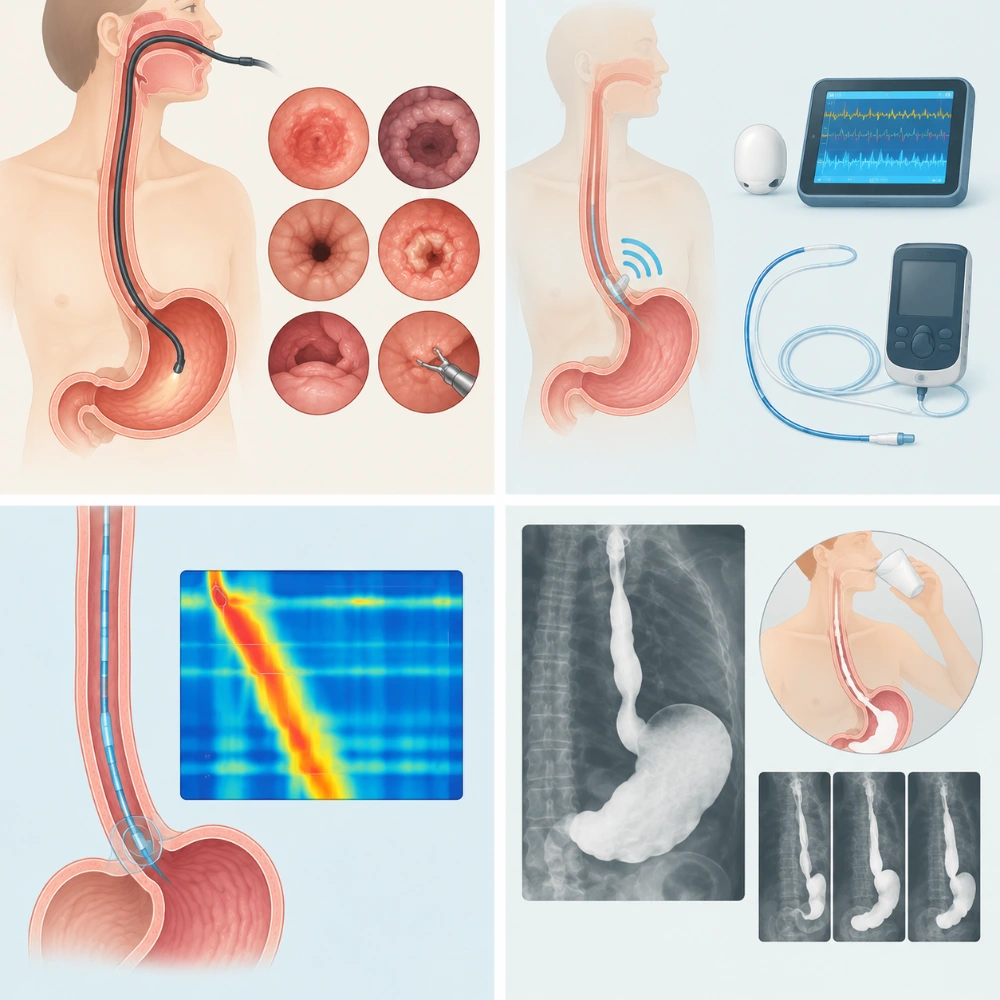
Four tests answer four different questions. Skipping any of them is the most common path to the wrong operation.
Upper endoscopy answers whether reflux has caused damage. It shows the lining, finds esophagitis, Barrett’s esophagus, ulcers and strictures, and allows biopsies. It does not diagnose GERD. It does not measure reflux events or assess sphincter function, and small hiatal hernias are not visible on every endoscopy. A normal endoscopy rules out damage, not disease.
pH monitoring answers whether reflux is happening at all. Using a wireless Bravo capsule or a catheter-based pH impedance probe, it records 48 to 72 hours while you eat, work, exercise and sleep normally. It measures how often reflux occurs, how long each episode lasts, when it happens, and whether your symptoms line up with the events. It also creates the baseline that makes any post-procedure comparison meaningful.
Manometry answers whether your esophagus can handle added resistance. Every anti-reflux procedure increases resistance at the gastroesophageal junction. If the esophagus cannot push food through that resistance, the result is dysphagia that is far harder to fix after surgery than to predict before it. Manometry also identifies achalasia, esophageal spasm, ineffective motility, jackhammer esophagus and hypertensive LES. All of them can look like reflux. None improves with reflux surgery, and several get worse.
A barium swallow answers what happens during an actual swallow, and it is used selectively. Patients swallow a pill or a marshmallow to reproduce the symptom while it is watched. One finding from that study rewrites a lot of assumptions: where a patient feels food stick matches the true anatomic location only about 60 percent of the time. Someone pointing at their throat frequently turns out to have delay in the distal esophagus.
The dual-channel probe used for throat symptoms
Standard reflux testing measures above the lower esophageal sphincter and stops there. For patients with throat symptoms, Dr. Grandhige uses a customized 24-hour pH impedance dual-channel probe that measures above both the lower and the upper esophageal sphincter, and that detects non-acid reflux including bile, pepsin and trypsin rather than acid alone.
The difference is specific. Without testing at the upper sphincter, patients with throat symptoms are commonly quoted roughly a 50 percent chance that surgery will help. With it, the patients who will benefit can be separated from the ones who will not, and reported improvement in Dr. Grandhige’s practice rises to approximately 80 percent.
The number that follows is the one nobody advertises: only about 50 to 60 percent of LPR patients have testing that justifies a procedure at all. The rest are referred to ENT, pulmonology or allergy, because their symptoms are coming from somewhere else.
The six-step sequence that selects your procedure, or rules surgery out
Procedure selection follows the same six steps for every patient. There is no best reflux operation, only the right operation for a specific anatomy and physiology, and in a meaningful number of cases the right answer is no operation.
One, confirm reflux is real. Objective pH testing, correlation of events against your recorded symptoms, and whether the reflux is acid, non-acid or bile-related. If reflux is not objectively proven, surgery is not recommended regardless of how convincing the symptoms are.
Two, map the anatomy. Hernia presence and size, esophageal length and position, and the relationship between stomach, diaphragm and esophagus. Anatomy determines which procedures are technically feasible and how durable a repair is likely to be.
Three, measure esophageal function. Motility is the most overlooked factor in the decision. It determines whether a full or partial wrap is safe, whether a magnetic device is appropriate, and whether surgery should be avoided entirely.
Four, separate your symptoms by likelihood. You are told which symptoms are very likely reflux-related, which are unlikely, and which may be multifactorial. Most patients want one diagnosis to explain everything. A technically perfect operation that fixes exactly what it was designed to fix still feels like a failure if nobody set that expectation first.
Five, weigh what you actually want. Durability, getting off medication, keeping the ability to burp and vomit, minimizing side effects, reversibility. These preferences refine the choice inside the boundaries set by anatomy and function. They never override them.
Six, choose a procedure or choose none. Fundoplication and which configuration, LINX, an endoscopic option, or continued medical management.
Dr. Grandhige puts it to patients this way: the operation is the last step, and the decision-making is the surgery.
He is also direct about the tradeoff. The patients he declines to operate on are often the least happy people leaving the office, because they arrived frustrated and wanted a definitive answer. They are also the patients who would have been considerably unhappier after an operation that left their symptoms unchanged.
About Dr. Gopal Grandhige, MD, FACS
Dr. Grandhige is a board-certified general surgeon who has limited his practice to foregut disease, meaning benign conditions of the esophagus, diaphragm and stomach, since 2009. He founded Tampa Bay Reflux Center in 2009 and has served as Founder and Medical Director of Tampa Bay Reflux Institute since 2022.
His training: a Bachelor of Science in Biology at Johns Hopkins University, his medical degree at the University of Michigan, general surgery residency at Yale-New Haven Hospital, and two Yale-New Haven fellowships, in Burn and Critical Care and in Foregut Surgery and Minimally Invasive Surgery. He is a Founding Member of the American Foregut Society, a Fellow of the American College of Surgeons, and a member of the Society of American Gastrointestinal and Endoscopic Surgeons. Florida license status and any disciplinary history can be checked independently through the Florida Department of Health license verification portal, and board certification through the American Board of Surgery.
He also treats achalasia with Heller myotomy guided by EndoFLIP measurement, and gastroparesis with endoscopic pyloromyotomy. The office team includes medical assistants who have worked with him for more than a decade and a dedicated physician assistant who assists in every surgical case and stays reachable through recovery. Patients can reach Dr. Grandhige directly after hours.
He does not treat cancers of the esophagus or stomach, or conditions outside the foregut. He also does not operate on patients whose symptoms are unlikely to improve with surgery, including esophageal hypersensitivity and functional chest pain, and refers those patients to colleagues he works with directly so the handoff does not duplicate care or lose the diagnosis.

Outcomes. Among appropriately selected patients with objectively documented reflux, suitable anatomy and adequate esophageal function, the practice reports more than 90 percent achieving significant symptom relief and elimination of daily reflux medication. Results are lower, and are discussed individually before any decision, in patients with reduced motility, large or recurrent hernias, prior foregut surgery or prior bariatric surgery. No procedure has a 100 percent success rate, and symptoms that are not reflux-related do not improve because a reflux operation was performed well.
Frequently asked questions
Book your evaluation
If you are in Brandon, stuck on daily medication, and nobody has yet proven that reflux is causing your symptoms, that is the gap to close first. Send your records ahead, come in once, and leave knowing what is actually happening and whether a repair would change it.
Tampa Bay Reflux Institute 1315 South Howard Avenue, Suite 101 Tampa, FL 33606 Phone: 813.922.2920 Fax: 813.742.0711 Hours: 9:00 AM to 6:00 PM, Monday through Friday Records: info@tampareflux.com
Written and medically reviewed by Gopal Grandhige, MD, FACS. Founder and Medical Director, Tampa Bay Reflux Institute. Board-certified general surgeon, Founding Member of the American Foregut Society. Last reviewed: October 2026.
This page is educational and is not a substitute for individual medical advice. Treatment decisions depend on objective testing of your own anatomy and esophageal function.


An endoscopy cannot tell you if you have reflux. It can only tell you if you have complications of GERD.
If you are unhappy with your reflux symptoms, come in and we can discuss testing and treatments that can accurately diagnose your problem.
#reflux #gerd #hiatalhernia #gastroparesis #linx


CALL US AT 813-922-2920
www.tampareflux.com
If you have a hiatal hernia and fit one of these categories, you should know your options.
Dr. Grandhige is an expert in his field and performs 200 of these surgeries a year. He is the only surgeon in the Tampa Bay Area who offers all surgical options - LINX, Fundoplications, TIF and will be one of 20 surgeons in America introducing the latest procedure RefluxStop in 2026.
We accept most insurances but will verify yours before you come in. These procedures are considered medically necessary and covered by your insurance. You can expect to pay your in-network deductibles and nothing else.
#hiatalhernia #reflux #GERD #LINX #refluxstop

What causes reflux ?
1. Weak lower esophageal sphincter
2. Hiatal hernia
3. Flattening of the Angle of His
4. Poor esophageal motility
5. Gastroparesis (slow stomach)
NOT increased acid production


Don’t let GERD get in the way of living your life. Request your appointment with us today on the link below.
.
.
.
.
https://tampareflux.com/contact-us/

Anyone can be victim to GERD and though weight loss can help reduce GERD symptoms. Many athletes with high impact workouts may continue to have these symptoms. This may be a symptom of a hiatal hernia or other issue. We are more then happy to assist you in finding your solution, just click the link below.
.
.
.
https://tampareflux.com/contact-us/
##healthylifestyle #workout #athletereflux #PPIs #heartburn #LINX #fundoplication #TIF #GERD#tampaheartburn #linx #TIF #fundoplication #tampabayreflux #GERD #acidreflux #acidrefluxsurgery #stopreflux
#nonsurgicalweightloss #ESG #gastricballoon #weightlossjourney #vsg #vsgjourney #spatz3 #orbera #orberaballoon #grandhige #DrG
#tampabayrefluxinstitute #guthealth #roboticsurgery

Heartburn may seem like an annoyance. But if you find yourself having symptoms on a daily basis, it may be time to to talk to Dr. Grandhige as it could be a symptom of something worse.
.
.
.
#chronicheartburn #gerdsymptoms #heartburnrelief #reflux #PPIs #heartburn #LINX #fundoplication #TIF #GERD#tampaheartburn #linx #TIF #fundoplication #tampabayreflux #GERD #acidreflux #acidrefluxsurgery #stopreflux
#nonsurgicalweightloss #ESG #gastricballoon #weightlossjourney #vsg #vsgjourney #spatz3 #orbera #orberaballoon #grandhige #DrG
#tampabayrefluxinstitute #guthealth #roboticsurgery

If you are tired of avoiding your favorite foods or taking daily medications, we can help.
We are the Tampa experts in reflux ! With years of experience and thousands of patients treated successfully, we offer all FDA approved anti-reflux procedures.
Call 813-922-2920 to schedule your appointment
All major insurances accepted.

Not all patients need surgical intervention. Many patients are living a heartburn free life with their PPIs. However 40% of patients taking PPIs are not getting the relief they need. If you are one of those, you have options! Come in and find out more.
.
.
.
.
#letushelpyou #medsnotworking #reflux #PPIs #heartburn #LINX #fundoplication #TIF #GERD#tampaheartburn #linx #TIF #fundoplication #tampabayreflux #GERD #acidreflux #acidrefluxsurgery #stopreflux
#nonsurgicalweightloss #ESG #gastricballoon #weightlossjourney #vsg #vsgjourney #spatz3 #orbera #orberaballoon #grandhige #DrG
#tampabayrefluxinstitute #guthealth #roboticsurgery

#heartburn #stopreflux #hiatalherniarepair #severeheartburn #reflux #tampabayreflux #acidrefluxsurgery #tampaheartburn #GERD #PPIs #achalasia #LINX #TIF #tampareflux #fundoplication #stomach #digestivehealth #ESG #obesity #overweight #weightlossjourney #gastricballoon
