
A normal endoscopy does not rule out your hernia
Endoscopy answers one question: has reflux caused visible damage? It does not answer whether reflux is happening, how often, or why. Small hiatal hernias are not visible on every endoscopy. Patients on acid-suppressing medication frequently have a completely normal scope while reflux continues.
That single gap is why so many Wesley Chapel patients arrive here after years of being told nothing is wrong.
Four other tests answer the questions endoscopy can’t:
pH monitoring measures reflux itself. A wireless Bravo capsule or a catheter probe records for 48 to 72 hours while you eat, sleep, work, and exercise normally. It captures how often reflux happens, how long each episode lasts, when it happens, and whether your symptoms line up with actual reflux events. This is the test that separates true reflux from esophageal hypersensitivity, functional chest pain, and motility disorders that feel identical to patients.
Esophageal manometry measures whether your esophagus is strong and coordinated enough to handle a repair. This is the test that decides which operation is safe for you. Skip it, and a weak esophagus paired with a full wrap produces exactly the swallowing problems reflux surgery is infamous for.
Barium swallow shows what happens when you actually swallow, not what things look like at rest. It’s used selectively, mostly for patients who feel food sticking or who’ve had prior foregut surgery. One finding from Dr. Grandhige’s own practice is worth knowing: only about 60% of the time is the spot a patient points to the spot where food is actually hanging up. Patients regularly feel it in the throat when the esophagram proves the delay is at the bottom of the esophagus.
Dual-channel pH impedance testing, for throat and voice symptoms. This is the piece most centers skip.
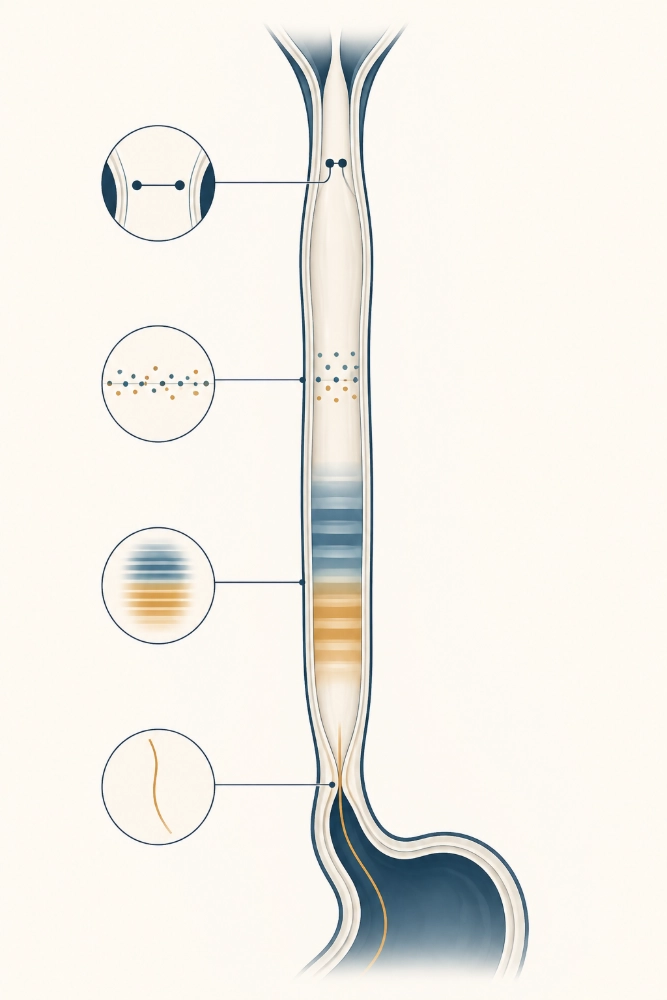
The test that changes the answer for throat and voice symptoms
Standard reflux testing measures reflux above the lower esophageal sphincter only. If your main problems are chronic throat clearing, hoarseness, cough, mucus, globus, or ear pressure, that test can come back normal while reflux is still reaching your larynx.
Dr. Grandhige uses a customized 24-hour pH impedance dual-channel probe that measures at two levels: above the lower esophageal sphincter and above the upper esophageal sphincter. It also measures non-acid reflux, which matters because bile, pepsin, and trypsin all reach the throat and none of them show up on an acid-only test.
The reason this matters is a difference in tissue sensitivity. The esophagus can tolerate 40 to 50 reflux episodes a day. The larynx and pharynx can develop symptoms from a single episode a day.
The practical consequence is blunt. Patients with throat-dominant reflux are routinely quoted around a 50% chance that surgery helps, because without dual-level testing nobody can tell who will respond. By selecting patients on dual-channel results instead of symptoms, Dr. Grandhige quotes roughly 80% improvement. He also declines to operate more often in this group: only about 50% to 60% of patients evaluated for silent reflux, or LPR, have testing that justifies a procedure at all. Fewer operations, better-selected patients.
This testing is not routine in most practices because it’s technically demanding, harder to interpret, and poorly reimbursed. That is the entire reason it’s rare, and it’s why a Wesley Chapel patient with a normal reflux study elsewhere may still have a real answer waiting.
Wesley Chapel: when to stay local, and when to make the drive
You have two hospitals in Wesley Chapel with general surgery programs, AdventHealth Wesley Chapel on Bruce B Downs and BayCare Hospital Wesley Chapel a little further north on the same road. Both handle hernia work, both have robotic platforms, and for a lot of general surgical problems staying close to home is the right call.
Hiatal hernia repair is where that logic gets more complicated, and the reason has nothing to do with the operating room.
Reflux surgery succeeds or fails on the decision made before anyone picks up an instrument. A surgeon who repairs a handful of hiatal hernias a year is making that decision from a smaller sample than one who evaluates foregut disease daily. The failure mode isn’t a botched repair. It’s a technically perfect wrap placed in a patient whose manometry should have ruled it out, or a procedure done on someone whose symptoms were never reflux to begin with.
Here’s a practical way to sort it. Consider staying local if you have a straightforward symptomatic hernia, complete testing already in hand, and a surgeon who can explain why they chose your specific wrap configuration based on your motility results. Consider making the drive if your endoscopy was normal but symptoms persist, if your main complaints are throat or voice symptoms, if you’ve had prior foregut or bariatric surgery, if you have a large or recurrent hernia, if a motility disorder has been raised, or if you want LINX or TIF rather than a wrap.
Ask any surgeon you’re considering how often they decide not to operate. A surgeon who never advises against surgery isn’t exercising judgment.
On the drive itself: the office is at 1315 South Howard Avenue, Suite 101, in South Tampa, roughly 30 miles from central Wesley Chapel via I-75 south to I-275. Plan on 35 to 45 minutes outside peak hours and meaningfully longer if you hit the I-275 rush. It’s a real trip, which is why the practice pushes testing back toward you whenever it can. When a study can be performed near Wesley Chapel, it gets ordered there, and the results come here for interpretation. The goal is that you make the drive for consultation and surgery, not for every test.
All surgery is performed at HCA Florida South Tampa Hospital. Dr. Grandhige operates there exclusively and by design, with the same operating room team, the same anesthesiologists, and his own employed physician assistant who assists in every case and stays involved in your recovery. He previously operated across four Tampa Bay hospitals and consolidated deliberately, because a team that does these operations constantly anticipates the steps instead of reacting to them.
About Dr. Gopal Grandhige, MD
Dr. Grandhige is a board-certified general surgeon and the founder and medical director of Tampa Bay Reflux Institute. He founded and ran Tampa Bay Reflux Center from 2009 to 2022 before the practice became the Institute.
His training: a Bachelor of Science in Biology from Johns Hopkins University, medical degree from the University of Michigan, general surgery residency at Yale New Haven Hospital, followed by two fellowships at Yale New Haven, one in burn and critical care and one in foregut and minimally invasive surgery.
He is a Fellow of the American College of Surgeons, a member of the Society of American Gastrointestinal and Endoscopic Surgeons, and a founding member of the American Foregut Society. He holds privileges at HCA Florida South Tampa Hospital, HCA Florida Brandon Hospital, St. Joseph’s Hospital, and St. Joseph’s Hospital South.
Beyond hiatal hernia and reflux, he treats achalasia with Heller myotomy using Endoflip for tailored intraoperative measurement, and gastroparesis with endoscopic pyloromyotomy. He does not treat esophageal or gastric cancer, and he does not operate on patients whose symptoms are unlikely to improve with surgery. More background is on the about the practice page.

You can verify board certification through the American Board of Surgery physician lookup and the American College of Surgeons directory, and active licensure and any disciplinary history through the Florida Department of Health license lookup. Dr. Grandhige encourages patients to check him and every other surgeon they’re considering.
Tampa Bay Reflux Institute 1315 South Howard Avenue, Suite 101 Tampa, FL 33606 Phone: 813.922.2920 Hours: Monday through Friday, 9:00 AM to 6:00 PM
Frequently asked questions
Talk to a foregut specialist about your hiatal hernia
You’ve likely spent years on medication that reduces acid without correcting the mechanical problem underneath. A complete evaluation tells you whether reflux is real, what’s causing it, and whether a repair would actually help you.
Send your records to info@tampareflux.com and call to schedule.
Call 813.922.2920


An endoscopy cannot tell you if you have reflux. It can only tell you if you have complications of GERD.
If you are unhappy with your reflux symptoms, come in and we can discuss testing and treatments that can accurately diagnose your problem.
#reflux #gerd #hiatalhernia #gastroparesis #linx


CALL US AT 813-922-2920
www.tampareflux.com
If you have a hiatal hernia and fit one of these categories, you should know your options.
Dr. Grandhige is an expert in his field and performs 200 of these surgeries a year. He is the only surgeon in the Tampa Bay Area who offers all surgical options - LINX, Fundoplications, TIF and will be one of 20 surgeons in America introducing the latest procedure RefluxStop in 2026.
We accept most insurances but will verify yours before you come in. These procedures are considered medically necessary and covered by your insurance. You can expect to pay your in-network deductibles and nothing else.
#hiatalhernia #reflux #GERD #LINX #refluxstop

What causes reflux ?
1. Weak lower esophageal sphincter
2. Hiatal hernia
3. Flattening of the Angle of His
4. Poor esophageal motility
5. Gastroparesis (slow stomach)
NOT increased acid production


Don’t let GERD get in the way of living your life. Request your appointment with us today on the link below.
.
.
.
.
https://tampareflux.com/contact-us/

Anyone can be victim to GERD and though weight loss can help reduce GERD symptoms. Many athletes with high impact workouts may continue to have these symptoms. This may be a symptom of a hiatal hernia or other issue. We are more then happy to assist you in finding your solution, just click the link below.
.
.
.
https://tampareflux.com/contact-us/
##healthylifestyle #workout #athletereflux #PPIs #heartburn #LINX #fundoplication #TIF #GERD#tampaheartburn #linx #TIF #fundoplication #tampabayreflux #GERD #acidreflux #acidrefluxsurgery #stopreflux
#nonsurgicalweightloss #ESG #gastricballoon #weightlossjourney #vsg #vsgjourney #spatz3 #orbera #orberaballoon #grandhige #DrG
#tampabayrefluxinstitute #guthealth #roboticsurgery

Heartburn may seem like an annoyance. But if you find yourself having symptoms on a daily basis, it may be time to to talk to Dr. Grandhige as it could be a symptom of something worse.
.
.
.
#chronicheartburn #gerdsymptoms #heartburnrelief #reflux #PPIs #heartburn #LINX #fundoplication #TIF #GERD#tampaheartburn #linx #TIF #fundoplication #tampabayreflux #GERD #acidreflux #acidrefluxsurgery #stopreflux
#nonsurgicalweightloss #ESG #gastricballoon #weightlossjourney #vsg #vsgjourney #spatz3 #orbera #orberaballoon #grandhige #DrG
#tampabayrefluxinstitute #guthealth #roboticsurgery

If you are tired of avoiding your favorite foods or taking daily medications, we can help.
We are the Tampa experts in reflux ! With years of experience and thousands of patients treated successfully, we offer all FDA approved anti-reflux procedures.
Call 813-922-2920 to schedule your appointment
All major insurances accepted.

Not all patients need surgical intervention. Many patients are living a heartburn free life with their PPIs. However 40% of patients taking PPIs are not getting the relief they need. If you are one of those, you have options! Come in and find out more.
.
.
.
.
#letushelpyou #medsnotworking #reflux #PPIs #heartburn #LINX #fundoplication #TIF #GERD#tampaheartburn #linx #TIF #fundoplication #tampabayreflux #GERD #acidreflux #acidrefluxsurgery #stopreflux
#nonsurgicalweightloss #ESG #gastricballoon #weightlossjourney #vsg #vsgjourney #spatz3 #orbera #orberaballoon #grandhige #DrG
#tampabayrefluxinstitute #guthealth #roboticsurgery

#heartburn #stopreflux #hiatalherniarepair #severeheartburn #reflux #tampabayreflux #acidrefluxsurgery #tampaheartburn #GERD #PPIs #achalasia #LINX #TIF #tampareflux #fundoplication #stomach #digestivehealth #ESG #obesity #overweight #weightlossjourney #gastricballoon
