
When a hiatal hernia actually needs surgical repair
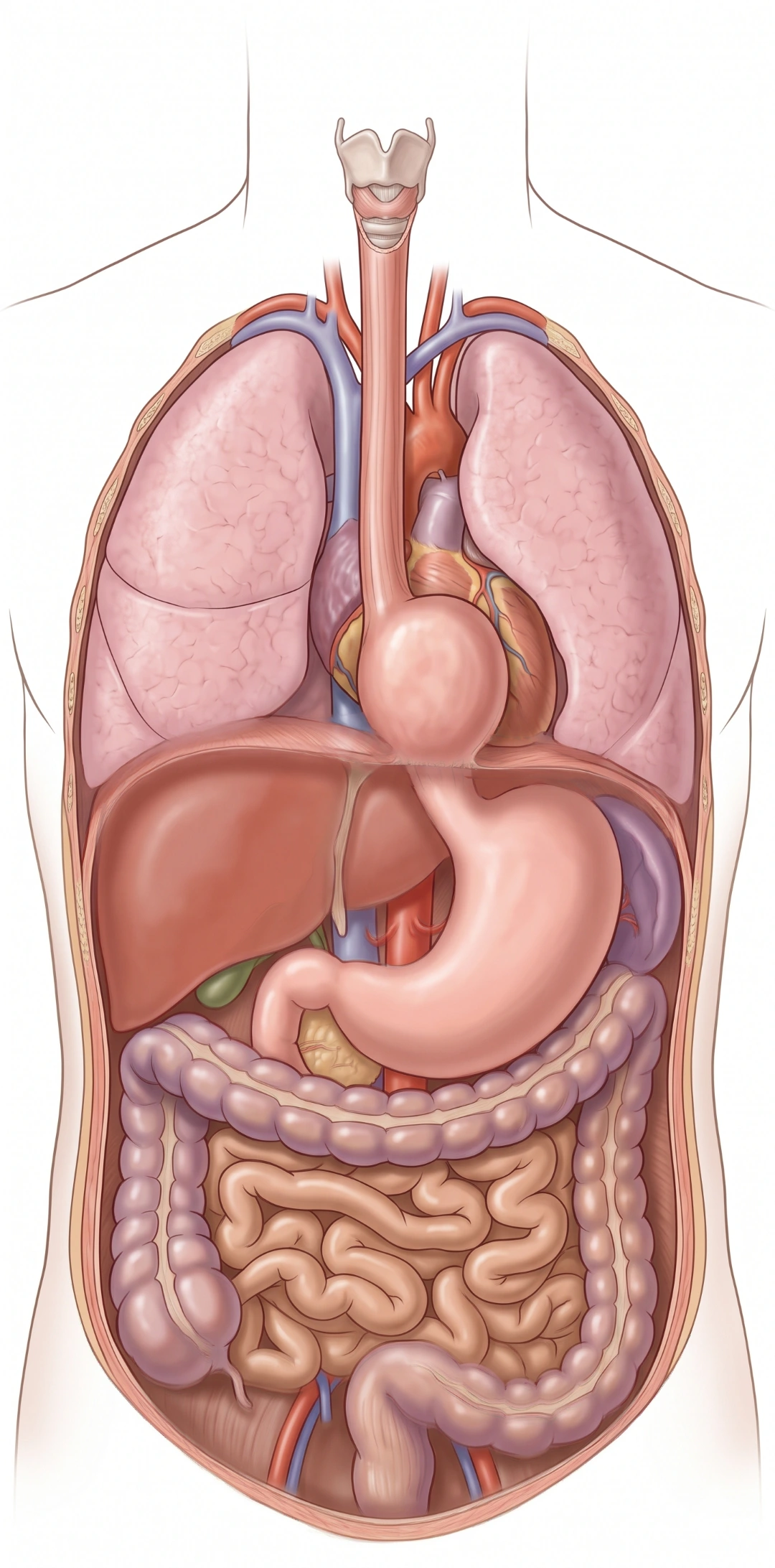
Dr. Grandhige recommends repair in four situations.
Any hiatal hernia larger than 3 centimeters. At that size the hernia almost always contributes mechanically to reflux and will not be controlled by medication alone. Larger hernias also tend to grow, raise the risk of gastric volvulus, and can leave an atonic stomach that may not recover even after a technically perfect repair.
Any hernia paired with significant reflux symptoms, especially regurgitation. Small hernias cause major symptoms when they sit alongside a weak lower esophageal sphincter.
Any hernia with complications of reflux. Severe esophagitis, Barrett’s esophagus and peptic strictures all point toward a durable mechanical fix rather than continued acid suppression.
Any hernia found during an evaluation for reflux surgery. Repairing the diaphragm is what makes the result last. Procedures that leave the hiatus untouched treat half the problem and fail sooner.
Who should not have the operation matters just as much. Patients with untreated severe esophageal motility disorders are not candidates. Neither are patients whose reflux has never been objectively proven. Esophageal hypersensitivity, functional chest pain, rumination and achalasia all produce reflux-like symptoms that surgery does not fix and can worsen. The multi-society consensus guideline on GERD treatment published by SAGES treats preoperative objective evaluation as a prerequisite for exactly this reason.
Dr. Grandhige turns patients away regularly, and he is direct about the consequence: the people he declines to operate on are often the most frustrated people who leave his office. They are also the people who would have been far unhappier after an operation that never touched the real problem.
Why a normal endoscopy does not rule out a hiatal hernia
Endoscopy answers one question: has reflux caused visible damage? It does not measure reflux events, assess sphincter function, or record how often and when reflux happens. Almost every patient with reflux has a hiatal hernia, and many are small enough that endoscopy misses them.
This is why people arrive after years of being told nothing is wrong. A normal scope becomes “you don’t have reflux,” the GERD evaluation stops there, and the medication continues indefinitely. Acid suppression lowers the acidity of what refluxes. It does not strengthen the sphincter, repair the diaphragm, or stop the reflux events themselves, which is why the National Institute of Diabetes and Digestive and Kidney Diseases lists surgery among the treatments for people whose symptoms persist on medication.
Four tests answer different questions. Dr. Grandhige personally reviews every study you already have before your visit.
The difference shows up in who gets operated on. Without this testing, patients with silent reflux are commonly quoted around a 50 percent chance that surgery helps. With it, Dr. Grandhige identifies the 50 to 60 percent of tested LPR patients whose results genuinely warrant intervention, and quotes roughly 80 percent symptom improvement in that selected group. He operates on fewer people, more accurately.
Two things he tells silent reflux patients up front. The testing is technically demanding, requires careful interpretation and reimburses poorly, which is why most centers do not perform it. And silent reflux is slow to resolve: heartburn and regurgitation often improve within days, while throat symptoms usually take four to six months.
The four anti-reflux repairs, and what each one costs you
There is no best reflux operation. Each of the four gives something up, and that trade is the part most pages leave out.
Fundoplication: most durable, most function traded
A fundoplication uses your own stomach to rebuild the reflux barrier, wrapping the upper stomach around the lower esophagus and repairing the diaphragm in the same operation. Dr. Grandhige performs four configurations: Nissen (360-degree wrap), Toupet (posterior 270-degree), Watson (anterior 270-degree) and Dor (anterior partial). Which one you get is decided from your manometry results before you enter the operating room. Robotic or laparoscopic, typically 1.5 to 2 hours, and most patients go home the same day.
What it costs you: fundoplication can limit your ability to burp and vomit, and gas-bloat is more common than with the alternatives. Depending on the wrap, those effects may be temporary or permanent. It is also the hardest of the four to reverse. In exchange you get decades of outcome data, the best durability, and the only option that handles very large hernias and weak motility well.
LINX: preserved anatomy, more early swallowing difficulty
The LINX system is a ring of magnetic titanium beads placed around the lower esophagus. It does not raise resting sphincter pressure. It resists opening when stomach pressure rises and opens when you swallow, which is why most patients keep the ability to burp and vomit once early inflammation settles. The stomach is left anatomically intact, the device can be removed, and hernia size is not a disqualifier as long as the hernia is repaired during the same operation. Current devices are MRI compatible up to 1.5 Tesla.
What it costs you: early swallowing difficulty is common, and a small number of patients have it longer term. LINX needs a strong, well-coordinated esophagus, so weak motility rules it out. It is a permanent implant, and patients who are unusually aware of internal sensation sometimes feel it. Dr. Grandhige uses a simple predictor: people who felt their Bravo pH capsule while it was in place often feel their LINX.
TIF: no incisions, least durable
TIF, or transoral incisionless fundoplication, is performed entirely through the mouth with the EsophyX device, which folds the stomach around the lower esophagus from the inside and secures it with fasteners. It runs 45 to 60 minutes under general anesthesia, leaves no abdominal wounds, and patients go home the same day. Heavy lifting is restricted for six weeks while the internal repair heals.
What it costs you: TIF cannot repair a hiatal hernia and does not address the diaphragm at all. It treats the sphincter only. Dr. Grandhige quotes a failure rate of 2 percent per year, roughly 20 percent per decade, and describes it as the best endoscopic procedure available rather than a permanent solution. He does not offer it outside tight criteria: minimal or no hiatal hernia, mild to moderate reflux, no severe esophagitis or Barrett’s esophagus, and not obese. Most of TIF’s poor reputation comes from being used outside those limits.
RefluxStop: new to the United States in 2026
RefluxStop received FDA premarket approval on August 20, 2026, supported by five-year clinical data from roughly 1,800 patients treated in Europe. The device works differently from the other three. Rather than wrapping or compressing the food passage, it repositions and holds the gastroesophageal junction in its normal position below the diaphragm. The manufacturer began the United States rollout at the American Foregut Society annual meeting in late September 2026 and has said adoption will build gradually, because every surgeon and every site requires training and activation first.
Dr. Grandhige is adding RefluxStop in 2026, which will make him the only surgeon in the Tampa Bay area offering all four anti-reflux procedures. If you have been researching your options from Brandon, this is the detail most pages have not caught up with yet.
From your first call to your surgery date
Most patients move from first consultation to surgery in four to eight weeks, in no more than two visits.
Scheduling. New consultations are usually scheduled within two weeks and always within four.
Before you come in. Email your records to info@tampareflux.com so Dr. Grandhige can review everything before you arrive: prior endoscopy and pathology reports, pH testing results including Bravo or catheter studies, manometry, barium swallow or other imaging, office notes from gastroenterology, ENT, pulmonology and allergy, a current medication list, and a list of prior surgeries. Signed releases are requested immediately, but fax-based systems and incompatible record platforms mean records requested that way often arrive late or incomplete. Patients who send their own get a far more definitive first visit. Studies from years ago still help, because they show how the disease has progressed.
If your testing is already complete. One consultation is usually enough. The diagnosis is confirmed at that visit, procedure options are discussed the same day, insurance authorization starts immediately, and surgery can often be scheduled as early as four weeks out.
If your testing is not complete. The first visit covers education, record review and test planning. Studies are grouped onto as few days as possible through a small number of testing sites the practice uses specifically so results come back quickly and read consistently. A second consultation about four weeks later reviews the results and finalizes the plan, which usually puts surgery around eight weeks from your first visit.
Insurance authorization. The office handles the whole process: gathering documentation, submitting testing results and clinical notes, communicating with the carrier, and answering follow-up requests. Authorization can take four to six weeks on complex cases and is always secured before a surgery date is set, so there are no denials or surprise bills after the fact. Patients sometimes call their own insurer to help. In practice that usually slows things down, because the office already knows what each carrier asks for and how to document it.
About Dr. Gopal Grandhige

Gopal Grandhige, MD is a board-certified general surgeon and the founder and medical director of Tampa Bay Reflux Institute. He founded and ran Tampa Bay Reflux Center from 2009 to 2022 and has practiced foregut surgery in Tampa Bay continuously since 2009.
He earned a Bachelor of Science in biology at Johns Hopkins University and his medical degree at the University of Michigan, completed his general surgery residency at Yale-New Haven Hospital, and completed two fellowships there: one in burn and critical care, one in foregut and minimally invasive surgery. He is a Fellow of the American College of Surgeons, a member of SAGES, and a founding member of the American Foregut Society. His full training and background is published on the practice site.
Published case experience: more than 600 fundoplications, more than 600 LINX procedures and more than 200 TIF procedures.
Beyond reflux and hiatal hernias, he treats achalasia with Heller myotomy guided by EndoFLIP, and gastroparesis with endoscopic pyloromyotomy. He does not treat malignant cancers of the esophagus or stomach, and he does not operate on symptoms that are clearly not foregut in origin.
The team is unusually stable. Several medical assistants have been with the practice more than a decade. The physician assistant Dr. Grandhige employs assists in every case, participates in operative planning, and remains reachable to patients afterward. Dr. Grandhige is reachable directly after hours when the situation calls for it.
All of this can be verified independently. Board certification through the American Board of Surgery physician lookup and the American College of Surgeons directory. Active Florida licensure and any disciplinary history through the Florida Department of Health Medical Quality Assurance license verification portal. Hospital privileges are granted only after credential review, peer evaluation and ongoing performance monitoring.
Brandon hiatal hernia questions, answered
Ready to find out what is actually causing your symptoms?
Dr. Grandhige reviews your existing records before you arrive, so your first visit is a diagnostic conversation rather than a data-gathering exercise. Brandon patients are usually seen within two weeks.
Tampa Bay Reflux Institute 1315 South Howard Avenue, Suite 101, Tampa, FL 33606 813.922.2920 | Monday to Friday, 9:00 AM to 6:00 PM
Medically reviewed by Gopal Grandhige, MD, FACS, board-certified general surgeon, founding member of the American Foregut Society. This page is educational and is not a substitute for an individual medical evaluation.


An endoscopy cannot tell you if you have reflux. It can only tell you if you have complications of GERD.
If you are unhappy with your reflux symptoms, come in and we can discuss testing and treatments that can accurately diagnose your problem.
#reflux #gerd #hiatalhernia #gastroparesis #linx


CALL US AT 813-922-2920
www.tampareflux.com
If you have a hiatal hernia and fit one of these categories, you should know your options.
Dr. Grandhige is an expert in his field and performs 200 of these surgeries a year. He is the only surgeon in the Tampa Bay Area who offers all surgical options - LINX, Fundoplications, TIF and will be one of 20 surgeons in America introducing the latest procedure RefluxStop in 2026.
We accept most insurances but will verify yours before you come in. These procedures are considered medically necessary and covered by your insurance. You can expect to pay your in-network deductibles and nothing else.
#hiatalhernia #reflux #GERD #LINX #refluxstop

What causes reflux ?
1. Weak lower esophageal sphincter
2. Hiatal hernia
3. Flattening of the Angle of His
4. Poor esophageal motility
5. Gastroparesis (slow stomach)
NOT increased acid production


Don’t let GERD get in the way of living your life. Request your appointment with us today on the link below.
.
.
.
.
https://tampareflux.com/contact-us/

Anyone can be victim to GERD and though weight loss can help reduce GERD symptoms. Many athletes with high impact workouts may continue to have these symptoms. This may be a symptom of a hiatal hernia or other issue. We are more then happy to assist you in finding your solution, just click the link below.
.
.
.
https://tampareflux.com/contact-us/
##healthylifestyle #workout #athletereflux #PPIs #heartburn #LINX #fundoplication #TIF #GERD#tampaheartburn #linx #TIF #fundoplication #tampabayreflux #GERD #acidreflux #acidrefluxsurgery #stopreflux
#nonsurgicalweightloss #ESG #gastricballoon #weightlossjourney #vsg #vsgjourney #spatz3 #orbera #orberaballoon #grandhige #DrG
#tampabayrefluxinstitute #guthealth #roboticsurgery

Heartburn may seem like an annoyance. But if you find yourself having symptoms on a daily basis, it may be time to to talk to Dr. Grandhige as it could be a symptom of something worse.
.
.
.
#chronicheartburn #gerdsymptoms #heartburnrelief #reflux #PPIs #heartburn #LINX #fundoplication #TIF #GERD#tampaheartburn #linx #TIF #fundoplication #tampabayreflux #GERD #acidreflux #acidrefluxsurgery #stopreflux
#nonsurgicalweightloss #ESG #gastricballoon #weightlossjourney #vsg #vsgjourney #spatz3 #orbera #orberaballoon #grandhige #DrG
#tampabayrefluxinstitute #guthealth #roboticsurgery

If you are tired of avoiding your favorite foods or taking daily medications, we can help.
We are the Tampa experts in reflux ! With years of experience and thousands of patients treated successfully, we offer all FDA approved anti-reflux procedures.
Call 813-922-2920 to schedule your appointment
All major insurances accepted.

Not all patients need surgical intervention. Many patients are living a heartburn free life with their PPIs. However 40% of patients taking PPIs are not getting the relief they need. If you are one of those, you have options! Come in and find out more.
.
.
.
.
#letushelpyou #medsnotworking #reflux #PPIs #heartburn #LINX #fundoplication #TIF #GERD#tampaheartburn #linx #TIF #fundoplication #tampabayreflux #GERD #acidreflux #acidrefluxsurgery #stopreflux
#nonsurgicalweightloss #ESG #gastricballoon #weightlossjourney #vsg #vsgjourney #spatz3 #orbera #orberaballoon #grandhige #DrG
#tampabayrefluxinstitute #guthealth #roboticsurgery

#heartburn #stopreflux #hiatalherniarepair #severeheartburn #reflux #tampabayreflux #acidrefluxsurgery #tampaheartburn #GERD #PPIs #achalasia #LINX #TIF #tampareflux #fundoplication #stomach #digestivehealth #ESG #obesity #overweight #weightlossjourney #gastricballoon
