
Why St. Petersburg patients cross the bridge for reflux surgery
Reflux surgery outcomes depend far more on specialization and testing than on how close the office is, which is why St. Petersburg patients regularly make the short trip to South Tampa. Tampa Bay Reflux Institute is at 1315 South Howard Avenue, about 20 to 30 minutes from most of St. Petersburg over the Gandy Bridge, traffic depending. St. Pete and Clearwater patients are already a steady part of the practice, alongside people who drive in from Sarasota, Orlando, and across Florida.
Dr. Grandhige treats one thing: benign disease of the esophagus, diaphragm, and stomach. That focus matters because most general surgeons perform reflux surgery only occasionally, and most gastroenterologists diagnose the complications of reflux rather than the mechanics behind it. A surgeon who does this every day recognizes the patient who will do well, the patient at risk for side effects, and the patient who should not have surgery at all.
For anyone coming from out of the area, the office plans the visit around fewer trips. When testing can be done closer to home, it’s arranged there, and studies are grouped onto as few days as possible so a St. Petersburg patient isn’t crossing the bridge over and over.
Objective testing comes before any surgery
Dr. Grandhige never recommends surgery on symptoms alone, because symptoms lie. Heartburn-like complaints can come from reflux, but also from esophageal hypersensitivity, motility disorders, functional chest pain, or ENT and lung conditions that surgery won’t help. Testing separates them before anyone talks about an operation. Each test answers a different question:
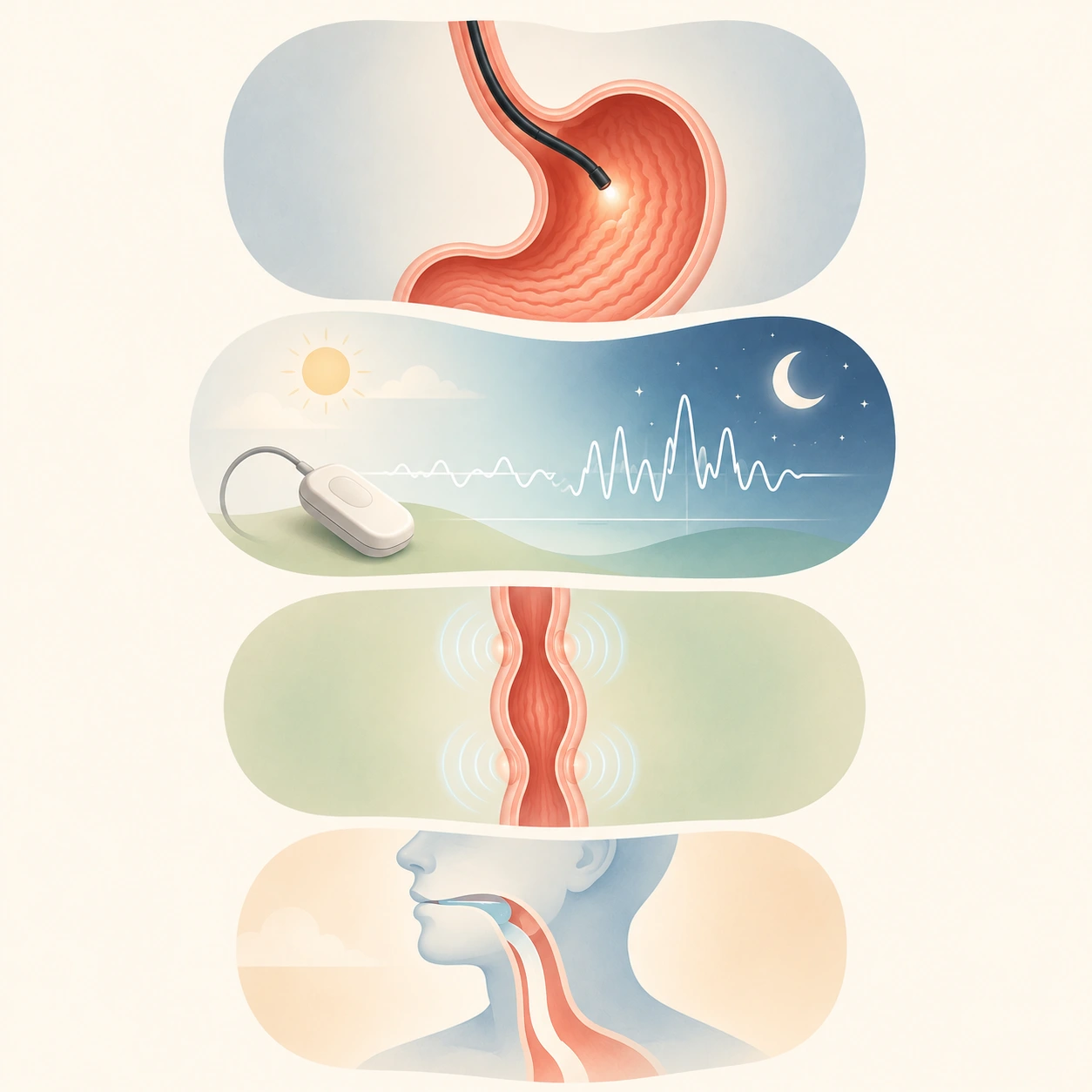
Silent reflux gets its own, sharper test. Silent reflux (LPR) isn’t milder reflux. It’s reflux reaching the wrong place. The throat and voice box can react to as little as one reflux episode a day, while the esophagus tolerates 40 to 50. Standard testing usually measures acid only in the lower esophagus, so it misses LPR entirely. Dr. Grandhige uses a dual-channel 24-hour pH-impedance probe that measures reflux above both the lower and upper esophageal sphincters and detects non-acid reflux, like bile and pepsin, that acid-only tests can’t see. That precision is why his LPR surgical success runs around 80%, compared with the roughly 50% many centers quote, because he operates only on the patients the data actually supports.
The four anti-reflux procedures, compared
There is no single best reflux operation. There’s only the right one for your anatomy, your esophageal function, and your goals, and sometimes the right answer is no surgery. Dr. Grandhige performs every major option, so the recommendation is driven by what fits you rather than by the one procedure a surgeon knows. He’s the only board-certified surgeon in the Tampa Bay area who performs fundoplication, LINX, and TIF regularly, and in 2026 he’s adding RefluxStop, which makes the practice the only one in the region offering all four.
|
Procedure |
Best suited for |
Burping and vomiting |
Reversible |
Repairs the hernia | Durability |
|---|---|---|---|---|---|
| Fundoplication (Nissen, Toupet, Dor, Watson) | Larger hernias, weaker motility (partial wraps), reflux despite medication, complications like severe esophagitis or Barrett’s | May be limited, more so with a full (Nissen) wrap | Harder to reverse | Yes, done together with the repair | Highest, decades of outcome data |
| LINX magnetic sphincter augmentation | Proven reflux with good esophageal motility, patients who want to keep normal anatomy | Usually preserved once early swelling settles | Yes, the device can be removed | Hernia is repaired at the same operation | Durable, with preserved physiology; slightly higher long-term swallowing-difficulty risk |
| TIF (transoral incisionless fundoplication) | Minimal or no hernia, mild to moderate reflux, no complications, not obese | Usually preserved | No anatomy is altered from the outside | No, it can’t reach the diaphragm | Lower, about 2% failure per year; works well for years, not permanent |
The three procedures above are the ones Dr. Grandhige performs with volume: over 600 fundoplications, over 600 LINX procedures, and over 200 TIF procedures. RefluxStop is a newer anti-reflux procedure joining the practice in 2026; the RefluxStop page covers how it works.
Fundoplication uses your own stomach tissue to rebuild the valve, so it doesn’t stop acid production, it stops acid from going where it doesn’t belong. LINX is a ring of magnetic titanium beads that resists opening when stomach pressure rises but still lets food through, and it’s compatible with MRI up to 1.5 Tesla. TIF is done entirely through the mouth with no incisions, which is why recovery feels easier, but because it can’t repair a hernia, patient selection has to be strict. The 2024 SAGES guidelines for the surgical treatment of hiatal hernias support this thinking, suggesting a fundoplication alongside the repair for many hiatal hernias and stressing shared decision-making, which is exactly how these decisions get made here.
How the right procedure gets chosen
Dr. Grandhige runs every patient through the same six-step process, and the operation is the last step, not the first:
- Confirm reflux is real. pH testing proves whether reflux is happening and whether it’s acid, non-acid, or bile. No objective reflux, no surgery, regardless of symptoms.
- Map the anatomy. Hernia size, esophageal length, and the relationship between stomach, diaphragm, and esophagus decide which repairs are even feasible.
- Test the motility. Manometry shows whether the esophagus can push food through a repair. Weak motility points toward a partial wrap and away from a device.
- Match symptoms to physiology. Some symptoms are very likely reflux, some are unlikely, some are mixed. He tells you which is which before anything is scheduled.
- Weigh your goals. Durability, staying off medication, keeping the ability to burp, reversibility. Preferences refine the choice, but they never override anatomy or function.
- Choose a procedure, or choose none. Only after all of the above. Continued medical management is a legitimate outcome of a consultation.
This is also where honesty about tradeoffs lives. A full wrap can limit burping and cause gas-bloat. LINX carries a slightly higher chance of early swallowing difficulty. TIF is less durable than surgery. Dr. Grandhige is direct that the most important skill in reflux surgery is knowing when not to operate, and which operation not to do. He operates on fewer LPR patients than many centers precisely because he’ll only recommend it when testing predicts it will work.
Recovery and what to expect
Most anti-reflux surgery here is outpatient, and the majority of patients go home the same day, walking and drinking liquids soon after. Fundoplication and LINX are done laparoscopically or robotically and usually take about 1.5 to 2 hours. TIF is endoscopic and takes roughly 45 to 60 minutes, with discomfort felt in the chest, left shoulder, and upper abdomen from the swelling and internal sutures rather than from any incision.
Diet moves in stages: liquids, then soft foods, then regular textures. After fundoplication, the repair keeps settling over about 2 to 3 months. Temporary tight swallowing and some gas and bloating are common in the early weeks and usually ease as things heal. Heavy lifting and hard core strain are held for about six weeks. After a fresh hiatal hernia repair, controlling nausea matters, because vomiting can put the repair at risk, so the team plans for that.
Results, stated honestly: in appropriately selected patients with typical reflux (heartburn and regurgitation), confirmed testing, suitable anatomy, and good esophageal function, more than 95% get significant symptom relief and come off daily reflux medication. For fundoplication specifically, that figure runs above 90%. No operation is 100%, and outcomes are lower when motility is reduced, disease is long-standing, hernias are large or recurrent, or there’s been prior foregut or bariatric surgery. Silent reflux improves more slowly than heartburn, often over 4 to 6 months.

Meet your surgeon: Dr. Gopal Grandhige
Dr. Gopal Grandhige is a board-certified general surgeon who has focused only on foregut surgery since 2009, more than 16 years. He completed a fellowship in foregut and minimally invasive surgery at Yale-New Haven Hospital, after general surgery residency there, medical school at the University of Michigan, and undergraduate study at Johns Hopkins. He’s a Fellow of the American College of Surgeons, a member of the Society of American Gastrointestinal and Endoscopic Surgeons (SAGES), and a founding member of the American Foregut Society. You can confirm his certification directly through the American Board of Surgery.
He performs every operation at HCA South Tampa Hospital, with the same operating-room team and his own physician assistant on every case, including recovery and after-hours calls. His office medical assistants have worked with him for over a decade, which is rare and means patients get consistent answers instead of a rotating cast. More on his background and approach is on the practice’s About page.
Beyond GERD and hiatal hernias, the practice also treats silent reflux (LPR), achalasia (with Heller myotomy and Endoflip-guided planning), and gastroparesis (with endoscopic pyloromyotomy), and it handles revision surgery when a previous reflux operation elsewhere has failed.
FAQS
Get a clear answer about your reflux
Whether you end up needing surgery or not, the goal of your first visit is a clear diagnosis and a plan that fits your body. Many patients arrive expecting an operation and leave with reassurance and a non-surgical plan instead. Send your records, and Dr. Grandhige will review them before you come in.


An endoscopy cannot tell you if you have reflux. It can only tell you if you have complications of GERD.
If you are unhappy with your reflux symptoms, come in and we can discuss testing and treatments that can accurately diagnose your problem.
#reflux #gerd #hiatalhernia #gastroparesis #linx


CALL US AT 813-922-2920
www.tampareflux.com
If you have a hiatal hernia and fit one of these categories, you should know your options.
Dr. Grandhige is an expert in his field and performs 200 of these surgeries a year. He is the only surgeon in the Tampa Bay Area who offers all surgical options - LINX, Fundoplications, TIF and will be one of 20 surgeons in America introducing the latest procedure RefluxStop in 2026.
We accept most insurances but will verify yours before you come in. These procedures are considered medically necessary and covered by your insurance. You can expect to pay your in-network deductibles and nothing else.
#hiatalhernia #reflux #GERD #LINX #refluxstop

What causes reflux ?
1. Weak lower esophageal sphincter
2. Hiatal hernia
3. Flattening of the Angle of His
4. Poor esophageal motility
5. Gastroparesis (slow stomach)
NOT increased acid production


Don’t let GERD get in the way of living your life. Request your appointment with us today on the link below.
.
.
.
.
https://tampareflux.com/contact-us/

Anyone can be victim to GERD and though weight loss can help reduce GERD symptoms. Many athletes with high impact workouts may continue to have these symptoms. This may be a symptom of a hiatal hernia or other issue. We are more then happy to assist you in finding your solution, just click the link below.
.
.
.
https://tampareflux.com/contact-us/
##healthylifestyle #workout #athletereflux #PPIs #heartburn #LINX #fundoplication #TIF #GERD#tampaheartburn #linx #TIF #fundoplication #tampabayreflux #GERD #acidreflux #acidrefluxsurgery #stopreflux
#nonsurgicalweightloss #ESG #gastricballoon #weightlossjourney #vsg #vsgjourney #spatz3 #orbera #orberaballoon #grandhige #DrG
#tampabayrefluxinstitute #guthealth #roboticsurgery

Heartburn may seem like an annoyance. But if you find yourself having symptoms on a daily basis, it may be time to to talk to Dr. Grandhige as it could be a symptom of something worse.
.
.
.
#chronicheartburn #gerdsymptoms #heartburnrelief #reflux #PPIs #heartburn #LINX #fundoplication #TIF #GERD#tampaheartburn #linx #TIF #fundoplication #tampabayreflux #GERD #acidreflux #acidrefluxsurgery #stopreflux
#nonsurgicalweightloss #ESG #gastricballoon #weightlossjourney #vsg #vsgjourney #spatz3 #orbera #orberaballoon #grandhige #DrG
#tampabayrefluxinstitute #guthealth #roboticsurgery

If you are tired of avoiding your favorite foods or taking daily medications, we can help.
We are the Tampa experts in reflux ! With years of experience and thousands of patients treated successfully, we offer all FDA approved anti-reflux procedures.
Call 813-922-2920 to schedule your appointment
All major insurances accepted.

Not all patients need surgical intervention. Many patients are living a heartburn free life with their PPIs. However 40% of patients taking PPIs are not getting the relief they need. If you are one of those, you have options! Come in and find out more.
.
.
.
.
#letushelpyou #medsnotworking #reflux #PPIs #heartburn #LINX #fundoplication #TIF #GERD#tampaheartburn #linx #TIF #fundoplication #tampabayreflux #GERD #acidreflux #acidrefluxsurgery #stopreflux
#nonsurgicalweightloss #ESG #gastricballoon #weightlossjourney #vsg #vsgjourney #spatz3 #orbera #orberaballoon #grandhige #DrG
#tampabayrefluxinstitute #guthealth #roboticsurgery

#heartburn #stopreflux #hiatalherniarepair #severeheartburn #reflux #tampabayreflux #acidrefluxsurgery #tampaheartburn #GERD #PPIs #achalasia #LINX #TIF #tampareflux #fundoplication #stomach #digestivehealth #ESG #obesity #overweight #weightlossjourney #gastricballoon
