
A slow stomach is not automatically gastroparesis
A delayed gastric emptying study proves your stomach is slow. It does not prove why, and the why changes the treatment completely.
The biggest shift in the last two years is GLP-1 medications. Slowed gastric emptying is not a side effect of semaglutide, liraglutide, or tirzepatide. It is the mechanism. That is part of how the drugs produce satiety and control post-meal glucose. Most people on these drugs who develop nausea, early fullness, and vomiting have drug-induced delayed emptying rather than true gastroparesis, and it often reverses once the prescriber adjusts the dose. If you are on one of these medications, say so before any test is scheduled. Testing on board can produce a slow result that has nothing to do with the disease you’re being worked up for. Do not stop a prescription on your own to game a test result. Talk to whoever prescribed it.
Opioid pain medications, some antidepressants, anticholinergics, and calcium channel blockers all slow the stomach too. So does a mechanical blockage, which is not gastroparesis at all and is treated differently.
Several conditions produce the same complaints from a completely different mechanism. Achalasia is a motility disorder where the lower esophageal sphincter fails to relax, and it causes regurgitation and chest discomfort that patients and physicians routinely mistake for a stomach problem. Rumination, functional dyspepsia, and esophageal hypersensitivity all mimic it. So does severe GERD, and when the symptoms are throat clearing, cough, and hoarseness rather than heartburn, silent reflux belongs in the differential before anyone talks about the pylorus.
One overlap gets missed often enough to name it. Large hiatal hernias can produce an atonic stomach. The bigger the hernia, the more likely it becomes, and repairing the hernia may or may not reverse it. A patient in that situation has a mechanical problem in the diaphragm, not a primary pyloric problem, and a myotomy is the wrong operation for them.
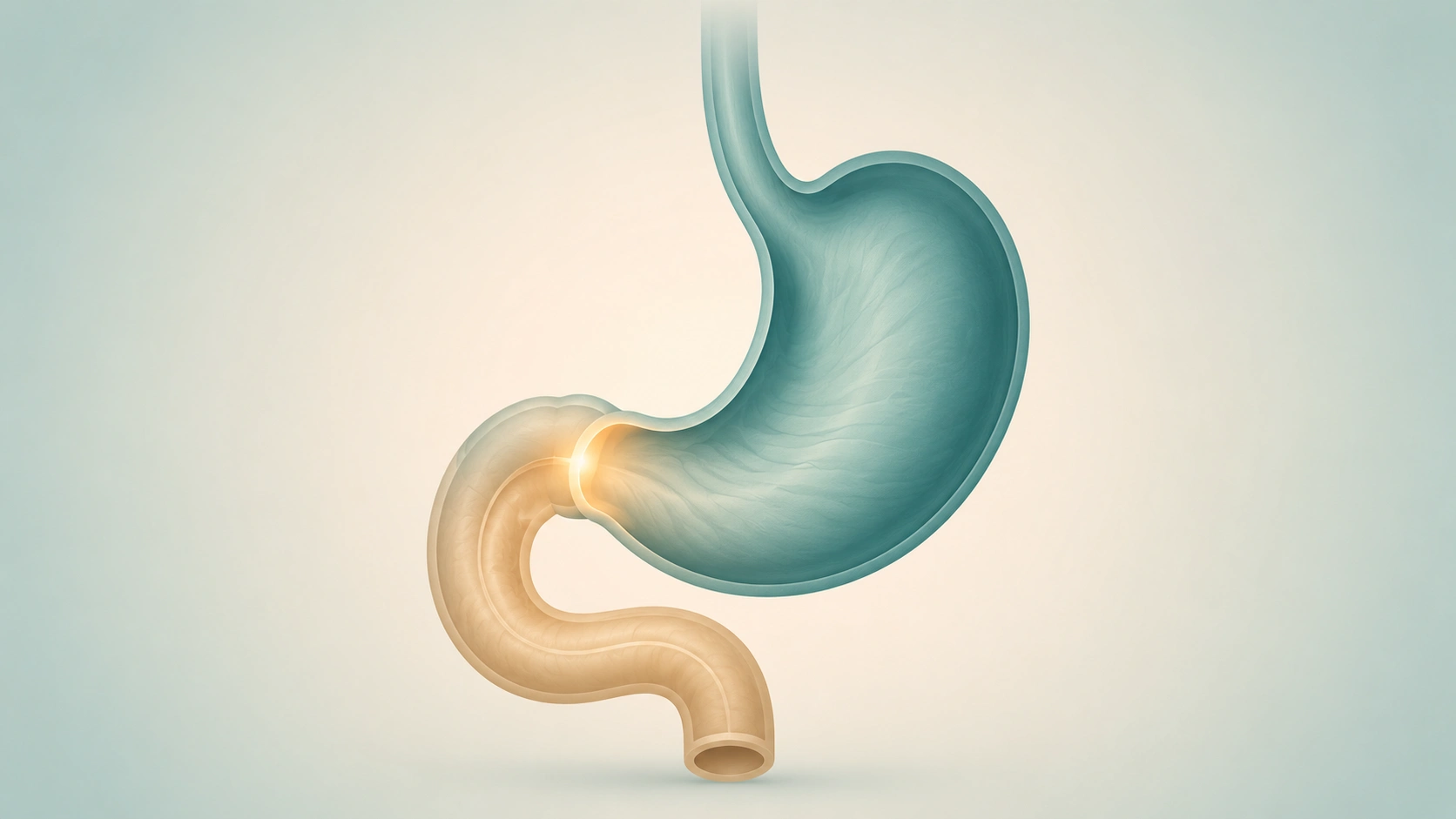
The testing that comes before anyone discusses a procedure
The diagnostic test is a 4-hour gastric emptying study, not a 2-hour one. The American Gastroenterological Association’s 2025 clinical practice guideline on gastroparesis issued a conditional recommendation against the 2-hour version and in favor of the 4-hour version, because the shorter study produces false results in both directions. If you were diagnosed on a 2-hour test, that diagnosis is worth revisiting before you commit to anything invasive.
Upper endoscopy has a job here, but it is not diagnosis. It rules out a blockage and it shows retained food after an appropriate fast, which raises suspicion. It cannot measure how fast your stomach empties. The NIDDK’s diagnostic overview lays out the same distinction.
Beyond that, testing depends on what the symptoms suggest. Esophageal manometry measures how the esophagus contracts and coordinates, and it is what separates achalasia from everything else. pH impedance testing determines whether reflux is driving the nausea. EndoFLIP measures how the sphincter behaves under distension, which matters when the question is whether the pylorus is the actual bottleneck.
Every one of these tests exists to answer a different question. Skipping them is how people end up with a technically successful procedure that fixes nothing.
Bring your medication list to the ordering physician, including GLP-1 drugs, opioids, and anything for blood pressure or mood. Several of them skew the result, and the study has to be timed around them or it is wasted.
What the guidelines say about treatment order, and what does not work
The AGA guideline contains 12 conditional recommendations, and the sequencing matters more than most patients are told.
Metoclopramide and erythromycin are the recommended first-line drugs, with caution because of their adverse effect profiles. Metoclopramide is the only medication the FDA has approved for gastroparesis. The panel issued conditional recommendations against domperidone, prucalopride, aprepitant, nortriptyline, buspirone, and cannabidiol as first-line therapy. That does not mean those drugs never help anyone. It means the evidence doesn’t support starting with them.
Botulinum toxin injected into the pylorus is worth a direct answer, because people still get offered it. The ACG’s 2022 gastroparesis guideline states plainly that it was not effective in two randomized controlled trials and does not recommend it. There is later work suggesting it may help a narrow group selected on pyloric distensibility measurements, but as a general first move it failed the trials it was tested in.
What the trip from Clearwater actually involves
For most Clearwater patients this is two visits, sometimes one. Not a string of trips across the bay.
Send your records before you come. Email them to info@tampareflux.com and I read every page myself before you sit down: prior endoscopy and pathology reports, pH testing, manometry, imaging, notes from your gastroenterologist or ENT or pulmonologist, your medication list, and your surgical history. Signed release forms exist, but records requested that way arrive late and incomplete more often than not. Patients who bring their own file get a far more definitive first visit.
We work with a small number of testing sites, and wherever a study can be done near you, we arrange it near you. There is no reason to drive across the bay for something that can happen in Pinellas.
Consultations are usually scheduled within two weeks and always within four. If your testing is complete when you arrive, one visit is typically enough to confirm the diagnosis and lay out options, and a procedure can be scheduled as early as four weeks out. If testing still has to be done, plan on two visits roughly four weeks apart and about eight weeks start to finish. Authorization paperwork is handled entirely by our office, can add four to six weeks on complex cases, and is completed before anything is scheduled rather than after.
Procedures are performed at HCA South Tampa Hospital, and only there. Same operating room team, same anesthesiologists, same physician assistant on every case. That physician assistant is in the room during your operation, knows your anatomy and your recovery plan, and is reachable afterward. You can also reach me directly after hours. Our medical assistants have been here over a decade, which is why the answer you get on the phone matches the answer you get in the room.
Tampa Bay Reflux Institute, 1315 South Howard Avenue, Suite 101, Tampa, FL 33606. Phone 813.922.2920. Office hours 9:00 AM to 6:00 PM, Monday through Friday. The building is yellow brick, next to Sally O’Neill’s Pizza, with parking behind the restaurant.
Dr. Gopal Grandhige, and how to check any of this yourself

I am a board-certified general surgeon. Bachelor of Science in Biology from Johns Hopkins University, medical degree from the University of Michigan, Ann Arbor, general surgery residency at Yale-New Haven Hospital, and fellowships there in burn and critical care and in foregut and minimally invasive surgery.
I founded Tampa Bay Reflux Center in 2009 and built it into Tampa Bay Reflux Institute in 2022. The clinical focus never changed: benign disease of the esophagus, diaphragm, and stomach. I am a Founding Member of the American Foregut Society, a Fellow of the American College of Surgeons, and a member of the Society of American Gastrointestinal and Endoscopic Surgeons. I have performed over 600 fundoplications, over 600 LINX procedures, and over 200 TIF procedures, and I am one of a small number of physicians performing endoscopic pyloromyotomy in Tampa Bay. More on the practice is on our about the practice page.
Do not take any of that on faith. Board certification is verifiable through the American Board of Surgery physician lookup and the American College of Surgeons directory. Active licensure and disciplinary history are public through the Florida Department of Health Medical Quality Assurance license lookup. I hold hospital privileges at St. Joseph’s Main, St. Joseph’s South, HCA Brandon, and HCA South Tampa, which are granted only after credential review and peer evaluation.
Questions Clearwater patients ask before booking
Take the first step
You have probably been told this is stress, or handed another prescription, or diagnosed on a test that was too short to be reliable. A 35-minute drive gets you an objective workup, a physician who reads your records before you arrive, and a clear statement about which of your symptoms a procedure would fix and which it would not.


An endoscopy cannot tell you if you have reflux. It can only tell you if you have complications of GERD.
If you are unhappy with your reflux symptoms, come in and we can discuss testing and treatments that can accurately diagnose your problem.
#reflux #gerd #hiatalhernia #gastroparesis #linx


CALL US AT 813-922-2920
www.tampareflux.com
If you have a hiatal hernia and fit one of these categories, you should know your options.
Dr. Grandhige is an expert in his field and performs 200 of these surgeries a year. He is the only surgeon in the Tampa Bay Area who offers all surgical options - LINX, Fundoplications, TIF and will be one of 20 surgeons in America introducing the latest procedure RefluxStop in 2026.
We accept most insurances but will verify yours before you come in. These procedures are considered medically necessary and covered by your insurance. You can expect to pay your in-network deductibles and nothing else.
#hiatalhernia #reflux #GERD #LINX #refluxstop

What causes reflux ?
1. Weak lower esophageal sphincter
2. Hiatal hernia
3. Flattening of the Angle of His
4. Poor esophageal motility
5. Gastroparesis (slow stomach)
NOT increased acid production


Don’t let GERD get in the way of living your life. Request your appointment with us today on the link below.
.
.
.
.
https://tampareflux.com/contact-us/

Anyone can be victim to GERD and though weight loss can help reduce GERD symptoms. Many athletes with high impact workouts may continue to have these symptoms. This may be a symptom of a hiatal hernia or other issue. We are more then happy to assist you in finding your solution, just click the link below.
.
.
.
https://tampareflux.com/contact-us/
##healthylifestyle #workout #athletereflux #PPIs #heartburn #LINX #fundoplication #TIF #GERD#tampaheartburn #linx #TIF #fundoplication #tampabayreflux #GERD #acidreflux #acidrefluxsurgery #stopreflux
#nonsurgicalweightloss #ESG #gastricballoon #weightlossjourney #vsg #vsgjourney #spatz3 #orbera #orberaballoon #grandhige #DrG
#tampabayrefluxinstitute #guthealth #roboticsurgery

Heartburn may seem like an annoyance. But if you find yourself having symptoms on a daily basis, it may be time to to talk to Dr. Grandhige as it could be a symptom of something worse.
.
.
.
#chronicheartburn #gerdsymptoms #heartburnrelief #reflux #PPIs #heartburn #LINX #fundoplication #TIF #GERD#tampaheartburn #linx #TIF #fundoplication #tampabayreflux #GERD #acidreflux #acidrefluxsurgery #stopreflux
#nonsurgicalweightloss #ESG #gastricballoon #weightlossjourney #vsg #vsgjourney #spatz3 #orbera #orberaballoon #grandhige #DrG
#tampabayrefluxinstitute #guthealth #roboticsurgery

If you are tired of avoiding your favorite foods or taking daily medications, we can help.
We are the Tampa experts in reflux ! With years of experience and thousands of patients treated successfully, we offer all FDA approved anti-reflux procedures.
Call 813-922-2920 to schedule your appointment
All major insurances accepted.

Not all patients need surgical intervention. Many patients are living a heartburn free life with their PPIs. However 40% of patients taking PPIs are not getting the relief they need. If you are one of those, you have options! Come in and find out more.
.
.
.
.
#letushelpyou #medsnotworking #reflux #PPIs #heartburn #LINX #fundoplication #TIF #GERD#tampaheartburn #linx #TIF #fundoplication #tampabayreflux #GERD #acidreflux #acidrefluxsurgery #stopreflux
#nonsurgicalweightloss #ESG #gastricballoon #weightlossjourney #vsg #vsgjourney #spatz3 #orbera #orberaballoon #grandhige #DrG
#tampabayrefluxinstitute #guthealth #roboticsurgery

#heartburn #stopreflux #hiatalherniarepair #severeheartburn #reflux #tampabayreflux #acidrefluxsurgery #tampaheartburn #GERD #PPIs #achalasia #LINX #TIF #tampareflux #fundoplication #stomach #digestivehealth #ESG #obesity #overweight #weightlossjourney #gastricballoon
