
What esophageal hiatal hernia treatment in Tampa involves
Treatment for an esophageal hiatal hernia runs from medication and lifestyle changes to a surgical repair, and the right path depends on objective testing of your anatomy and esophageal function, not on symptoms alone or on which procedure a surgeon happens to favor.
Acid-reducing medication, weight changes, meal timing, and sleeping with the head of the bed raised can lower symptoms. They do not repair the hernia or the failed valve. When the hernia is the mechanical cause and symptoms keep breaking through, a repair is what corrects the anatomy.
Tampa Bay Reflux Institute is a foregut-only practice. Dr. Gopal Grandhige has treated reflux and foregut disease since 2009, and he performs reflux surgery regularly rather than occasionally. He is the only board-certified surgeon in the Tampa Bay area who performs all three current anti-reflux procedures (fundoplication, LINX, and TIF) with regularity, with a fourth, RefluxStop, planned once it clears FDA review. This page explains what a hiatal hernia is, when it needs surgery, how the decision is made, and what each repair does and does not do.

What a hiatal hernia is, and why it causes reflux
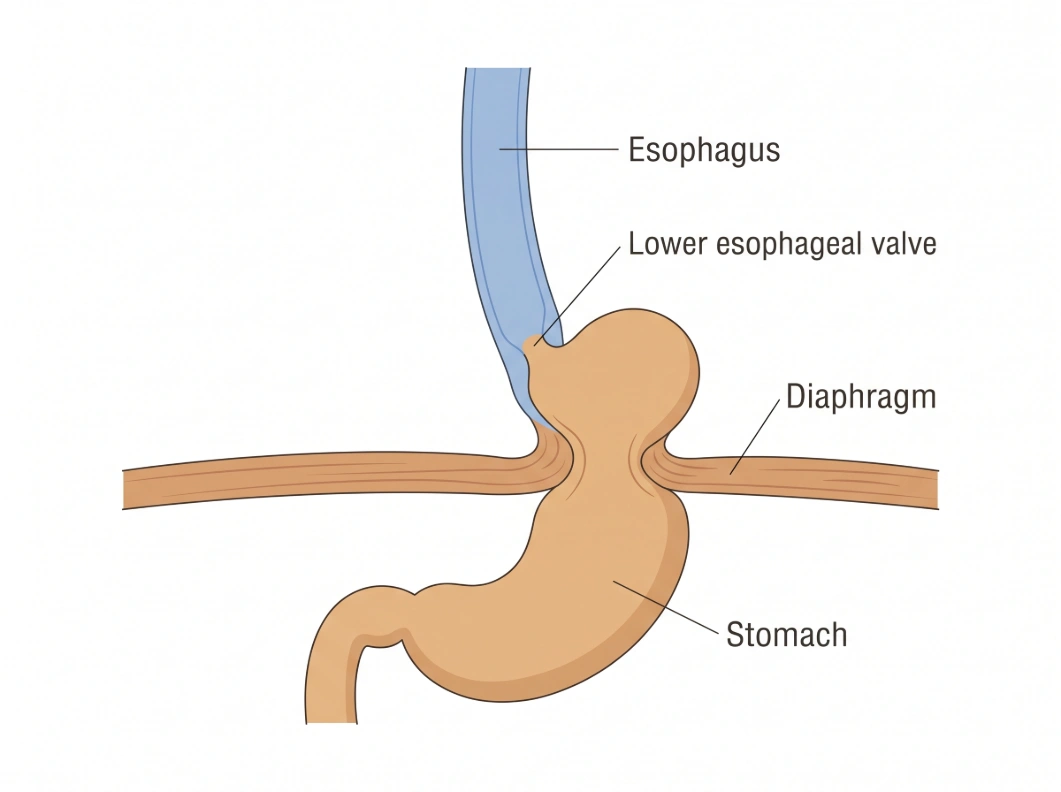
A hiatal hernia is a widening or weakening of the opening in the diaphragm (the hiatus) where the esophagus passes before it meets the stomach, which lets the stomach slide up into the chest and breaks the body’s reflux barrier. Almost every patient with reflux has a hiatal hernia, even a small one that an endoscopy cannot see.
Think of the reflux barrier as a two-part door. One part is the lower esophageal sphincter, the muscular valve at the bottom of the esophagus. The other part is the diaphragm, which wraps that valve and supports it when you bend, lift, or strain. In a hiatal hernia the diaphragm opening stretches, the valve slides up to where pressure favors reflux instead of stopping it, and the angle that normally helps hold food down is lost. If one part of the door fails, reflux happens. If both fail, reflux is close to inevitable.
This is why medication often is not enough. Acid drugs lower the acidity of what refluxes, but they do not repair the diaphragm or the valve, so reflux events continue, often at night, and bile and digestive enzymes can still reach the esophagus. Hiatal hernias develop from ordinary pressure on the abdomen over time, from pregnancy, weight changes, chronic coughing, straining, and heavy lifting. They are not something a patient did wrong.
When a hiatal hernia needs surgery
A hiatal hernia needs surgical repair in a few clear situations, and size is one of the strongest signals: Dr. Grandhige recommends repair for any hernia larger than 3 centimeters, because at that size the hernia almost always drives reflux mechanically, tends to grow, and carries a risk of the stomach twisting (gastric volvulus).
He also recommends repair when:
- A hernia of any size comes with significant reflux symptoms, especially regurgitation.
- A hernia is tied to complications of reflux such as severe esophagitis, Barrett’s esophagus, or a peptic stricture.
- A hernia is found during the workup of a patient who already needs reflux surgery, since leaving it unrepaired undercuts the durability of any repair.
The reason for the threshold is durability. Procedures that treat the valve but ignore the diaphragm fix only half the problem and are more likely to fail over time. That is also why testing comes before any recommendation, and why a smaller hernia with controlled symptoms may be managed without surgery at all.
How Dr. Grandhige decides whether to operate
The operation is the last step. The decision-making is the real work, and it follows a fixed six-part sequence that is built to find the right procedure or to rule surgery out. As Dr. Grandhige puts it, there is no single best reflux operation, only the right operation for the right patient, and in many cases the right answer is not to operate.
Step 1: Confirm reflux is actually present
Before any procedure is discussed, objective pH or pH-impedance testing has to show that reflux is happening and that it lines up with your symptoms. Many people have symptoms that mimic reflux but come from esophageal hypersensitivity, motility disorders, or functional chest pain. If reflux is not proven, surgery is not recommended.
Step 2: Map the anatomy
Imaging and endoscopy define the size of the hernia, the length and position of the esophagus, and how the stomach, diaphragm, and esophagus relate. Anatomy decides whether surgery is appropriate, which procedures are feasible, and how durable a repair will be.
Step 3: Measure esophageal function
Esophageal manometry measures the strength and coordination of your swallowing muscles. This is the most overlooked factor in procedure choice. A weak esophagus may not tolerate a full wrap or a magnetic device, and ignoring it leads to swallowing trouble and regret.
Step 4: Match symptoms to physiology
Not every symptom is reflux. Dr. Grandhige is explicit about which symptoms he expects to improve, which may improve partially, and which are unlikely to be reflux-related, so expectations are set before any decision.
Step 5: Weigh your priorities
Durability, getting off medication, keeping the ability to burp and vomit, minimizing side effects, reversibility: these refine the choice once a procedure is medically appropriate. Preference never overrides anatomy and function, but it shapes the final decision.
Step 6: Choose a procedure, or choose none
Only after all of the above does the choice come down to a specific repair, observation, or medical management. Because the practice performs several procedures, the decision is driven by fit rather than by the one operation a surgeon knows best.
The testing that comes first
Each test answers a different question, and skipping tests is the most common reason reflux surgery goes wrong. Here is what each one tells us.
Upper endoscopy (EGD) shows the lining of the esophagus and finds damage: inflammation, Barrett’s esophagus, ulcers, strictures, and hiatal hernias. What it does not do is diagnose reflux. A normal endoscopy does not rule reflux out, because endoscopy looks for damage, not for reflux events, and many people with significant reflux have a normal exam, especially on medication.
Esophageal pH monitoring is the test that actually diagnoses reflux. Worn for 48 to 72 hours during normal daily life as a Bravo capsule or a thin catheter, it records how often reflux happens, how long episodes last, how acidic they are, and whether they line up with your symptoms.
Esophageal manometry measures how the esophagus moves and whether the valve relaxes properly. It identifies motility disorders such as achalasia that can imitate reflux but need entirely different treatment, and it dictates whether a full or partial repair is safe.
A barium swallow is used selectively to watch swallowing in real time, size a hernia, and reproduce the exact spot where food hangs up. That last point matters: where a patient feels food stick matches the real location only about 60 percent of the time.
For throat-driven symptoms, Dr. Grandhige uses a customized 24-hour dual-channel pH-impedance probe that measures reflux at two levels, above the lower esophageal sphincter and above the upper esophageal sphincter. Standard reflux testing usually looks only at the lower level, which is why true silent reflux is so often missed. Measuring both, and measuring non-acid reflux like bile and pepsin that only impedance can detect, is what separates patients who will benefit from a procedure from those who will not.
The repairs, and who each one fits
There is no universally best reflux operation, so the procedure is matched to your hernia, your esophageal function, and your goals. Larger hernias usually point toward a fundoplication; smaller hernias may suit LINX or an incisionless TIF. Across more than a decade, Dr. Grandhige has performed over 600 fundoplications, over 600 LINX procedures, and over 200 TIF procedures.
| REPAIR | BEST FIT | Hiatal Hernia | Incisions | Hospital stay |
|---|---|---|---|---|
| Fundoplication (Nissen, Toupet, Dor, Watson) | Larger hernias, weak valve, most durable result | Any size, including over 3 cm | Robotic or laparoscopic (small) | Usually same day |
| LINX (magnetic sphincter augmentation) | Good esophageal motility, wants to keep burping and vomiting | Any size, repaired at the same time | Robotic or laparoscopic (small) | Outpatient |
| TIF (incisionless, EsophyX) | Mild to moderate reflux, no or minimal hernia, not obese | None, or very small | None (through the mouth) | Same day |
| RefluxStop (planned 2026, pending FDA approval) | To be determined on approval | To be determined | Laparoscopic | To be determined |
The trade-offs other pages skip
Every reflux repair has trade-offs, and a page that hides them is the one to distrust. Modern reflux surgery has a far better side-effect profile than the operations of the 1970s, mostly because testing and procedure selection have improved, but no procedure is risk-free.
Fundoplication can cause swallowing difficulty in the early weeks and some gas-bloat, since a tighter valve makes it harder for air and food to come back up. Most of this eases, and the degree depends on the wrap type chosen from your motility.
LINX carries a higher rate of early, and occasionally longer-term, swallowing difficulty than fundoplication, which is why it needs good esophageal strength and active swallowing during recovery. Some patients sense the device. It can be removed if needed.
TIF is less durable than the surgical repairs, particularly in anyone with a real hernia or more advanced disease, and some patients still need acid medication afterward.
Two points from recent data are worth knowing. Robotic repair has been linked to lower one-year symptom recurrence and less postoperative ileus than standard laparoscopic surgery, with similar one-month results, in a 2025 analysis of national data (Bassiri et al., Annals of Thoracic Surgery, 2025). And mesh is used selectively here, not routinely, because while it can lower recurrence in some cases, larger data has tied it to higher readmission and longer operative times. Recurrence is possible with any repair and rises the longer patients are followed, which is part of why selection and surgeon volume matter.
The results, and the patients we turn down
When patients are correctly selected and a standard repair is appropriate, outcomes are strong: for typical reflux symptoms with objective reflux, suitable anatomy, and good esophageal function, Dr. Grandhige reports better than 95 percent success in meaningful symptom relief, getting off daily reflux medication, and patient satisfaction, with fundoplication specifically achieving symptom resolution and medication elimination in over 90 percent of appropriate patients.
That number holds because of restraint, not despite it. Dr. Grandhige is known among Tampa Bay referring physicians for declining to operate when testing does not support it. The clearest example is silent reflux: only about 50 to 60 percent of patients with throat-type symptoms have testing that warrants surgery, and operating only on that group raises the improvement rate from roughly 50 percent to about 80 percent. Throat symptoms also take longer to settle, often four to six months, while classic heartburn frequently resolves within days.
Success is defined honestly. It means the reflux-related symptoms improve, not that every symptom a patient walked in with disappears, because many symptoms are multifactorial and some are not reflux at all. Setting that expectation up front is why patients report high satisfaction even when results are not perfect.
Why a high-volume foregut specialist changes your odds
Where you have reflux surgery affects the result. In a 2025 analysis of more than 13,000 hiatal hernia repairs in a national database, 30-day complications dropped step by step with center volume, from about 22 percent at low-volume centers to about 14 percent at high-volume centers, along with lower reoperation rates (Rosenbaum et al., Annals of Surgery Open, 2025).
There is a practical reason. A clean first repair is far easier and safer than revising one that failed. A surgeon who does foregut work daily recognizes the patterns, and the warning signs, that a generalist sees only a few times a year, which is why most general surgeons in the area refer their complex reflux patients to Dr. Grandhige.
The system around the surgeon matters too. All of his procedures are performed at HCA South Tampa Hospital with one operating-room team and a dedicated physician assistant who assists in every case and knows each patient’s anatomy and recovery. That continuity, rather than rotating teams across several hospitals, is one of the better predictors of safe, consistent outcomes, and it means questions after surgery go to someone who was in the room.
What recovery actually looks like
Recovery from a minimally invasive repair is usually easier than patients expect. Fundoplication and TIF are typically same-day procedures, and LINX is outpatient, so most people go home the day of surgery.
Diet advances in stages, from liquids to soft foods to regular textures, and the internal repair needs that time to heal whether or not there were incisions. After fundoplication, diet progresses over roughly two to three months; after TIF, heavy lifting and core strain are held for about six weeks. Temporary swallowing difficulty in the early weeks is common and usually settles on its own, and many patients end up able to eat foods that used to trigger symptoms. Throat symptoms from silent reflux are the slowest to improve, often taking four to six months, while classic heartburn and regurgitation tend to resolve quickly.
FAQS


An endoscopy cannot tell you if you have reflux. It can only tell you if you have complications of GERD.
If you are unhappy with your reflux symptoms, come in and we can discuss testing and treatments that can accurately diagnose your problem.
#reflux #gerd #hiatalhernia #gastroparesis #linx


CALL US AT 813-922-2920
www.tampareflux.com
If you have a hiatal hernia and fit one of these categories, you should know your options.
Dr. Grandhige is an expert in his field and performs 200 of these surgeries a year. He is the only surgeon in the Tampa Bay Area who offers all surgical options - LINX, Fundoplications, TIF and will be one of 20 surgeons in America introducing the latest procedure RefluxStop in 2026.
We accept most insurances but will verify yours before you come in. These procedures are considered medically necessary and covered by your insurance. You can expect to pay your in-network deductibles and nothing else.
#hiatalhernia #reflux #GERD #LINX #refluxstop

What causes reflux ?
1. Weak lower esophageal sphincter
2. Hiatal hernia
3. Flattening of the Angle of His
4. Poor esophageal motility
5. Gastroparesis (slow stomach)
NOT increased acid production


Don’t let GERD get in the way of living your life. Request your appointment with us today on the link below.
.
.
.
.
https://tampareflux.com/contact-us/

Anyone can be victim to GERD and though weight loss can help reduce GERD symptoms. Many athletes with high impact workouts may continue to have these symptoms. This may be a symptom of a hiatal hernia or other issue. We are more then happy to assist you in finding your solution, just click the link below.
.
.
.
https://tampareflux.com/contact-us/
##healthylifestyle #workout #athletereflux #PPIs #heartburn #LINX #fundoplication #TIF #GERD#tampaheartburn #linx #TIF #fundoplication #tampabayreflux #GERD #acidreflux #acidrefluxsurgery #stopreflux
#nonsurgicalweightloss #ESG #gastricballoon #weightlossjourney #vsg #vsgjourney #spatz3 #orbera #orberaballoon #grandhige #DrG
#tampabayrefluxinstitute #guthealth #roboticsurgery

Heartburn may seem like an annoyance. But if you find yourself having symptoms on a daily basis, it may be time to to talk to Dr. Grandhige as it could be a symptom of something worse.
.
.
.
#chronicheartburn #gerdsymptoms #heartburnrelief #reflux #PPIs #heartburn #LINX #fundoplication #TIF #GERD#tampaheartburn #linx #TIF #fundoplication #tampabayreflux #GERD #acidreflux #acidrefluxsurgery #stopreflux
#nonsurgicalweightloss #ESG #gastricballoon #weightlossjourney #vsg #vsgjourney #spatz3 #orbera #orberaballoon #grandhige #DrG
#tampabayrefluxinstitute #guthealth #roboticsurgery

If you are tired of avoiding your favorite foods or taking daily medications, we can help.
We are the Tampa experts in reflux ! With years of experience and thousands of patients treated successfully, we offer all FDA approved anti-reflux procedures.
Call 813-922-2920 to schedule your appointment
All major insurances accepted.

Not all patients need surgical intervention. Many patients are living a heartburn free life with their PPIs. However 40% of patients taking PPIs are not getting the relief they need. If you are one of those, you have options! Come in and find out more.
.
.
.
.
#letushelpyou #medsnotworking #reflux #PPIs #heartburn #LINX #fundoplication #TIF #GERD#tampaheartburn #linx #TIF #fundoplication #tampabayreflux #GERD #acidreflux #acidrefluxsurgery #stopreflux
#nonsurgicalweightloss #ESG #gastricballoon #weightlossjourney #vsg #vsgjourney #spatz3 #orbera #orberaballoon #grandhige #DrG
#tampabayrefluxinstitute #guthealth #roboticsurgery

#heartburn #stopreflux #hiatalherniarepair #severeheartburn #reflux #tampabayreflux #acidrefluxsurgery #tampaheartburn #GERD #PPIs #achalasia #LINX #TIF #tampareflux #fundoplication #stomach #digestivehealth #ESG #obesity #overweight #weightlossjourney #gastricballoon
