
Heartburn and nausea: one problem or two?
Reflux can cause nausea on its own. The National Institute of Diabetes and Digestive and Kidney Diseases lists nausea alongside heartburn, regurgitation, chest pain, chronic cough and hoarseness as symptoms of GERD. So nausea by itself doesn’t prove a second diagnosis. What tips the balance is the pattern: nausea that arrives after eating, paired with feeling full a few bites in and bloating that lingers, is the signature of delayed gastric emptying rather than acid alone.
Here’s the part that matters most, and it’s the part most pages skip. Anti-reflux surgery is built to fix reflux. If your nausea is being driven by a stomach that empties slowly, a well-performed anti-reflux operation can clear your heartburn and regurgitation completely and leave the nausea exactly where it was. Patients who weren’t told this in advance experience a technically successful operation as a failure.
That’s why the workup separates the two before anything else happens.
On the reflux side, the real problem is rarely acid volume. Most people with GERD make a normal amount of acid. The barrier fails for mechanical reasons: a weak lower esophageal sphincter, a diaphragm that’s stopped supporting it, or a hiatal hernia that pulls the two apart. Acid-suppressing medication turns down the burn. It does not stop the leak, which is why regurgitation, nighttime symptoms and throat symptoms often continue on a full dose.
On the nausea side, the question is how fast your stomach empties. Gastroparesis produces nausea, early satiety and bloating through an entirely different mechanism, and acid suppression does nothing for it.
What the 2025 gastroparesis guideline actually says
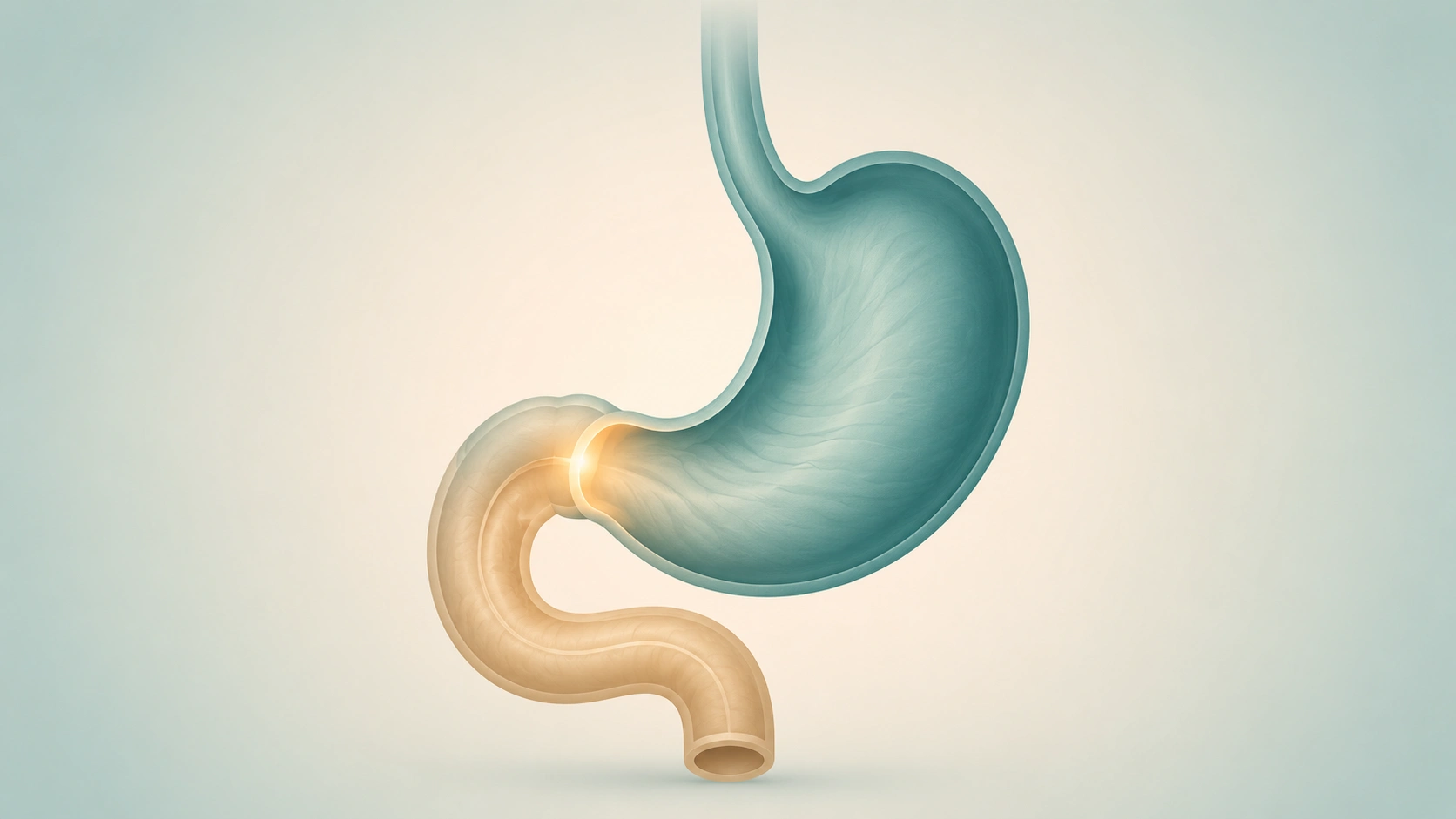
If nausea is a prominent part of your symptoms, ask for a full four-hour gastric emptying study rather than a two-hour version.
The American Gastroenterological Association published its first gastroparesis-focused clinical practice guideline in 2025, with 12 conditional recommendations. The AGA clinical guidance on gastroparesis advises against two-hour or shorter gastric emptying studies in favor of the four-hour study, because shorter protocols reclassify a meaningful number of patients incorrectly. Some people whose stomachs look normal at two hours are clearly delayed at four. Measuring directly at four hours, rather than extrapolating from earlier readings, is what the guideline calls for.
Severity is read from the percentage of the meal still retained at four hours. That number carries real weight later: it’s part of what separates a patient who should stay on medical therapy from one who should be considered for a procedure.
The guideline puts metoclopramide and erythromycin first for drug therapy, with explicit shared decision-making about side effects, and metoclopramide remains the only medication with full FDA approval for gastroparesis. It advises against domperidone, prucalopride, aprepitant, nortriptyline, buspirone and cannabidiol as first-line options. It also advises against routine early use of endoscopic pyloromyotomy (G-POEM) or gastric electrical stimulation, holding both back for patients whose symptoms don’t respond to optimized medical therapy.
Dr. Grandhige performs endoscopic pyloromyotomy for selected gastroparesis patients, and the sequence above is the sequence he follows. A procedure offered before a proper four-hour study and a real medication trial is a procedure offered too early.
Four anti-reflux procedures, and how the right one gets chosen
There is no best reflux operation. There is the right operation for a specific anatomy and a specific esophagus, and in a meaningful number of cases the right answer is no operation at all.
The decision runs in a fixed order. Prove reflux objectively. Map the anatomy, including hernia size and esophageal length. Measure motility. Match which symptoms are likely reflux-related against which are not. Weigh what you care about most, whether that’s durability, getting off medication, keeping the ability to burp, or reversibility. Only then choose a procedure, or choose none. Patient preference refines the decision inside the boundaries set by anatomy and function. It never overrides them.
Fundoplication rebuilds the barrier using your own stomach tissue, wrapped around the lower esophagus and combined with hernia repair. It comes in several configurations: Nissen (360-degree), Toupet (posterior 270-degree), Watson (anterior 270-degree) and Dor (anterior partial). Motility findings determine which one. It’s the most durable option, it handles large hiatal hernias, and it has decades of outcome data behind it. The trade-off is that it can limit burping and vomiting, temporarily or permanently depending on the configuration. Typical operative time is 1.5 to 2 hours, and most patients go home the same day. Dr. Grandhige has performed more than 600.
LINX is a ring of magnetic titanium beads placed around the lower esophagus. It doesn’t raise resting sphincter pressure; it resists opening when stomach pressure rises, then opens for swallowing. Most patients keep the ability to burp and vomit once early inflammation settles, so gas-bloat symptoms are less common. Hernia size doesn’t disqualify you as long as the hernia is repaired at the same time. It requires good esophageal motility, carries a somewhat higher risk of longer-term swallowing difficulty, is compatible with MRI up to 1.5 Tesla, and can be removed without closing off future options. More than 600 performed.
TIF (EsophyX) is done entirely through the mouth with no external incisions, typically in 45 to 60 minutes. It rebuilds a partial internal valve and lengthens the reflux barrier. Its limits are firm and worth stating plainly: it cannot repair a hiatal hernia and does not address the diaphragm at all. Failure runs roughly 2% per year, about 20% over a decade. It is not offered here to patients with moderate or large hiatal hernias, severe esophagitis, Barrett’s esophagus, peptic strictures, or to patients who are obese. Used inside those limits it’s the best endoscopic option available, and most patients get years of relief from it. More than 200 performed.
RefluxStop received FDA Premarket Approval in August 2026, supported by five-year European outcomes across roughly 1,800 patients. It works differently from the other three: it repositions and holds the gastroesophageal junction in place without encircling the esophagus or applying continuous pressure on the food passageway. The U.S. rollout is deliberately staged, limited at first to selected centers with surgeons trained on the device, so national availability is building gradually rather than launching all at once. Tampa Bay Reflux Institute plans to add it. Call the office for current status before you assume it’s available anywhere, here or elsewhere.
When the honest answer is no operation
A significant share of consultations here end without surgery being recommended, and that’s by design.
The clearest example is throat-driven reflux. Roughly 50% to 60% of LPR patients test as surgical candidates. Among patients with typical heartburn and regurgitation, the majority do. The difference is what dual-channel testing reveals, and operating on the wrong half of that group is how reflux surgery earned its old reputation.
Surgery is not recommended for esophageal hypersensitivity, functional chest pain, functional heartburn, rumination, or reflux-like symptoms with no objectively proven reflux. Untreated severe motility disorders rule out a wrap. Achalasia can look like reflux and needs a different operation entirely. In each of those cases an anti-reflux procedure either does nothing or makes things worse.
Dr. Grandhige puts it this way: the most important skill in reflux surgery is knowing when not to operate, and which operation not to do. The patients told no are sometimes the most frustrated people who walk out of the office. They would have been considerably more frustrated after an operation that didn’t change anything.
Expectations get set before, not after. Every consultation covers which symptoms are very likely reflux-related, which are unlikely to be, and which may have more than one cause. Typical reflux symptoms often resolve almost immediately. LPR symptoms usually take four to six months to settle. The standing rule is to give it six months, then address whatever remains, which sometimes means a referral to ENT, pulmonology or allergy for the part that was never reflux.
One more thing worth raising with whoever prescribes your medication: vonoprazan, a potassium-competitive acid blocker approved in the U.S. for erosive esophagitis and for heartburn in non-erosive GERD, works differently from traditional PPIs. It acts on both active and inactive acid pumps, so it doesn’t need tight meal timing and takes effect faster. Long-term U.S. safety data is shorter than the decades behind PPIs. Whether it fits your situation is a conversation for your prescribing physician, and it doesn’t change the mechanical picture underneath.
What the process looks like from Wesley Chapel
Most Wesley Chapel patients complete this in one or two visits, not five.
The drive is I-75 south to I-275, then west into South Tampa. Wesley Chapel and the wider Pasco corridor have solid general gastroenterology for diagnosis and medical management. What routes south to Tampa is the physiologic testing and the motility procedures: dual-channel pH impedance, manometry, EndoFLIP-guided treatment and endoscopic pyloromyotomy.
Two things cut the number of trips. First, send your records ahead to info@tampareflux.com so Dr. Grandhige can review everything before you arrive. Send prior endoscopy and pathology reports, pH testing results including Bravo or catheter studies, manometry results, barium swallow or other imaging, office notes from gastroenterology, ENT, pulmonology and allergy, a current medication list, and a list of prior surgeries. Studies from years ago still help, because they show how the disease has moved. Signed record releases get started immediately, but fax-based systems and incompatible electronic records mean releases alone frequently arrive late or incomplete. Patients who bring their own records get a decision visit instead of a data-gathering visit.
Second, testing gets grouped into the fewest days possible, and anything that can be done closer to home is done closer to home.
The timeline is predictable. New patients are usually seen within two weeks and always within four. If your testing is already complete, one consultation is typically enough and surgery can often be scheduled as early as four weeks out. If testing is still needed, the first visit covers education, record review and test planning, a second visit about four weeks later reviews results and finalizes the plan, and the full path from first visit to surgery generally runs about eight weeks.
All surgery is performed at HCA South Tampa Hospital with the same operating room team, the same anesthesiologists and the same physician assistant on every case. The office is at 1315 South Howard Avenue, Suite 101, Tampa, FL 33606, in the yellow brick building next to Sally O’Neill’s Pizza, with parking behind the restaurant. Office hours are 9am to 6pm Monday through Friday. Phone: 813.922.2920.
After hours, patients reach Dr. Grandhige directly.
Who you’ll actually see
Gopal Grandhige, MD, FACS has been performing foregut and anti-reflux surgery since 2009 and limits his practice to benign conditions of the esophagus, diaphragm and stomach.
He earned a Bachelor of Science in Biology from Johns Hopkins University and his medical degree from the University of Michigan, Ann Arbor. He completed his General Surgery Residency at Yale-New Haven Hospital, followed by two fellowships there: Burn and Critical Care, and Foregut Surgery and Minimally Invasive Surgery. He is a Founding Member of the American Foregut Society, a member of the Society of American Gastrointestinal and Endoscopic Surgeons (SAGES), and a Fellow of the American College of Surgeons.
You can verify all of it independently. Board certification is searchable through the American Board of Surgery physician lookup and the American College of Surgeons directory. Active licensure and any disciplinary history are searchable through the Florida Department of Health license lookup.
The team around him has been stable for years. His medical assistants have worked with him for over a decade and know reflux well enough to answer most questions on the first call. His physician assistant is employed by the practice, assists on every case, and handles postoperative questions with full knowledge of your specific anatomy and operation, so you’re never handed to someone unfamiliar. Outside the office, Dr. Grandhige supports Feeding Tampa Bay, Equality Florida, USF Radio and Meacham Urban Farm.

Questions Wesley Chapel patients ask most
You’ve probably been told your endoscopy was normal, handed another prescription, and left without an explanation that made sense. Testing exists that answers the actual questions: whether reflux is happening, how high it reaches, how fast your stomach empties, and whether your esophagus can handle a repair.
Send your records to info@tampareflux.com, and let’s find out which problem you actually have.


An endoscopy cannot tell you if you have reflux. It can only tell you if you have complications of GERD.
If you are unhappy with your reflux symptoms, come in and we can discuss testing and treatments that can accurately diagnose your problem.
#reflux #gerd #hiatalhernia #gastroparesis #linx


CALL US AT 813-922-2920
www.tampareflux.com
If you have a hiatal hernia and fit one of these categories, you should know your options.
Dr. Grandhige is an expert in his field and performs 200 of these surgeries a year. He is the only surgeon in the Tampa Bay Area who offers all surgical options - LINX, Fundoplications, TIF and will be one of 20 surgeons in America introducing the latest procedure RefluxStop in 2026.
We accept most insurances but will verify yours before you come in. These procedures are considered medically necessary and covered by your insurance. You can expect to pay your in-network deductibles and nothing else.
#hiatalhernia #reflux #GERD #LINX #refluxstop

What causes reflux ?
1. Weak lower esophageal sphincter
2. Hiatal hernia
3. Flattening of the Angle of His
4. Poor esophageal motility
5. Gastroparesis (slow stomach)
NOT increased acid production


Don’t let GERD get in the way of living your life. Request your appointment with us today on the link below.
.
.
.
.
https://tampareflux.com/contact-us/

Anyone can be victim to GERD and though weight loss can help reduce GERD symptoms. Many athletes with high impact workouts may continue to have these symptoms. This may be a symptom of a hiatal hernia or other issue. We are more then happy to assist you in finding your solution, just click the link below.
.
.
.
https://tampareflux.com/contact-us/
##healthylifestyle #workout #athletereflux #PPIs #heartburn #LINX #fundoplication #TIF #GERD#tampaheartburn #linx #TIF #fundoplication #tampabayreflux #GERD #acidreflux #acidrefluxsurgery #stopreflux
#nonsurgicalweightloss #ESG #gastricballoon #weightlossjourney #vsg #vsgjourney #spatz3 #orbera #orberaballoon #grandhige #DrG
#tampabayrefluxinstitute #guthealth #roboticsurgery

Heartburn may seem like an annoyance. But if you find yourself having symptoms on a daily basis, it may be time to to talk to Dr. Grandhige as it could be a symptom of something worse.
.
.
.
#chronicheartburn #gerdsymptoms #heartburnrelief #reflux #PPIs #heartburn #LINX #fundoplication #TIF #GERD#tampaheartburn #linx #TIF #fundoplication #tampabayreflux #GERD #acidreflux #acidrefluxsurgery #stopreflux
#nonsurgicalweightloss #ESG #gastricballoon #weightlossjourney #vsg #vsgjourney #spatz3 #orbera #orberaballoon #grandhige #DrG
#tampabayrefluxinstitute #guthealth #roboticsurgery

If you are tired of avoiding your favorite foods or taking daily medications, we can help.
We are the Tampa experts in reflux ! With years of experience and thousands of patients treated successfully, we offer all FDA approved anti-reflux procedures.
Call 813-922-2920 to schedule your appointment
All major insurances accepted.

Not all patients need surgical intervention. Many patients are living a heartburn free life with their PPIs. However 40% of patients taking PPIs are not getting the relief they need. If you are one of those, you have options! Come in and find out more.
.
.
.
.
#letushelpyou #medsnotworking #reflux #PPIs #heartburn #LINX #fundoplication #TIF #GERD#tampaheartburn #linx #TIF #fundoplication #tampabayreflux #GERD #acidreflux #acidrefluxsurgery #stopreflux
#nonsurgicalweightloss #ESG #gastricballoon #weightlossjourney #vsg #vsgjourney #spatz3 #orbera #orberaballoon #grandhige #DrG
#tampabayrefluxinstitute #guthealth #roboticsurgery

#heartburn #stopreflux #hiatalherniarepair #severeheartburn #reflux #tampabayreflux #acidrefluxsurgery #tampaheartburn #GERD #PPIs #achalasia #LINX #TIF #tampareflux #fundoplication #stomach #digestivehealth #ESG #obesity #overweight #weightlossjourney #gastricballoon
