
Why your medication stopped working

Acid suppression turns down the burn. It doesn’t stop the leak.
Your reflux barrier has three parts: the lower esophageal sphincter, the diaphragm that wraps and supports it, and the natural angle where the esophagus meets the stomach. When the diaphragmatic opening stretches, the stomach slides up into the chest, the sphincter loses its external support, and the barrier fails mechanically. That is a hiatal hernia, and almost every reflux patient has one, even when it’s small enough to be missed on endoscopy.
Proton pump inhibitors block acid production for roughly 12 to 16 hours. H2 blockers work for 4 to 6 hours and take about 30 minutes to start, which makes them useful on an as-needed basis. Neither strengthens a sphincter. Neither repairs a diaphragm. Reflux keeps happening, it’s just less acidic, and bile, pepsin, and other digestive enzymes still reach tissue that isn’t built to handle them.
There’s a newer option worth knowing about. Vonoprazan, sold as Voquezna, is a potassium-competitive acid blocker, the first of its class approved in the United States. The FDA approved it for heartburn associated with non-erosive GERD in July 2024, after a 2023 approval for erosive disease. It’s a real addition to the medication shelf. It is still acid suppression. It does not repair the barrier either.
The other thing that keeps people stuck is a normal endoscopy. Endoscopy looks for damage that reflux has already caused: esophagitis, Barrett’s esophagus, strictures, hernia, and biopsy findings like H. pylori. It does not measure whether reflux is occurring, how often, or when. The National Institute of Diabetes and Digestive and Kidney Diseases makes the same distinction, noting that esophageal pH monitoring is the most accurate way to detect stomach acid in the esophagus while upper endoscopy is used to check for complications. A normal endoscopy tells you reflux hasn’t scarred anything yet. It doesn’t tell you reflux isn’t happening.
What reflux care you can finish in Pinellas, and what requires crossing the bay
Clearwater and Largo handle most of the medical side of reflux well. What Pinellas does not have is one surgeon who performs the full range of anti-reflux procedures and reads the physiologic testing that decides between them.
Here’s the practical split, which no other page targeting this search seems willing to lay out.
The four tests that decide your treatment
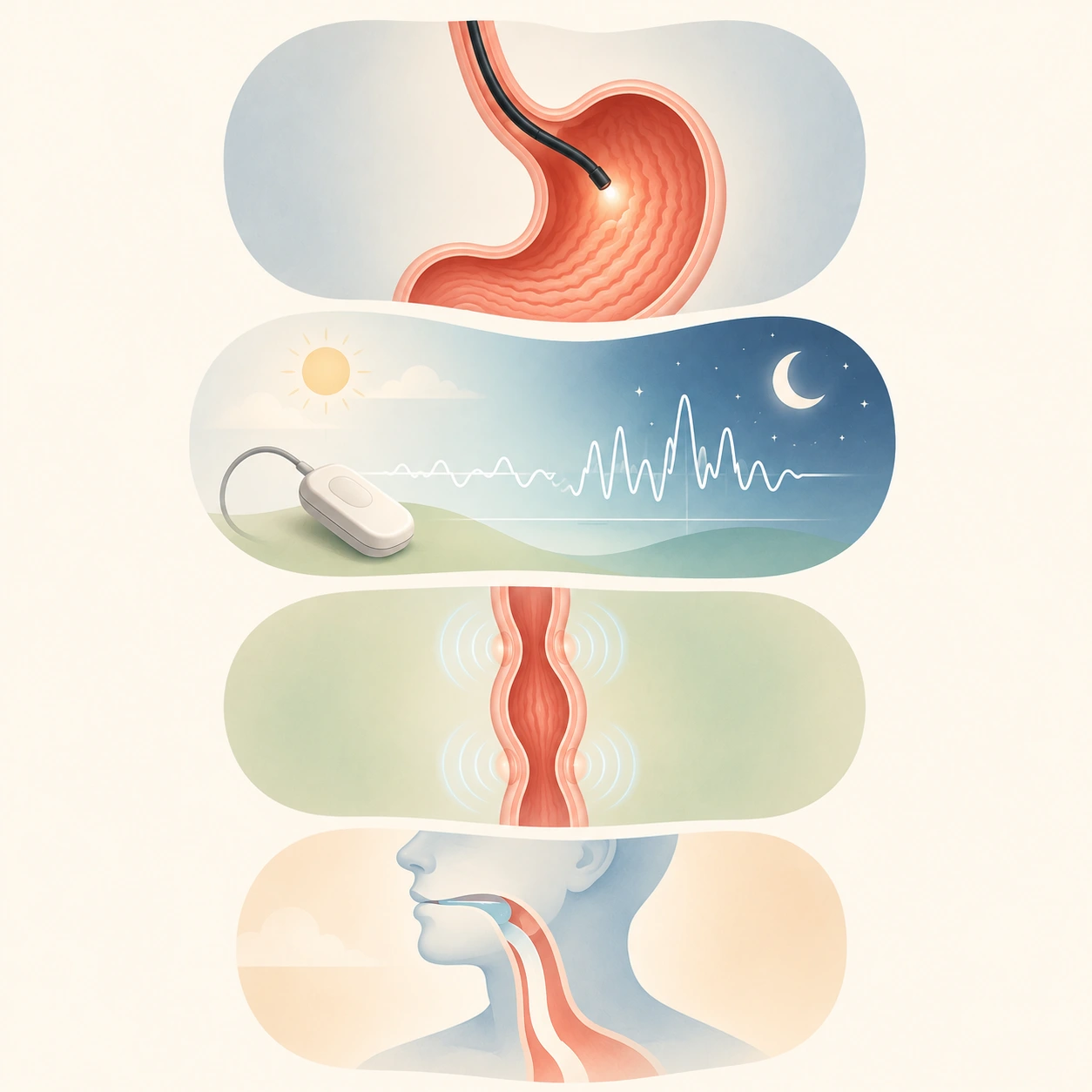
Procedure selection is decided by testing, not by how bad your symptoms feel. Each test answers a different question, and skipping one is how people end up with the wrong operation.
Upper endoscopy answers whether reflux has caused damage. It visualizes the lining, identifies esophagitis, Barrett’s esophagus, ulcers, strictures, and hernias, and allows biopsies.
pH monitoring answers whether reflux is actually happening. This is the reference standard. It’s done with a wireless Bravo capsule or a catheter-based probe, recording over 48 to 72 hours while you eat, work, exercise, and sleep normally. It measures how often reflux occurs, how long each episode lasts, how acidic it is, when it happens, and whether your symptoms line up with the events.
Manometry answers whether your esophagus can handle a procedure. It measures contraction strength, swallow coordination, and sphincter relaxation. Results decide whether a full or partial wrap is safe, whether a magnetic device is appropriate, and whether surgery should be avoided. It also catches achalasia, spasm, and ineffective motility, all of which can imitate reflux and none of which improve with reflux surgery.
Barium swallow answers what happens when you actually swallow. It’s used selectively, mostly for dysphagia, suspected strictures, unclear anatomy, or prior foregut surgery. One finding from this practice is worth repeating: when patients point to where food is sticking, the sensed location matches the true anatomic location only about 60% of the time. People routinely feel an obstruction in the throat that an esophagram proves is sitting in the distal esophagus.
Then there’s the test most centers don’t run. Silent reflux, or LPR, produces throat clearing, hoarseness, cough, mucus, globus sensation, and ear pressure, often with no heartburn at all. Standard reflux testing measures above the lower esophageal sphincter only, which is why so many LPR patients are told their reflux study was normal. Dr. Grandhige uses a customized 24-hour pH impedance dual-channel probe that measures above both the lower and the upper esophageal sphincter, and detects non-acid reflux including bile and pepsin. The reason the second channel matters: the esophagus can tolerate 40 to 50 reflux episodes a day, while the larynx and pharynx can become symptomatic from a single one.
The outcome difference is the point. LPR patients are commonly quoted around a 50% chance that surgery helps. With dual-channel testing used to select candidates, symptom improvement in this practice runs closer to 80%. It also means only about 50 to 60% of tested LPR patients turn out to warrant surgery at all. Fewer operations, better-chosen ones.
The Six-Gate Reflux Decision Path
There is no best reflux operation. There is the right operation for your anatomy, and often the right answer is no operation. Every patient here runs through the same six gates before a procedure is named.
Gate 1: Prove reflux is happening. Objective pH testing, correlation between reflux events and your symptoms, and whether the reflux is acid, non-acid, or bile. If reflux isn’t proven, surgery isn’t recommended, regardless of how convincing the symptoms are.
Gate 2: Map the anatomy. Hernia presence and size, esophageal length and position, the relationship between stomach, diaphragm, and esophagus. Anatomy decides which procedures are even feasible and how durable a repair will be.
Gate 3: Measure esophageal function. Manometry. Contraction strength, coordination, spasm. Ignoring motility is the single most common route to post-operative dysphagia.
Gate 4: Match symptoms to physiology. Which symptoms should improve, which may improve partially, which are unlikely to change at all. This gets said out loud before you decide anything.
Gate 5: Weigh your priorities. Durability, getting off medication, keeping the ability to burp and vomit, minimizing side effects, reversibility. Preference refines the decision inside the boundaries set by Gates 2 and 3. It never overrides them.
Gate 6: Choose a procedure, or choose none. Observation and medical management are real answers, not failures.
What we tell you that most pages leave out
Every one of these procedures has a cost attached. You should hear this version before you decide, not after.
TIF is the least durable option. The failure rate quoted to patients here is about 2% per year, roughly 20% per decade. Most people get years of good symptom relief from it. It is the best endoscopic procedure that exists, and it still should not be described to you as permanent.
Fundoplication can limit burping and vomiting. Because it makes it harder for acid to come up, it can make it harder for air and food to come up too. Gas and bloating are the common complaints. Depending on the wrap, these effects may be temporary or permanent.
LINX carries a higher early dysphagia rate than fundoplication, plus a small but real risk of longer-term swallowing difficulty. There’s also a pattern worth naming: patients who are highly attuned to internal sensation tend to sense the device. As a rule of thumb, people who could feel their Bravo pH capsule while it was in place often report feeling their LINX.
Surgery fixes reflux. It does not fix every symptom. Heartburn and regurgitation may resolve completely while throat symptoms improve only partly and bloating persists from a different mechanism entirely. If expectations aren’t set first, a technically successful operation gets remembered as a failure.
Silent reflux takes longer to improve. Typical heartburn often resolves almost immediately. LPR symptoms generally take 4 to 6 months.
RefluxStop is not available in the United States. Some pages describing local reflux options present it as a current choice. It isn’t one yet. Implantica submitted its final response to FDA questions on the last module of the premarket approval application in May 2026, and the device remains uncleared for sale in the US. It will be offered here once it clears, and not a day before that.
Coming from Clearwater: what the visit actually looks like
Most Clearwater patients make one trip for the consultation and one for the procedure. The process is built to keep it that way.
Before you come, send your records to info@tampareflux.com. That means endoscopy and pathology reports, pH results from Bravo or catheter studies, manometry, barium swallow or other imaging, office notes from gastroenterology, ENT, pulmonology, and allergy, a current medication list, and any prior surgeries. Dr. Grandhige reviews all of it personally before you arrive, which is what lets the visit be spent on explanation instead of data gathering. Signed record releases alone frequently aren’t enough. Fax-based systems and incompatible electronic records mean patients are usually the most reliable carriers of their own history.
Getting in takes under 2 weeks in most cases and never more than 4.
If your testing is already complete, one consultation is typically all that’s needed. The diagnosis can often be confirmed that day and the plan set.
If testing isn’t complete, expect two visits about 4 weeks apart. The first covers education, record review, and test planning. Studies get ordered in between, routed near Clearwater when they can be performed properly there. The second reviews results and finalizes the plan.
From first visit to surgery runs about 4 weeks when testing is already done and about 8 weeks when it isn’t, with authorization moving in parallel.
The surgery itself happens at HCA South Tampa Hospital, every time. Same operating room team, same anesthesiologists who understand foregut physiology, and the same physician assistant on every case. Operating at one facility rather than four means the equipment is set up correctly and the team anticipates the steps. Most patients go home the same day.
Afterward, the physician assistant who was in your operation handles your questions and knows your specific anatomy. Dr. Grandhige is reachable directly after hours. Much of the office staff has been with the practice more than a decade, which means the person answering your call about GERD testing has heard the question several thousand times.
About the surgeon
Gopal Grandhige, MD, FACS. Board-certified general surgeon. Founder and Medical Director of Tampa Bay Reflux Center from 2009 to 2022, and of Tampa Bay Reflux Institute since 2022. Practicing foregut surgery in Tampa Bay since 2009.
- BS in Biology, Johns Hopkins University
- MD, University of Michigan, Ann Arbor
- General Surgery Residency, Yale-New Haven Hospital
- Fellowship in Burn and Critical Care, Yale-New Haven Hospital
- Fellowship in Foregut Surgery and Minimally Invasive Surgery, Yale-New Haven Hospital
- Founding Member, American Foregut Society
- Member, Society of American Gastrointestinal and Endoscopic Surgeons
- Fellow, American College of Surgeons
Credentials can be independently confirmed through the American Board of Surgery physician lookup, the American College of Surgeons directory, and the Florida Department of Health Medical Quality Assurance license search.
Frequently asked questions
Ready to find out what’s actually causing it?
If you’ve been on acid suppression for years and still don’t feel normal, the next step isn’t a higher dose. It’s finding out whether reflux is happening, why, and whether the mechanics can be corrected.


An endoscopy cannot tell you if you have reflux. It can only tell you if you have complications of GERD.
If you are unhappy with your reflux symptoms, come in and we can discuss testing and treatments that can accurately diagnose your problem.
#reflux #gerd #hiatalhernia #gastroparesis #linx


CALL US AT 813-922-2920
www.tampareflux.com
If you have a hiatal hernia and fit one of these categories, you should know your options.
Dr. Grandhige is an expert in his field and performs 200 of these surgeries a year. He is the only surgeon in the Tampa Bay Area who offers all surgical options - LINX, Fundoplications, TIF and will be one of 20 surgeons in America introducing the latest procedure RefluxStop in 2026.
We accept most insurances but will verify yours before you come in. These procedures are considered medically necessary and covered by your insurance. You can expect to pay your in-network deductibles and nothing else.
#hiatalhernia #reflux #GERD #LINX #refluxstop

What causes reflux ?
1. Weak lower esophageal sphincter
2. Hiatal hernia
3. Flattening of the Angle of His
4. Poor esophageal motility
5. Gastroparesis (slow stomach)
NOT increased acid production


Don’t let GERD get in the way of living your life. Request your appointment with us today on the link below.
.
.
.
.
https://tampareflux.com/contact-us/

Anyone can be victim to GERD and though weight loss can help reduce GERD symptoms. Many athletes with high impact workouts may continue to have these symptoms. This may be a symptom of a hiatal hernia or other issue. We are more then happy to assist you in finding your solution, just click the link below.
.
.
.
https://tampareflux.com/contact-us/
##healthylifestyle #workout #athletereflux #PPIs #heartburn #LINX #fundoplication #TIF #GERD#tampaheartburn #linx #TIF #fundoplication #tampabayreflux #GERD #acidreflux #acidrefluxsurgery #stopreflux
#nonsurgicalweightloss #ESG #gastricballoon #weightlossjourney #vsg #vsgjourney #spatz3 #orbera #orberaballoon #grandhige #DrG
#tampabayrefluxinstitute #guthealth #roboticsurgery

Heartburn may seem like an annoyance. But if you find yourself having symptoms on a daily basis, it may be time to to talk to Dr. Grandhige as it could be a symptom of something worse.
.
.
.
#chronicheartburn #gerdsymptoms #heartburnrelief #reflux #PPIs #heartburn #LINX #fundoplication #TIF #GERD#tampaheartburn #linx #TIF #fundoplication #tampabayreflux #GERD #acidreflux #acidrefluxsurgery #stopreflux
#nonsurgicalweightloss #ESG #gastricballoon #weightlossjourney #vsg #vsgjourney #spatz3 #orbera #orberaballoon #grandhige #DrG
#tampabayrefluxinstitute #guthealth #roboticsurgery

If you are tired of avoiding your favorite foods or taking daily medications, we can help.
We are the Tampa experts in reflux ! With years of experience and thousands of patients treated successfully, we offer all FDA approved anti-reflux procedures.
Call 813-922-2920 to schedule your appointment
All major insurances accepted.

Not all patients need surgical intervention. Many patients are living a heartburn free life with their PPIs. However 40% of patients taking PPIs are not getting the relief they need. If you are one of those, you have options! Come in and find out more.
.
.
.
.
#letushelpyou #medsnotworking #reflux #PPIs #heartburn #LINX #fundoplication #TIF #GERD#tampaheartburn #linx #TIF #fundoplication #tampabayreflux #GERD #acidreflux #acidrefluxsurgery #stopreflux
#nonsurgicalweightloss #ESG #gastricballoon #weightlossjourney #vsg #vsgjourney #spatz3 #orbera #orberaballoon #grandhige #DrG
#tampabayrefluxinstitute #guthealth #roboticsurgery

#heartburn #stopreflux #hiatalherniarepair #severeheartburn #reflux #tampabayreflux #acidrefluxsurgery #tampaheartburn #GERD #PPIs #achalasia #LINX #TIF #tampareflux #fundoplication #stomach #digestivehealth #ESG #obesity #overweight #weightlossjourney #gastricballoon
