
Why acid medication stops working, even when you take it exactly right
Most people with reflux disease produce a normal amount of stomach acid. The problem is usually mechanical. The valve at the bottom of the esophagus has weakened, the diaphragm no longer braces it, and in most cases a hiatal hernia has let the top of the stomach slide upward into the chest. Acid is the irritant. It is not the cause.
That distinction explains why your medication plateaued. A proton pump inhibitor blocks acid production for roughly 12 to 16 hours of the day. An H2 blocker like famotidine works for about 4 to 6 hours and takes around 30 minutes to start. Neither one strengthens a weak sphincter. Neither one repairs a diaphragm. The reflux keeps happening on the same schedule, carrying bile, pepsin and other digestive enzymes upward, and only the acidity of it has changed.
Dr. Grandhige puts it to patients this way: reflux medications turn down the burn, but they do not stop the leak.
This is also why doses creep. Symptoms improve, then return, then need twice-daily dosing, then need a second drug added at night. Each escalation treats the irritant harder while the mechanical defect stays exactly where it was. If you want to understand the underlying disease before your first visit, the GERD overview covers the mechanics in more depth.
The three tests that decide everything, and the one that gets skipped
An upper endoscopy cannot diagnose GERD. This is the single most common misunderstanding in reflux care, and it is why so many Wesley Chapel patients arrive having been told nothing is wrong.
Endoscopy answers one question: has reflux caused visible damage? It finds esophagitis, Barrett’s esophagus, strictures and hernias, and it allows biopsies. It does not measure reflux events, it does not assess sphincter function, and it does not tell you how often reflux happens or when. A completely normal endoscopy is common in people with severe reflux, especially anyone already on acid suppression. Small hiatal hernias are also missed on endoscopy routinely.
pH monitoring is the test that actually diagnoses reflux. Using either a wireless Bravo capsule or a catheter-based probe, it records over 48 to 72 hours while you eat, sleep, work and exercise normally. It measures how often reflux occurs, how long each episode lasts, when it happens, and whether your symptoms line up with actual reflux events. Reflux is a dynamic process. A snapshot taken in a clinic room cannot capture it.
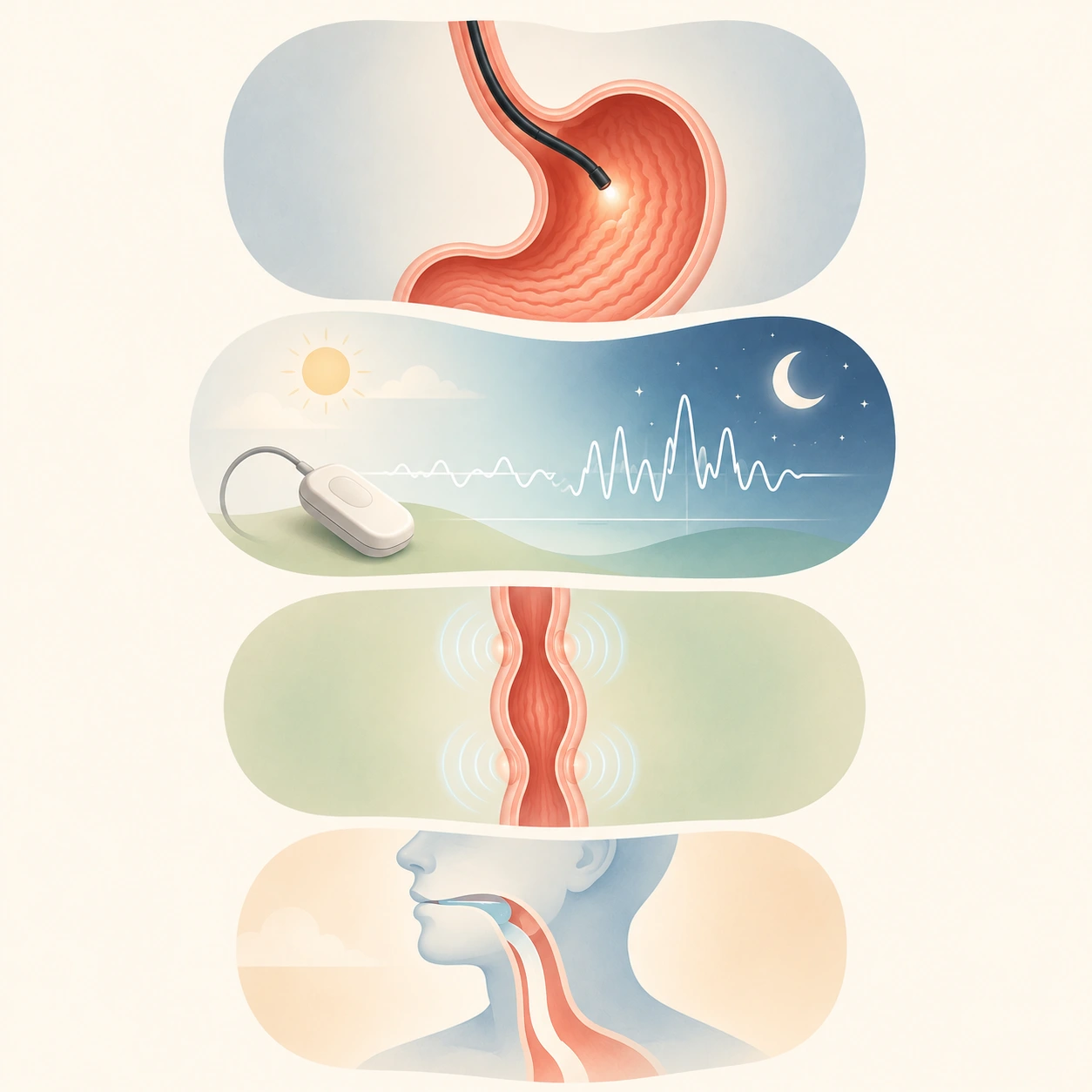
Esophageal manometry is the test most often skipped, and it decides which operation is safe for you. It measures contraction strength, swallowing coordination, and how the lower sphincter relaxes. Every anti-reflux procedure adds resistance at the bottom of the esophagus. If the esophagus is not strong enough to push food past that resistance, the result is food sticking, chest pain and long-term swallowing trouble. Manometry also identifies achalasia and esophageal spasm, both of which can look like reflux and both of which get worse after a reflux operation.
A barium swallow gets used selectively, mostly when someone reports food sticking or has had prior foregut surgery. One reason it earns its place: patients correctly identify where food is hanging up only about 60 percent of the time. Someone will feel it in the throat when the study shows the delay is in the lower esophagus.
Which procedure fits which patient
There is no best reflux operation. There is the operation that matches your anatomy, your esophageal motility and your priorities, and sometimes the right answer is no operation. Dr. Grandhige performs all three current procedures with regularity, which means procedure selection is driven by your testing rather than by what a surgeon is most comfortable doing.
What actually changed in reflux treatment in 2026
Two developments this year are worth knowing about, and neither one appears on most local heartburn pages yet.
RefluxStop received FDA premarket approval on August 20, 2026. Implantica announced the approval after a full FDA review that included five-year clinical data. The device works on a different principle from everything else available. It does not encircle the esophagus or apply pressure to it the way a wrap or a magnetic ring does. Instead it repositions the gastroesophageal junction back below the diaphragm and holds it there, restoring the natural anatomy rather than adding resistance. The European five-year outcomes, including data on dysphagia, gas bloating and ability to belch, are published in peer-reviewed literature.
Tampa Bay Reflux Institute is adding RefluxStop, which will make Dr. Grandhige the only surgeon in the Tampa Bay area offering all four anti-reflux procedures. Being direct about the timing: the U.S. rollout is staged and requires site activation and surgeon training at each center, so this is not something being scheduled today. Ask about it at your consultation and you will get a current answer rather than a marketing one.
On the medication side, vonoprazan (Voquezna) is now available. It is the first potassium-competitive acid blocker approved in the United States, and it is a real pharmacologic advance. P-CABs bind reversibly, are stable in acid, and are not affected by the presence of food, so unlike most PPIs it does not have to be timed around meals.
Here is where Dr. Grandhige’s view diverges from most coverage of it. A better acid blocker is still an acid blocker. If your reflux is driven by a 4 cm hiatal hernia and a sphincter that has stopped closing, a faster and steadier rise in stomach pH does not repair the diaphragm and does not stop the reflux events. It changes what is in the fluid moving upward. For symptom control while you go through testing, it is a reasonable option to discuss with your prescriber. As an answer to the question of why this is happening to you, it is not one.
Who should not have reflux surgery
Dr. Grandhige declines to operate on a meaningful share of the people who come in specifically asking for surgery. That is the point of testing first.
An anti-reflux procedure is not recommended when reflux has not been objectively proven, regardless of how convincing the symptoms are. Several conditions produce reflux-like symptoms and do not respond to reflux surgery: esophageal hypersensitivity, functional chest pain, rumination, and untreated severe motility disorders. Achalasia is its own diagnosis with its own operation, a Heller myotomy, and treating it as reflux makes people worse. As noted above, only about half to 60 percent of patients presenting with throat-predominant symptoms have testing that supports a procedure.
Dr. Grandhige is candid that the patients he turns down are often the least happy leaving the office. They came for a solution and left with a diagnosis they did not want. His position is that those same people would be considerably less happy after an operation that carried real recovery and did not touch the symptom. When surgery is not the answer, he refers to ENT, pulmonology, allergy or gastroenterology through relationships he has built over 16 years in Tampa Bay, so the handoff does not restart the diagnostic process from zero.
For patients who do proceed, expectations get set item by item before anything is scheduled. He names which symptoms he expects to improve, which may improve partially, and which are unlikely to be reflux-related at all. Anything remaining at six months gets reassessed then, sometimes with another specialist. One recovery detail that surprises people: vomiting after surgery is associated with early failure of a hiatal hernia repair, which is why the staged diet is a structural requirement and not a suggestion.
His summary of the whole discipline, and the reason the practice looks the way it does: the most important skill in reflux surgery is knowing when not to operate, and which operation not to do.
What the trip from Wesley Chapel actually looks like
Most Wesley Chapel patients make two trips to South Tampa before surgery. Some make one. The number depends entirely on what testing you have already had, which is why the single most useful thing you can do is send your records before you drive down.
Email prior studies to info@tampareflux.com ahead of your appointment. That means endoscopy and pathology reports, any pH testing including Bravo studies, manometry results, barium swallow or other imaging, office notes from your gastroenterologist and any ENT, pulmonology or allergy visits, a current medication list, and a list of prior surgeries. Dr. Grandhige personally reviews all of it before you walk in. Signed record releases get submitted too, but releases are slow and frequently come back incomplete, and in the current system patients are the most reliable carriers of their own history. Studies from years ago still count; they show progression.
If your testing is already complete, one consultation is usually enough. Diagnosis can be confirmed at that visit, options discussed the same day, and surgery scheduled as early as roughly four weeks out. If testing is not complete, the first visit covers education, record review and test planning, a second visit about four weeks later reviews results and finalizes the plan, and surgery typically falls around eight weeks from the first appointment. New patients are usually seen within two weeks and always within four. Insurance authorization is handled entirely by the office and runs in parallel rather than after the fact.
Testing gets routed through a small number of trusted sites, which is a scheduling decision rather than a convenience one: fewer sites means faster appointments, consistent test quality and results that come back promptly. For patients traveling in, anything that can reasonably be done closer to home is done closer to home so the trip stays efficient.
The office is at 1315 South Howard Avenue, Suite 101, Tampa, FL 33606, in the yellow brick building next to Sally O’Neill’s Pizza, with parking behind the restaurant. Hours are 9am to 6pm Monday through Friday, and the number is 813.922.2920. All surgery is performed at HCA South Tampa Hospital, where Dr. Grandhige operates exclusively with the same anesthesia and nursing team and his own physician assistant present in every case. That PA knows your anatomy and your operation and is reachable during recovery, and after hours you can reach Dr. Grandhige directly. You can read more about his training and background before deciding whether the drive is worth it.

Questions Wesley Chapel patients ask before the first visit
Medically reviewed by Gopal Grandhige, MD, FACS Board-Certified General Surgeon | Founder and Medical Director, Tampa Bay Reflux Institute
Dr. Grandhige has practiced foregut surgery in Tampa Bay since 2009, founding Tampa Bay Reflux Center in 2009 and Tampa Bay Reflux Institute in 2022. He completed his undergraduate degree in biology at Johns Hopkins University, earned his medical degree at the University of Michigan, and completed his general surgery residency along with fellowships in Burn and Critical Care and in Foregut and Minimally Invasive Surgery at Yale-New Haven Hospital. He is a Founding Member of the American Foregut Society, a member of the Society of American Gastrointestinal and Endoscopic Surgeons (SAGES), and a Fellow of the American College of Surgeons. He holds privileges at St. Joseph’s Main Hospital, St. Joseph’s South Hospital, HCA Brandon Hospital and HCA South Tampa Hospital, and performs all surgery at HCA South Tampa. His practice covers benign foregut disease only: GERD, hiatal hernias, laryngopharyngeal reflux, achalasia and gastroparesis.
Board certification can be verified through the American Board of Surgery physician lookup and the American College of Surgeons directory. Active Florida licensure can be verified through the Florida Department of Health Medical Quality Assurance license lookup.


An endoscopy cannot tell you if you have reflux. It can only tell you if you have complications of GERD.
If you are unhappy with your reflux symptoms, come in and we can discuss testing and treatments that can accurately diagnose your problem.
#reflux #gerd #hiatalhernia #gastroparesis #linx


CALL US AT 813-922-2920
www.tampareflux.com
If you have a hiatal hernia and fit one of these categories, you should know your options.
Dr. Grandhige is an expert in his field and performs 200 of these surgeries a year. He is the only surgeon in the Tampa Bay Area who offers all surgical options - LINX, Fundoplications, TIF and will be one of 20 surgeons in America introducing the latest procedure RefluxStop in 2026.
We accept most insurances but will verify yours before you come in. These procedures are considered medically necessary and covered by your insurance. You can expect to pay your in-network deductibles and nothing else.
#hiatalhernia #reflux #GERD #LINX #refluxstop

What causes reflux ?
1. Weak lower esophageal sphincter
2. Hiatal hernia
3. Flattening of the Angle of His
4. Poor esophageal motility
5. Gastroparesis (slow stomach)
NOT increased acid production


Don’t let GERD get in the way of living your life. Request your appointment with us today on the link below.
.
.
.
.
https://tampareflux.com/contact-us/

Anyone can be victim to GERD and though weight loss can help reduce GERD symptoms. Many athletes with high impact workouts may continue to have these symptoms. This may be a symptom of a hiatal hernia or other issue. We are more then happy to assist you in finding your solution, just click the link below.
.
.
.
https://tampareflux.com/contact-us/
##healthylifestyle #workout #athletereflux #PPIs #heartburn #LINX #fundoplication #TIF #GERD#tampaheartburn #linx #TIF #fundoplication #tampabayreflux #GERD #acidreflux #acidrefluxsurgery #stopreflux
#nonsurgicalweightloss #ESG #gastricballoon #weightlossjourney #vsg #vsgjourney #spatz3 #orbera #orberaballoon #grandhige #DrG
#tampabayrefluxinstitute #guthealth #roboticsurgery

Heartburn may seem like an annoyance. But if you find yourself having symptoms on a daily basis, it may be time to to talk to Dr. Grandhige as it could be a symptom of something worse.
.
.
.
#chronicheartburn #gerdsymptoms #heartburnrelief #reflux #PPIs #heartburn #LINX #fundoplication #TIF #GERD#tampaheartburn #linx #TIF #fundoplication #tampabayreflux #GERD #acidreflux #acidrefluxsurgery #stopreflux
#nonsurgicalweightloss #ESG #gastricballoon #weightlossjourney #vsg #vsgjourney #spatz3 #orbera #orberaballoon #grandhige #DrG
#tampabayrefluxinstitute #guthealth #roboticsurgery

If you are tired of avoiding your favorite foods or taking daily medications, we can help.
We are the Tampa experts in reflux ! With years of experience and thousands of patients treated successfully, we offer all FDA approved anti-reflux procedures.
Call 813-922-2920 to schedule your appointment
All major insurances accepted.

Not all patients need surgical intervention. Many patients are living a heartburn free life with their PPIs. However 40% of patients taking PPIs are not getting the relief they need. If you are one of those, you have options! Come in and find out more.
.
.
.
.
#letushelpyou #medsnotworking #reflux #PPIs #heartburn #LINX #fundoplication #TIF #GERD#tampaheartburn #linx #TIF #fundoplication #tampabayreflux #GERD #acidreflux #acidrefluxsurgery #stopreflux
#nonsurgicalweightloss #ESG #gastricballoon #weightlossjourney #vsg #vsgjourney #spatz3 #orbera #orberaballoon #grandhige #DrG
#tampabayrefluxinstitute #guthealth #roboticsurgery

#heartburn #stopreflux #hiatalherniarepair #severeheartburn #reflux #tampabayreflux #acidrefluxsurgery #tampaheartburn #GERD #PPIs #achalasia #LINX #TIF #tampareflux #fundoplication #stomach #digestivehealth #ESG #obesity #overweight #weightlossjourney #gastricballoon
