
Why Your Heartburn Keeps Coming Back
Acid-suppressing medication reduces the acidity of what refluxes. It does not stop the reflux.
A proton pump inhibitor blocks acid production for roughly 12 to 16 hours a day. An H2 blocker like famotidine lasts about 4 to 6 hours and takes around 30 minutes to start, which makes it useful on an as-needed basis rather than as a foundation. Neither strengthens a weak lower esophageal sphincter, repairs a hiatal hernia, or prevents a single reflux event. What comes up is still stomach contents, including bile, pepsin and trypsin, none of which are acid and none of which are touched by acid suppression.
That is why the pattern is so consistent. The medication helps at first. Symptoms creep back. The dose goes up. A second drug gets added. The mechanical problem underneath never moved.
A newer class is worth knowing about. Vonoprazan is a potassium-competitive acid blocker approved in the US in 2024 for heartburn associated with non-erosive GERD. It binds at a different site than a PPI and works with or without food. It is still acid suppression, so it has the same ceiling, but if you have cycled through the standard options it is a fair thing to raise with your Brandon primary care doctor before you drive anywhere.
One thing worth knowing before your next pharmacy run. A lot of reflux advice online recommends a liquid alginate, which floats a gel raft on top of the stomach contents instead of neutralizing acid. The product those clinical studies used is Gaviscon Advance, a UK pharmacy formulation with 1,000 mg of sodium alginate and 200 mg of potassium bicarbonate per 10 ml dose. It is not sold in the United States. The Gaviscon on the shelf at the Walgreens and CVS locations on Parsons Avenue and Bloomingdale Avenue is a different product built on aluminum hydroxide and magnesium carbonate, which work as conventional antacids. US products built around the raft mechanism exist, but they have to be ordered rather than picked up, and they carry a sodium load worth checking if you watch your salt. Shelf stock was last checked in October 2026 and varies by store.
People try the alginate approach, buy the wrong formulation, get nothing from it, and conclude nothing works. The raft approach has real limits either way, which brings us to the mechanism.
What Reflux Actually Is
Reflux is a mechanical and physiologic problem. Acid is the irritant, not the cause. Most patients with GERD produce a normal amount of stomach acid.
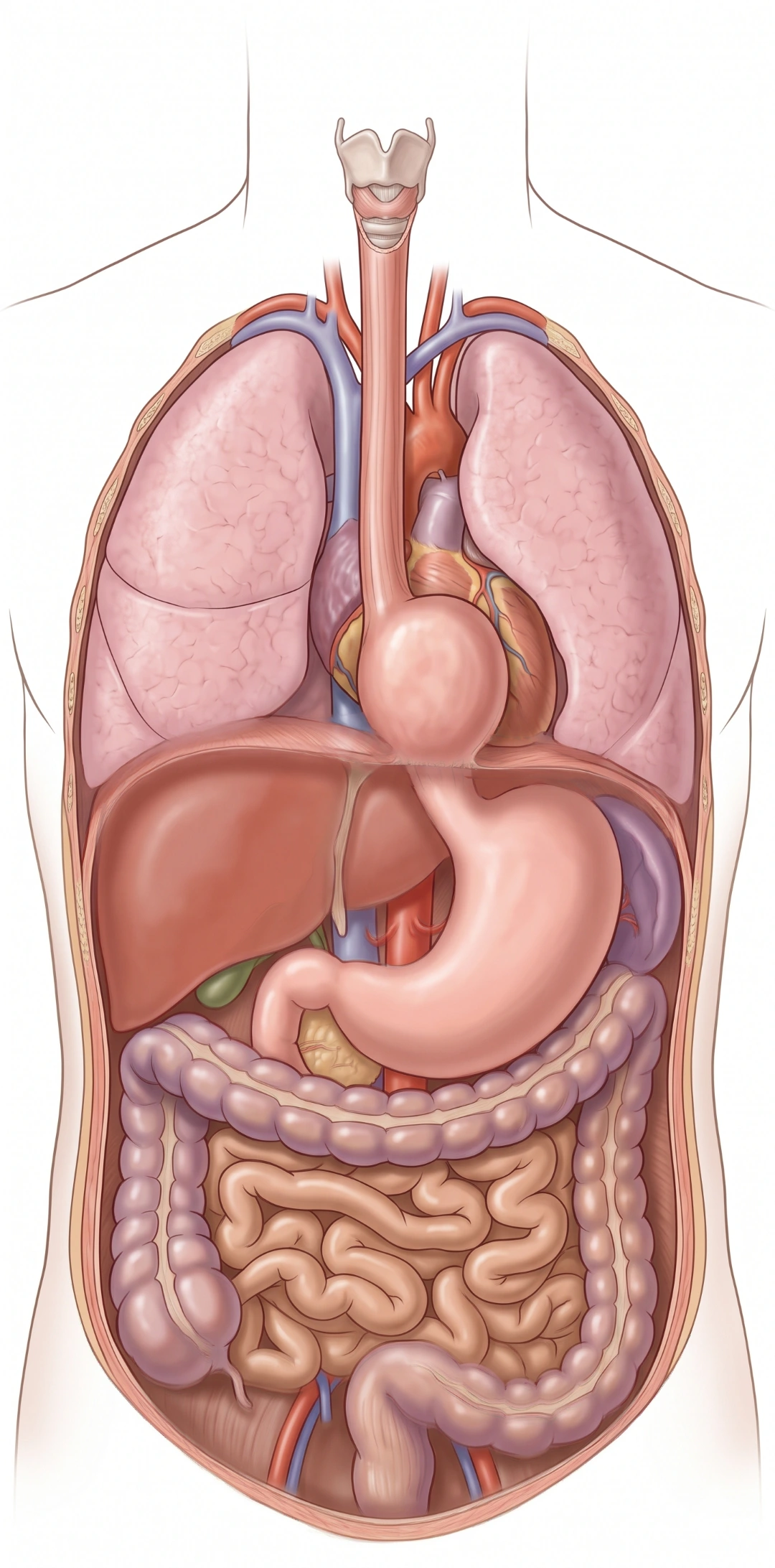
Your body prevents reflux with a two-part barrier. The first part is the lower esophageal sphincter, a muscular valve where the esophagus meets the stomach. The second is the diaphragm, which wraps that junction and tightens further when you engage your core to bend, lift or exercise. There is also a natural angle between esophagus and stomach, the angle of His, that helps the arrangement seal. If one part fails, reflux occurs. If both fail, reflux is close to inevitable.
A hiatal hernia is what happens when the opening in the diaphragm stretches and the stomach slides upward into the chest. The sphincter moves into a pressure environment that favors reflux rather than preventing it, the angle of His opens up, and the diaphragm stops supporting the valve. Almost every reflux patient has some degree of hiatal hernia, often small enough that nobody mentioned it and nothing showed on endoscopy. In larger hernias other structures can migrate upward too, including portions of intestine, the spleen and rarely parts of the pancreas.
Hernias are not the result of anything you did wrong. They come from ordinary wear on the diaphragm over years, and they are more common after pregnancy, with weight fluctuation, with chronic coughing or straining, and in people who lift heavy things for work or for sport.
This is also why a normal endoscopy does not rule reflux out. Endoscopy answers one question: has reflux caused visible damage? It does not measure reflux events or assess sphincter function. Many patients with severe reflux have a completely normal endoscopy, especially while taking acid suppression. The National Institute of Diabetes and Digestive and Kidney Diseases defines GERD by reflux causing repeated symptoms or complications over time, which is a definition about behavior, not about what a camera sees on one afternoon.
How Reflux Gets Proven Before It Gets Treated
Dr. Grandhige works through a six-step decision process before any procedure is discussed. He puts it to patients this way: the operation is the last step, and the decision-making is the surgery.
The Six-Step Reflux Decision Process
- Confirm reflux is occurring. Objective pH testing, correlation of reflux events with your symptoms, and whether the reflux is acid, non-acid or bile-related. If reflux is not proven, no procedure is recommended, however convincing the symptoms are.
- Map the anatomy. Presence and size of a hiatal hernia, esophageal length and position, and the relationship between stomach, diaphragm and esophagus. Anatomy decides which procedures are even possible and how durable a repair will be.
- Measure esophageal function. Contraction strength, swallowing coordination, spasm or motility disorder. This decides whether a full or partial wrap is safe, whether a magnetic device is appropriate, and whether surgery should be avoided outright.
- Match each symptom to physiology. Separating symptoms very likely to be reflux-related from those unlikely to be, and those that are multifactorial.
- Weigh your priorities. Durability, medication elimination, the ability to burp and vomit, side-effect profile, reversibility. Preference refines the decision inside the limits set by anatomy and function. It never overrides them.
- Choose a procedure, or choose none. Observation and medical management are live options here, not consolation prizes.
Four tests feed that process, and each answers a different question.
Upper endoscopy answers whether reflux has caused damage. It finds esophagitis, Barrett’s esophagus, ulcers, strictures and hernias, allows biopsies, and is how a pH probe gets placed.
Esophageal pH monitoring answers whether reflux is happening, how often, for how long, and whether it lines up with what you feel. The study runs 48 to 72 hours with either a wireless Bravo capsule or a catheter probe while you eat, sleep, work and exercise normally. A snapshot taken in a clinic cannot capture a process this dynamic.
Esophageal manometry answers whether your esophagus has the strength and coordination to handle added resistance at the junction. It identifies achalasia, esophageal spasm, ineffective motility, jackhammer and nutcracker patterns, and a hypertensive sphincter. Skipping it is how patients end up with swallowing problems that were predictable.
Barium swallow answers what happens when you actually swallow, and gets used selectively: food sticking, suspected stricture, unclear anatomy, or prior foregut surgery. It is also useful for a reason patients find surprising. Where you feel food catching is only where it is actually catching about 60 percent of the time. People point at their throat when the imaging shows the delay is down in the distal esophagus.
Silent Reflux (LPR), and Why It Gets Missed
Silent reflux is not a milder version of reflux. It is reflux in the wrong place, and the tissue it reaches is far less tolerant.
The esophageal lining handles roughly 40 to 50 reflux episodes a day. The larynx and pharynx can develop symptoms from as little as one episode a day. That gap explains how laryngopharyngeal reflux behaves: chronic throat clearing, hoarseness, cough, a sensation of mucus or postnasal drip, sinus drainage, ear fullness, and globus, the feeling of a lump in the throat, often with little or no heartburn.
Because those symptoms sit outside the esophagus, patients usually see an ENT physician, a pulmonologist or an allergist first, get treated for allergies, asthma or sinus disease, and improve very little. Then standard reflux testing comes back normal and the file closes. Standard testing measures reflux above the lower esophageal sphincter. It does not measure whether anything is reaching the throat.
Dr. Grandhige uses a customized 24-hour pH impedance dual-channel probe that measures at two levels: above the lower esophageal sphincter and above the upper esophageal sphincter. The impedance component matters because the larynx reacts to more than acid. Bile, pepsin and trypsin all reach it, and none of them register on acid-only testing.
The outcome difference is the point. Patients with throat symptoms are commonly told surgery has roughly a 50 percent chance of helping, which is an honest figure when selection rests on incomplete data. With dual-channel testing identifying who is actually refluxing into the pharynx, Dr. Grandhige reports symptom improvement near 80 percent among the patients he selects. Roughly 50 to 60 percent of LPR patients who come to him have testing that supports a procedure. The rest do not, and are told so. He operates on fewer people and on better-chosen ones.
One expectation worth setting early: LPR symptoms typically take 4 to 6 months to improve after a procedure, while typical heartburn and regurgitation often resolve overnight. Patients who expect the same timeline for both get discouraged for no reason. This testing is not routinely performed in most practices because it is technically demanding and the interpretation is unforgiving.
Four Procedures, and Who Each One Is Wrong For
There is no best reflux operation. There is a right operation for a specific patient, and often the right decision is not to operate at all. Dr. Grandhige performs all four major anti-reflux procedures, so the recommendation is not shaped by what he happens to be comfortable with.
Fundoplication. The fundoplication uses the upper part of your own stomach, wrapped around the lower esophagus, to reinforce the failing valve. The hiatal hernia is repaired first and the diaphragm tightened to support the esophagus. A wrap built without repairing the diaphragm produces inferior results, which is one reason reflux surgery earned a poor reputation decades ago. He performs four configurations: Nissen at 360 degrees, Toupet as a posterior 270, Watson as an anterior 270, and Dor as an anterior partial, with manometry driving the choice. Operative time is 1.5 to 2 hours, typically outpatient with same-day discharge, and diet progresses over 2 to 3 months. In appropriately selected patients his practice reports symptom resolution and elimination of daily reflux medication in over 90 percent of cases. The trade-off is real: a fundoplication makes it harder for air and food to come up as well as acid, so bloating and reduced ability to vomit are possible, temporary or permanent depending on configuration. Patients with untreated severe motility disorders are not candidates.
LINX. The LINX magnetic sphincter augmentation system is a ring of magnetic titanium beads placed around the lower esophagus. It does not raise resting sphincter pressure. It resists opening when stomach pressure rises, such as after a meal, while still letting food pass on a swallow. Most patients keep the ability to burp and vomit once early inflammation settles, which is the main draw for people worried about gas-bloat. It is reversible, it preserves stomach anatomy, and it is MRI compatible up to 1.5 Tesla. Operative time is 1.5 to 2 hours, outpatient. Two corrections to what you have probably read. Hernia size does not disqualify you from LINX as long as the hernia is repaired at the same operation. And LINX is not a lighter version of surgery, it is a different physiologic solution with its own requirements. Motility has to be good, because your esophagus must push food through the device. Early swallowing difficulty is common and recovery involves deliberately eating small amounts hourly. One detail you will not find elsewhere: patients who are unusually attuned to internal sensation tend to feel the device. People who could feel a Bravo pH capsule while it was in place usually report feeling their LINX.
TIF. Transoral incisionless fundoplication is performed entirely through the mouth with an endoscope and the EsophyX device, with no abdominal incisions. It folds stomach tissue around the lower esophagus from the inside and secures it with fasteners, lengthening the reflux barrier and recreating a valve. In patients without a hernia it also restores the angle of His. It takes about 45 to 60 minutes under general anesthesia and patients go home the same day. Discomfort shows up in the chest, left shoulder and upper abdomen from swelling and sutures, and some patients get muscle spasms treated with medication. Heavy lifting is restricted for 6 weeks, and the diet progression has to be followed or the internal repair loses integrity. Here is the limitation that decides everything: TIF cannot repair a hiatal hernia or address the diaphragm, because the work happens from inside the stomach. Dr. Grandhige quotes a failure rate near 2 percent per year, roughly 20 percent per decade. He calls it the best endoscopic procedure available and a durable solution for many years rather than a permanent one. He declines to perform TIF outside tight criteria, specifically anyone with more than a minimal hiatal hernia and anyone who is obese, along with patients who have severe esophagitis, Barrett’s esophagus or peptic strictures. Most of TIF’s mixed reputation comes from being used outside those boundaries.
RefluxStop. The FDA granted premarket approval for RefluxStop on August 20, 2026 under PMA number P250018. It works differently from everything above. Rather than wrapping the esophagus or encircling it, it repositions the gastroesophageal junction into its natural place below the diaphragm and holds it there, without putting continuous pressure on the food passageway. Approval rested on five-year published outcomes from roughly 1,800 European patients treated since 2018. The approval order also requires a post-approval study enrolling 200 patients followed for five years, with at least half the sites in the United States. Dr. Grandhige is adding RefluxStop, which will make him one of a small number of US surgeons offering all four major options.
An honest note on availability. As of October 2026, commercial launch is authorized but rollout is limited to selected centers with completed device training. RefluxStop is not yet a routine option at HCA Brandon Hospital or most local hospitals. If you read a page implying you can schedule it near Brandon next month, that page is ahead of reality. Ask directly about current availability rather than assuming.
Getting From Brandon to an Answer
Most patients are seen within 2 weeks, and always within 4. The full path from first consultation to surgery runs 4 to 8 weeks, and which end you land on depends on one thing: whether your testing is already done.
If you arrive with completed testing, meaning upper endoscopy, pH study, manometry and relevant imaging, one consultation is usually enough. The diagnosis can be confirmed that day, options discussed immediately, and authorization paperwork started by the office. Surgery can often be scheduled about 4 weeks out.
If testing is not complete, the first visit covers education, record review and test planning. Studies are ordered and coordinated, and a second consultation about 4 weeks later reviews results and finalizes the plan. That path lands near 8 weeks from first visit to surgery.
Send your records ahead to info@tampareflux.com before the appointment. Dr. Grandhige personally reviews everything before you arrive: prior endoscopy and pathology reports, pH studies whether Bravo or catheter-based, manometry, barium swallow and imaging, office notes from your gastroenterologist, ENT, pulmonologist and allergist, your medication history and prior surgeries. Studies from years ago still matter, because they show how the disease has moved. A signed records release gets filed on day one, but releases are routinely slow, fax systems still fail, and records between unaffiliated practices often do not transfer cleanly. Patients who bring their own records get a far more definitive first visit.
Where you are going. The office is at 1315 South Howard Avenue, Suite 101, Tampa, FL 33606, in a yellow brick building next to Sally O’Neill’s Pizza, with parking behind the restaurant. Hours are 9am to 6pm Monday through Friday. Phone is 813.922.2920. From Brandon it is a direct run west on the Lee Roy Selmon Expressway.
Where surgery happens. All foregut and reflux surgery is performed at HCA South Tampa Hospital. Dr. Grandhige holds privileges at St. Joseph’s Main, St. Joseph’s South and HCA Brandon Hospital as well, and used to operate across several of them. He consolidated deliberately. The same anesthesiologists, nurses and surgical technologists work these cases with him, the specialized equipment is set up the same way every time, and his own employed physician assistant assists in every operation and handles postoperative calls. Anesthesia management matters more here than patients expect, because vomiting after a hiatal hernia repair is associated with early failure of the repair.
For patients coming from outside South Tampa, the office works with a short list of testing sites, groups studies onto the fewest possible days, and arranges a study closer to home when that is possible.

Common Questions From Brandon Patients
You do not have to accept daily medication as a permanent arrangement, and you do not have to accept surgery as the price of finding out what is wrong. Reflux is a mechanical condition and it can be measured. Once it is measured, the right decision for your anatomy usually becomes obvious, whether that is an operation, a different medication strategy, or a referral to the specialist who treats what you actually have.
Send your records to info@tampareflux.com, then book a consultation.


An endoscopy cannot tell you if you have reflux. It can only tell you if you have complications of GERD.
If you are unhappy with your reflux symptoms, come in and we can discuss testing and treatments that can accurately diagnose your problem.
#reflux #gerd #hiatalhernia #gastroparesis #linx


CALL US AT 813-922-2920
www.tampareflux.com
If you have a hiatal hernia and fit one of these categories, you should know your options.
Dr. Grandhige is an expert in his field and performs 200 of these surgeries a year. He is the only surgeon in the Tampa Bay Area who offers all surgical options - LINX, Fundoplications, TIF and will be one of 20 surgeons in America introducing the latest procedure RefluxStop in 2026.
We accept most insurances but will verify yours before you come in. These procedures are considered medically necessary and covered by your insurance. You can expect to pay your in-network deductibles and nothing else.
#hiatalhernia #reflux #GERD #LINX #refluxstop

What causes reflux ?
1. Weak lower esophageal sphincter
2. Hiatal hernia
3. Flattening of the Angle of His
4. Poor esophageal motility
5. Gastroparesis (slow stomach)
NOT increased acid production


Don’t let GERD get in the way of living your life. Request your appointment with us today on the link below.
.
.
.
.
https://tampareflux.com/contact-us/

Anyone can be victim to GERD and though weight loss can help reduce GERD symptoms. Many athletes with high impact workouts may continue to have these symptoms. This may be a symptom of a hiatal hernia or other issue. We are more then happy to assist you in finding your solution, just click the link below.
.
.
.
https://tampareflux.com/contact-us/
##healthylifestyle #workout #athletereflux #PPIs #heartburn #LINX #fundoplication #TIF #GERD#tampaheartburn #linx #TIF #fundoplication #tampabayreflux #GERD #acidreflux #acidrefluxsurgery #stopreflux
#nonsurgicalweightloss #ESG #gastricballoon #weightlossjourney #vsg #vsgjourney #spatz3 #orbera #orberaballoon #grandhige #DrG
#tampabayrefluxinstitute #guthealth #roboticsurgery

Heartburn may seem like an annoyance. But if you find yourself having symptoms on a daily basis, it may be time to to talk to Dr. Grandhige as it could be a symptom of something worse.
.
.
.
#chronicheartburn #gerdsymptoms #heartburnrelief #reflux #PPIs #heartburn #LINX #fundoplication #TIF #GERD#tampaheartburn #linx #TIF #fundoplication #tampabayreflux #GERD #acidreflux #acidrefluxsurgery #stopreflux
#nonsurgicalweightloss #ESG #gastricballoon #weightlossjourney #vsg #vsgjourney #spatz3 #orbera #orberaballoon #grandhige #DrG
#tampabayrefluxinstitute #guthealth #roboticsurgery

If you are tired of avoiding your favorite foods or taking daily medications, we can help.
We are the Tampa experts in reflux ! With years of experience and thousands of patients treated successfully, we offer all FDA approved anti-reflux procedures.
Call 813-922-2920 to schedule your appointment
All major insurances accepted.

Not all patients need surgical intervention. Many patients are living a heartburn free life with their PPIs. However 40% of patients taking PPIs are not getting the relief they need. If you are one of those, you have options! Come in and find out more.
.
.
.
.
#letushelpyou #medsnotworking #reflux #PPIs #heartburn #LINX #fundoplication #TIF #GERD#tampaheartburn #linx #TIF #fundoplication #tampabayreflux #GERD #acidreflux #acidrefluxsurgery #stopreflux
#nonsurgicalweightloss #ESG #gastricballoon #weightlossjourney #vsg #vsgjourney #spatz3 #orbera #orberaballoon #grandhige #DrG
#tampabayrefluxinstitute #guthealth #roboticsurgery

#heartburn #stopreflux #hiatalherniarepair #severeheartburn #reflux #tampabayreflux #acidrefluxsurgery #tampaheartburn #GERD #PPIs #achalasia #LINX #TIF #tampareflux #fundoplication #stomach #digestivehealth #ESG #obesity #overweight #weightlossjourney #gastricballoon
