
3 centimeters is the number that decides most of this
Any hiatal hernia larger than 3 centimeters should be evaluated for repair. At that size the hernia is almost always contributing mechanically to reflux, it is unlikely to be controlled by medication alone, and it tends to keep enlarging. Large hernias also carry a risk of gastric volvulus, and the larger they get, the more likely the stomach becomes atonic, which may or may not recover after repair.
Four other situations warrant evaluation even when the hernia is smaller:
- Any hernia paired with significant reflux symptoms, particularly regurgitation
- Reflux that persists on a once-daily proton pump inhibitor
- Needing more than once-daily medication to stay comfortable
- Complications of reflux, meaning severe esophagitis, Barrett’s esophagus or a peptic stricture
Almost everyone with reflux has some degree of hiatal hernia, including many people whose hernia is too small to be reported on endoscopy. So “you have a small hernia” is not a reason to stop asking questions, and it is also not a reason to operate. The size determines how much of the problem is mechanical, and that determines whether an operation can fix it.
Here is the part most pages skip. Plenty of people who arrive expecting surgery leave without it. Reflux-like symptoms are also produced by esophageal hypersensitivity, functional chest pain, motility disorders, rumination and achalasia. None of those improve with a hernia repair, and some get worse.
What a normal endoscopy does not prove
Endoscopy answers one question: has reflux already caused visible damage? It does not measure whether reflux is happening, how often, how long each episode lasts, or whether your symptoms line up with those episodes. A normal endoscopy does not rule out reflux, and it does not rule out a hernia. Many people with significant reflux have a completely normal scope, especially while taking acid-suppressing medication.
Three other tests carry the decision:
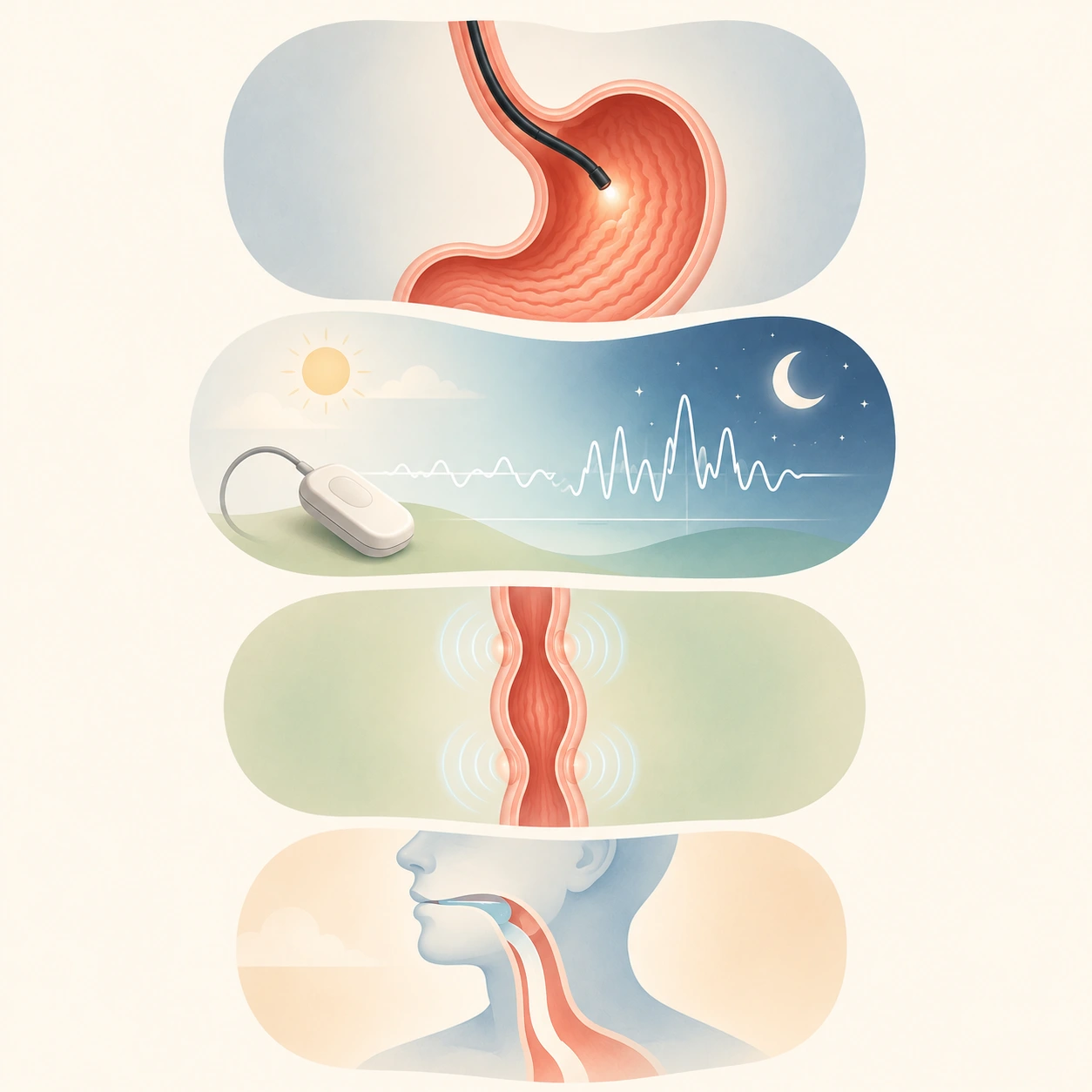
pH monitoring is the actual diagnostic test for reflux. It records frequency, duration, acidity and timing over 48 to 72 hours of ordinary life, including sleep, meals and exercise, then correlates those events against the symptoms you log.
Esophageal manometry measures whether your esophagus is strong and coordinated enough to push food through a repair. Every anti-reflux procedure adds resistance at the junction. If the esophagus cannot overcome it, the result is dysphagia, food sticking and chest pain, and those problems are far harder to fix after the fact than before. Manometry is also how achalasia gets caught before it is mistakenly treated as reflux.
Barium swallow shows the esophagus working in real time, with pills or food, which is the only way to reproduce what you actually feel. One finding from that study is worth knowing: where a patient senses food sticking matches the true anatomic location only about 60 percent of the time. People routinely point at their throat when the delay is in the distal esophagus.
Silent reflux is measured above two valves, not one
Standard reflux testing looks above the lower esophageal sphincter only. That is adequate for typical heartburn and inadequate for laryngopharyngeal reflux, where symptoms sit in the throat and voice box. The esophagus tolerates 40 to 50 reflux episodes a day. The larynx and pharynx can become symptomatic from one.
Dr. Grandhige uses a 24-hour dual-channel pH impedance probe that measures above the lower esophageal sphincter and above the upper esophageal sphincter, and measures non-acid reflux, so bile, pepsin and trypsin are captured rather than missed. The reason this matters is selection. Patients with throat symptoms are commonly quoted roughly a 50 percent chance that surgery helps. In Dr. Grandhige’s reported experience, selecting from dual-channel data raises expected improvement to roughly 80 percent, and only about 50 to 60 percent of silent-reflux patients turn out to have testing that supports an operation at all. Fewer operations, better-chosen ones.
Four ways to repair it, and how the choice gets made
There is no best hiatal hernia operation. There is a correct one for your anatomy, your esophageal function and your priorities, and sometimes the correct answer is no operation. Because this practice performs all four, the decision is not shaped by which procedure is available.
What the Wesley Chapel search results leave out
Search “best hiatal hernia surgeons in Wesley Chapel, FL” and you will get Healthgrades and U.S. News pages listing general surgeons and gastroenterologists near AdventHealth Wesley Chapel and BayCare Hospital Wesley Chapel, sorted by star rating, distance from your ZIP and hospital affiliation. The clinical detail usually stops at a line like “treats diaphragmatic and hiatal hernia.” Those directories publish no case volume specific to the hiatus, no recurrence rates and no long-term medication-independence data for anyone. There is no public registry that fills the gap either.
That absence is the real problem, and it is fixable with five questions. Ask any surgeon you are considering, local or otherwise:
- How will you confirm reflux is actually causing my symptoms? Symptom history and medication response are not confirmation.
- What testing do you require before recommending surgery? If testing gets minimized, stop there.
- How many hiatal hernia repairs do you perform in a year, and which procedures do you offer? A surgeon who performs one operation will recommend one operation.
- How often do you decide not to operate? A surgeon who never advises against surgery is not exercising judgment.
- What happens if my symptoms only partly improve?
For reference, this practice evaluates and treats more than 600 reflux patients a year, and Dr. Grandhige has performed more than 600 fundoplications, more than 600 LINX procedures and more than 200 TIF procedures since 2009. He is one of the busiest LINX surgeons in the country. Ask for comparable numbers wherever else you interview.
Recovery, and the symptoms that will not change
Fundoplication and LINX are outpatient procedures, generally 1.5 to 2 hours, and most patients go home the same day. Diet advances in stages over roughly two to three months. Heavy lifting and core strain are restricted while the repair heals. In Dr. Grandhige’s reported experience with appropriately selected patients who have typical symptoms, objective reflux and adequate esophageal function, more than 90 percent achieve significant symptom relief and come off daily reflux medication. Results run lower with reduced motility, prior foregut or bariatric surgery, or large and recurrent hernias, and that gets discussed before any decision rather than after.
Now the parts that get undersold elsewhere.
Fundoplication makes it harder for acid to travel up, which also makes it harder for air and food to travel up. Bloating and reduced ability to vomit are real, and whether they are temporary or permanent depends on the wrap. Adults tend to heave rather than vomit, and being unable to bring solid food back up is uncomfortable rather than dangerous. LINX carries a somewhat higher long-term dysphagia risk than fundoplication, usually manageable, and current devices are MRI compatible to 1.5 Tesla.
Typical heartburn and regurgitation often resolve almost immediately. Throat symptoms do not. Cough, hoarseness and throat clearing commonly take four to six months to improve, and expecting otherwise turns a successful operation into a disappointment. Surgery is designed to correct proven reflux, not every upper gastrointestinal symptom you have. Bloating, abdominal pain and food intolerance frequently have a separate mechanism. The rule here is six months, then a review of whatever remains, which sometimes means a referral to ENT, pulmonology, allergy or gastroenterology rather than another operation.
One honest note. The patients least satisfied with this practice are usually the ones told no. They came for a solution and left with a diagnosis instead, and that is frustrating. They would have been more frustrated after an unnecessary operation that changed nothing.

How to verify a reflux surgeon, including this one
Verify independently rather than trusting any website, this one included. Board certification can be checked through the American Board of Surgery physician lookup and the American College of Surgeons directory. Active Florida licensure and any disciplinary history can be checked through the Florida Department of Health Medical Quality Assurance license lookup. Hospital privileges are a real credential because they are granted only after credential review, peer evaluation and ongoing performance monitoring.
Dr. Grandhige earned his bachelor’s degree at Johns Hopkins University and his MD at the University of Michigan, then completed general surgery residency and fellowship training in foregut and minimally invasive surgery at Yale New Haven Hospital. He is a Fellow of the American College of Surgeons, a member of SAGES, and a founding member of the American Foregut Society. He holds privileges at St. Joseph’s Main, St. Joseph’s South, HCA Florida Brandon and HCA Florida South Tampa. He founded Tampa Bay Reflux Center in 2009 and Tampa Bay Reflux Institute in 2022. His practice covers benign foregut disease only, which means GERD, hiatal hernias, silent reflux, achalasia and gastroparesis. He does not treat esophageal or gastric cancer.
Most of this practice arrives by physician referral rather than advertising, from gastroenterologists, ENT physicians, pulmonologists, allergists and primary care doctors across Tampa Bay.
Frequently asked questions
Take the next step
Bring your prior testing. You will get an explanation of what is mechanically happening, which symptoms an operation can address, which it cannot, and whether a repair makes sense for you at all.


An endoscopy cannot tell you if you have reflux. It can only tell you if you have complications of GERD.
If you are unhappy with your reflux symptoms, come in and we can discuss testing and treatments that can accurately diagnose your problem.
#reflux #gerd #hiatalhernia #gastroparesis #linx


CALL US AT 813-922-2920
www.tampareflux.com
If you have a hiatal hernia and fit one of these categories, you should know your options.
Dr. Grandhige is an expert in his field and performs 200 of these surgeries a year. He is the only surgeon in the Tampa Bay Area who offers all surgical options - LINX, Fundoplications, TIF and will be one of 20 surgeons in America introducing the latest procedure RefluxStop in 2026.
We accept most insurances but will verify yours before you come in. These procedures are considered medically necessary and covered by your insurance. You can expect to pay your in-network deductibles and nothing else.
#hiatalhernia #reflux #GERD #LINX #refluxstop

What causes reflux ?
1. Weak lower esophageal sphincter
2. Hiatal hernia
3. Flattening of the Angle of His
4. Poor esophageal motility
5. Gastroparesis (slow stomach)
NOT increased acid production


Don’t let GERD get in the way of living your life. Request your appointment with us today on the link below.
.
.
.
.
https://tampareflux.com/contact-us/

Anyone can be victim to GERD and though weight loss can help reduce GERD symptoms. Many athletes with high impact workouts may continue to have these symptoms. This may be a symptom of a hiatal hernia or other issue. We are more then happy to assist you in finding your solution, just click the link below.
.
.
.
https://tampareflux.com/contact-us/
##healthylifestyle #workout #athletereflux #PPIs #heartburn #LINX #fundoplication #TIF #GERD#tampaheartburn #linx #TIF #fundoplication #tampabayreflux #GERD #acidreflux #acidrefluxsurgery #stopreflux
#nonsurgicalweightloss #ESG #gastricballoon #weightlossjourney #vsg #vsgjourney #spatz3 #orbera #orberaballoon #grandhige #DrG
#tampabayrefluxinstitute #guthealth #roboticsurgery

Heartburn may seem like an annoyance. But if you find yourself having symptoms on a daily basis, it may be time to to talk to Dr. Grandhige as it could be a symptom of something worse.
.
.
.
#chronicheartburn #gerdsymptoms #heartburnrelief #reflux #PPIs #heartburn #LINX #fundoplication #TIF #GERD#tampaheartburn #linx #TIF #fundoplication #tampabayreflux #GERD #acidreflux #acidrefluxsurgery #stopreflux
#nonsurgicalweightloss #ESG #gastricballoon #weightlossjourney #vsg #vsgjourney #spatz3 #orbera #orberaballoon #grandhige #DrG
#tampabayrefluxinstitute #guthealth #roboticsurgery

If you are tired of avoiding your favorite foods or taking daily medications, we can help.
We are the Tampa experts in reflux ! With years of experience and thousands of patients treated successfully, we offer all FDA approved anti-reflux procedures.
Call 813-922-2920 to schedule your appointment
All major insurances accepted.

Not all patients need surgical intervention. Many patients are living a heartburn free life with their PPIs. However 40% of patients taking PPIs are not getting the relief they need. If you are one of those, you have options! Come in and find out more.
.
.
.
.
#letushelpyou #medsnotworking #reflux #PPIs #heartburn #LINX #fundoplication #TIF #GERD#tampaheartburn #linx #TIF #fundoplication #tampabayreflux #GERD #acidreflux #acidrefluxsurgery #stopreflux
#nonsurgicalweightloss #ESG #gastricballoon #weightlossjourney #vsg #vsgjourney #spatz3 #orbera #orberaballoon #grandhige #DrG
#tampabayrefluxinstitute #guthealth #roboticsurgery

#heartburn #stopreflux #hiatalherniarepair #severeheartburn #reflux #tampabayreflux #acidrefluxsurgery #tampaheartburn #GERD #PPIs #achalasia #LINX #TIF #tampareflux #fundoplication #stomach #digestivehealth #ESG #obesity #overweight #weightlossjourney #gastricballoon
