
Best Hiatal Hernia Surgeons In St. Petersburg, FL
You don’t have to settle for the surgeon who operates on hiatal hernias a few times a year. A 25-minute drive from downtown St. Petersburg puts you in front of a surgeon who treats nothing but the esophagus, diaphragm, and stomach, and who repairs hiatal hernias every week.
Testing decides the surgery, every time
No surgical recommendation here is based on symptoms alone. Every decision is built on objective physiologic testing that proves what is happening inside your body before any procedure is discussed.
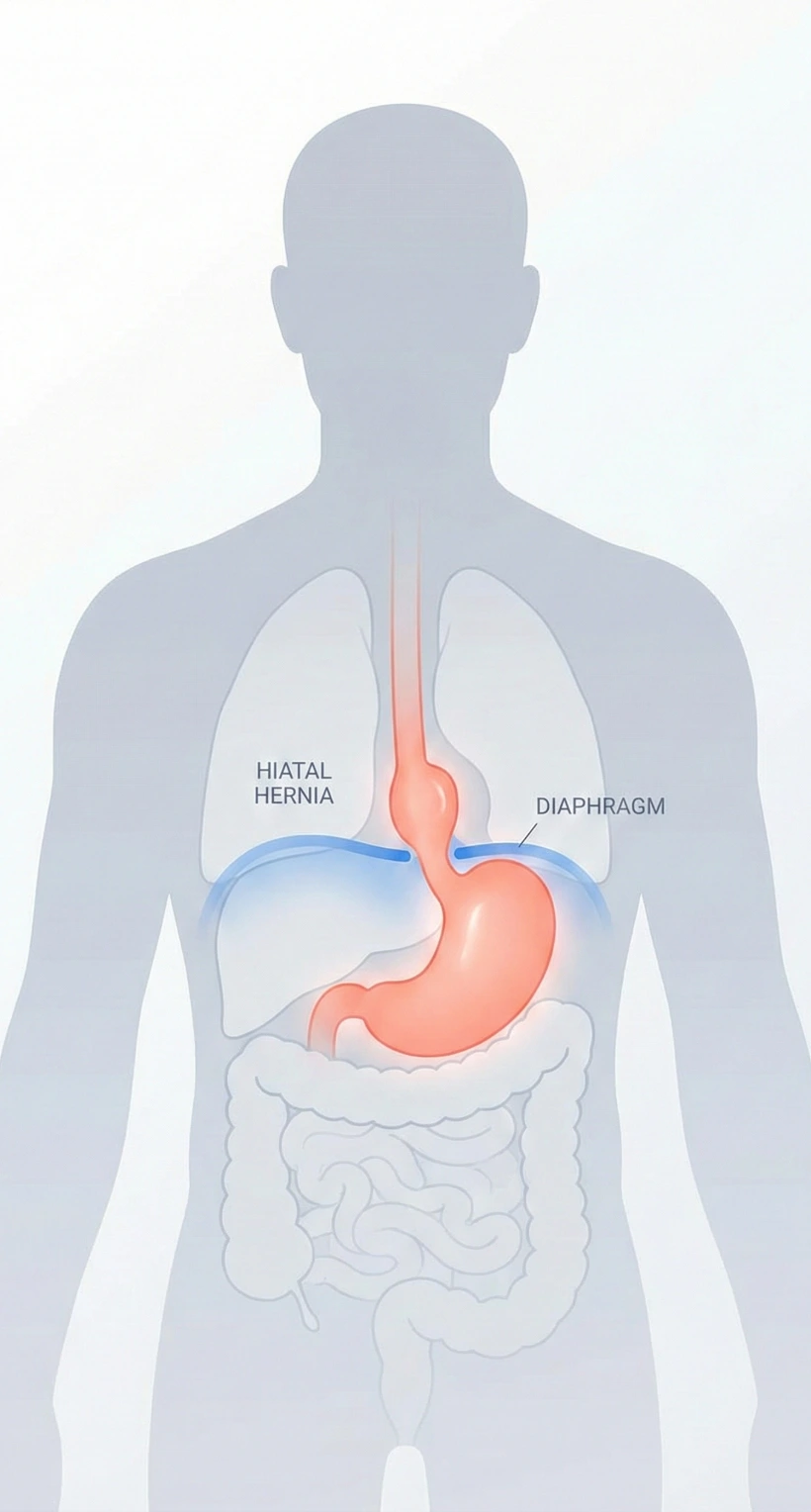
A hiatal hernia is a mechanical failure of the diaphragm, not just a bulge. The size of the hernia, the strength of your esophageal muscles, the type of reflux you have, and your own goals all change which repair will last. So the workup comes first: upper endoscopy to assess anatomy and complications, esophageal pH or pH-impedance monitoring to confirm and measure reflux, and esophageal manometry to test how well your esophagus actually pushes food down. A barium swallow is added when swallowing problems or anatomy need a closer read.
Manometry is the step most occasional surgeons skip, and skipping it is how patients end up with dysphagia after surgery. Esophageal motility dictates which repair is safe. Weak motility may call for a partial wrap instead of a full one, or may rule out a device entirely. Find that out before surgery, not after. This is also why a normal endoscopy does not mean you are fine: endoscopy looks for damage, not for reflux events or sphincter function. Many patients with significant reflux and a small hiatal hernia have a completely normal endoscopy, especially while on acid-suppressing medication.
Four repair options, matched to your anatomy
Because Dr. Grandhige performs four anti-reflux procedures, the decision is driven by what fits your body, not by what is most familiar to the surgeon. There is no single best operation. There is the right operation for your anatomy and physiology, and in some cases the right answer is no operation at all.
The repair of the hiatal hernia is the longest and most demanding part of any anti-reflux surgery. The diaphragm opening is closed and tightened around the esophagus, the stomach is brought back below the diaphragm without tension, and then one of the anti-reflux procedures is added, since almost every hiatal hernia patient also has reflux:
Silent reflux and throat symptoms: the testing most centers don’t do
If your main symptoms are throat clearing, hoarseness, chronic cough, or a lump-in-the-throat feeling, standard reflux testing often misses the cause, and that is why many patients are told surgery has only a 50% chance of helping.
This is laryngopharyngeal reflux, or silent reflux, and it behaves differently from classic heartburn. The throat and voice box are far more sensitive than the esophagus. The esophagus may tolerate 40 to 50 reflux episodes a day; the larynx can develop symptoms from a single one. Standard testing measures reflux only above the lower esophageal sphincter, so it cannot tell whether reflux is actually reaching your throat.
Dr. Grandhige uses a customized 24-hour dual-channel pH-impedance probe that measures reflux at two levels, above the lower esophageal sphincter and above the upper esophageal sphincter, and detects non-acid reflux such as bile and pepsin that standard acid-only testing never sees. By confirming whether reflux truly reaches the throat and correlating it with your symptoms, he raises the surgical success rate for silent reflux (LPR) patients from roughly 50% to approximately 80%. That means operating on fewer patients, but on the right ones. This testing is technically demanding and reimbursed poorly, which is exactly why most centers don’t do it and accept lower success rates instead.
One more detail patients find surprising: where you feel food stick is only the true location about 60% of the time. A patient may feel food catching in the throat when a barium swallow proves the holdup is in the lower esophagus. Precise testing prevents the wrong operation.
The procedure is the last step. The decision is the surgery.
The most important skill in reflux surgery is knowing when not to operate, and which operation not to do. Dr. Grandhige is known across the region for being conservative, and many patients arrive expecting surgery and leave with a non-surgical plan and a clear explanation instead.
This is the honest part most pages won’t print: the patients he chooses not to operate on are often the most frustrated in the short term. But they would be far unhappier after an unnecessary operation that left their symptoms unchanged. Conditions like esophageal hypersensitivity, functional chest pain, and certain motility disorders can mimic reflux and are not improved by surgery. Identifying those patients protects them. Surgery is recommended only when objective testing supports it, which is why outcomes here are strong and why gastroenterologists, ENT physicians, and pulmonologists across the region refer their patients for evaluation.
When surgery is the right answer for appropriately selected patients with typical reflux symptoms, proven reflux, suitable anatomy, and good esophageal function, the practice reports greater than 95% significant symptom relief and elimination of daily reflux medication. These outcomes follow from selection and testing, not from operating on everyone who walks in.
The judgment behind that restraint is backed by real credentials. Dr. Grandhige is a board-certified general surgeon, fellowship-trained in foregut and minimally invasive surgery, a Fellow of the American College of Surgeons, a member of SAGES, and a founding member of the American Foregut Society. You can confirm his active license and any disciplinary history through the Florida Board of Medicine.

What to expect: testing to surgery in four to eight weeks
Most St. Petersburg patients move from first consultation to surgery within four to eight weeks, often with only one or two visits.
Before your first visit, Dr. Grandhige personally reviews your records: prior endoscopy, pH studies, manometry, imaging, operative reports, and notes from your other physicians. Send them ahead to info@tampareflux.com so the consultation is a real diagnostic discussion, not a data-gathering session. If your testing is already complete, your diagnosis can often be confirmed and your options discussed in a single visit, with surgery scheduled as soon as about four weeks out. If you need more testing, the first visit covers education and test planning, a second visit about four weeks later reviews results and finalizes the plan, and the target from first visit to surgery is roughly eight weeks. The office handles insurance authorization in parallel, which can take four to six weeks on its own.
For out-of-town and St. Pete patients, the team coordinates testing close to home where possible so your trips to Tampa stay efficient. New patients are usually seen within two weeks, and always within four.
Are these your symptoms?
A hiatal hernia and reflux can show up in ways that don’t look like classic heartburn. Patients commonly describe:
- Waking at night with acid or food coming up into the throat
- Years on daily heartburn medication with symptoms that still break through
- Chest pressure or discomfort that has been mistaken for a heart problem
- Trouble swallowing, or food that feels stuck
- Chronic throat clearing, hoarseness, or a lingering cough
- A normal endoscopy paired with the certainty that something is still wrong
- Needing twice-daily medication just to feel comfortable
- Reflux that worsens lying down, so you avoid eating before bed
Medication lowers acid, but it cannot repair a hernia or rebuild a weak valve. If the mechanical problem is real, it needs a mechanical fix.
FAQS
Get clarity on your hiatal hernia
You didn’t cause your hiatal hernia. Hernias come from normal pressure on the diaphragm over years: pregnancy, weight changes, coughing, lifting, aging. What you do get to decide is what happens next.
You can keep escalating medication that never fixes the mechanical problem, or you can get a complete evaluation from a surgeon who will tell you the truth about whether surgery helps. Bring your prior testing. You’ll leave understanding what is happening in your body and what your real options are, in plain language, with no pressure.


An endoscopy cannot tell you if you have reflux. It can only tell you if you have complications of GERD.
If you are unhappy with your reflux symptoms, come in and we can discuss testing and treatments that can accurately diagnose your problem.
#reflux #gerd #hiatalhernia #gastroparesis #linx


CALL US AT 813-922-2920
www.tampareflux.com
If you have a hiatal hernia and fit one of these categories, you should know your options.
Dr. Grandhige is an expert in his field and performs 200 of these surgeries a year. He is the only surgeon in the Tampa Bay Area who offers all surgical options - LINX, Fundoplications, TIF and will be one of 20 surgeons in America introducing the latest procedure RefluxStop in 2026.
We accept most insurances but will verify yours before you come in. These procedures are considered medically necessary and covered by your insurance. You can expect to pay your in-network deductibles and nothing else.
#hiatalhernia #reflux #GERD #LINX #refluxstop

What causes reflux ?
1. Weak lower esophageal sphincter
2. Hiatal hernia
3. Flattening of the Angle of His
4. Poor esophageal motility
5. Gastroparesis (slow stomach)
NOT increased acid production


Don’t let GERD get in the way of living your life. Request your appointment with us today on the link below.
.
.
.
.
https://tampareflux.com/contact-us/

Anyone can be victim to GERD and though weight loss can help reduce GERD symptoms. Many athletes with high impact workouts may continue to have these symptoms. This may be a symptom of a hiatal hernia or other issue. We are more then happy to assist you in finding your solution, just click the link below.
.
.
.
https://tampareflux.com/contact-us/
##healthylifestyle #workout #athletereflux #PPIs #heartburn #LINX #fundoplication #TIF #GERD#tampaheartburn #linx #TIF #fundoplication #tampabayreflux #GERD #acidreflux #acidrefluxsurgery #stopreflux
#nonsurgicalweightloss #ESG #gastricballoon #weightlossjourney #vsg #vsgjourney #spatz3 #orbera #orberaballoon #grandhige #DrG
#tampabayrefluxinstitute #guthealth #roboticsurgery

Heartburn may seem like an annoyance. But if you find yourself having symptoms on a daily basis, it may be time to to talk to Dr. Grandhige as it could be a symptom of something worse.
.
.
.
#chronicheartburn #gerdsymptoms #heartburnrelief #reflux #PPIs #heartburn #LINX #fundoplication #TIF #GERD#tampaheartburn #linx #TIF #fundoplication #tampabayreflux #GERD #acidreflux #acidrefluxsurgery #stopreflux
#nonsurgicalweightloss #ESG #gastricballoon #weightlossjourney #vsg #vsgjourney #spatz3 #orbera #orberaballoon #grandhige #DrG
#tampabayrefluxinstitute #guthealth #roboticsurgery

If you are tired of avoiding your favorite foods or taking daily medications, we can help.
We are the Tampa experts in reflux ! With years of experience and thousands of patients treated successfully, we offer all FDA approved anti-reflux procedures.
Call 813-922-2920 to schedule your appointment
All major insurances accepted.

Not all patients need surgical intervention. Many patients are living a heartburn free life with their PPIs. However 40% of patients taking PPIs are not getting the relief they need. If you are one of those, you have options! Come in and find out more.
.
.
.
.
#letushelpyou #medsnotworking #reflux #PPIs #heartburn #LINX #fundoplication #TIF #GERD#tampaheartburn #linx #TIF #fundoplication #tampabayreflux #GERD #acidreflux #acidrefluxsurgery #stopreflux
#nonsurgicalweightloss #ESG #gastricballoon #weightlossjourney #vsg #vsgjourney #spatz3 #orbera #orberaballoon #grandhige #DrG
#tampabayrefluxinstitute #guthealth #roboticsurgery

#heartburn #stopreflux #hiatalherniarepair #severeheartburn #reflux #tampabayreflux #acidrefluxsurgery #tampaheartburn #GERD #PPIs #achalasia #LINX #TIF #tampareflux #fundoplication #stomach #digestivehealth #ESG #obesity #overweight #weightlossjourney #gastricballoon
