
Acid Reflux & Heartburn Relief In St. Petersburg, FL
You don’t have to drive far for subspecialty reflux care. Tampa Bay Reflux Institute sits about 25 minutes from St. Petersburg across the Howard Frankland Bridge, and the approach starts with one question most St. Pete patients have never had answered: is this actually reflux, and why is it happening?
Reflux is a mechanical problem, not just an acid problem
Most people are taught reflux means too much acid, and that suppressing acid is the fix. That’s incomplete, and it’s why medication so often stops working.
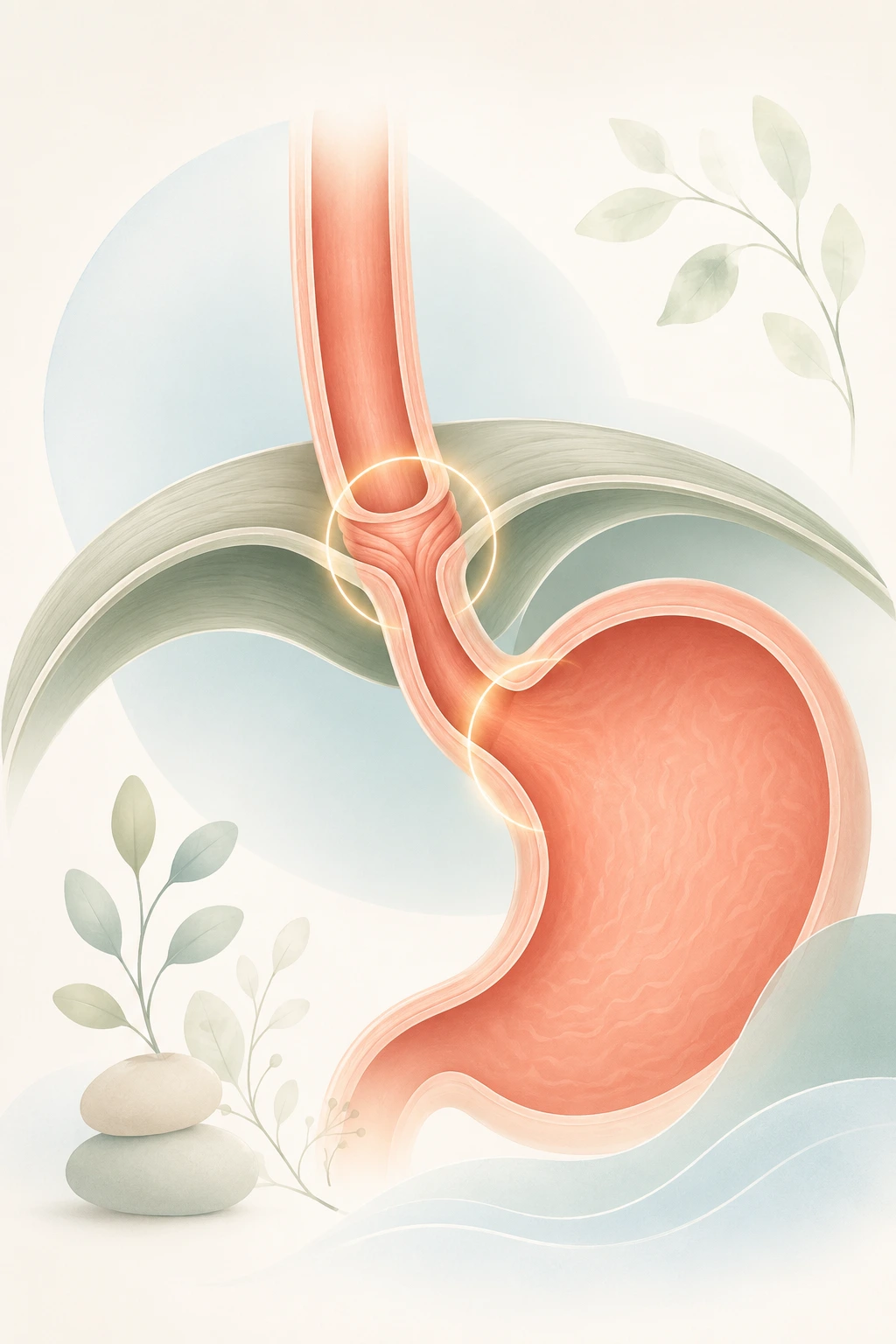
Your body has a reflux barrier where the esophagus meets the stomach. It has three parts: the lower esophageal sphincter (a muscular valve), the diaphragm that supports it, and the natural angle between the two. When that barrier weakens or a hiatal hernia pulls it out of position, stomach contents move up into places they don’t belong. That’s when heartburn, regurgitation, throat symptoms, and broken sleep start.
Medication reduces how much acid your stomach makes. It does not strengthen a weak sphincter, repair a hiatal hernia, or fix the mechanical defect causing the reflux. That’s why symptoms come back when you miss a dose, why doses creep up over time, and why some symptoms never fully respond. The acid is only the irritant. The leak is mechanical, and most people with GERD make a normal amount of acid in the first place.
There’s a second consequence that matters: medication only changes the acidity of what refluxes. Bile, pepsin, and other digestive enzymes still travel up and can still irritate tissue, even when your symptoms feel quieter. Medications turn down the burn. They don’t stop the leak.
Testing first: how reflux is actually diagnosed
Before any treatment decision, the goal is to prove reflux objectively and find out what part of the barrier is failing. Four tests do different jobs, and each answers a question the others can’t.
Skipping these tests is exactly how reflux surgery earned its old, poor reputation: operations done on assumptions instead of physiology. Each test protects you from the wrong procedure. Most patients come to see why testing is being done for them, not to delay them.
When to see a foregut specialist instead of staying on medication
Consider an evaluation when reflux is persistent, progressive, complicated, or just unclear, rather than refilling a prescription indefinitely. Specific situations that warrant a specialist:
- A hiatal hernia larger than 3 centimeters, which almost always drives reflux mechanically and won’t be fixed by medication
- Symptoms that continue despite a daily proton pump inhibitor
- Needing more than once-daily medication, or stacking a PPI with an H2 blocker
- Complications of reflux: severe esophagitis, Barrett’s esophagus, or peptic strictures
- A clear preference not to stay on acid-suppressing medication for life
Considering an evaluation is not the same as committing to surgery. It means getting a complete picture so the decision, whatever it turns out to be, is based on physiology instead of a guess. For a deeper read on the long-term side of medication and where surgery fits, the hiatal hernia page covers the anatomy that drives most of these cases.
Silent reflux (LPR): why your throat symptoms keep getting missed
If your main problems are throat clearing, hoarseness, chronic cough, or a lump-in-the-throat feeling, and every test so far has come back normal, you may have laryngopharyngeal reflux. It’s reflux in the wrong place, not “mild” reflux.
Typical GERD irritates the esophagus, which tolerates acid reasonably well. LPR travels higher, past the upper esophageal sphincter into the throat and voice box, tissues far more sensitive. The esophagus can shrug off 40 to 50 reflux episodes a day. The larynx and pharynx can develop symptoms from as little as one. That’s why you can have real, disruptive LPR with little or no heartburn, and a normal endoscopy.
Standard reflux testing usually measures only the lower esophagus, so it misses LPR entirely. That’s how patients end up treated for allergies, asthma, or sinus disease for years with no improvement. The evaluation here uses a customized 24-hour pH-impedance dual-channel probe that measures reflux at two levels, above the lower sphincter and above the upper sphincter, and detects non-acid reflux like bile and pepsin that standard acid-only testing can’t see.
This is where careful diagnosis changes the math. Without precise testing, LPR patients are often quoted a 50% chance that surgery helps, a coin flip that scares people off. With dual-channel testing to confirm reflux is actually reaching the throat, the practice reports symptom improvement rises to roughly 80% in the patients who are correctly selected. Across patients evaluated for LPR, only about 50 to 60% have testing that supports surgery; the rest are steered away from it. Fewer operations, on the right people. The full picture is on the silent reflux (LPR) page.
Your treatment options, and how the right one gets chosen
There is no single best reflux operation. There’s only the right operation for the right patient, and often the right answer is no operation at all. Dr. Grandhige performs the full range, which means the recommendation is driven by your anatomy and goals rather than by the one procedure a surgeon happens to do.
Beginning in 2026, the practice will add RefluxStop, making Dr. Grandhige the only surgeon in the Tampa Bay area offering all four major anti-reflux procedures. To date he has performed over 600 fundoplications, over 600 LINX procedures, and over 200 TIF procedures.
Fundoplication wraps the upper stomach around the lower esophagus to rebuild the reflux barrier. It’s durable, backed by decades of outcome data, and the only option here that fully repairs large hiatal hernias and works well even when esophageal motility is weak. It comes in several configurations (Nissen, Toupet, Dor, Watson), chosen by your motility and anatomy. Typical operating time is about 1.5 to 2 hours, and most patients go home the same day. The tradeoff: depending on the wrap, it can limit the ability to burp or vomit and cause more gas-bloat.
LINX is a ring of magnetic titanium beads around the lower esophagus, FDA-approved for GERD since 2012. It preserves normal stomach anatomy, usually keeps your ability to burp and vomit once early swelling settles, and is reversible if ever needed. It’s a strong fit for patients with proven reflux and good esophageal motility who want to avoid a wrap. It requires adequate motility to work, carries a somewhat higher risk of early swallowing difficulty, and is MRI-compatible up to 1.5 Tesla. Hiatal hernia size, contrary to a common myth, does not disqualify you as long as the hernia is repaired at the same time.
TIF (transoral incisionless fundoplication) is done entirely through the mouth with no incisions, using the EsophyX device to build a partial valve from the inside. Recovery is faster and there are no abdominal wounds. But it’s honest work to say what it can’t do: it cannot repair a hiatal hernia or address the diaphragm, so it’s only for carefully selected patients with minimal or no hernia, mild-to-moderate reflux, and no severe esophagitis or Barrett’s. Dr. Grandhige quotes a failure rate of about 2% per year, roughly 20% per decade, and is direct that TIF is the best endoscopic option available, not a permanent replacement for surgery. He won’t offer it to patients who fall outside those tight criteria, even when they want it because it’s incisionless.
RefluxStop, new for 2026, reconstructs the anti-reflux barrier without encircling the esophagus. Whether it fits you is decided the same way as everything else here: by testing first.
What success actually means here
For patients with typical reflux symptoms, objective evidence of reflux, suitable anatomy, and good esophageal function, the practice reports greater than 95% success in significant symptom relief, elimination of daily reflux medication, and patient satisfaction. For LPR patients selected with dual-channel testing, the figure is roughly 80%.
Those numbers come with honest qualifiers, which is the point. No procedure is 100%. Outcomes are individualized for patients with reduced motility, large or recurrent hernias, long-standing disease, or prior foregut or bariatric surgery, where results may be lower and the procedure is chosen to prioritize safety. Symptom improvement and complete medication elimination are not the same thing; many patients achieve both, some still need occasional acid suppression, and that isn’t failure.
And success isn’t only about the people who have surgery. A large share of patients arrive expecting an operation and leave with reassurance and a non-surgical plan, because their testing didn’t support surgery. Many also report better sleep, more daytime energy, and easier exercise once reflux is treated, since nighttime reflux fragments sleep even when you don’t feel heartburn.
Care from a specialist and a team that stays the same
Dr. Gopal Grandhige is a board-certified general surgeon and fellowship-trained foregut specialist who has treated reflux and esophageal disorders exclusively since 2009. He completed his undergraduate degree at Johns Hopkins, his medical degree at the University of Michigan, and his general surgery residency plus fellowships in foregut, minimally invasive, and burn/critical care surgery at Yale-New Haven Hospital. He is a Founding Member of the American Foregut Society, a member of SAGES, and a Fellow of the American College of Surgeons. You can read more on the About Us page.
What that specialization buys you is judgment, not just technical skill. He personally reviews all of your prior testing, endoscopy and pH studies, manometry, imaging, and notes from your other physicians, before you walk in, so the consultation is spent on explanation and decisions rather than data gathering. During the visit he explains reflux with diagrams patients consistently mention as the thing that finally made it click, and he frames his opinion against what your other doctors have said so you understand why the assessment differs.
The team is unusually stable. Office medical assistants who’ve been with the practice over a decade understand reflux deeply and handle testing logistics. A dedicated physician assistant assists in every surgical case and provides continuity before, during, and after. After hours and on weekends, Dr. Grandhige and his PA remain reachable for urgent questions, which cuts down on unnecessary ER trips. Every surgery is performed at HCA South Tampa Hospital, where the OR team, anesthesia, and nursing staff routinely do foregut cases, because in this surgery small details compound and a familiar team catches problems early.

Coming from St. Petersburg
The office is at 1315 South Howard Avenue, Suite 101, Tampa, FL 33606, in a yellow brick building next to Sally O’Neill’s Pizza, with parking behind the restaurant. From St. Petersburg it’s about a 25-minute drive across the Howard Frankland Bridge.
Out-of-area patients are routine here, and the team coordinates testing to minimize trips. When possible, testing that can be done closer to home is arranged locally so your visits to Tampa are efficient. Office hours are 9 AM to 6 PM, Monday through Friday, and you can send prior records ahead to info@tampareflux.com so everything is reviewed before your consultation. Most patients are seen within two weeks and always within four.
FAQS
Take the first step
You don’t have to keep refilling a prescription you were never sure you needed. The first step is clarity: confirming whether reflux is present, why it’s happening, and what your real options are. If you’re in St. Petersburg and tired of partial relief, an evaluation built on objective testing is a short drive away.


An endoscopy cannot tell you if you have reflux. It can only tell you if you have complications of GERD.
If you are unhappy with your reflux symptoms, come in and we can discuss testing and treatments that can accurately diagnose your problem.
#reflux #gerd #hiatalhernia #gastroparesis #linx


CALL US AT 813-922-2920
www.tampareflux.com
If you have a hiatal hernia and fit one of these categories, you should know your options.
Dr. Grandhige is an expert in his field and performs 200 of these surgeries a year. He is the only surgeon in the Tampa Bay Area who offers all surgical options - LINX, Fundoplications, TIF and will be one of 20 surgeons in America introducing the latest procedure RefluxStop in 2026.
We accept most insurances but will verify yours before you come in. These procedures are considered medically necessary and covered by your insurance. You can expect to pay your in-network deductibles and nothing else.
#hiatalhernia #reflux #GERD #LINX #refluxstop

What causes reflux ?
1. Weak lower esophageal sphincter
2. Hiatal hernia
3. Flattening of the Angle of His
4. Poor esophageal motility
5. Gastroparesis (slow stomach)
NOT increased acid production


Don’t let GERD get in the way of living your life. Request your appointment with us today on the link below.
.
.
.
.
https://tampareflux.com/contact-us/

Anyone can be victim to GERD and though weight loss can help reduce GERD symptoms. Many athletes with high impact workouts may continue to have these symptoms. This may be a symptom of a hiatal hernia or other issue. We are more then happy to assist you in finding your solution, just click the link below.
.
.
.
https://tampareflux.com/contact-us/
##healthylifestyle #workout #athletereflux #PPIs #heartburn #LINX #fundoplication #TIF #GERD#tampaheartburn #linx #TIF #fundoplication #tampabayreflux #GERD #acidreflux #acidrefluxsurgery #stopreflux
#nonsurgicalweightloss #ESG #gastricballoon #weightlossjourney #vsg #vsgjourney #spatz3 #orbera #orberaballoon #grandhige #DrG
#tampabayrefluxinstitute #guthealth #roboticsurgery

Heartburn may seem like an annoyance. But if you find yourself having symptoms on a daily basis, it may be time to to talk to Dr. Grandhige as it could be a symptom of something worse.
.
.
.
#chronicheartburn #gerdsymptoms #heartburnrelief #reflux #PPIs #heartburn #LINX #fundoplication #TIF #GERD#tampaheartburn #linx #TIF #fundoplication #tampabayreflux #GERD #acidreflux #acidrefluxsurgery #stopreflux
#nonsurgicalweightloss #ESG #gastricballoon #weightlossjourney #vsg #vsgjourney #spatz3 #orbera #orberaballoon #grandhige #DrG
#tampabayrefluxinstitute #guthealth #roboticsurgery

If you are tired of avoiding your favorite foods or taking daily medications, we can help.
We are the Tampa experts in reflux ! With years of experience and thousands of patients treated successfully, we offer all FDA approved anti-reflux procedures.
Call 813-922-2920 to schedule your appointment
All major insurances accepted.

Not all patients need surgical intervention. Many patients are living a heartburn free life with their PPIs. However 40% of patients taking PPIs are not getting the relief they need. If you are one of those, you have options! Come in and find out more.
.
.
.
.
#letushelpyou #medsnotworking #reflux #PPIs #heartburn #LINX #fundoplication #TIF #GERD#tampaheartburn #linx #TIF #fundoplication #tampabayreflux #GERD #acidreflux #acidrefluxsurgery #stopreflux
#nonsurgicalweightloss #ESG #gastricballoon #weightlossjourney #vsg #vsgjourney #spatz3 #orbera #orberaballoon #grandhige #DrG
#tampabayrefluxinstitute #guthealth #roboticsurgery

#heartburn #stopreflux #hiatalherniarepair #severeheartburn #reflux #tampabayreflux #acidrefluxsurgery #tampaheartburn #GERD #PPIs #achalasia #LINX #TIF #tampareflux #fundoplication #stomach #digestivehealth #ESG #obesity #overweight #weightlossjourney #gastricballoon
