

Written By: Jeffrey Atlas, Health Content Writer
Medically Reviewed By: Dr. Gopal Grandhige, MD, FACS, Board-Certified Surgeon
Last Reviewed: November 15, 2026
Severe acid reflux happens when the muscle between your stomach and esophagus stops sealing, letting acid wash upward several times a week or more. Treatment moves through three tiers: habit changes, acid-reducing medication, and procedures that rebuild the valve. Medication controls symptoms. Only a procedure repairs the mechanical problem underneath.
Most people stall on tier two for a decade.
I’ve watched this at Tampa Bay Reflux Institute more times than I can count. Someone starts a daily acid blocker at 38. They’re still taking it at 51, still burning at night, and nobody has ever looked at their anatomy. Nobody mentioned tier three.
One scope note. This covers chronic acid reflux that keeps winning despite treatment. It skips occasional heartburn, and it skips reflux that shows up as hoarseness or chronic cough. That one needs its own discussion.

Start With the Habits That Move the Needle
Two changes carry real evidence. Losing weight if you’re carrying extra, and raising the head of your bed.
The American College of Gastroenterology grades weight loss as a strong recommendation backed by moderate-quality evidence. That’s the highest grade anything in reflux care receives. Every other item on the standard lifestyle sheet sits at conditional and low.
Now the part nobody wants to hear.
That printed list of forbidden foods? The evidence behind it is thin, and the same guideline says so. When researchers measured the valve directly, carbonated drinks produced a 30 to 50 percent pressure drop lasting roughly 20 minutes. Chocolate and tobacco showed real effects. Spicy food and citrus mostly didn’t. They sting an esophagus that’s already raw, which feels identical but isn’t the same problem.
Coffee splits the research. A 2014 meta-analysis of 15 case-control studies found no significant population link, with an odds ratio of 1.06. Direct pressure testing found the opposite, dropping valve pressure from 9.1 to 5.5 mmHg. Both are real. A two-week food diary beats a photocopied handout.
Alcohol has firmer numbers. A 2019 meta-analysis pooling 29 studies put drinkers at roughly 48% higher odds of reflux disease.
Sugar-free gum after meals is underrated. In a trial of 31 people, chewing for half an hour after a reflux-provoking meal cut esophageal acid exposure from 5.7% to 3.6%. Skip mint flavors. Mint relaxes the same valve you’re protecting.
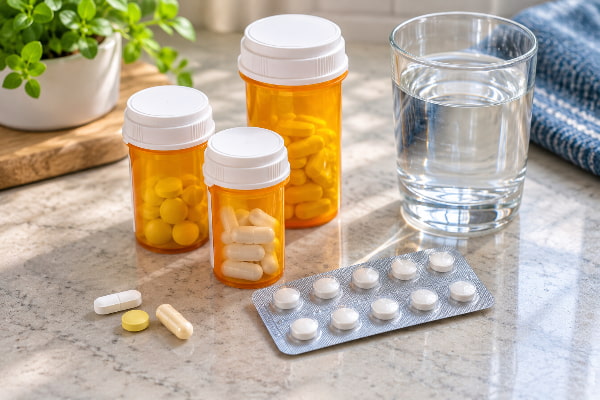
Do Acid Blockers Fix Severe Reflux?
No. They reduce the acid in what refluxes. The refluxing keeps happening.
That gap shows up in the data. A US population study found 54.1% of people on a daily acid-reducing drug still reported troublesome heartburn or regurgitation. More than half, on treatment.
The drugs sort into four groups. Antacids neutralize what’s already there and fade fast. H2 blockers slow production and last longer. Proton pump inhibitors suppress hardest and take days to kick in. A newer class blocks the same pumps differently. All four manage symptoms. None tighten a loose valve.
The Refractory 40 Percent
Guidelines put breakthrough symptoms on medication at up to 40%.
Actually, that framing is sloppy and I should correct it. In a study of 366 patients whose heartburn resisted medication, full testing showed only 21% had symptoms truly caused by reflux. The rest had something else entirely.
Which is why I won’t operate on anyone who hasn’t been tested. Wrapping a stomach when acid isn’t the problem turns one complaint into two.
When Is Surgery the Right Treatment for Severe Acid Reflux?
Surgery fits when testing confirms real reflux, medication isn’t holding, and there’s a mechanical defect to repair. The standard operation is a fundoplication, wrapping the top of the stomach around the lower esophagus to rebuild the seal. A few small incisions, and most patients go home within a day or two.
Nearly every severe case has a hiatal hernia underneath it, with part of the stomach pushed up through the diaphragm. That’s the real defect. Repairing it is the main event. The wrap keeps it from sliding back.
Not Every Wrap Is the Same
A full 360-degree wrap delivers the tightest control. It also brings more swallowing difficulty and trapped-gas bloating. A partial wrap trades a little control to cut both.
Which one you get should follow how well your esophagus moves, measured beforehand, not your surgeon’s habit. Large hernia with normal motility leans full. Borderline motility leans partial.
The Question Almost Nobody Asks
How many of these did you do last year?
Ask it out loud. Outcomes track surgeon volume more closely than any other single factor, with thresholds landing north of 15 to 25 antireflux cases a year. A revision after a failed wrap is far harder than getting it right once.
Can Reflux Be Fixed Without Incisions?
Sometimes, depending entirely on your anatomy. A scope goes down through the mouth and rebuilds the valve from inside, no cuts anywhere.
The anatomy rules are strict. Current guidance from gastroenterology’s endoscopy society points here for confirmed reflux with a small hernia, 2 centimeters or less. Anything larger needs surgical repair first. A 2025 multicenter study reported clinical success near 94%, with about 72% of patients normalizing acid exposure.
There’s also a magnetic implant, a ring of small beads around the lower esophagus that opens for food and closes behind it. Strong control, better belching than a full wrap, reversible. Large hernias and weak motility rule it out.
| Option | Best fit | Main trade-off |
| Full wrap | Severe disease, large hernia | Most swallowing and bloating issues |
| Partial wrap | Borderline motility | Slightly less reflux control |
| Magnetic implant | Small or repaired hernia | Early swallowing trouble, usually temporary |
| Incisionless repair | Hernia 2 cm or less | Durability varies past a few years |
Anatomy decides every severe reflux treatment call, start to finish.
What To Do Next
One number should drive your next move: how long you’ve been on daily medication.
Under a year with decent control? Stay the course, work on weight, raise the bed. Past a year, still symptomatic, never tested? That isn’t a medication problem. It’s an anatomy problem nobody has looked at.
Get the workup. pH monitoring confirms acid is the culprit. Manometry shows how your esophagus moves. Endoscopy checks for damage. Those three decide whether a procedure makes sense and which one, and skipping them is how people end up with the wrong operation.
The right treatment for severe acid reflux is the one matched to your anatomy. You can’t match what nobody has measured yet, and Dr. Grandhige would rather test you once than treat you wrong for ten years.
FAQs
What is the best treatment for severe acid reflux?
The best treatment for severe acid reflux depends on what testing shows, not on symptom severity alone. Medication works for people whose acid production is the main driver, but a US population study found 54.1% of daily acid-blocker users still had troublesome symptoms. When a hiatal hernia or a failing valve is the cause, a repair procedure addresses it directly.
Can severe acid reflux be fixed without surgery?
Sometimes. An incisionless repair done through the mouth rebuilds the valve with no cuts, and a 2025 multicenter study reported clinical success near 94%. It requires a hiatal hernia of 2 centimeters or less. Larger hernias need surgical repair, either on its own or combined with the endoscopic procedure in one session.
Why do I still have heartburn on daily medication?
Acid-reducing drugs lower the acid content of what refluxes, but they don’t stop reflux from happening. If a hiatal hernia or a weakened valve is driving it, the mechanical problem continues regardless of medication. It’s also possible the symptoms aren’t reflux at all. In one study of 366 patients with medication-resistant heartburn, only 21% had symptoms actually caused by reflux.
Do I really need pH testing and manometry before surgery?
Yes, and anyone offering to operate without them should give you pause. pH monitoring confirms acid is actually reaching your esophagus. Manometry measures how well the esophagus pushes food down, which determines whether a full wrap is safe or whether a partial wrap is the better call. Incomplete testing is a leading cause of poor surgical outcomes.
Is weight loss enough treatment for severe acid reflux?
Rarely, once a significant hiatal hernia is present. Weight loss carries the strongest evidence grade of any lifestyle change in the American College of Gastroenterology guideline, and it helps. But it can’t pull a stomach back below the diaphragm. If part of your stomach has migrated upward, that anatomy stays the same at any weight.
Do I have to give up coffee and spicy food?
Probably not all of it. Research on the classic trigger list is weaker than most people assume. Carbonated drinks measurably drop valve pressure by 30 to 50 percent, and chocolate has real effects, but spicy food and citrus mostly irritate an already-inflamed esophagus rather than causing more reflux. Keep a two-week food diary and cut only what reliably bothers you.
How long is recovery after reflux surgery?
Most patients go home within a day or two after a laparoscopic repair and return to desk work inside two weeks. Expect a soft or liquid diet for several weeks while swelling settles. Temporary swallowing difficulty is common and usually resolves. Heavy lifting typically waits four to six weeks to protect the hernia repair.


An endoscopy cannot tell you if you have reflux. It can only tell you if you have complications of GERD.
If you are unhappy with your reflux symptoms, come in and we can discuss testing and treatments that can accurately diagnose your problem.
#reflux #gerd #hiatalhernia #gastroparesis #linx

CALL US AT 813-922-2920
www.tampareflux.com
If you have a hiatal hernia and fit one of these categories, you should know your options.
Dr. Grandhige is an expert in his field and performs 200 of these surgeries a year. He is the only surgeon in the Tampa Bay Area who offers all surgical options - LINX, Fundoplications, TIF and will be one of 20 surgeons in America introducing the latest procedure RefluxStop in 2026.
We accept most insurances but will verify yours before you come in. These procedures are considered medically necessary and covered by your insurance. You can expect to pay your in-network deductibles and nothing else.
#hiatalhernia #reflux #GERD #LINX #refluxstop
What causes reflux ?
1. Weak lower esophageal sphincter
2. Hiatal hernia
3. Flattening of the Angle of His
4. Poor esophageal motility
5. Gastroparesis (slow stomach)
NOT increased acid production
Don’t let GERD get in the way of living your life. Request your appointment with us today on the link below.
.
.
.
.
https://tampareflux.com/contact-us/
Anyone can be victim to GERD and though weight loss can help reduce GERD symptoms. Many athletes with high impact workouts may continue to have these symptoms. This may be a symptom of a hiatal hernia or other issue. We are more then happy to assist you in finding your solution, just click the link below.
.
.
.
https://tampareflux.com/contact-us/
##healthylifestyle #workout #athletereflux #PPIs #heartburn #LINX #fundoplication #TIF #GERD#tampaheartburn #linx #TIF #fundoplication #tampabayreflux #GERD #acidreflux #acidrefluxsurgery #stopreflux
#nonsurgicalweightloss #ESG #gastricballoon #weightlossjourney #vsg #vsgjourney #spatz3 #orbera #orberaballoon #grandhige #DrG
#tampabayrefluxinstitute #guthealth #roboticsurgery
Heartburn may seem like an annoyance. But if you find yourself having symptoms on a daily basis, it may be time to to talk to Dr. Grandhige as it could be a symptom of something worse.
.
.
.
#chronicheartburn #gerdsymptoms #heartburnrelief #reflux #PPIs #heartburn #LINX #fundoplication #TIF #GERD#tampaheartburn #linx #TIF #fundoplication #tampabayreflux #GERD #acidreflux #acidrefluxsurgery #stopreflux
#nonsurgicalweightloss #ESG #gastricballoon #weightlossjourney #vsg #vsgjourney #spatz3 #orbera #orberaballoon #grandhige #DrG
#tampabayrefluxinstitute #guthealth #roboticsurgery
If you are tired of avoiding your favorite foods or taking daily medications, we can help.
We are the Tampa experts in reflux ! With years of experience and thousands of patients treated successfully, we offer all FDA approved anti-reflux procedures.
Call 813-922-2920 to schedule your appointment
All major insurances accepted.
Not all patients need surgical intervention. Many patients are living a heartburn free life with their PPIs. However 40% of patients taking PPIs are not getting the relief they need. If you are one of those, you have options! Come in and find out more.
.
.
.
.
#letushelpyou #medsnotworking #reflux #PPIs #heartburn #LINX #fundoplication #TIF #GERD#tampaheartburn #linx #TIF #fundoplication #tampabayreflux #GERD #acidreflux #acidrefluxsurgery #stopreflux
#nonsurgicalweightloss #ESG #gastricballoon #weightlossjourney #vsg #vsgjourney #spatz3 #orbera #orberaballoon #grandhige #DrG
#tampabayrefluxinstitute #guthealth #roboticsurgery
#heartburn #stopreflux #hiatalherniarepair #severeheartburn #reflux #tampabayreflux #acidrefluxsurgery #tampaheartburn #GERD #PPIs #achalasia #LINX #TIF #tampareflux #fundoplication #stomach #digestivehealth #ESG #obesity #overweight #weightlossjourney #gastricballoon


