

Written By: Jeffrey Atlas, Health Content Writer
Medically Reviewed By: Dr. Gopal Grandhige, MD, FACS, Board-Certified Surgeon
Last Reviewed: November 9, 2026
Heartburn that won’t go away usually comes down to three things. Your reflux isn’t controlled. Something mechanical is letting stomach contents through. Or the burning isn’t coming from your esophagus at all.
Most of the time it’s the first one.
Heartburn that won’t go away is burning chest discomfort that keeps returning for weeks despite antacids or daily acid-blocking medicine. It usually points to uncontrolled gastroesophageal reflux disease, a failure of the valve between stomach and esophagus, or a separate condition producing similar pain. It calls for testing, not another refill.
I’m Dr. Gopal Grandhige, a board-certified surgeon in Tampa. I’ve sat across from people who waited. Not weeks. Years. They came in because the pill quit working, and by then their esophagus had a story to tell.
Plenty of articles send you hunting for rare causes first. That frame gets clicks. It also sends frightened people down a rabbit hole while the real problem keeps burning.
What heartburn is, and what it isn’t
Heartburn is a symptom, not a diagnosis. It’s a burning behind the breastbone that climbs toward the throat, worst after meals or lying flat.
Your stomach lining is built to sit in acid. Your esophagus isn’t.
Is heartburn the same thing as acid reflux?
No. Heartburn is what you feel. Acid reflux is what’s happening.
People swap the words constantly and it muddies the picture. Reflux is the event, stomach contents moving backward past the valve. Heartburn is one possible result. You can reflux and feel nothing. You can also burn while your acid tests normal, and that case matters more than you’d expect.
What sets off a reflux episode
This is where I part ways with most of what you’ll read online.
The standard list reads like a grocery ban. Citrus, tomatoes, chocolate, coffee, anything with heat. I handed out that sheet myself years ago. The evidence behind it is thinner than the confidence people repeat it with.
When the American College of Gastroenterology went through the laboratory work, coffee, caffeine, citrus and spicy food showed little measurable effect on pressure in the lower esophageal valve. A meta-analysis of 15 case-control studies pegged the odds ratio for coffee and reflux disease at 1.06, which is statistical language for nothing.
Citrus can still sting. On a lining that’s already raw, acidic food hurts without increasing how much acid travels up. Symptom trigger, not disease driver.
Actually, that framing needs sharpening. A few items hold up. Alcohol, chocolate, peppermint and high-fat meals all lower valve pressure in controlled settings, and fat is the most consistent offender since it relaxes the valve and slows emptying at once.
But behavior beats the food list, and it isn’t close. Randomized data in Clinical Gastroenterology and Hepatology found late evening meals raised overnight acid exposure by roughly 5.2 percentage points, while raising the head of the bed dropped supine acid exposure from 21% to 15%. Weight loss earns the ACG’s strongest recommendation grade of any lifestyle change.
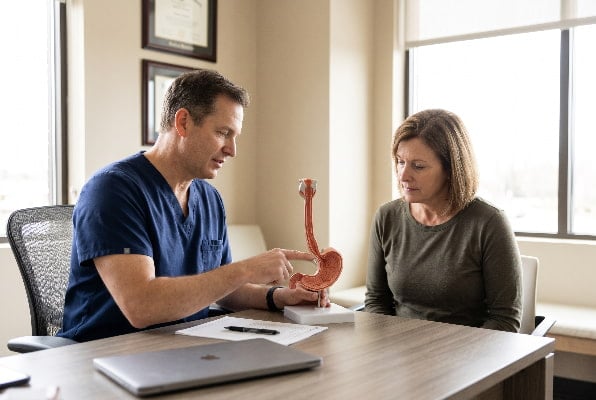
What is GERD?
GERD is reflux frequent enough, or damaging enough, to count as a disease rather than a bad night. The working threshold is symptoms two or more days a week.
The mechanism is mechanical. A ring of muscle at the bottom of your esophagus becomes weak or relaxes when it shouldn’t. Stomach contents get an open door.
Somewhere between 18% and 28% of American adults report reflux symptoms depending on the survey. That makes gastroesophageal reflux disease one of the most common conditions in the country, and one of the most casually treated.
The symptom list runs wider than people expect. Burning chest pain. Regurgitation. A sour taste. Trouble swallowing. Chronic cough, hoarseness, a lump-in-the-throat feeling, bad breath, nausea.
Some people never burn at all. Their reflux hits the throat instead, and they spend years in ENT waiting rooms for a problem that starts below the ribcage.
Can GERD damage your esophagus?
Yes, and this is the part the antacid aisle leaves off the box.
Years of acid exposure can scar the esophagus into a narrow tube that makes swallowing hard. It can cause bleeding. It can push the lining to swap itself for different tissue, a change called Barrett’s esophagus.
Non-dysplastic Barrett’s converts to esophageal adenocarcinoma at roughly 0.2% to 0.5% a year, per a 2026 review on PubMed Central. Small. But once high-grade dysplasia appears the rate jumps to about 7%, and US incidence of that cancer climbed from 0.4 to 2.8 cases per 100,000 person-years between 1975 and 2017.
I don’t repeat those numbers to frighten anyone. Patients ask why I care about three or four untreated years, and that’s the answer.
Heartburn, acid reflux, GERD: the short version
| Term | What it actually describes | How common |
| Heartburn | The burning sensation you notice | Occasional in most adults |
| Acid reflux | Stomach contents moving up past the valve | Happens to everyone now and then |
| GERD | Reflux frequent or damaging enough to be a disease | Symptoms two or more days a week |

Which conditions can feel like heartburn but aren’t?
Several conditions produce chest or upper-belly burning that passes for reflux. A few are emergencies. Most aren’t. All need someone other than you making the call.
The odds still favor reflux. Chasing a rare diagnosis while a common one goes untreated is how people lose years.
Heart attack
Cardiac chest pain can feel exactly like stomach chest pain. Emergency physicians can’t reliably tell them apart on symptoms alone, and neither can I.
A few features push toward the heart. Pressure instead of burning. Pain that worsens with exertion. Discomfort spreading into the left arm, jaw, neck or back. Shortness of breath, cold sweats, nausea. Women and people with diabetes often present nothing like that list. If you’re asking whether this might be your heart, the question is the answer. Go.
Gastritis
Gastritis is inflammation of the stomach lining, and it passes for reflux easily.
The usual driver is a long-running bacterial infection called Helicobacter pylori, treatable with antibiotics and invisible without testing. Anti-inflammatory drugs and alcohol do it too. Left alone it can progress to ulcers, bleeding, sometimes stomach cancer.
Peptic ulcers
Ulcers are open sores in the stomach lining or the first stretch of small intestine, and the pain differs from reflux usefully. It sits deeper and lower, and shifts with eating rather than lying down.
A few signs demand attention today. Vomiting blood or something resembling coffee grounds. Black tarry stools. Unplanned weight loss. Pain that wakes you at three in the morning.
Gallstones
Pain that arrives after a rich meal and settles under the right ribs is often the gallbladder, not the esophagus.
Gallstones are hardened deposits forming in an organ that sits beside the stomach. The pain hits suddenly, radiates toward the right shoulder or back, and brings nausea. Antacids don’t touch it. A stone lodged in the wrong duct causes serious infection or pancreatitis.
Gastroparesis
Gastroparesis means the stomach empties too slowly, and that delay makes reflux more likely by keeping food and acid where gravity works against you.
The giveaways differ from plain reflux. Feeling stuffed after three bites. Vomiting food eaten hours earlier. Unplanned weight loss. Causes run from diabetes to certain medications.
Hiatal hernia
A hiatal hernia means part of the stomach has slid into the chest through the opening in the diaphragm where your esophagus passes.
StatPearls puts hiatal hernia prevalence at roughly 55% to 60% of people over 50, and most never notice. But among people with reflux esophagitis, US and European studies put it between 50% and 94%.
This is the part to sit with. When a hernia drives your reflux, the problem is anatomical. No pill reshapes a diaphragm. That’s the most common reason medication eventually quits, and why people spend a decade on rising doses while nobody checks the anatomy.
What else gets mistaken for heartburn?
Plenty. Esophagitis, pericarditis, pleurisy, angina and ordinary indigestion all make the list. Esophageal spasm is the sneaky one, producing a squeezing chest pain that imitates cardiac pain almost perfectly.
One more gets missed for years. A swallowing disorder called achalasia stops the lower valve from opening, so food and liquid pool above the stomach and come back up. Reflux medication does nothing for it.

When should you see a doctor about heartburn?
Call someone if burning hits two or more days a week, if drugstore medicine has stopped working, or if it’s run past two or three weeks without a real break. Almost no article gives you a number. I will.
| Go now | Call this week |
| Chest pain with shortness of breath, sweating or nausea | Burning two or more days a week |
| Pain spreading to arm, neck, jaw or back | Symptoms waking you at night |
| Pain that worsens with exertion | Trouble or pain when swallowing |
| Vomiting blood, or black tarry stools | Hoarseness or a cough that lingers |
Now the part that explains why you’re reading this. A population-based study in Gastroenterology surveyed 71,812 people and found 54.1% of those on a daily acid-blocking medication still had ongoing heartburn or regurgitation. More than half. These drugs do their job. They don’t repair a valve.
So what happens when the medicine fails? More medicine, usually. That’s the wrong move.
Research in the Journal of Neurogastroenterology and Motility found over 60% of people who don’t respond to acid blockers show no abnormal reflux when tested off the drug. Their burning is real. Acid isn’t causing it.
A real workup runs in order.
- Upper endoscopy to check the tissue for damage, Barrett’s, ulcers or a hernia.
- pH or impedance monitoring off medication, measuring how much reflux happens and whether it’s acid.
- High-resolution manometry to see how the esophagus moves and whether a motility disorder hides underneath.
Skip those and everyone involved is guessing. I’ve met people sent to surgery without them, and the outcomes were about what you’d expect.
When testing confirms reflux that medication can’t hold, SAGES guidelines recommend surgery over medication for adults with chronic or refractory disease. Rebuilding the valve is one route among several, and which fits depends on your anatomy, not a brochure.
Why 2027 is the wrong year to keep guessing about heartburn that won’t go away
Take one thing from this article and let it be this. Persistent burning is information. Ignoring it costs more than acting on it.
Reflux care changed in the last five years. Objective testing before any procedure is standard now, and the tools for measuring what’s refluxing got sharper. None of that reaches someone still cycling through drugstore brands in year four.
I’ve watched too many people walk in after a decade of self-management with a hernia that could have been repaired years earlier and an esophagus that had already changed. The medication was doing what medication does. Nobody asked whether it was the right tool.
Tampa Bay Reflux Institute helps people eliminate reflux and GERD rather than muting them, and that starts with finding out what’s happening in your chest. If your heartburn that won’t go away has outlasted two rounds of medication, book an evaluation. Bring the symptom history.
FAQs
How long is too long for heartburn that won’t go away?
Heartburn that won’t go away for more than two to three weeks, or that returns two or more days a week, has crossed out of occasional reflux and into something worth evaluating. Two days a week is the threshold most gastroenterology guidelines use to define gastroesophageal reflux disease. Waiting past that point doesn’t make the problem easier to fix later.
Why does my heartburn that won’t go away continue even on daily medication?
Roughly 54% of people taking a daily acid-blocking medication still report ongoing heartburn or regurgitation, according to a population-based study published in Gastroenterology. Two common reasons are mechanical failure, such as a hiatal hernia that no drug can correct, and non-acid reflux that acid suppression doesn’t touch. Testing performed off medication is the only reliable way to tell which one you’re dealing with.
Can heartburn be a sign of a heart attack?
Yes. Chest pain from the heart and chest pain from the esophagus can feel identical, and emergency physicians cannot reliably separate them on symptoms alone. Pain that spreads to the arm, neck, jaw or back, worsens with exertion, or arrives with shortness of breath or cold sweats should be treated as cardiac until proven otherwise. Call 911 instead of talking yourself out of it.
Do coffee and tomatoes really cause acid reflux?
The evidence is weaker than the advice suggests. The American College of Gastroenterology found that coffee, caffeine, citrus and spicy foods had little measurable effect on lower esophageal valve pressure in laboratory studies, and a meta-analysis of 15 case-control studies found no significant association between coffee intake and reflux disease. Tomatoes sit in a similar gray zone, often reported as a personal trigger without a clearly proven link to reflux itself. Acidic foods can still irritate an inflamed esophagus, so skipping them during a flare is reasonable, but weight loss and earlier dinners carry much stronger evidence.
Is it safe to stay on acid-blocking medication for years?
Observational studies have raised questions about kidney problems, fractures and intestinal infections, though reviews published through 2026 describe the causal evidence as weak and heavily confounded. For most people the bigger issue isn’t drug safety. It’s that medication suppresses acid without repairing the mechanical defect letting stomach contents through, which is why symptoms often creep back over time.
What tests diagnose chronic heartburn?
A full reflux evaluation usually includes upper endoscopy to inspect the esophageal lining, pH or impedance monitoring performed off medication to measure actual reflux events, and high-resolution manometry to assess how the esophagus moves. Skipping these raises the odds of a wrong diagnosis, since more than 60% of people who don’t respond to acid blockers show no abnormal reflux when properly tested.


An endoscopy cannot tell you if you have reflux. It can only tell you if you have complications of GERD.
If you are unhappy with your reflux symptoms, come in and we can discuss testing and treatments that can accurately diagnose your problem.
#reflux #gerd #hiatalhernia #gastroparesis #linx

CALL US AT 813-922-2920
www.tampareflux.com
If you have a hiatal hernia and fit one of these categories, you should know your options.
Dr. Grandhige is an expert in his field and performs 200 of these surgeries a year. He is the only surgeon in the Tampa Bay Area who offers all surgical options - LINX, Fundoplications, TIF and will be one of 20 surgeons in America introducing the latest procedure RefluxStop in 2026.
We accept most insurances but will verify yours before you come in. These procedures are considered medically necessary and covered by your insurance. You can expect to pay your in-network deductibles and nothing else.
#hiatalhernia #reflux #GERD #LINX #refluxstop
What causes reflux ?
1. Weak lower esophageal sphincter
2. Hiatal hernia
3. Flattening of the Angle of His
4. Poor esophageal motility
5. Gastroparesis (slow stomach)
NOT increased acid production
Don’t let GERD get in the way of living your life. Request your appointment with us today on the link below.
.
.
.
.
https://tampareflux.com/contact-us/
Anyone can be victim to GERD and though weight loss can help reduce GERD symptoms. Many athletes with high impact workouts may continue to have these symptoms. This may be a symptom of a hiatal hernia or other issue. We are more then happy to assist you in finding your solution, just click the link below.
.
.
.
https://tampareflux.com/contact-us/
##healthylifestyle #workout #athletereflux #PPIs #heartburn #LINX #fundoplication #TIF #GERD#tampaheartburn #linx #TIF #fundoplication #tampabayreflux #GERD #acidreflux #acidrefluxsurgery #stopreflux
#nonsurgicalweightloss #ESG #gastricballoon #weightlossjourney #vsg #vsgjourney #spatz3 #orbera #orberaballoon #grandhige #DrG
#tampabayrefluxinstitute #guthealth #roboticsurgery
Heartburn may seem like an annoyance. But if you find yourself having symptoms on a daily basis, it may be time to to talk to Dr. Grandhige as it could be a symptom of something worse.
.
.
.
#chronicheartburn #gerdsymptoms #heartburnrelief #reflux #PPIs #heartburn #LINX #fundoplication #TIF #GERD#tampaheartburn #linx #TIF #fundoplication #tampabayreflux #GERD #acidreflux #acidrefluxsurgery #stopreflux
#nonsurgicalweightloss #ESG #gastricballoon #weightlossjourney #vsg #vsgjourney #spatz3 #orbera #orberaballoon #grandhige #DrG
#tampabayrefluxinstitute #guthealth #roboticsurgery
If you are tired of avoiding your favorite foods or taking daily medications, we can help.
We are the Tampa experts in reflux ! With years of experience and thousands of patients treated successfully, we offer all FDA approved anti-reflux procedures.
Call 813-922-2920 to schedule your appointment
All major insurances accepted.
Not all patients need surgical intervention. Many patients are living a heartburn free life with their PPIs. However 40% of patients taking PPIs are not getting the relief they need. If you are one of those, you have options! Come in and find out more.
.
.
.
.
#letushelpyou #medsnotworking #reflux #PPIs #heartburn #LINX #fundoplication #TIF #GERD#tampaheartburn #linx #TIF #fundoplication #tampabayreflux #GERD #acidreflux #acidrefluxsurgery #stopreflux
#nonsurgicalweightloss #ESG #gastricballoon #weightlossjourney #vsg #vsgjourney #spatz3 #orbera #orberaballoon #grandhige #DrG
#tampabayrefluxinstitute #guthealth #roboticsurgery
#heartburn #stopreflux #hiatalherniarepair #severeheartburn #reflux #tampabayreflux #acidrefluxsurgery #tampaheartburn #GERD #PPIs #achalasia #LINX #TIF #tampareflux #fundoplication #stomach #digestivehealth #ESG #obesity #overweight #weightlossjourney #gastricballoon


