

Written By: Jeffrey Atlas, Health Content Writer
Medically Reviewed By: Dr. Gopal Grandhige, MD, FACS, Board-Certified Surgeon
Last Reviewed: October 13, 2026
Yes, acid reflux can cause esophageal cancer. The odds are far smaller than the internet has convinced you, and the people who should worry fit a narrow profile.
Can acid reflux cause esophageal cancer? Yes. Years of stomach acid washing into the esophagus can change the cells that line it, and those changed cells can eventually turn cancerous. The risk belongs to people with weekly reflux lasting five years or longer. It does not belong to someone who gets heartburn after a heavy dinner.
Now the numbers. A 2024 systematic review of 43 studies found Barrett’s esophagus in 7% of people with reflux versus 2.2% without. Esophageal cancer turned up in 0.6% of the reflux group, 0.1% of everyone else. The National Cancer Institute counted about 22,070 new esophageal cancer cases in the U.S. for 2025, roughly 1.1% of all new diagnoses, while about 20% of American adults get weekly heartburn.
Run that math. The gap between “I have reflux” and “I will get cancer” is enormous.
I’ve sat across from hundreds of patients certain they had cancer. Almost none did. The ones who keep me up at night stopped complaining a decade ago.
What Acid Actually Does to the Esophagus
Your stomach is built for acid. Your esophagus isn’t.
The stomach has a thick mucous lining that shrugs off digestive acid. The esophagus has none. Every time acid pushes past the valve and sits there, it burns living tissue. Do that twice a week for fifteen years and the body does something clever and dangerous. It swaps the delicate lining for a tougher one that looks like intestine.
That swap is Barrett’s esophagus. The body protecting itself, and the doorway to cancer.
Two cancers grow here. Adenocarcinoma comes from this reflux pathway. Squamous cell carcinoma comes mostly from tobacco and heavy drinking and has little to do with chronic reflux disease. Nearly every article lumps them together, which is how bad risk advice circulates for decades. This piece sticks to adenocarcinoma and skips chemotherapy protocols, because if you’re reading this you probably don’t have cancer.

How Does Reflux Damage Turn Into Cancer?
Slowly, through Barrett’s esophagus, and usually not at all.
Once Barrett’s develops, cells can start looking abnormal under a microscope. Pathologists call that dysplasia. Published progression data puts annual cancer risk for Barrett’s without dysplasia at 0.1% to 0.5%. High-grade dysplasia is the serious one, with reported progression between 23% and 60% per year.
Fewer than 5% of people with Barrett’s ever develop esophageal cancer.
So why do I push patients toward a scope? Because progression is quiet. About 40% of esophageal adenocarcinomas occur in people who never reported chronic heartburn.
Consider anyone dealing with reflux without the heartburn. Hoarseness, throat clearing, a cough that won’t quit. Those people go years untreated because nothing burns.
I used to tell patients that improving symptoms meant improving risk. That’s not quite how I’d put it now. Barrett’s can actually reduce the burning, because the new lining tolerates acid better. Feeling better and being safer are two different things.
Warning Signs That Mean You Need a Scope Now
Trouble swallowing is the symptom that changes everything. If food feels like it’s sticking, stop reading and call someone today.
Doctors call it dysphagia. It starts with bread or dry meat, then softer foods, then liquids, because a tumor is physically narrowing the tube. Pain when swallowing often follows.
Other signs that deserve immediate attention:
- Losing weight without trying
- Hoarseness lasting more than three weeks
- A chronic cough with no clear cause
- Vomiting blood or passing black stools
- Reflux that suddenly changes character after years
That last one gets ignored constantly. Patients tell me their heartburn finally eased up and they’re relieved. Sometimes that’s healing. Sometimes a warning.
Early esophageal cancer causes no symptoms at all. Waiting for them is the most expensive mistake in this disease.

Who Actually Needs Screening?
The American College of Gastroenterology suggests a one-time screening endoscopy for chronic reflux plus three or more additional risk factors. Chronic means weekly symptoms or five years of history.
| Risk factor | Counts toward screening? |
| Weekly reflux for 5+ years | Required starting point |
| Male sex | Yes (men face roughly 4x the incidence) |
| Age over 50 | Yes |
| White, non-Hispanic race | Yes |
| Current or former smoker | Yes |
| Obesity, especially belly weight | Yes |
| Barrett’s or esophageal cancer in a close relative | Yes |
| Occasional heartburn only | No |
Three or more plus chronic reflux, and you’ve earned a scope. One or two, and routine screening isn’t the right call.
A swallowable sponge-on-a-string test now exists as an alternative to sedated endoscopy, which removes the usual excuse for delay.
A hiatal hernia belongs here too. When the top of the stomach slides up through the diaphragm, the valve fails mechanically, and no amount of dietary discipline fixes a structural problem.
How Doctors Find Esophageal Cancer
Endoscopy is the test that matters. Everything else supports it.
- Upper endoscopy with biopsy. A thin camera goes down the throat under sedation. The physician examines the lining and takes tissue samples. Only this test diagnoses Barrett’s or cancer.
- Barium swallow. You drink a chalky liquid that coats the esophagus, then an X-ray shows narrowing. Useful for mapping, useless for diagnosis, since it takes no tissue.
- CT or PET imaging. Ordered after cancer is confirmed, to see whether it spread.
If your physician offers a barium swallow instead of an endoscopy for alarm symptoms, ask why. I’ve watched that cost months.
Treatment Depends Almost Entirely on Timing
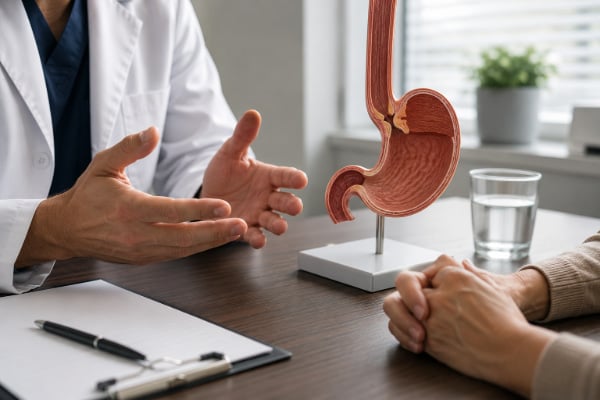
Caught early, esophageal cancer can often be removed through the mouth without a single incision.
Barrett’s with high-grade dysplasia or very early cancer is often treated endoscopically. The abnormal tissue gets lifted off or ablated, and healthy lining grows back. No incision, no removed organs, short recovery.
Advanced cancer is a different world, usually requiring surgery plus chemotherapy and radiation.
The distance between those two paragraphs is the entire argument for screening.
Survival Numbers, and Why Stage Beats Everything Else
Stage at diagnosis predicts outcome more than anything else, including treatment. Federal cancer registry data puts five-year relative survival here:
- Localized (confined to the esophagus): roughly 49%
- Regional (spread to nearby lymph nodes): roughly 28%
- Distant (spread to other organs): about 5%
- All stages combined: around 22%
Plenty of articles still quote 43% for localized disease. That figure is years out of date, and the cliff between localized and distant makes the point on its own.
Can You Lower Your Risk?
Yes, and the advice you’ve been given is partly wrong.
Time for the uncomfortable part. Nearly every esophageal cancer risk list includes alcohol. For squamous cell carcinoma that’s correct, and the association is strong. For the adenocarcinoma that reflux causes, a pooled analysis of eleven studies found no increased risk at any drinking level, and a separate meta-analysis agreed. Alcohol does worsen reflux symptoms by relaxing the valve, so cutting back is reasonable. Calling it a cancer risk for this disease isn’t supported.
Trigger food lists deserve similar skepticism. The ACG recommendation to avoid them is conditional and rests on low-quality evidence. Lab studies show coffee, caffeine, citrus, and spicy food barely move valve pressure. The stronger evidence is duller. Large, high-calorie meals measurably increase acid exposure, and so does excess weight.
Eat smaller portions. Lose weight if you carry it around the middle. Stop eating three hours before bed. Raise the head of the bed itself, not the pillows. Quit smoking.
A 2025 AGA guideline found daily acid-blocking therapy associated with lower odds of progression to high-grade dysplasia or cancer in Barrett’s patients, an odds ratio of 0.47. That same guideline found anti-reflux surgery showed no clear advantage for preventing progression.
Which surprises people who assume surgically rebuilding the valve is the cancer-prevention move. It isn’t, or the data doesn’t say so yet. Surgery stays excellent for symptom control, especially for anyone who can’t tolerate lifelong medication or has a significant hernia. Different goals, and conflating them disappoints patients.
Fruits and vegetables are worth eating, though the evidence is messier than most sites admit. A cohort of nearly 491,000 adults found real protection against squamous cell carcinoma, almost none against adenocarcinoma. Processed meat looks more consistent, with a large European cohort reporting a 13% rise in adenocarcinoma risk per extra 30 grams daily.
So can acid reflux cause esophageal cancer? It can, and for most people it won’t. The deciding variable isn’t willpower at dinner. It’s whether somebody looks at your esophagus before the cells change. If you’ve had weekly reflux for five years and check a few boxes on that risk table, schedule an evaluation with a board-certified surgeon who treats this every week.
FAQs
Can acid reflux cause esophageal cancer if I only get heartburn once in a while?
No. Occasional heartburn carries no meaningful cancer risk. The concern applies to weekly symptoms lasting five years or more, and even then a 2024 systematic review found esophageal cancer in only 0.6% of people with reflux compared with 0.1% of people without it.
How many years of reflux does it take before cancer risk goes up?
Chronic reflux is generally defined as weekly symptoms lasting at least five years. Progression from reflux to Barrett’s esophagus to cancer typically takes 10 to 20 years when it happens at all. Most people never move past the first step.
If my symptoms improved on medication, can acid reflux still cause esophageal cancer?
Yes. Barrett’s esophagus can actually reduce burning, because the replacement lining tolerates acid better than normal esophageal tissue. Roughly 40% of esophageal adenocarcinomas occur in people who never reported chronic heartburn. Symptom relief is not proof of safety.
What is the yearly cancer risk if I already have Barrett’s esophagus?
For Barrett’s without dysplasia, published annual progression risk runs between 0.1% and 0.5% per year. Fewer than 5% of people with Barrett’s ever develop esophageal cancer. High-grade dysplasia is the exception, with far higher reported progression rates.
Does anti-reflux surgery prevent esophageal cancer better than medication?
A 2025 American Gastroenterological Association guideline found daily acid-blocking medication was associated with lower odds of progression (odds ratio 0.47), while anti-reflux surgery showed no clear advantage for cancer prevention. Surgery remains a strong option for symptom control and durable repair, which is a different goal.
Should I get an endoscopy if I have long-term reflux but no other risk factors?
Probably not. The American College of Gastroenterology suggests screening for people with chronic reflux plus three or more additional risk factors, including male sex, age over 50, White race, smoking history, obesity, and a family history of Barrett’s or esophageal cancer.
Is difficulty swallowing always a sign of cancer?
No, but it always warrants prompt evaluation. Trouble swallowing can come from strictures, motility disorders, or inflammation. It’s also the most common presenting symptom of esophageal cancer, which is why it should never be watched and waited on.


An endoscopy cannot tell you if you have reflux. It can only tell you if you have complications of GERD.
If you are unhappy with your reflux symptoms, come in and we can discuss testing and treatments that can accurately diagnose your problem.
#reflux #gerd #hiatalhernia #gastroparesis #linx

CALL US AT 813-922-2920
www.tampareflux.com
If you have a hiatal hernia and fit one of these categories, you should know your options.
Dr. Grandhige is an expert in his field and performs 200 of these surgeries a year. He is the only surgeon in the Tampa Bay Area who offers all surgical options - LINX, Fundoplications, TIF and will be one of 20 surgeons in America introducing the latest procedure RefluxStop in 2026.
We accept most insurances but will verify yours before you come in. These procedures are considered medically necessary and covered by your insurance. You can expect to pay your in-network deductibles and nothing else.
#hiatalhernia #reflux #GERD #LINX #refluxstop
What causes reflux ?
1. Weak lower esophageal sphincter
2. Hiatal hernia
3. Flattening of the Angle of His
4. Poor esophageal motility
5. Gastroparesis (slow stomach)
NOT increased acid production
Don’t let GERD get in the way of living your life. Request your appointment with us today on the link below.
.
.
.
.
https://tampareflux.com/contact-us/
Anyone can be victim to GERD and though weight loss can help reduce GERD symptoms. Many athletes with high impact workouts may continue to have these symptoms. This may be a symptom of a hiatal hernia or other issue. We are more then happy to assist you in finding your solution, just click the link below.
.
.
.
https://tampareflux.com/contact-us/
##healthylifestyle #workout #athletereflux #PPIs #heartburn #LINX #fundoplication #TIF #GERD#tampaheartburn #linx #TIF #fundoplication #tampabayreflux #GERD #acidreflux #acidrefluxsurgery #stopreflux
#nonsurgicalweightloss #ESG #gastricballoon #weightlossjourney #vsg #vsgjourney #spatz3 #orbera #orberaballoon #grandhige #DrG
#tampabayrefluxinstitute #guthealth #roboticsurgery
Heartburn may seem like an annoyance. But if you find yourself having symptoms on a daily basis, it may be time to to talk to Dr. Grandhige as it could be a symptom of something worse.
.
.
.
#chronicheartburn #gerdsymptoms #heartburnrelief #reflux #PPIs #heartburn #LINX #fundoplication #TIF #GERD#tampaheartburn #linx #TIF #fundoplication #tampabayreflux #GERD #acidreflux #acidrefluxsurgery #stopreflux
#nonsurgicalweightloss #ESG #gastricballoon #weightlossjourney #vsg #vsgjourney #spatz3 #orbera #orberaballoon #grandhige #DrG
#tampabayrefluxinstitute #guthealth #roboticsurgery
If you are tired of avoiding your favorite foods or taking daily medications, we can help.
We are the Tampa experts in reflux ! With years of experience and thousands of patients treated successfully, we offer all FDA approved anti-reflux procedures.
Call 813-922-2920 to schedule your appointment
All major insurances accepted.
Not all patients need surgical intervention. Many patients are living a heartburn free life with their PPIs. However 40% of patients taking PPIs are not getting the relief they need. If you are one of those, you have options! Come in and find out more.
.
.
.
.
#letushelpyou #medsnotworking #reflux #PPIs #heartburn #LINX #fundoplication #TIF #GERD#tampaheartburn #linx #TIF #fundoplication #tampabayreflux #GERD #acidreflux #acidrefluxsurgery #stopreflux
#nonsurgicalweightloss #ESG #gastricballoon #weightlossjourney #vsg #vsgjourney #spatz3 #orbera #orberaballoon #grandhige #DrG
#tampabayrefluxinstitute #guthealth #roboticsurgery
#heartburn #stopreflux #hiatalherniarepair #severeheartburn #reflux #tampabayreflux #acidrefluxsurgery #tampaheartburn #GERD #PPIs #achalasia #LINX #TIF #tampareflux #fundoplication #stomach #digestivehealth #ESG #obesity #overweight #weightlossjourney #gastricballoon


