
The testing that comes before any procedure
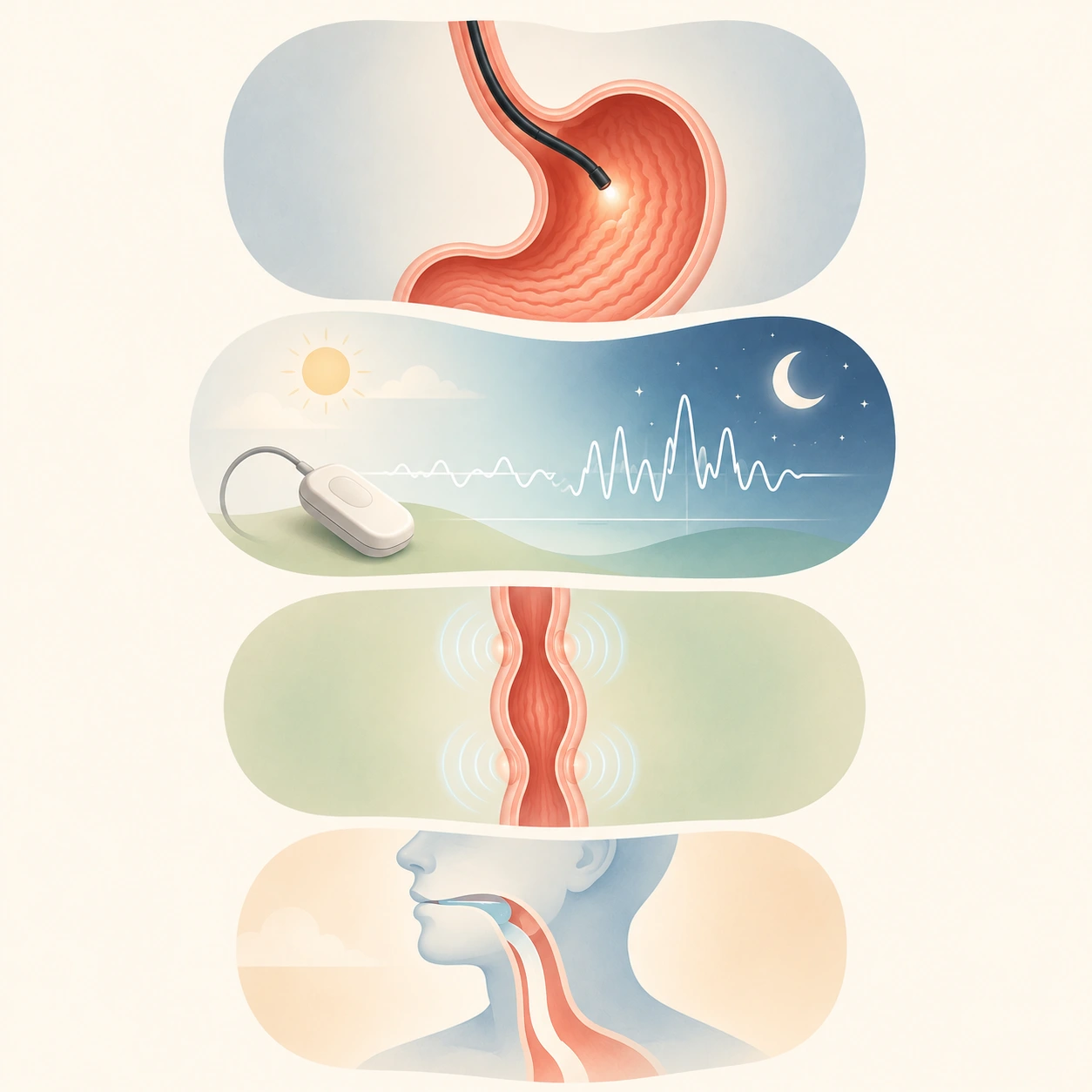
Three studies carry the decision. pH monitoring proves reflux, manometry protects your swallowing, and imaging clarifies anatomy when the picture is unclear.
24-hour to 72-hour pH monitoring. Performed with either a wireless Bravo capsule or a catheter-based pH impedance probe, recorded while you eat, sleep, work and exercise normally. It measures how often reflux happens, how long each episode lasts, when it happens, and whether your symptoms line up with actual reflux events. This is the study that separates true reflux from esophageal hypersensitivity, functional chest pain, motility disorders and rumination, all of which can feel identical to the patient and respond very differently to surgery.
Esophageal manometry. This measures contraction strength, swallow coordination and how the lower esophageal sphincter relaxes. Every anti-reflux procedure adds resistance at the junction between esophagus and stomach. If your esophagus cannot push food through that added resistance, you get dysphagia, food sticking and chest pain. Manometry is also what catches achalasia, esophageal spasm and ineffective motility before someone treats them as reflux.
Barium swallow, used selectively. Reserved for dysphagia, suspected strictures, unclear anatomy, prior foregut surgery, or when symptoms contradict the other tests. One finding from this study is worth knowing in advance: where patients feel food sticking matches the actual anatomic location only about 60% of the time. Someone who swears food is catching in their throat is frequently showing delay in the distal esophagus on film.
If your symptoms are in your throat, standard testing is the wrong tool
Most reflux testing measures acid exposure above the lower esophageal sphincter only. For silent reflux (LPR), that is the wrong measurement point. Dr. Grandhige uses a customized 24-hour pH impedance dual-channel probe that records above the lower esophageal sphincter and above the upper esophageal sphincter, and measures non-acid reflux alongside acid.
The sensitivity difference explains why. The esophagus can tolerate 40 to 50 reflux episodes a day. The larynx and pharynx can produce symptoms from a single episode. Bile, pepsin and trypsin only show up on impedance testing, so an acid-only study can read as normal in a patient whose throat is being irritated several times a day.
That testing changes who gets operated on. With standard testing, LPR patients are commonly quoted around a 50% chance that surgery helps. With dual-channel impedance selection, Dr. Grandhige’s reported improvement rate is approximately 80%. Roughly 50% to 60% of LPR patients who get tested have results that warrant surgery. The other 40% to 50% are told so, and sent in a different direction. Chronic throat clearing, hoarseness, cough, globus sensation, postnasal drip and ear fullness are the symptom set this applies to.
Four anti-reflux procedures, and how yours gets chosen
There is no best reflux operation. There is a right operation for your anatomy and your esophageal function, and sometimes that answer is no operation. Dr. Grandhige performs all of the following, which means procedure selection is not limited by what he is comfortable doing.
About the LINX news you may have read
Johnson & Johnson withdrew LINX from markets outside the United States beginning at the end of March 2026. The company stated the decision was commercial and not related to device safety or efficacy. LINX remains available in the United States. If you came across that story and assumed the option was gone, it is not.
What reflux surgery will not fix
Reflux surgery fixes reflux. It does not fix every symptom you walked in with, and confusing those two things is the most common reason people feel let down by an operation that worked.
Patients usually arrive with a long list: heartburn, regurgitation, chest discomfort, throat clearing, cough, hoarseness, bloating, nausea, poor sleep, fatigue, globus sensation, sinus pressure, abdominal pain, bad breath, food intolerance. Some of those are reflux. Some overlap with ENT conditions, pulmonary disease, allergies, anxiety, functional GI disorders and esophageal hypersensitivity. Without testing and symptom correlation, there is no way to tell which is which, and surgery performed on the wrong assumption is technically successful and clinically disappointing.
Before any procedure, you should be told explicitly which of your symptoms are expected to improve, which may improve partially, and which are unlikely to change. Heartburn and regurgitation generally resolve. Atypical throat and airway symptoms are slower and less certain. LPR symptoms usually take 4 to 6 months to improve, while typical heartburn often resolves within a day. Dr. Grandhige asks patients to give it six months before judging the result, and then addresses whatever remains, which sometimes means a referral to a different specialist.
Ask directly about four things: swallowing changes, gas and bloating, the ability to burp and vomit, and revision risk over a lifetime. Whether each is temporary or permanent depends on which procedure you have. These are functional operations. Like a joint replacement, they work well, they are subject to wear, and some will need revision eventually.
In appropriately selected patients, meaning typical heartburn and regurgitation, objective reflux on testing, workable anatomy and good esophageal function, Dr. Grandhige reports greater than 95% significant symptom relief with elimination of daily reflux medication, supported by pre-procedure and post-procedure testing. Outcomes are lower with reduced motility, large or recurrent hernias, prior foregut surgery or prior bariatric surgery, and those cases are discussed individually.
Dr. Gopal Grandhige, and how to check him yourself

Gopal Grandhige, MD is a board-certified general surgeon who has focused on foregut surgery in Tampa Bay since 2009. He founded Tampa Bay Reflux Center in 2009 and Tampa Bay Reflux Institute in 2022, where he serves as Medical Director.
Training: BS in Biology from Johns Hopkins University, MD from the University of Michigan, general surgery residency at Yale-New Haven Hospital, followed by fellowships at Yale-New Haven in both burn and critical care and in foregut and minimally invasive surgery. He is a Fellow of the American College of Surgeons, a member of SAGES, and a Founding Member of the American Foregut Society. Beyond reflux he treats achalasia with Heller myotomy using EndoFlip, and gastroparesis with endoscopic pyloromyotomy.
Do not take any of that on a website’s word. You can confirm his certification status directly through the American Board of Surgery’s primary source verification, and his active license and any disciplinary history through the Florida Department of Health Medical Quality Assurance license lookup.
The team matters as much as the credentials on a surgery like this. His physician assistant assists in every case, participates in operative decision-making and handles postoperative questions with full knowledge of your specific anatomy. Several of his medical assistants have worked with him for over a decade. After hours, patients reach Dr. Grandhige directly rather than an answering service, which is the single fastest way to keep a small postoperative concern from becoming an emergency room visit.
Brandon heartburn questions
Find out what is actually causing your heartburn
You can keep escalating medication, or you can find out whether reflux is happening, how often, and whether anything mechanical is driving it. Testing gives you an answer either way, and the answer is sometimes that you do not need surgery.
Brandon patients are usually seen within 2 weeks. Send your prior records to info@tampareflux.com before the visit so your first appointment is a conversation about your results instead of a search for them.


An endoscopy cannot tell you if you have reflux. It can only tell you if you have complications of GERD.
If you are unhappy with your reflux symptoms, come in and we can discuss testing and treatments that can accurately diagnose your problem.
#reflux #gerd #hiatalhernia #gastroparesis #linx


CALL US AT 813-922-2920
www.tampareflux.com
If you have a hiatal hernia and fit one of these categories, you should know your options.
Dr. Grandhige is an expert in his field and performs 200 of these surgeries a year. He is the only surgeon in the Tampa Bay Area who offers all surgical options - LINX, Fundoplications, TIF and will be one of 20 surgeons in America introducing the latest procedure RefluxStop in 2026.
We accept most insurances but will verify yours before you come in. These procedures are considered medically necessary and covered by your insurance. You can expect to pay your in-network deductibles and nothing else.
#hiatalhernia #reflux #GERD #LINX #refluxstop

What causes reflux ?
1. Weak lower esophageal sphincter
2. Hiatal hernia
3. Flattening of the Angle of His
4. Poor esophageal motility
5. Gastroparesis (slow stomach)
NOT increased acid production


Don’t let GERD get in the way of living your life. Request your appointment with us today on the link below.
.
.
.
.
https://tampareflux.com/contact-us/

Anyone can be victim to GERD and though weight loss can help reduce GERD symptoms. Many athletes with high impact workouts may continue to have these symptoms. This may be a symptom of a hiatal hernia or other issue. We are more then happy to assist you in finding your solution, just click the link below.
.
.
.
https://tampareflux.com/contact-us/
##healthylifestyle #workout #athletereflux #PPIs #heartburn #LINX #fundoplication #TIF #GERD#tampaheartburn #linx #TIF #fundoplication #tampabayreflux #GERD #acidreflux #acidrefluxsurgery #stopreflux
#nonsurgicalweightloss #ESG #gastricballoon #weightlossjourney #vsg #vsgjourney #spatz3 #orbera #orberaballoon #grandhige #DrG
#tampabayrefluxinstitute #guthealth #roboticsurgery

Heartburn may seem like an annoyance. But if you find yourself having symptoms on a daily basis, it may be time to to talk to Dr. Grandhige as it could be a symptom of something worse.
.
.
.
#chronicheartburn #gerdsymptoms #heartburnrelief #reflux #PPIs #heartburn #LINX #fundoplication #TIF #GERD#tampaheartburn #linx #TIF #fundoplication #tampabayreflux #GERD #acidreflux #acidrefluxsurgery #stopreflux
#nonsurgicalweightloss #ESG #gastricballoon #weightlossjourney #vsg #vsgjourney #spatz3 #orbera #orberaballoon #grandhige #DrG
#tampabayrefluxinstitute #guthealth #roboticsurgery

If you are tired of avoiding your favorite foods or taking daily medications, we can help.
We are the Tampa experts in reflux ! With years of experience and thousands of patients treated successfully, we offer all FDA approved anti-reflux procedures.
Call 813-922-2920 to schedule your appointment
All major insurances accepted.

Not all patients need surgical intervention. Many patients are living a heartburn free life with their PPIs. However 40% of patients taking PPIs are not getting the relief they need. If you are one of those, you have options! Come in and find out more.
.
.
.
.
#letushelpyou #medsnotworking #reflux #PPIs #heartburn #LINX #fundoplication #TIF #GERD#tampaheartburn #linx #TIF #fundoplication #tampabayreflux #GERD #acidreflux #acidrefluxsurgery #stopreflux
#nonsurgicalweightloss #ESG #gastricballoon #weightlossjourney #vsg #vsgjourney #spatz3 #orbera #orberaballoon #grandhige #DrG
#tampabayrefluxinstitute #guthealth #roboticsurgery

#heartburn #stopreflux #hiatalherniarepair #severeheartburn #reflux #tampabayreflux #acidrefluxsurgery #tampaheartburn #GERD #PPIs #achalasia #LINX #TIF #tampareflux #fundoplication #stomach #digestivehealth #ESG #obesity #overweight #weightlossjourney #gastricballoon
