
Why your heartburn returns the day you skip a pill
Acid medication lowers the acidity of what refluxes. It doesn’t stop the reflux.
A proton pump inhibitor blocks acid production for roughly 12 to 16 hours a day. An H2 blocker like famotidine lasts about 4 to 6 hours and takes around 30 minutes to start working, which is why it’s useful as needed rather than as a foundation. Both reduce how much acid your stomach makes. Neither strengthens the lower esophageal sphincter. Neither repairs a hernia.
That’s the pattern most Brandon patients describe. The burn improves. The regurgitation, the nighttime symptoms, and the throat clearing often don’t. Stomach contents are still traveling upward, just less acidic. Bile, pepsin, and trypsin keep refluxing no matter what a PPI does, and none of those are acid.
Dr. Grandhige explains it in one line: reflux medication turns down the burn, but it doesn’t stop the leak.
Almost everyone with gastroesophageal reflux disease has a hiatal hernia, even when it’s small enough that an endoscopy misses it. The hernia lifts the sphincter into the chest, where pressure works against you, and takes the diaphragm’s support out of the equation. The reflux barrier has two parts. Both can fail, and medication fixes neither.
One newer medication is worth knowing about, because most reflux pages skip it. Vonoprazan (Voquezna) is a potassium-competitive acid blocker, a different drug class from every PPI. The FDA approved it for erosive esophagitis in November 2023 and for heartburn with non-erosive GERD in July 2024. It suppresses acid faster and holds it down more consistently. It still doesn’t repair a hernia or strengthen a sphincter. If acid is your whole problem, ask your prescriber. If mechanics are your problem, it changes the chemistry and not the anatomy.
A normal endoscopy does not rule out reflux
Upper endoscopy answers one question: has reflux already caused visible damage? It does not answer whether reflux is happening, how often, or why.
This is the most common reason patients arrive frustrated. They were scoped, told everything looked fine, and sent back out with a refill. Endoscopy finds esophagitis, Barrett’s esophagus, ulcers, and strictures. It does not measure reflux events, assess sphincter function, or capture timing. Plenty of people with significant reflux have a normal endoscopy, especially while taking acid suppressors. Small hiatal hernias aren’t visible on every scope either.
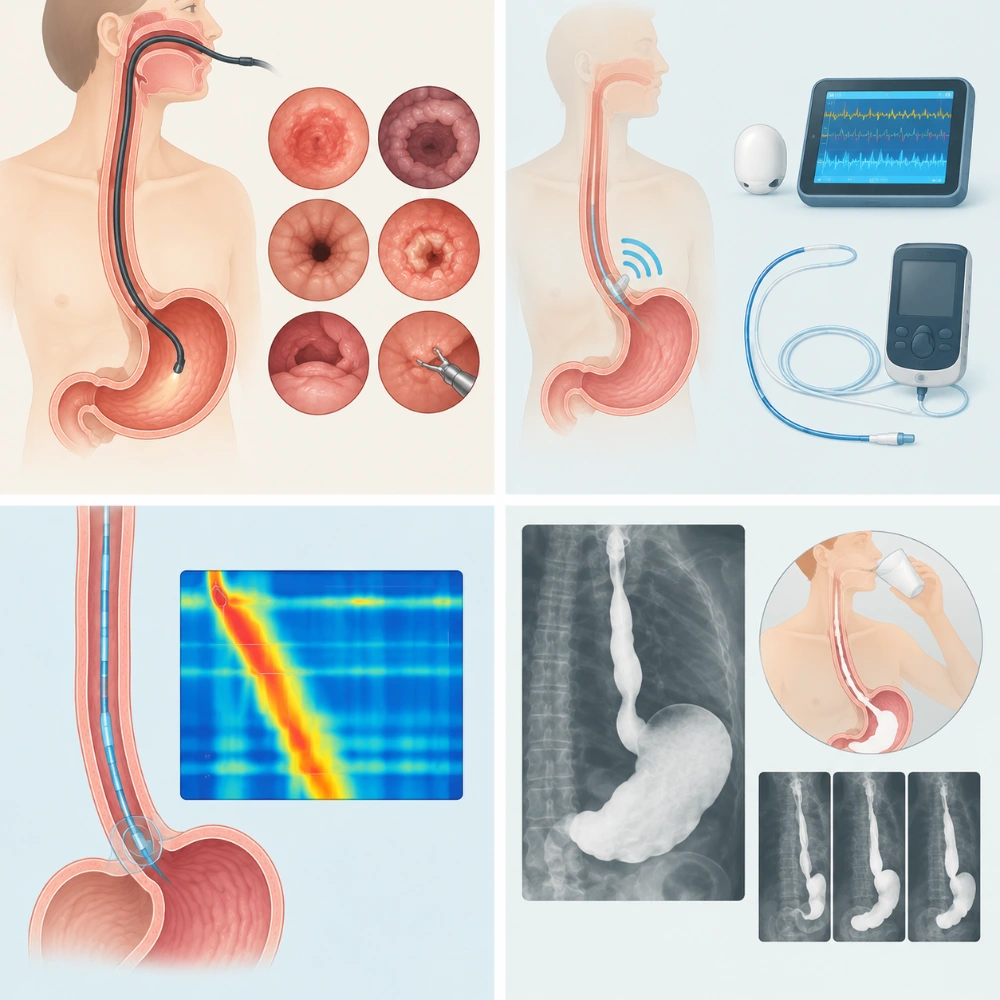
Four tests answer four different questions. They’re ordered based on what’s still unknown, not as a package.
pH monitoring measures reflux itself, in real time, over 48 to 72 hours using a wireless Bravo capsule or a catheter probe. It records how often reflux happens, how long each episode lasts, when, and whether your symptoms line up with actual reflux events. This confirms or rules out GERD, and gives a baseline to compare against after any procedure.
Esophageal manometry measures whether your esophagus has the strength and coordination to handle a procedure. It decides which operation is safe for you and which would leave you unable to swallow comfortably. Skipping it is how people end up with lasting dysphagia.
Barium swallow shows what happens while you swallow, which a camera at rest can’t. One finding surprises nearly everyone: where you feel food getting stuck is the correct anatomic location only about 60 percent of the time. Patients regularly point at their throat when the delay is in the lower esophagus.
Dual-channel pH impedance testing is the one most centers don’t run. Standard testing measures above the lower esophageal sphincter only. Dr. Grandhige uses a customized 24-hour probe that measures above the lower sphincter and above the upper sphincter, so it can tell whether reflux is physically reaching your throat and voice box. It also detects non-acid reflux, which standard pH testing misses.
That last test matters because the throat isn’t built like the esophagus. The esophagus tolerates 40 to 50 reflux episodes a day without complaint. The larynx and pharynx can produce symptoms from a single episode. That’s why silent reflux, or LPR, gets treated as allergies, asthma, or sinus disease for years while every standard test reads normal.
The four procedures, and who each one is wrong for
Each of these fixes a different part of the problem, and each one has a group of patients it should not be used on.
Fundoplication. The upper stomach is wrapped around the lower esophagus to rebuild the reflux barrier, with the hernia repaired at the same time. Laparoscopic or robotic, typically 1.5 to 2 hours, usually same-day discharge. Four configurations exist (Nissen, Toupet, Dor, Watson), chosen from your manometry results. Diet progresses over 2 to 3 months. In appropriately selected patients, more than 90 percent see symptoms resolve and stop daily medication. The trade-off is real: because it’s harder for acid to come up, it’s also harder for air and food to come up. Bloating and limits on vomiting are the honest downsides. Fundoplication is not for patients with untreated severe motility disorders.
LINX. A ring of magnetic titanium beads around the lower esophagus. It doesn’t raise resting sphincter pressure. It resists opening when stomach pressure rises and opens when you swallow, so most patients keep the ability to burp and vomit once early swallowing issues settle. Hernia size doesn’t disqualify you, as long as the hernia is repaired during the same operation. The device is MRI compatible up to 1.5 Tesla and can be removed later without closing off future options. LINX magnetic sphincter augmentation is wrong for patients with poor esophageal motility, who face a higher risk of lasting swallowing difficulty. One observation from this practice: patients highly attuned to internal sensation, including those who could feel a Bravo pH capsule, often report sensing the device.
TIF. Performed entirely through the mouth with the EsophyX device, no abdominal incisions, typically 45 to 60 minutes under general anesthesia, same-day discharge. Lifting and core strain are restricted for 6 weeks. Here is the number nobody quotes: Dr. Grandhige tells patients to expect a failure rate of about 2 percent per year, or roughly 20 percent per decade. It’s the best endoscopic option available and it buys many patients years of relief, but it should be understood as durable rather than permanent. TIF cannot repair a hiatal hernia, because the diaphragm can’t be reached from inside. It is not offered here to patients with moderate or large hernias, Barrett’s esophagus, severe esophagitis, strictures, or to patients who are obese. Most of TIF’s bad reputation comes from being used outside those limits.
RefluxStop. The FDA granted premarket approval to RefluxStop on August 20, 2026, under PMA number P250018. It holds the gastroesophageal junction in its normal position below the diaphragm without encircling or compressing the food passageway, which is a different mechanism from everything above. Approval rested on five-year European outcome data. The FDA also required a post-approval study following 200 patients for five years, so the U.S. evidence base is still being built. Dr. Grandhige is adding RefluxStop to the practice. Call the office for current availability before you plan around it.
When we tell Brandon patients not to have surgery
A surgeon who never advises against operating isn’t exercising judgment. Here, the recommendation against surgery is common enough to be a defining feature of the practice.
The clearest numbers come from the LPR side. Among patients evaluated for throat symptoms, roughly 50 to 60 percent have testing that actually supports a procedure. The rest don’t, and they’re told so. Nationally, LPR patients are often quoted around a 50 percent chance that surgery helps. With dual-channel testing identifying who genuinely has reflux reaching the larynx, that improvement rate rises to roughly 80 percent. The mechanism isn’t a better operation. It’s operating on fewer people and choosing them correctly.
Symptoms that look like reflux and aren’t include esophageal hypersensitivity, functional chest pain, rumination, achalasia, and motility disorders. Surgery doesn’t help any of them, and in some cases makes things worse.
Dr. Grandhige is direct about the cost of this approach: the patients he declines to operate on are often the least satisfied in the short term, because they arrived wanting a solution. They’d be far unhappier having had an unnecessary operation and still having the symptom.
One more expectation worth setting now. Typical reflux symptoms often resolve almost immediately after a procedure. LPR symptoms take 4 to 6 months. Patients are asked to give it six months, at which point whatever remains gets addressed, sometimes with a referral to ENT, pulmonology, or allergy.
What happens between your first call and your procedure
Most patients are seen within 2 weeks, and always within 4.
On your first call the office collects your symptoms, goals, and insurance information, and verifies coverage before anything is scheduled. Before you arrive, send your prior records to info@tampareflux.com: endoscopy and pathology reports, any pH testing including Bravo studies, manometry results, barium swallow or imaging, office notes from your gastroenterologist, ENT, pulmonologist, or allergist, plus your medication and surgical history. Records that arrive early get personally reviewed early, which turns the consultation from data gathering into decision-making. Signed releases alone aren’t reliable. Fax systems and incompatible record platforms lose things constantly, and patients remain the most dependable carriers of their own history.
If your testing is already complete, one visit is usually enough and the diagnosis can be confirmed that day. Surgery can follow as early as 4 weeks.
If testing isn’t complete, the first visit covers education, record review, and test planning. Studies run through a small number of sites the practice works with regularly, which keeps scheduling fast and quality consistent, and testing is grouped onto as few days as possible. A second visit about 4 weeks later reviews results and finalizes the plan. First consultation to surgery, the target is roughly 8 weeks.
The office handles insurance authorization entirely, including follow-up requests. Authorization can take 4 to 6 weeks on complex cases, and surgery is never scheduled before it’s secured. Most anti-reflux procedures are covered when objective testing documents the diagnosis and symptoms persist despite medical therapy. Calling your insurer yourself usually slows this down rather than speeding it up.
Getting here from Brandon, and who’s actually treating you

The office is at 1315 South Howard Avenue, Suite 101, Tampa, FL 33606, in a yellow brick building next to Sally O’Neill’s Pizza. Parking is behind the restaurant. From Brandon it’s a direct run west on the Selmon Expressway, roughly [INSERT VERIFIED DRIVE TIME] minutes outside rush hour. Office hours are 9am to 6pm, Monday through Friday. Phone: 813.922.2920.
Dr. Grandhige holds surgical privileges at HCA Florida Brandon Hospital. All reflux and foregut procedures are performed at HCA South Tampa Hospital, deliberately at one facility, with the same anesthesia team, the same surgical staff, and the same dedicated physician assistant on every case.
For Brandon patients, that physician assistant matters more than the address. She assists on every operation, knows your anatomy and recovery course, and is reachable during office hours. Dr. Grandhige is reachable directly after hours and on weekends.
Dr. Grandhige’s training and background: biology at Johns Hopkins, medical degree from the University of Michigan, general surgery residency at Yale-New Haven Hospital, then two Yale fellowships, one in burn and critical care and one in foregut and minimally invasive surgery. He’s a Fellow of the American College of Surgeons, a member of SAGES, and a founding member of the American Foregut Society. He founded Tampa Bay Reflux Center in 2009 and Tampa Bay Reflux Institute in 2022, and has performed more than 600 fundoplications, more than 600 LINX procedures, and more than 200 TIF procedures. Credentials can be verified independently through the American Board of Surgery physician lookup, the American College of Surgeons directory, and the Florida Department of Health license verification tool.
Frequently asked questions
Get an answer instead of another refill
You’ve probably been told your tests look fine, to stay on the medication, and to come back if it gets worse. That isn’t a diagnosis. Objective testing tells you whether reflux is actually happening, which part of the barrier failed, and whether a procedure would help you or waste your time. Some patients leave with a surgical plan. Some leave knowing medication is the right long-term answer for them. Either way, you’ll leave knowing why.
Tampa Bay Reflux Institute 1315 South Howard Avenue, Suite 101, Tampa, FL 33606 813.922.2920 | Monday through Friday, 9am to 6pm Serving Brandon, Riverview, Valrico, Seffner, Lithia, and the greater Tampa Bay area.


An endoscopy cannot tell you if you have reflux. It can only tell you if you have complications of GERD.
If you are unhappy with your reflux symptoms, come in and we can discuss testing and treatments that can accurately diagnose your problem.
#reflux #gerd #hiatalhernia #gastroparesis #linx


CALL US AT 813-922-2920
www.tampareflux.com
If you have a hiatal hernia and fit one of these categories, you should know your options.
Dr. Grandhige is an expert in his field and performs 200 of these surgeries a year. He is the only surgeon in the Tampa Bay Area who offers all surgical options - LINX, Fundoplications, TIF and will be one of 20 surgeons in America introducing the latest procedure RefluxStop in 2026.
We accept most insurances but will verify yours before you come in. These procedures are considered medically necessary and covered by your insurance. You can expect to pay your in-network deductibles and nothing else.
#hiatalhernia #reflux #GERD #LINX #refluxstop

What causes reflux ?
1. Weak lower esophageal sphincter
2. Hiatal hernia
3. Flattening of the Angle of His
4. Poor esophageal motility
5. Gastroparesis (slow stomach)
NOT increased acid production


Don’t let GERD get in the way of living your life. Request your appointment with us today on the link below.
.
.
.
.
https://tampareflux.com/contact-us/

Anyone can be victim to GERD and though weight loss can help reduce GERD symptoms. Many athletes with high impact workouts may continue to have these symptoms. This may be a symptom of a hiatal hernia or other issue. We are more then happy to assist you in finding your solution, just click the link below.
.
.
.
https://tampareflux.com/contact-us/
##healthylifestyle #workout #athletereflux #PPIs #heartburn #LINX #fundoplication #TIF #GERD#tampaheartburn #linx #TIF #fundoplication #tampabayreflux #GERD #acidreflux #acidrefluxsurgery #stopreflux
#nonsurgicalweightloss #ESG #gastricballoon #weightlossjourney #vsg #vsgjourney #spatz3 #orbera #orberaballoon #grandhige #DrG
#tampabayrefluxinstitute #guthealth #roboticsurgery

Heartburn may seem like an annoyance. But if you find yourself having symptoms on a daily basis, it may be time to to talk to Dr. Grandhige as it could be a symptom of something worse.
.
.
.
#chronicheartburn #gerdsymptoms #heartburnrelief #reflux #PPIs #heartburn #LINX #fundoplication #TIF #GERD#tampaheartburn #linx #TIF #fundoplication #tampabayreflux #GERD #acidreflux #acidrefluxsurgery #stopreflux
#nonsurgicalweightloss #ESG #gastricballoon #weightlossjourney #vsg #vsgjourney #spatz3 #orbera #orberaballoon #grandhige #DrG
#tampabayrefluxinstitute #guthealth #roboticsurgery

If you are tired of avoiding your favorite foods or taking daily medications, we can help.
We are the Tampa experts in reflux ! With years of experience and thousands of patients treated successfully, we offer all FDA approved anti-reflux procedures.
Call 813-922-2920 to schedule your appointment
All major insurances accepted.

Not all patients need surgical intervention. Many patients are living a heartburn free life with their PPIs. However 40% of patients taking PPIs are not getting the relief they need. If you are one of those, you have options! Come in and find out more.
.
.
.
.
#letushelpyou #medsnotworking #reflux #PPIs #heartburn #LINX #fundoplication #TIF #GERD#tampaheartburn #linx #TIF #fundoplication #tampabayreflux #GERD #acidreflux #acidrefluxsurgery #stopreflux
#nonsurgicalweightloss #ESG #gastricballoon #weightlossjourney #vsg #vsgjourney #spatz3 #orbera #orberaballoon #grandhige #DrG
#tampabayrefluxinstitute #guthealth #roboticsurgery

#heartburn #stopreflux #hiatalherniarepair #severeheartburn #reflux #tampabayreflux #acidrefluxsurgery #tampaheartburn #GERD #PPIs #achalasia #LINX #TIF #tampareflux #fundoplication #stomach #digestivehealth #ESG #obesity #overweight #weightlossjourney #gastricballoon
