

Written By: Jeffrey Atlas, Health Content Writer
Medically Reviewed By: Dr. Gopal Grandhige, MD, FACS, Board-Certified Surgeon
Last Reviewed: September 30, 2026
The causes and symptoms of heartburn trace back to a single failure point. A ring of muscle at the bottom of your esophagus is supposed to stay closed between swallows. When it loosens, stomach acid travels up into a tube with no lining built to handle it.
Heartburn is a burning pain in the middle of your chest, behind the breastbone, climbing toward your throat. It happens when stomach acid flows backward into the esophagus through a weakened lower esophageal sphincter. Large meals, lying down too soon after eating, extra abdominal weight, pregnancy, and certain medications all make it more likely.
I operate on people who have lived with this for ten or fifteen years. Nearly all of them tell me the same story. They thought it was something they ate.
Usually it wasn’t.
This guide covers what’s driving the burn and which symptoms mean you should stop self-treating. No food list for your fridge.
What Does Heartburn Feel Like?
Heartburn feels like a hot, pressing pain behind the breastbone that builds over several minutes and moves toward the throat. Many people also taste something sour or bitter at the back of the mouth.
What patients describe most:
- Burning behind the breastbone, worse after eating
- A sour or metallic taste in the mouth
- Chest pressure that worsens lying flat or bending over
- Food or liquid coming back up without warning
- A cough or hoarse voice that won’t clear
Symptoms That Don’t Feel Like Heartburn at All
This is the part that gets missed. Federal digestive health data lists chest pain, chronic cough, and hoarseness right alongside heartburn, and plenty of people with reflux never get the classic burn at all.
Chronic throat clearing. A rough voice by midafternoon. A dry cough running eight months. Those point toward silent reflux, where acid reaches the throat and larynx without producing chest pain. I’ve had patients cycle through two ENTs and an allergist before anyone looked at their esophagus.
How Long Does Heartburn Last?
Most episodes run a few minutes to a couple of hours and begin within an hour of eating. Standing up shortens them. Lying down stretches them out, because flat on your back nothing stops the acid, which is why nighttime episodes damage more tissue.
If your burn lasts most of the day, or wakes you more than once a week, that isn’t ordinary heartburn anymore.
The Causes and Symptoms of Heartburn Trace Back to One Weak Valve
Heartburn begins when the lower esophageal sphincter, a ring of muscle where your esophagus meets your stomach, fails to stay shut. Three things break it. The muscle relaxes at random moments unrelated to swallowing, its resting tension drops, or the anatomy around it gets pulled out of position.
That third one matters more than the other two combined, and almost nobody hears about it.
Your diaphragm wraps the esophagus at the same spot as a second clamp. When part of the stomach slides up through that opening, you have a hiatal hernia, and the two clamps stop squeezing together.
Actually, I want to fix how I framed that. A hernia doesn’t just weaken the valve. It pulls apart two structures built to tighten at the same instant, and that’s much harder to solve with a pill.
Risk Factors That Stack the Deck Against You
Some you control. Some you don’t.
- Abdominal weight. Pressure pushes stomach contents upward and widens the diaphragm opening over time.
- Pregnancy. Pressure plus hormonal relaxation of smooth muscle, most often in the third trimester.
- Smoking. Secondhand exposure counts. People who quit or cut back are roughly three times more likely to improve.
- Medications. Calcium channel blockers, tricyclic antidepressants, nitrates, benzodiazepines, and NSAIDs.
- Slow stomach emptying. Food sitting longer means more volume pressing on a tired valve.
Roughly 20% of people in the United States have GERD. The American Society for Gastrointestinal Endoscopy put the 2025 figure at 18% to 28% of US adults. Worldwide, cases climbed from about 450.8 million in 1990 to 825.6 million in 2021.
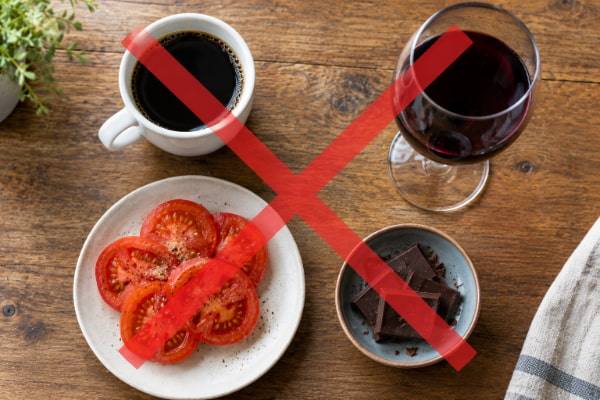
Trigger Foods and What the Evidence Actually Says
The nine-item trigger food list is the most repeated advice in this category, and the weakest.
Coffee, chocolate, citrus, tomatoes, peppermint, spicy food, fried food, soda, alcohol. You’ve seen it. The American College of Gastroenterology’s 2022 practice guideline does suggest avoiding trigger foods, but rates that suggestion conditional and built on low-quality evidence. Weight loss in overweight patients, by comparison, carries a strong recommendation backed by moderate-quality evidence.
The same guideline notes something people skip. Alcohol, chocolate, peppermint, and high-fat foods do lower sphincter pressure in a lab. Very few studies show that avoiding them helps.
Coffee is the cleanest example. A meta-analysis pooling 40 studies and 122,074 patients found GERD in 34.9% of coffee drinkers against 30.7% of non-drinkers, an odds ratio of 1.18. Real, but small. Narrowed to people drinking at least a cup daily, it vanished entirely (odds ratio 1.03).
Alcohol behaves differently. A meta-analysis of 29 studies landed on an odds ratio of 1.48 for drinkers, rising to 1.78 for erosive esophagitis, with a dose-response of about 1.16 per 12.5 grams per day. More drinks, more reflux. That one holds.
So drop the blanket elimination. Keep a two-week symptom diary, find the two or three things that reliably set you off, and stop sacrificing the rest for a list somebody printed in 1994.
Heartburn or Heart Attack?
If you can’t tell the difference, treat it as cardiac and call 911. Nobody gets thrown out of an emergency room for that.
Reflux pain tends to burn, follows meals, shifts with body position, and arrives with a sour taste. Cardiac pain tends to press or crush, spreads toward the jaw, arm, or back, and brings sweating, breathlessness, or lightheadedness.
The overlap is real, and no symptom list is reliable enough to gamble on.
Lifestyle Changes That Actually Work
Rank them by evidence, not by repetition.
Weight loss sits at the top. It’s the only lifestyle item in the ACG guideline carrying a strong rating, because lowering abdominal pressure fixes the mechanism instead of the irritant.
Meal timing is second. Research in the American Journal of Gastroenterology found that eating within three hours of lying down measurably raised overnight acid exposure. Give yourself the gap.
Raising the head of your bed about six inches helps nighttime symptoms, using risers under the frame. Stacking pillows folds you at the waist and makes things worse.
Smoking cessation. Smaller portions. Looser waistbands.
What none of it fixes: a hernia already slid into place. Weight loss reduces pressure. It doesn’t pull the stomach back below the diaphragm.
Treatment Options in 2026, From Antacids to Surgery
Treatment runs in tiers. Most people stall on tier two for a decade.
| Tier | What it does | Best suited for | Limits |
| Antacids | Neutralizes acid present | Occasional burn | Fades inside an hour |
| H2 blockers | Reduces acid production | Mild symptoms | Tolerance builds |
| Proton pump inhibitors | Suppresses acid strongly | Erosive disease | 30–40% partial relief |
| Acid blockers (newer class) | Faster, steadier control | Non-responders | Less long-term data |
| Endoscopic valve repair | Rebuilds valve through the mouth | Hernias under 2 cm | Not for large hernias |
| Surgical repair | Fixes hernia, rebuilds valve | Larger hernias | Recovery in weeks |
My opinion, and it isn’t universally popular: “stay on medication forever” is not a treatment plan. It’s a deferral. Acid suppression changes the pH of what comes up. It doesn’t close the valve. If you’ve taken a daily acid blocker for over a year and still have symptoms, ask whether rebuilding the valve surgically fits your anatomy.
Antacids Buy You an Hour, Not a Fix
Antacids neutralize acid already sitting in your esophagus using calcium, magnesium, or aluminum compounds. Fast, cheap, short. They’re a fire extinguisher, not a wiring repair.
Reaching for them five times a day for months isn’t managing reflux. It’s measuring it.
When Should You See a Doctor About Heartburn?
Two or more episodes a week, for more than a few weeks, is the threshold. So is heartburn that stops responding to whatever used to work.
Go sooner for:
- Trouble swallowing, or food that feels stuck
- Pain while swallowing
- Black or bloody stools
- Vomiting blood
- Unintentional weight loss
- Chest pain with sweating or breathlessness
Swallowing trouble deserves its own mention. It can mean scarring from years of acid, or a swallowing disorder unrelated to reflux. The treatments are nothing alike.
How Is Heartburn Diagnosed?
Most heartburn gets diagnosed on history alone. Confirming the cause takes testing, and that’s where I see corners cut.
- Upper endoscopy. A camera examines the lining for inflammation, scarring, or precancerous change.
- pH or pH-impedance monitoring. Measures acid reaching the esophagus over 24 hours, catching non-acid reflux that medication won’t touch.
- High-resolution manometry. Measures the strength and coordination of esophageal contractions.
- Barium swallow. X-ray imaging that maps anatomy, including hernia size and position.
Nobody should undergo an antireflux procedure without the first three. I’ve reviewed operations performed on assumptions. A revision is always harder than a first operation.
What Happens If You Ignore Frequent Heartburn
Untreated reflux doesn’t hold still. Repeated acid exposure inflames the esophageal lining, which is esophagitis. Chronic inflammation scars and narrows the tube, making swallowing steadily harder. In some people the lining converts to a different cell type altogether, called Barrett’s esophagus, which raises esophageal cancer risk and calls for ongoing surveillance.
Persistent symptoms mean this has crossed into GERD territory, a structural condition that gets managed deliberately, not waited out.
Stop Managing Heartburn and Start Fixing It
Your valve isn’t closing. Everything else is downstream of that fact.
If you buy antacids in the family-size bottle, or you’ve taken a daily acid blocker long enough that you can’t remember starting, no food list solves it. Dr. Gopal Grandhige is a board-certified surgeon who treats reflux as the mechanical problem it is. The causes and symptoms of heartburn become fixable the moment someone examines the valve instead of your menu, so patients done managing this can sit down with our team in Tampa and find out what’s repairable.
FAQs
What are the most common causes and symptoms of heartburn?
The most common cause is a weakened lower esophageal sphincter that lets stomach acid flow backward into the esophagus, often made worse by a hiatal hernia, abdominal weight, or pregnancy. The signature symptom is burning chest pain behind the breastbone that climbs toward the throat, usually within an hour of eating. Regurgitation and a sour taste are close behind.
Can you have acid reflux without any heartburn?
Yes, and it happens more often than people expect. Federal digestive health data lists chest pain, chronic cough, and hoarseness as reflux symptoms, and some people never experience classic chest burning at all. Throat-dominant symptoms like constant clearing, a rough voice, or post-nasal drip point toward silent reflux, which gets mistaken for allergies for months or years.
Does coffee really cause heartburn?
The evidence is weaker than the reputation. A meta-analysis of 40 studies covering 122,074 patients found GERD in 34.9% of coffee drinkers versus 30.7% of non-drinkers, an odds ratio of 1.18. When researchers isolated people drinking at least one cup daily, the association disappeared. Alcohol, by contrast, showed an odds ratio of 1.48 across 29 studies with a clear dose-response curve.
How long should you wait after eating before lying down?
Three hours. Research in the American Journal of Gastroenterology found that eating within three hours of lying down measurably increased overnight acid exposure, and the 2022 American College of Gastroenterology guideline suggests the same two-to-three-hour window. Nighttime reflux damages the esophagus more than daytime reflux because gravity isn’t helping clear the acid.
What’s the difference between heartburn, acid reflux, and GERD?
Acid reflux is the event, meaning stomach contents moving up into the esophagus. Heartburn is the symptom that event often produces. GERD is the diagnosis when reflux happens often enough to cause ongoing symptoms or tissue damage. Roughly 20% of people in the United States have GERD, so that progression is common.
Can the causes and symptoms of heartburn be treated without lifelong medication?
Often, yes. Around 30–40% of patients taking proton pump inhibitors still get incomplete relief, and acid suppression never closes the valve itself. Endoscopic and surgical repairs target the mechanical failure directly, though both require objective testing first, including endoscopy, pH monitoring, and manometry.
Is daily heartburn dangerous?
Daily heartburn is worth taking seriously. Repeated acid exposure can cause esophagitis, scarring that narrows the esophagus, and Barrett’s esophagus, a change in the esophageal lining that raises esophageal cancer risk and needs ongoing monitoring. Two or more episodes a week over several weeks is the point to get evaluated rather than keep self-treating.


An endoscopy cannot tell you if you have reflux. It can only tell you if you have complications of GERD.
If you are unhappy with your reflux symptoms, come in and we can discuss testing and treatments that can accurately diagnose your problem.
#reflux #gerd #hiatalhernia #gastroparesis #linx

CALL US AT 813-922-2920
www.tampareflux.com
If you have a hiatal hernia and fit one of these categories, you should know your options.
Dr. Grandhige is an expert in his field and performs 200 of these surgeries a year. He is the only surgeon in the Tampa Bay Area who offers all surgical options - LINX, Fundoplications, TIF and will be one of 20 surgeons in America introducing the latest procedure RefluxStop in 2026.
We accept most insurances but will verify yours before you come in. These procedures are considered medically necessary and covered by your insurance. You can expect to pay your in-network deductibles and nothing else.
#hiatalhernia #reflux #GERD #LINX #refluxstop
What causes reflux ?
1. Weak lower esophageal sphincter
2. Hiatal hernia
3. Flattening of the Angle of His
4. Poor esophageal motility
5. Gastroparesis (slow stomach)
NOT increased acid production
Don’t let GERD get in the way of living your life. Request your appointment with us today on the link below.
.
.
.
.
https://tampareflux.com/contact-us/
Anyone can be victim to GERD and though weight loss can help reduce GERD symptoms. Many athletes with high impact workouts may continue to have these symptoms. This may be a symptom of a hiatal hernia or other issue. We are more then happy to assist you in finding your solution, just click the link below.
.
.
.
https://tampareflux.com/contact-us/
##healthylifestyle #workout #athletereflux #PPIs #heartburn #LINX #fundoplication #TIF #GERD#tampaheartburn #linx #TIF #fundoplication #tampabayreflux #GERD #acidreflux #acidrefluxsurgery #stopreflux
#nonsurgicalweightloss #ESG #gastricballoon #weightlossjourney #vsg #vsgjourney #spatz3 #orbera #orberaballoon #grandhige #DrG
#tampabayrefluxinstitute #guthealth #roboticsurgery
Heartburn may seem like an annoyance. But if you find yourself having symptoms on a daily basis, it may be time to to talk to Dr. Grandhige as it could be a symptom of something worse.
.
.
.
#chronicheartburn #gerdsymptoms #heartburnrelief #reflux #PPIs #heartburn #LINX #fundoplication #TIF #GERD#tampaheartburn #linx #TIF #fundoplication #tampabayreflux #GERD #acidreflux #acidrefluxsurgery #stopreflux
#nonsurgicalweightloss #ESG #gastricballoon #weightlossjourney #vsg #vsgjourney #spatz3 #orbera #orberaballoon #grandhige #DrG
#tampabayrefluxinstitute #guthealth #roboticsurgery
If you are tired of avoiding your favorite foods or taking daily medications, we can help.
We are the Tampa experts in reflux ! With years of experience and thousands of patients treated successfully, we offer all FDA approved anti-reflux procedures.
Call 813-922-2920 to schedule your appointment
All major insurances accepted.
Not all patients need surgical intervention. Many patients are living a heartburn free life with their PPIs. However 40% of patients taking PPIs are not getting the relief they need. If you are one of those, you have options! Come in and find out more.
.
.
.
.
#letushelpyou #medsnotworking #reflux #PPIs #heartburn #LINX #fundoplication #TIF #GERD#tampaheartburn #linx #TIF #fundoplication #tampabayreflux #GERD #acidreflux #acidrefluxsurgery #stopreflux
#nonsurgicalweightloss #ESG #gastricballoon #weightlossjourney #vsg #vsgjourney #spatz3 #orbera #orberaballoon #grandhige #DrG
#tampabayrefluxinstitute #guthealth #roboticsurgery
#heartburn #stopreflux #hiatalherniarepair #severeheartburn #reflux #tampabayreflux #acidrefluxsurgery #tampaheartburn #GERD #PPIs #achalasia #LINX #TIF #tampareflux #fundoplication #stomach #digestivehealth #ESG #obesity #overweight #weightlossjourney #gastricballoon


