
What changed in reflux care between 2023 and 2026
Two things have shifted that most reflux pages have not caught up on.
A new drug class exists. Potassium-competitive acid blockers, or PCABs, are now available in the United States. Vonoprazan (Voquezna) is the first and only FDA-approved PCAB. It was approved in 2023 for treating all severities of erosive esophagitis, and on July 18, 2024 for relief of heartburn associated with non-erosive GERD. It is a different mechanism from a proton pump inhibitor and does not need an acid environment to activate. For patients who have already cycled through multiple PPIs, this is a medical option worth discussing with a prescribing physician before assuming medication has been exhausted.
A new device received FDA approval. The FDA granted Premarket Approval for RefluxStop on August 20, 2026. It works by restoring and maintaining the natural anatomy of the gastroesophageal junction without encircling or applying pressure on the food passageway, which makes it mechanically distinct from both a stomach wrap and a magnetic ring. The approval was backed by five-year clinical data and roughly 1,800 European patients treated. You can read the manufacturer’s approval announcement directly.
Being honest about availability: commercial adoption is building gradually, because each center requires physician training and site activation. Dr. Grandhige is adding RefluxStop to the practice. It is not being performed here yet. Anyone telling Brandon patients it is available today is ahead of the rollout.
A normal endoscopy does not rule out reflux
Endoscopy answers one question: has reflux caused visible damage? It does not answer whether reflux is occurring, how often, how long each episode lasts, or whether your symptoms line up with reflux events. Many patients with significant reflux have a completely normal endoscopy, especially while taking acid suppressors. Small hiatal hernias are not visible on every endoscopy either.
This is the single most common reason Brandon patients arrive after years of being told nothing is wrong.
Objective testing answers the questions endoscopy cannot:
- Esophageal pH monitoring is the gold standard for diagnosing GERD. Using a wireless Bravo capsule or a catheter-based probe, it records 48 to 72 hours of normal life, including eating, working, exercising, and sleeping. It measures how often reflux happens, how long it lasts, how acidic it is, when it happens, and whether symptoms correlate.
- Esophageal manometry measures contraction strength, swallow coordination, and sphincter relaxation. It identifies achalasia, spasm, and ineffective motility, all of which can imitate reflux and none of which are improved by reflux surgery.
- A barium swallow shows how the esophagus behaves during an actual swallow. It is used selectively. One reason it matters: patients correctly identify where food is sticking only about 60 percent of the time. Someone who feels food catching in the throat is often showing delay in the distal esophagus.
- Dual-channel pH impedance testing measures reflux above both the lower and the upper esophageal sphincter, which standard testing does not do.
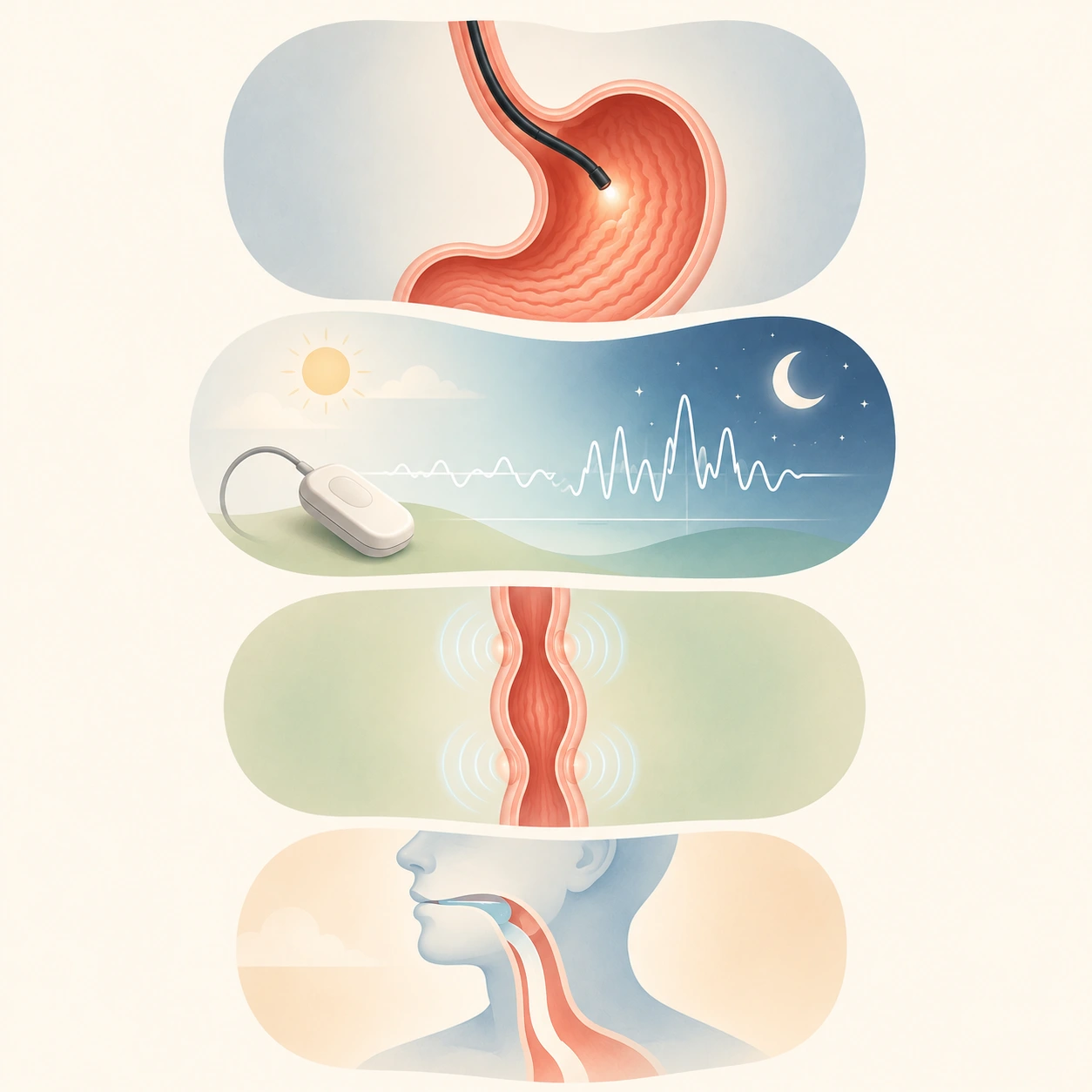
That last test is the one that changes outcomes for silent reflux (LPR). The esophagus can tolerate 40 to 50 reflux episodes a day. The larynx and pharynx are sensitive enough to produce symptoms from a single episode. Patients with throat clearing, hoarseness, cough, globus sensation, or sinus and ear pressure are routinely told their reflux test was normal, because the test never looked where their symptoms are.
Dr. Grandhige’s figures on this are specific. Using standard testing, LPR patients are commonly quoted around a 50 percent chance that surgery helps. Using dual-channel testing to select the right patients, his reported improvement rate is approximately 80 percent. In his LPR population, testing supports surgery in roughly 50 to 60 percent of patients. Among patients with typical heartburn and regurgitation, the majority test positive. The result is fewer operations performed, on better-selected patients.
What the path looks like coming from Brandon
You do not have to leave the Tampa Bay system to be evaluated. Dr. Grandhige holds privileges at HCA Florida Brandon Hospital, St. Joseph’s Main, St. Joseph’s South, and HCA South Tampa. All foregut and reflux surgery is performed at HCA South Tampa, and that is deliberate. One hospital means the same operating room team, the same anesthesiologists familiar with foregut physiology, and the same dedicated physician assistant in every case. Vomiting after a hiatal hernia repair is associated with early failure of that repair, which is why anesthesia handled by a team that does these cases routinely is part of the outcome, not an administrative detail.
The office is in South Tampa, a direct run west from Brandon on the Selmon Expressway.
Before your visit, email prior records to info@tampareflux.com. Dr. Grandhige personally reviews everything before you arrive. Send endoscopy and pathology reports, pH studies including Bravo or catheter-based, manometry results, barium swallow or other imaging, office notes from gastroenterology, ENT, pulmonology, and allergy, a current and prior medication list, and prior surgeries. Studies from years ago still carry useful information. Signed record releases are submitted immediately, but fax-based systems and incompatible electronic records delay things often enough that patient-supplied records remain the most reliable route.
Scheduling. Patients are typically seen within 2 weeks and always within 4.
Consultation to surgery. If your testing is already complete, one visit is usually enough and surgery can often be scheduled about 4 weeks out. If testing is still needed, the first visit covers education and test planning, a second visit about 4 weeks later reviews results, and the target from first visit to surgery is roughly 8 weeks. Insurance authorization runs in parallel and is handled by the office rather than by you, with the understanding that review itself can take four to six weeks on more complex cases.
Testing logistics for out-of-area patients. Testing is grouped onto the fewest days possible, and when a study can be performed closer to home, it is.
After surgery. The physician assistant who assisted in your operation knows your anatomy and is reachable during office hours. Dr. Grandhige is reachable directly after hours and on weekends.
Results, and what success actually means here

In appropriately selected patients with objectively proven reflux, suitable anatomy, and good esophageal function, Dr. Grandhige reports greater than 95 percent success in significant symptom relief, elimination of daily reflux medication, and patient satisfaction. For fundoplication specifically in well-selected patients, he reports greater than 90 percent achieving symptom resolution and coming off daily medication. For LPR patients selected with dual-channel testing, approximately 80 percent improve.
Outcomes are not identical for everyone. Reduced esophageal motility, long-standing disease, large or recurrent hiatal hernias, prior foregut surgery, and prior bariatric surgery all lower the expected result, and in those cases the procedure is modified to favor safety over aggressiveness. No procedure succeeds 100 percent of the time, and these are functional operations that are subject to wear and may require revision over a lifetime.
Timing differs by symptom type. Typical heartburn and regurgitation often resolve immediately. LPR symptoms generally take 4 to 6 months to improve, and patients are counseled to give it six months before assessing what remains.
Success here is defined narrowly on purpose. It means the symptoms that were caused by reflux improve. It does not mean every symptom on your list disappears. Patients arrive with heartburn, regurgitation, cough, hoarseness, bloating, nausea, fatigue, and abdominal pain and understandably want one diagnosis to explain all of it. Reflux surgery fixes reflux. Sorting out which symptoms belong to reflux and which do not is the work that happens before the operation, and it is why Dr. Grandhige’s practice is built around testing rather than around symptom reports.
Brandon reflux questions, answered
Medically reviewed by Gopal Grandhige, MD. Board-certified general surgeon. Bachelor of Science, Johns Hopkins University. MD, University of Michigan, Ann Arbor. General surgery residency and fellowship in minimally invasive and foregut surgery, Yale New Haven Hospital. Fellow of the American College of Surgeons (FACS). Member, Society of American Gastrointestinal and Endoscopic Surgeons (SAGES). Founding member, American Foregut Society. Practicing in Tampa Bay since 2009; founder of Tampa Bay Reflux Center (2009 to 2022) and Tampa Bay Reflux Institute (2022 to present). Board certification can be independently confirmed through the American Board of Surgery certification lookup, and Florida licensure through the Florida Department of Health Medical Quality Assurance license search.
Tampa Bay Reflux Institute | 1315 South Howard Avenue, Suite 101, Tampa, FL 33606 | 813.922.2920 | 9AM to 6PM, Monday through Friday


An endoscopy cannot tell you if you have reflux. It can only tell you if you have complications of GERD.
If you are unhappy with your reflux symptoms, come in and we can discuss testing and treatments that can accurately diagnose your problem.
#reflux #gerd #hiatalhernia #gastroparesis #linx


CALL US AT 813-922-2920
www.tampareflux.com
If you have a hiatal hernia and fit one of these categories, you should know your options.
Dr. Grandhige is an expert in his field and performs 200 of these surgeries a year. He is the only surgeon in the Tampa Bay Area who offers all surgical options - LINX, Fundoplications, TIF and will be one of 20 surgeons in America introducing the latest procedure RefluxStop in 2026.
We accept most insurances but will verify yours before you come in. These procedures are considered medically necessary and covered by your insurance. You can expect to pay your in-network deductibles and nothing else.
#hiatalhernia #reflux #GERD #LINX #refluxstop

What causes reflux ?
1. Weak lower esophageal sphincter
2. Hiatal hernia
3. Flattening of the Angle of His
4. Poor esophageal motility
5. Gastroparesis (slow stomach)
NOT increased acid production


Don’t let GERD get in the way of living your life. Request your appointment with us today on the link below.
.
.
.
.
https://tampareflux.com/contact-us/

Anyone can be victim to GERD and though weight loss can help reduce GERD symptoms. Many athletes with high impact workouts may continue to have these symptoms. This may be a symptom of a hiatal hernia or other issue. We are more then happy to assist you in finding your solution, just click the link below.
.
.
.
https://tampareflux.com/contact-us/
##healthylifestyle #workout #athletereflux #PPIs #heartburn #LINX #fundoplication #TIF #GERD#tampaheartburn #linx #TIF #fundoplication #tampabayreflux #GERD #acidreflux #acidrefluxsurgery #stopreflux
#nonsurgicalweightloss #ESG #gastricballoon #weightlossjourney #vsg #vsgjourney #spatz3 #orbera #orberaballoon #grandhige #DrG
#tampabayrefluxinstitute #guthealth #roboticsurgery

Heartburn may seem like an annoyance. But if you find yourself having symptoms on a daily basis, it may be time to to talk to Dr. Grandhige as it could be a symptom of something worse.
.
.
.
#chronicheartburn #gerdsymptoms #heartburnrelief #reflux #PPIs #heartburn #LINX #fundoplication #TIF #GERD#tampaheartburn #linx #TIF #fundoplication #tampabayreflux #GERD #acidreflux #acidrefluxsurgery #stopreflux
#nonsurgicalweightloss #ESG #gastricballoon #weightlossjourney #vsg #vsgjourney #spatz3 #orbera #orberaballoon #grandhige #DrG
#tampabayrefluxinstitute #guthealth #roboticsurgery

If you are tired of avoiding your favorite foods or taking daily medications, we can help.
We are the Tampa experts in reflux ! With years of experience and thousands of patients treated successfully, we offer all FDA approved anti-reflux procedures.
Call 813-922-2920 to schedule your appointment
All major insurances accepted.

Not all patients need surgical intervention. Many patients are living a heartburn free life with their PPIs. However 40% of patients taking PPIs are not getting the relief they need. If you are one of those, you have options! Come in and find out more.
.
.
.
.
#letushelpyou #medsnotworking #reflux #PPIs #heartburn #LINX #fundoplication #TIF #GERD#tampaheartburn #linx #TIF #fundoplication #tampabayreflux #GERD #acidreflux #acidrefluxsurgery #stopreflux
#nonsurgicalweightloss #ESG #gastricballoon #weightlossjourney #vsg #vsgjourney #spatz3 #orbera #orberaballoon #grandhige #DrG
#tampabayrefluxinstitute #guthealth #roboticsurgery

#heartburn #stopreflux #hiatalherniarepair #severeheartburn #reflux #tampabayreflux #acidrefluxsurgery #tampaheartburn #GERD #PPIs #achalasia #LINX #TIF #tampareflux #fundoplication #stomach #digestivehealth #ESG #obesity #overweight #weightlossjourney #gastricballoon
