
The testing that comes before any repair is offered
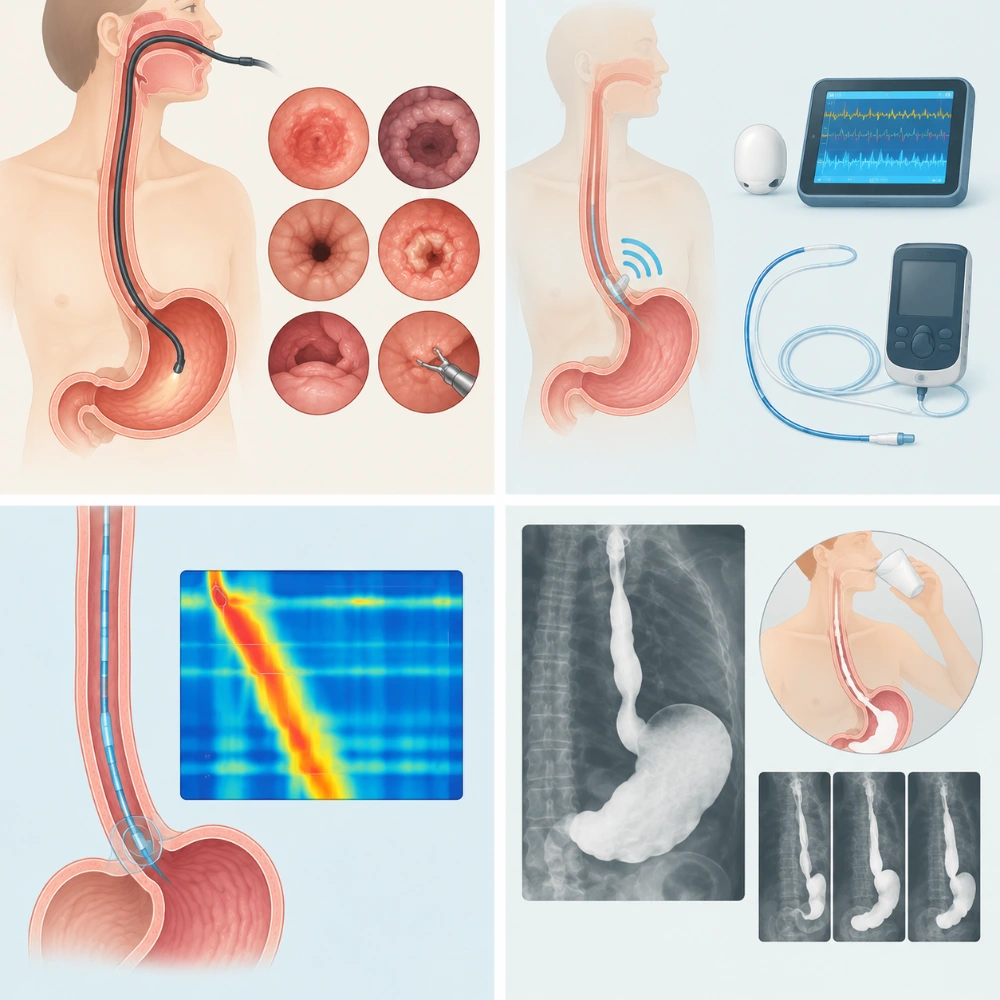
Four tests are used, and each answers a different question. No procedure is discussed until the answers are in.
Upper endoscopy answers: has reflux caused damage? It shows inflammation, Barrett’s esophagus, ulcers, strictures and hernia anatomy, and it allows biopsies. It does not diagnose GERD. A normal endoscopy does not mean reflux is absent, and small hiatal hernias are not visible on every endoscopy. Many patients with significant reflux have a completely normal study, particularly if they are on acid suppression. Endoscopy is also how the pH probe gets placed.
pH monitoring answers: is reflux happening, how often, and does it match your symptoms? This is the test that actually diagnoses GERD. It records over 48 to 72 hours using either a wireless Bravo capsule or a catheter-based probe, while you eat, sleep, work and exercise normally. It measures how often reflux occurs, how long each episode lasts, how acidic it is, when it happens, and whether your symptoms line up with real reflux events.
Manometry answers: can your esophagus handle a repair? Every anti-reflux procedure adds resistance at the gastroesophageal junction. If the esophagus cannot push food through that resistance, the result is dysphagia, food sticking, chest pain and regret. Manometry measures contraction strength, swallow coordination and sphincter relaxation, and it catches achalasia, esophageal spasm and ineffective motility. It is the single test that determines whether a full or partial wrap is safe.
Barium swallow answers: what happens when you actually swallow? Used selectively, not routinely. It is ordered for dysphagia, suspected strictures, unclear anatomy, prior foregut surgery, or when other results contradict each other. Patients can swallow a pill, a marshmallow or a bagel to reproduce the exact symptom. This matters more than it sounds: where a patient feels food sticking is the true location only about 60 percent of the time. People frequently point to their throat when the delay is in the distal esophagus.
Specialized testing for throat symptoms. Silent reflux, or LPR, is routinely missed because standard testing only measures above the lower esophageal sphincter. Dr. Grandhige uses a customized 24-hour pH impedance dual-channel probe that measures above both the lower and the upper esophageal sphincter, and captures non-acid reflux including bile, pepsin and trypsin. The larynx and pharynx are far more sensitive than the esophagus. The esophagus may tolerate 40 to 50 reflux episodes a day; the larynx can produce symptoms from one.
That difference in testing changes the numbers. LPR patients are commonly quoted a roughly 50 percent chance that surgery helps. With dual-channel testing identifying which patients are actually refluxing above the upper sphincter, expected symptom improvement rises to approximately 80 percent. The trade-off is that fewer LPR patients are offered surgery at all. Roughly 50 to 60 percent test into being surgical candidates.
Where possible, testing for Brandon-area patients is arranged at a facility closer to home so the number of trips across the bay stays low.
The four repair options, and the trade-offs that come with each
Fundoplication
A fundoplication uses the top of your own stomach, the fundus, wrapped around the lower esophagus to reinforce a failing sphincter. It does not remove the stomach, change digestion or affect absorption. The hiatal hernia is repaired first and the diaphragm tightened, because a wrap without a hernia repair produces inferior results.
It is not one operation. Four configurations are used: Nissen (a 360 degree wrap), Toupet (posterior 270), Watson (anterior 270) and Dor (anterior partial). Motility results decide which one.
Performed laparoscopically or robotically under general anesthesia. Typical operative time is 1.5 to 2 hours, longer for large hernias, significant scarring or complex anatomy. Most patients go home the same day.
Strengths: very durable, decades of outcome data, handles large hiatal hernias, and it can be adjusted for a weak esophagus. Trade-offs: it can limit the ability to burp or vomit, it carries a higher rate of gas and bloating than the alternatives, and it is harder to reverse.
LINX
LINX is a ring of magnetic titanium beads placed around the lower esophagus. It does not raise resting sphincter pressure. It resists opening when pressure in the stomach rises, then opens to let food through.
Strengths: normal stomach anatomy is preserved, most patients keep the ability to burp and can vomit once post-operative swelling settles, long-term bloating is generally milder, and the device can be removed without preventing a future fundoplication. Hernia size is not a disqualifier as long as the hernia is repaired at the same time.
Trade-offs: a higher rate of early swallowing difficulty and a small but real risk of longer-term dysphagia. It requires good esophageal motility, so patients with weak peristalsis are better served by a partial fundoplication. Current devices are MRI compatible up to 1.5 Tesla. Patients who are unusually attuned to internal sensation sometimes feel the device; as a rule of thumb, people who can feel a Bravo capsule while it is in place often feel their LINX.
TIF (EsophyX)
TIF is performed entirely through the mouth with an endoscope. No abdominal incisions. The EsophyX device folds part of the stomach around the lower esophagus from the inside and secures it with fasteners, rebuilding a flap valve at the gastroesophageal junction. Roughly 45 to 60 minutes under general anesthesia, same-day discharge.
Strengths: no incisions, less pain, faster return to normal activity, and a lower short-term surgical risk profile in well-chosen patients.
The limitation is the one that decides candidacy. TIF cannot repair a hiatal hernia and does not address the diaphragm at all. It only modifies sphincter mechanics. That is why it is offered only to patients with no hernia or a very small one, mild to moderate disease, no severe esophagitis or Barrett’s, and who are not obese. Dr. Grandhige quotes a failure rate of about 2 percent per year, or roughly 20 percent per decade, and describes it as the best endoscopic anti-reflux procedure available rather than a permanent solution. Most patients get years of relief. Heavy lifting and core strain are restricted for 6 weeks while the internal repair heals.
TIF has a mixed reputation, and the reason is not the device. It is that the procedure was widely used outside its indications. Offered to the wrong patient it produces incomplete relief, short-lived benefit and another procedure later.
RefluxStop
RefluxStop is being added to the practice in 2026, giving patients access to all four anti-reflux procedures without changing surgeons to change options. Other surgeons who offer fundoplication alone refer patients here when those patients start asking about LINX, TIF or RefluxStop.
Recovery, side effects, and what the success numbers actually mean
Most patients go home the same day, walking and drinking liquids shortly after surgery. An overnight stay is occasionally recommended for observation. Diet progresses over 2 to 3 months, from liquids through soft foods to regular texture.
Symptom timelines differ by symptom type. Typical reflux symptoms such as heartburn and regurgitation often resolve almost immediately. LPR and throat symptoms take longer, generally 4 to 6 months, and patients are counseled on that gap in advance so they do not conclude the operation failed at week six.
The side effects worth knowing before you decide. Bloating and reduced ability to vomit are the two most common concerns. The mechanics are simple: a repair that makes it harder for acid to travel up also makes it harder for air and food to travel up. Depending on the procedure, that effect may be temporary or permanent. Adults tend to heave rather than vomit the way children do, and being unable to bring up solid food is not dangerous. Those solids clear in the other direction given time.
Early swallowing changes are expected during healing and are time-limited. Long term, most patients eat a normal diet, and many expand it to include foods that previously triggered symptoms.
The outcome numbers, with the qualifiers attached. For patients with typical reflux symptoms who have objective evidence of reflux, suitable anatomy and good esophageal function, and who receive a standard anti-reflux procedure, the practice reports success above 95 percent for meaningful symptom relief, elimination of daily reflux medication, and patient satisfaction.
That qualifier chain is the whole point. Outcomes are lower for patients with reduced esophageal motility, long-standing or complex disease, large or recurrent hiatal hernias, prior foregut surgery, or previous bariatric surgery. In those cases the procedure is modified to prioritize safety over aggressiveness, and expectations are set individually before anything is scheduled.
No anti-reflux procedure has a 100 percent success rate. These are functional operations, closer to a joint replacement than a permanent fix: they work well, they are subject to wear, and some will need revision across a lifetime. The instruction given to every post-operative patient is to give it six months, at which point any remaining symptoms get addressed on their own terms, sometimes with another specialist.
Surgery is designed to correct reflux. It is not designed to fix every upper gastrointestinal symptom you have, and the most common source of disappointment after a technically perfect operation is a patient who expected it to.
What the process looks like if you live in Brandon or Riverview
Consultations happen in South Tampa. The office is at 1315 South Howard Avenue, Suite 101, Tampa, FL 33606, in a yellow brick building next to Sally O’Neill’s Pizza, with parking behind the pizza place. Office hours are 9am to 6pm, Monday through Friday. From Brandon it is a single trip down the Selmon Expressway.
Send your records before you come. Email prior endoscopy and pathology reports, pH studies including Bravo or catheter results, manometry results, barium swallow or other imaging, office notes from your gastroenterologist, ENT, pulmonologist or allergist, a medication list and a list of prior surgeries to info@tampareflux.com. Dr. Grandhige personally reviews everything before you arrive, including how other physicians have interpreted your symptoms. Signed record releases are requested immediately, but records routinely arrive late or incomplete, so patients who bring their own get more out of the visit.
Testing is arranged as close to Brandon as possible. The practice works with a small number of testing sites to keep quality consistent and results fast, and coordinates studies locally for out-of-area patients wherever the test can be done there.
Timeline. New patients are usually seen within 2 weeks and always within 4. If your testing is already complete, one consultation is typically enough and surgery can often be scheduled about 4 weeks out. If testing is still needed, the first visit covers education and test planning, a second visit about 4 weeks later reviews results and finalizes the plan, and surgery follows at roughly 8 weeks from the first visit.
Insurance authorization is handled by the office, before surgery is scheduled. Insurers generally require documented persistent symptoms despite medical therapy, objective testing confirming reflux or hernia, and evidence that symptoms correlate with the findings. Authorization can take four to six weeks on complex cases. The office gathers documentation, submits it and communicates directly with the insurer. Patients who call their own insurance company to help usually slow the process down rather than speed it up.
Surgery is at HCA Florida South Tampa Hospital. Dr. Grandhige holds privileges at HCA Florida Brandon Hospital, St. Joseph’s Main and St. Joseph’s South, and previously operated at all of them. He now performs every foregut case at one facility on purpose. The same anesthesiologists, nurses and surgical technologists work these cases routinely, the specialized equipment is always set up correctly, and complications get anticipated instead of reacted to. Anesthesia matters more here than most patients realize, because vomiting after the procedure is associated with early failure of the hernia repair.
After surgery you are not handed off. A dedicated physician assistant, employed by the practice, assists in every case, knows your specific anatomy and operation, and is reachable during office hours. Dr. Grandhige is reachable directly after hours and on weekends. Much of the office staff has been with the practice for over a decade.
Credentials you can verify yourself

Dr. Gopal Grandhige, MD, FACS, is a board-certified general surgeon and the founder and medical director of Tampa Bay Reflux Institute. He earned his bachelor’s degree at Johns Hopkins University and his MD at the University of Michigan, Ann Arbor, then completed general surgery residency and fellowship training in foregut and minimally invasive surgery at Yale New Haven Hospital. He moved to Tampa in 2009, founded Tampa Bay Reflux Center that year, and founded Tampa Bay Reflux Institute in 2022 to work on foregut disease exclusively. You can read more about his background and how the practice is run.
He is a Fellow of the American College of Surgeons, a member of the Society of American Gastrointestinal and Endoscopic Surgeons, and a founding member of the American Foregut Society. He participates in national research studies and committees on GERD treatment.
Do not take any of that on faith. Board certification can be confirmed directly through the American Board of Surgery certification check, which is primary source verification updated in real time. Active Florida licensure and any disciplinary history can be confirmed through the Florida Department of Health license verification portal. Hospital privileges are a third layer, granted only after credential review, peer evaluation and ongoing performance monitoring.
Beyond surgery, Dr. Grandhige supports Feeding Tampa Bay, Equality Florida, USF Radio and Meacham Urban Farm.
Frequently asked questions
Get an answer instead of another prescription
If you have been on reflux medication for years, if you need more than one dose a day to function, if you have been told there is a hernia but nothing to worry about, or if your endoscopy came back normal while your symptoms did not, the next step is objective testing rather than a higher dose.
Bring your prior records. You will leave understanding what is happening in your body, which of your symptoms are reflux-related and which are not, and what your options actually are. Sometimes that means surgery. Sometimes it means continued medical management. Either way you leave with an answer.
Tampa Bay Reflux Institute 1315 South Howard Avenue, Suite 101, Tampa, FL 33606 Phone: 813.922.2920 | Fax: 813.742.0711 Hours: 9am to 6pm, Monday through Friday Email: info@tampareflux.com
Medically reviewed by Gopal Grandhige, MD, FACS, board-certified general surgeon, fellowship trained in foregut and minimally invasive surgery, founding member of the American Foregut Society.


An endoscopy cannot tell you if you have reflux. It can only tell you if you have complications of GERD.
If you are unhappy with your reflux symptoms, come in and we can discuss testing and treatments that can accurately diagnose your problem.
#reflux #gerd #hiatalhernia #gastroparesis #linx


CALL US AT 813-922-2920
www.tampareflux.com
If you have a hiatal hernia and fit one of these categories, you should know your options.
Dr. Grandhige is an expert in his field and performs 200 of these surgeries a year. He is the only surgeon in the Tampa Bay Area who offers all surgical options - LINX, Fundoplications, TIF and will be one of 20 surgeons in America introducing the latest procedure RefluxStop in 2026.
We accept most insurances but will verify yours before you come in. These procedures are considered medically necessary and covered by your insurance. You can expect to pay your in-network deductibles and nothing else.
#hiatalhernia #reflux #GERD #LINX #refluxstop

What causes reflux ?
1. Weak lower esophageal sphincter
2. Hiatal hernia
3. Flattening of the Angle of His
4. Poor esophageal motility
5. Gastroparesis (slow stomach)
NOT increased acid production


Don’t let GERD get in the way of living your life. Request your appointment with us today on the link below.
.
.
.
.
https://tampareflux.com/contact-us/

Anyone can be victim to GERD and though weight loss can help reduce GERD symptoms. Many athletes with high impact workouts may continue to have these symptoms. This may be a symptom of a hiatal hernia or other issue. We are more then happy to assist you in finding your solution, just click the link below.
.
.
.
https://tampareflux.com/contact-us/
##healthylifestyle #workout #athletereflux #PPIs #heartburn #LINX #fundoplication #TIF #GERD#tampaheartburn #linx #TIF #fundoplication #tampabayreflux #GERD #acidreflux #acidrefluxsurgery #stopreflux
#nonsurgicalweightloss #ESG #gastricballoon #weightlossjourney #vsg #vsgjourney #spatz3 #orbera #orberaballoon #grandhige #DrG
#tampabayrefluxinstitute #guthealth #roboticsurgery

Heartburn may seem like an annoyance. But if you find yourself having symptoms on a daily basis, it may be time to to talk to Dr. Grandhige as it could be a symptom of something worse.
.
.
.
#chronicheartburn #gerdsymptoms #heartburnrelief #reflux #PPIs #heartburn #LINX #fundoplication #TIF #GERD#tampaheartburn #linx #TIF #fundoplication #tampabayreflux #GERD #acidreflux #acidrefluxsurgery #stopreflux
#nonsurgicalweightloss #ESG #gastricballoon #weightlossjourney #vsg #vsgjourney #spatz3 #orbera #orberaballoon #grandhige #DrG
#tampabayrefluxinstitute #guthealth #roboticsurgery

If you are tired of avoiding your favorite foods or taking daily medications, we can help.
We are the Tampa experts in reflux ! With years of experience and thousands of patients treated successfully, we offer all FDA approved anti-reflux procedures.
Call 813-922-2920 to schedule your appointment
All major insurances accepted.

Not all patients need surgical intervention. Many patients are living a heartburn free life with their PPIs. However 40% of patients taking PPIs are not getting the relief they need. If you are one of those, you have options! Come in and find out more.
.
.
.
.
#letushelpyou #medsnotworking #reflux #PPIs #heartburn #LINX #fundoplication #TIF #GERD#tampaheartburn #linx #TIF #fundoplication #tampabayreflux #GERD #acidreflux #acidrefluxsurgery #stopreflux
#nonsurgicalweightloss #ESG #gastricballoon #weightlossjourney #vsg #vsgjourney #spatz3 #orbera #orberaballoon #grandhige #DrG
#tampabayrefluxinstitute #guthealth #roboticsurgery

#heartburn #stopreflux #hiatalherniarepair #severeheartburn #reflux #tampabayreflux #acidrefluxsurgery #tampaheartburn #GERD #PPIs #achalasia #LINX #TIF #tampareflux #fundoplication #stomach #digestivehealth #ESG #obesity #overweight #weightlossjourney #gastricballoon
