
The testing that decides which procedure fits you
Four tests answer four different questions, and the answers determine both whether surgery is appropriate and which procedure gets chosen.
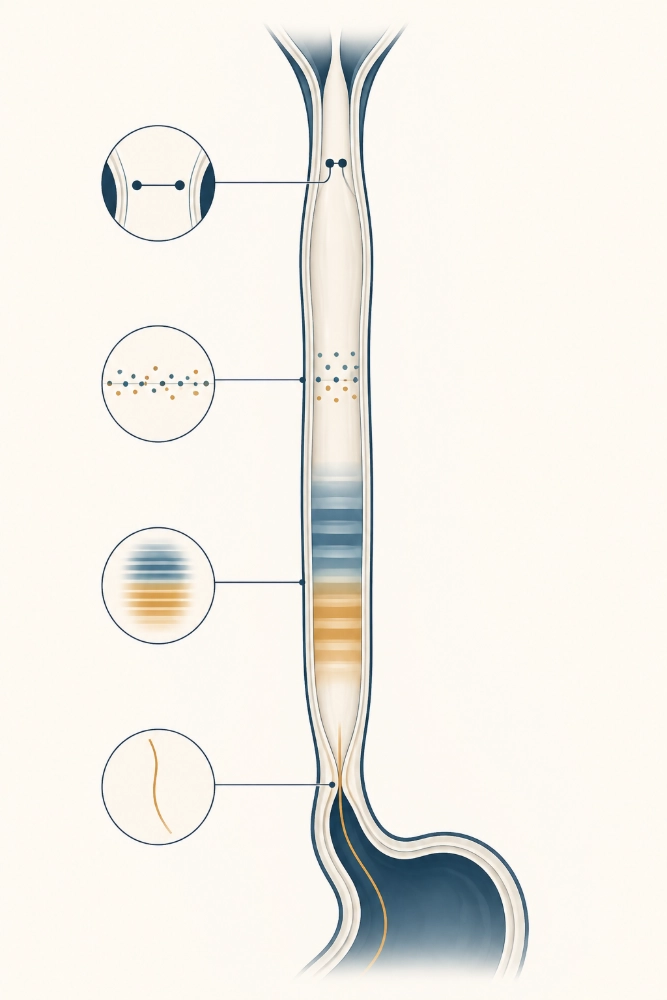
pH monitoring is the test that actually diagnoses GERD. It records the frequency of reflux episodes, how long each one lasts, how acidic they are, when they happen relative to meals and sleep, and whether your symptoms line up with real reflux events. The study runs 48 to 72 hours using either a wireless Bravo capsule or a catheter-based pH impedance probe, while you eat, work, exercise, and sleep normally.
Esophageal manometry measures whether your esophagus can handle a reflux procedure. Every anti-reflux operation adds resistance at the gastroesophageal junction. If the esophagus cannot generate enough strength or coordination to push food past that resistance, the result is dysphagia. Manometry also identifies achalasia, esophageal spasm, ineffective motility, jackhammer esophagus, and hypertensive LES, all of which can imitate reflux and none of which improve with reflux surgery. Weak motility often means a partial fundoplication rather than a full wrap.
Barium swallow is used selectively, not routinely. Dr. Grandhige orders it for dysphagia, suspected strictures, unclear anatomy, prior foregut surgery, symptoms that contradict other test findings, and patients who cannot tolerate manometry. It has one property the other tests do not: it can reproduce your symptom in real time while you swallow a pill, a bagel, or a marshmallow. That matters more than it sounds, because where a patient feels food sticking is the actual location only about 60 percent of the time. People routinely point at their throat when the delay is in the distal esophagus.
Dual-channel LPR testing is the study most throat-symptom patients never receive. Standard reflux testing measures only above the lower esophageal sphincter. Dr. Grandhige uses a customized 24-hour pH impedance dual-channel probe that measures above the lower esophageal sphincter and above the upper esophageal sphincter, and that detects non-acid reflux including bile, pepsin, and trypsin. The distinction matters because the esophagus may tolerate 40 to 50 reflux episodes a day while the larynx and pharynx can produce symptoms from a single episode. With standard testing, patients with silent reflux (LPR) are commonly quoted around a 50 percent chance that surgery helps. With dual-channel testing to select the right candidates, this practice reports symptom improvement near 80 percent. About 50 to 60 percent of LPR patients who are tested turn out to have findings that warrant surgery. The rest are told no.
Where Brandon patients are seen, and where surgery happens
Brandon patients are evaluated at the South Tampa office and operated on at HCA South Tampa Hospital. Dr. Grandhige holds privileges at HCA Brandon Hospital, St. Joseph’s Main, and St. Joseph’s South, and he previously operated at four local hospitals, but he now performs every foregut and reflux operation at a single facility on purpose.
The reason is the team, not the building. The same anesthesiologists, nurses, surgical technologists, and the same dedicated physician assistant he employs work every one of his cases. That PA assists in every operation, knows each patient’s anatomy and procedure, and is reachable afterward. Anesthesia management matters more in foregut surgery than most people expect, because postoperative vomiting is associated with significant early failure of a hiatal hernia repair. A team that runs these cases routinely prevents that. A rotating team does not.
If you are driving in from Brandon, the practical details: the office is at 1315 South Howard Avenue, Suite 101, Tampa, FL 33606, in a yellow brick building next to Sally O’Neill’s Pizza, with parking behind the pizza place. Hours are 9am to 6pm, Monday through Friday. The office works with a small number of trusted testing sites so studies can be scheduled quickly and grouped onto the fewest possible days, and for patients traveling any real distance, testing that can be completed closer to home is arranged that way.
How long it takes from first call to surgery
Most patients are seen within 2 weeks, and always within 4 weeks. From there the path splits based on what testing you already have.
If your endoscopy, pH testing, manometry, and imaging are already complete, one consultation is usually enough. The diagnosis can often be confirmed at that first visit, procedure options discussed the same day, and insurance authorization started immediately. Surgery can be scheduled as early as 4 weeks out.
If testing is not complete, the first visit covers education, record review, and test planning. Studies are ordered and coordinated, and a second consultation about 4 weeks later reviews results and finalizes the plan. That route runs about 8 weeks from first visit to surgery.
Insurance authorization runs in parallel rather than after, which is how the timeline holds. Complex cases can take 4 to 6 weeks to authorize. The office handles submission and follow-up directly. Patients who call their own insurance company to help usually slow it down.
Email your records to info@tampareflux.com before your appointment: prior endoscopy and pathology reports, pH studies including Bravo or catheter-based results, manometry, barium swallow or other imaging, office notes from gastroenterology, ENT, pulmonology, and allergy, plus current and prior medications and past surgeries. Dr. Grandhige personally reviews all of it before you walk in. Signed release forms get submitted immediately, but records frequently arrive late or incomplete, and studies from years ago are still useful for showing how the disease progressed.
About Dr. Gopal Grandhige, MD
Dr. Gopal Grandhige is a board-certified general surgeon who has practiced foregut and anti-reflux surgery in Tampa Bay since 2009. He completed his Bachelor of Science in Biology at Johns Hopkins University, his medical degree at the University of Michigan, and his general surgery residency at Yale-New Haven Hospital, followed by fellowships at Yale-New Haven in Burn and Critical Care and in Foregut Surgery and Minimally Invasive Surgery.
He is a Founding Member of the American Foregut Society, a member of the Society of American Gastrointestinal and Endoscopic Surgeons, and a Fellow of the American College of Surgeons. He founded Tampa Bay Reflux Center in 2009 and Tampa Bay Reflux Institute in 2022, and you can read more about his background and the practice directly.
His practice covers benign disease of the esophagus, diaphragm, and stomach: GERD, hiatal hernias, LPR, achalasia treated with Heller myotomy using Endoflip for tailored measurement, gastroparesis treated with endoscopic pyloromyotomy, esophageal motility disorders, rumination, esophageal hypersensitivity, functional heartburn, and complications from foregut surgery performed elsewhere. For established patients he will also handle gallbladder removal or other abdominal hernia repairs during the same operation to avoid a second round of anesthesia. He does not treat malignant cancers of the esophagus or stomach.
You can confirm his certification independently through the American Board of Surgery’s verification process and his active license through the Florida Department of Health license lookup. In appropriately selected patients with objectively documented reflux, suitable anatomy, and good esophageal function, this practice reports greater than 95 percent success in significant symptom relief, elimination of daily reflux medication, and patient satisfaction. Results run lower with reduced motility, long-standing or recurrent disease, large hernias, or prior foregut or bariatric surgery, and those cases are discussed individually before any decision.

Frequently asked questions
Get an answer that is based on your own test results
You do not have to keep escalating medication without knowing why it stopped working. Send your prior records to info@tampareflux.com, and Dr. Grandhige will review every study, image, and physician note before your visit. You will leave understanding which of your symptoms are reflux, which are not, and what each option can and cannot fix.
Tampa Bay Reflux Institute 1315 South Howard Avenue, Suite 101, Tampa, FL 33606 Phone: 813-922-2920 | Fax: 813-742-0711 Hours: Monday to Friday, 9am to 6pm
Medically reviewed by Gopal Grandhige, MD, FACS, board-certified general surgeon, Founding Member of the American Foregut Society.


An endoscopy cannot tell you if you have reflux. It can only tell you if you have complications of GERD.
If you are unhappy with your reflux symptoms, come in and we can discuss testing and treatments that can accurately diagnose your problem.
#reflux #gerd #hiatalhernia #gastroparesis #linx


CALL US AT 813-922-2920
www.tampareflux.com
If you have a hiatal hernia and fit one of these categories, you should know your options.
Dr. Grandhige is an expert in his field and performs 200 of these surgeries a year. He is the only surgeon in the Tampa Bay Area who offers all surgical options - LINX, Fundoplications, TIF and will be one of 20 surgeons in America introducing the latest procedure RefluxStop in 2026.
We accept most insurances but will verify yours before you come in. These procedures are considered medically necessary and covered by your insurance. You can expect to pay your in-network deductibles and nothing else.
#hiatalhernia #reflux #GERD #LINX #refluxstop

What causes reflux ?
1. Weak lower esophageal sphincter
2. Hiatal hernia
3. Flattening of the Angle of His
4. Poor esophageal motility
5. Gastroparesis (slow stomach)
NOT increased acid production


Don’t let GERD get in the way of living your life. Request your appointment with us today on the link below.
.
.
.
.
https://tampareflux.com/contact-us/

Anyone can be victim to GERD and though weight loss can help reduce GERD symptoms. Many athletes with high impact workouts may continue to have these symptoms. This may be a symptom of a hiatal hernia or other issue. We are more then happy to assist you in finding your solution, just click the link below.
.
.
.
https://tampareflux.com/contact-us/
##healthylifestyle #workout #athletereflux #PPIs #heartburn #LINX #fundoplication #TIF #GERD#tampaheartburn #linx #TIF #fundoplication #tampabayreflux #GERD #acidreflux #acidrefluxsurgery #stopreflux
#nonsurgicalweightloss #ESG #gastricballoon #weightlossjourney #vsg #vsgjourney #spatz3 #orbera #orberaballoon #grandhige #DrG
#tampabayrefluxinstitute #guthealth #roboticsurgery

Heartburn may seem like an annoyance. But if you find yourself having symptoms on a daily basis, it may be time to to talk to Dr. Grandhige as it could be a symptom of something worse.
.
.
.
#chronicheartburn #gerdsymptoms #heartburnrelief #reflux #PPIs #heartburn #LINX #fundoplication #TIF #GERD#tampaheartburn #linx #TIF #fundoplication #tampabayreflux #GERD #acidreflux #acidrefluxsurgery #stopreflux
#nonsurgicalweightloss #ESG #gastricballoon #weightlossjourney #vsg #vsgjourney #spatz3 #orbera #orberaballoon #grandhige #DrG
#tampabayrefluxinstitute #guthealth #roboticsurgery

If you are tired of avoiding your favorite foods or taking daily medications, we can help.
We are the Tampa experts in reflux ! With years of experience and thousands of patients treated successfully, we offer all FDA approved anti-reflux procedures.
Call 813-922-2920 to schedule your appointment
All major insurances accepted.

Not all patients need surgical intervention. Many patients are living a heartburn free life with their PPIs. However 40% of patients taking PPIs are not getting the relief they need. If you are one of those, you have options! Come in and find out more.
.
.
.
.
#letushelpyou #medsnotworking #reflux #PPIs #heartburn #LINX #fundoplication #TIF #GERD#tampaheartburn #linx #TIF #fundoplication #tampabayreflux #GERD #acidreflux #acidrefluxsurgery #stopreflux
#nonsurgicalweightloss #ESG #gastricballoon #weightlossjourney #vsg #vsgjourney #spatz3 #orbera #orberaballoon #grandhige #DrG
#tampabayrefluxinstitute #guthealth #roboticsurgery

#heartburn #stopreflux #hiatalherniarepair #severeheartburn #reflux #tampabayreflux #acidrefluxsurgery #tampaheartburn #GERD #PPIs #achalasia #LINX #TIF #tampareflux #fundoplication #stomach #digestivehealth #ESG #obesity #overweight #weightlossjourney #gastricballoon
