
A normal endoscopy does not mean your reflux is not real
An upper endoscopy shows whether reflux has caused damage. It does not show whether reflux is happening, how often, or why. Those are different questions, and they need different tests.
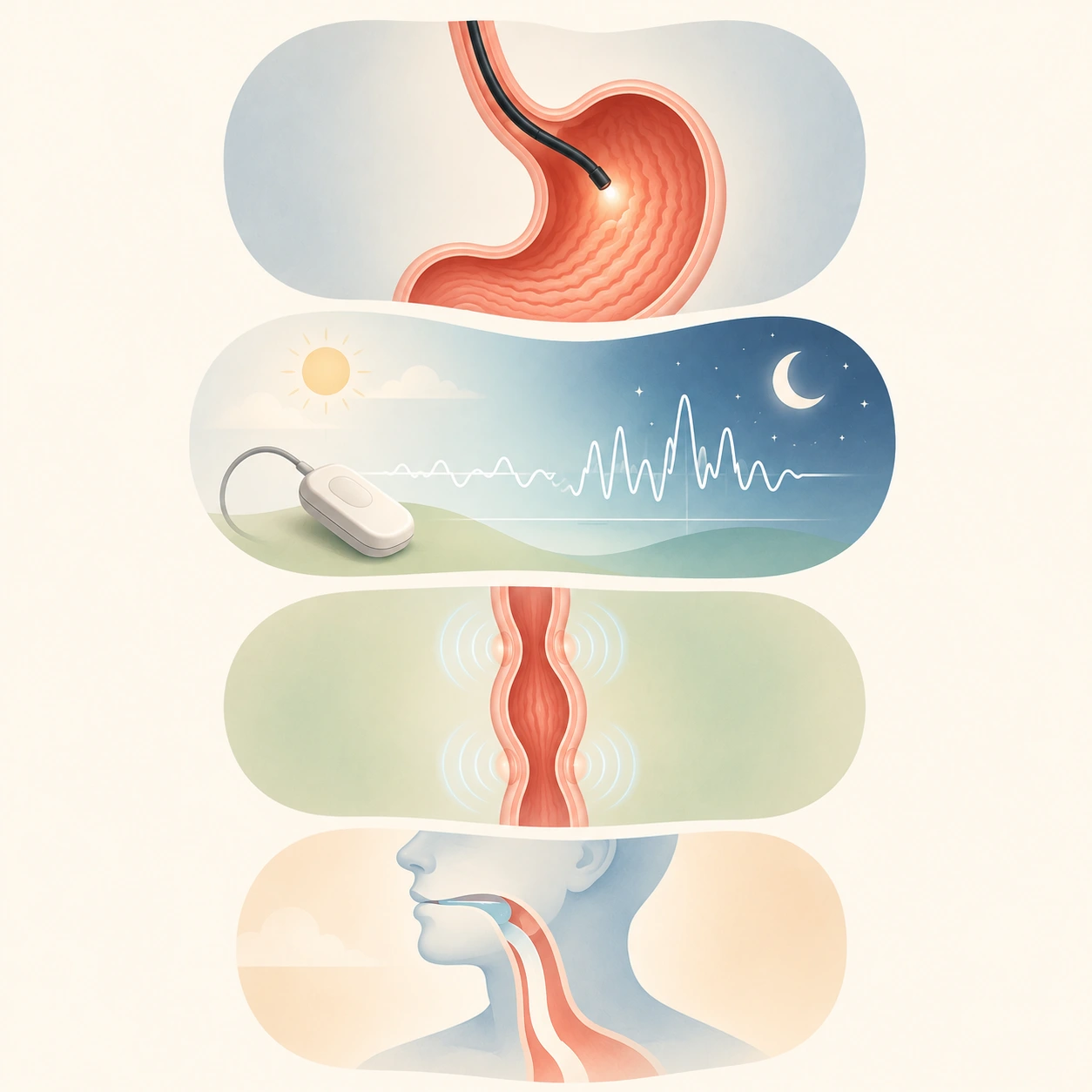
Endoscopy is good at what it does. It finds esophagitis, Barrett’s esophagus, ulcers, strictures, and larger hiatal hernias, and it takes biopsies. What it cannot do is measure a single reflux event. It cannot assess sphincter function, frequency, duration, or timing. Small hiatal hernias do not show up on every endoscopy. And if you are already taking acid-suppressing medication, a person with severe reflux can have a completely clean study.
This is why so many patients are told nothing is wrong while their symptoms continue. They were not missed. They were evaluated with a tool built for a different question.
pH monitoring answers whether reflux is actually occurring. It runs 48 to 72 hours using either a wireless Bravo capsule or a catheter-based probe, while you eat, sleep, work, and exercise normally. It records how often reflux happens, how long each episode lasts, how acidic it is, when it happens, and whether your symptoms line up with the events.
Esophageal manometry answers whether your esophagus can handle a procedure at all. It measures contraction strength, swallow coordination, and how the sphincter relaxes. It identifies achalasia, esophageal spasm, ineffective motility, jackhammer esophagus, and a hypertensive sphincter. Every anti-reflux procedure adds resistance at the bottom of the esophagus. If the esophagus cannot push through that resistance, you get food sticking and chest pain instead of relief.
Barium swallow answers what happens when you actually swallow, and it gets used selectively rather than routinely. One finding from it is worth knowing: where a patient feels food catching matches the real anatomic location only about 60 percent of the time. People point to their throat when the delay is sitting in the lower esophagus.
The testing that changes the answer for throat symptoms
Standard reflux testing measures above the lower esophageal sphincter only. That is fine for classic heartburn. It is not enough for silent reflux, also called LPR, where the symptoms are chronic throat clearing, hoarseness, cough, mucus, globus, or ear pressure.
Dr. Grandhige uses a customized 24-hour pH impedance dual-channel probe that measures reflux at two levels: above the lower esophageal sphincter and above the upper esophageal sphincter. The reason matters. Your esophagus can tolerate 40 to 50 reflux episodes a day. Your larynx and pharynx can produce symptoms from one. Impedance also picks up non-acid reflux, including bile, pepsin, and trypsin, which a pH-only study will not see.
This testing is technically demanding and is not routinely performed in most practices. That gap is why patients with genuine LPR get told their reflux test was normal, or that surgery has roughly a coin-flip chance of helping them.
Which procedures let you keep burping, and which limit it
If gas and bloating are your main complaint, procedure choice matters more here than almost anywhere else in reflux surgery, because this is exactly where the four operations differ.
One thing patients ask about constantly
Losing the ability to vomit sounds alarming, and it is worth putting in proportion. Adults heave rather than vomit the way children do. Not being able to bring up solid food is not dangerous. It passes in the other direction in time.
When the answer is not surgery
A meaningful share of people who come in for evaluation leave without an operation, and that is the point rather than a failure of the visit.
Among patients with silent reflux, roughly 50 to 60 percent have testing that supports surgery. The rest are told plainly that it will not help them. With the dual-channel testing described above and careful selection, symptom improvement in LPR patients runs around 80 percent. Without that testing, patients are commonly quoted around 50 percent. Fewer operations, chosen better.
Surgery is not recommended for esophageal hypersensitivity, functional chest pain, rumination, untreated severe motility disorders, or symptoms driven by causes outside the foregut. Those conditions can look like reflux from the symptom list alone, which is exactly why the testing comes first.
Dr. Grandhige is direct about a consequence of this. The patients he turns away are often the most frustrated people who walk out of the office. They would be considerably more frustrated after an operation that changed nothing.
There is a second piece of expectation-setting that shapes satisfaction more than any technical detail. Reflux surgery fixes reflux. It does not fix every symptom on your list. Heartburn and regurgitation may resolve completely while throat symptoms improve only partially, and some bloating has a different mechanism entirely that a reflux operation will not touch. You are told which symptoms are expected to improve, which may improve partially, and which are unlikely to change, before anything is scheduled.
Timing differs by symptom type too. Typical reflux symptoms often resolve almost immediately. LPR symptoms usually take four to six months. The standing advice is to give it six months, then sit down and address whatever remains, which sometimes means a referral to another specialist rather than another procedure.
What treatment looks like from Wesley Chapel
The office sits in South Tampa, roughly a 30-minute drive down I-75 from Wesley Chapel, and the schedule is built so you make that drive as few times as possible.
Send your records before the visit. Email them to info@tampareflux.com so Dr. Grandhige can review everything before you walk in: prior endoscopy and pathology reports, any pH testing including Bravo or catheter studies, manometry results, barium swallow or other imaging, office notes from gastroenterology, ENT, pulmonology, and allergy, a list of current and prior medications, and a list of prior surgeries. Studies from years ago still help, because they show how the disease has moved. Signed record releases get submitted the same day you call, but fax-based systems and incompatible record platforms mean patient-supplied records are usually faster and more complete.
Scheduling. New patients are typically seen within two weeks, and always within four.

If your testing is already complete, one consultation is usually enough. The diagnosis can often be confirmed at that first visit, options get discussed the same day, and surgery can frequently be scheduled about four weeks out.
If testing is still needed, the first visit covers education, record review, and test planning. A second visit about four weeks later reviews the results and finalizes the plan. Surgery generally lands around eight weeks from the first visit. Authorization paperwork is handled entirely by the office and runs in parallel with testing rather than after it.
Testing closer to home. Where a study can reasonably be done near Wesley Chapel, it gets arranged there. Whatever has to happen in Tampa gets consolidated onto as few days as possible. The practice works with a small number of trusted testing sites, which is what makes fast scheduling and consistent test quality possible.
Where surgery happens. All foregut and reflux procedures are performed at HCA South Tampa Hospital, with the same anesthesiologists, the same nurses and surgical technologists, and the same physician assistant who assists on every case and stays involved in your recovery. That consistency is deliberate. Dr. Grandhige previously operated at four local hospitals and consolidated to one.
Access after you go home. During office hours you reach a team that has worked with Dr. Grandhige for over a decade and understands reflux disease. After hours and on weekends, you reach Dr. Grandhige directly. No call center, no rotating provider who has never seen your anatomy.
Finding the office. Coming south on I-75, the office is at 1315 South Howard Avenue in South Tampa, in a yellow brick building next to Sally O’Neill’s Pizza. Parking is behind the restaurant.
Tampa Bay Reflux Institute 1315 South Howard Avenue, Suite 101 Tampa, FL 33606 Phone: 813-922-2920 Fax: 813-742-0711 Hours: Monday through Friday
Frequently asked questions
Find out what is actually causing it
You have probably been told to change your diet, raise the head of your bed, and take another pill. If that worked, you would not be reading this.
The first step is not a procedure. It is a clear answer about whether reflux is happening, what part of the barrier is failing, and which of your symptoms it explains. If surgery helps, you will hear exactly which operation fits your anatomy and why. If it does not, you will hear that too.
Medically reviewed by
Gopal Grandhige, MD, FACS Board-Certified General Surgeon Founder and Medical Director, Tampa Bay Reflux Institute
Dr. Grandhige has performed foregut and anti-reflux surgery in Tampa Bay since 2009. He completed his Bachelor of Science in Biology at Johns Hopkins University and his medical degree at the University of Michigan, Ann Arbor. He completed his general surgery residency at Yale-New Haven Hospital, followed by a fellowship in burn and critical care surgery and a fellowship in foregut surgery and minimally invasive surgery, both at Yale-New Haven Hospital.
He is a Founding Member of the American Foregut Society, a member of the Society of American Gastrointestinal and Endoscopic Surgeons, and a Fellow of the American College of Surgeons. His practice is limited to benign conditions of the esophagus, diaphragm, and stomach.


An endoscopy cannot tell you if you have reflux. It can only tell you if you have complications of GERD.
If you are unhappy with your reflux symptoms, come in and we can discuss testing and treatments that can accurately diagnose your problem.
#reflux #gerd #hiatalhernia #gastroparesis #linx


CALL US AT 813-922-2920
www.tampareflux.com
If you have a hiatal hernia and fit one of these categories, you should know your options.
Dr. Grandhige is an expert in his field and performs 200 of these surgeries a year. He is the only surgeon in the Tampa Bay Area who offers all surgical options - LINX, Fundoplications, TIF and will be one of 20 surgeons in America introducing the latest procedure RefluxStop in 2026.
We accept most insurances but will verify yours before you come in. These procedures are considered medically necessary and covered by your insurance. You can expect to pay your in-network deductibles and nothing else.
#hiatalhernia #reflux #GERD #LINX #refluxstop

What causes reflux ?
1. Weak lower esophageal sphincter
2. Hiatal hernia
3. Flattening of the Angle of His
4. Poor esophageal motility
5. Gastroparesis (slow stomach)
NOT increased acid production


Don’t let GERD get in the way of living your life. Request your appointment with us today on the link below.
.
.
.
.
https://tampareflux.com/contact-us/

Anyone can be victim to GERD and though weight loss can help reduce GERD symptoms. Many athletes with high impact workouts may continue to have these symptoms. This may be a symptom of a hiatal hernia or other issue. We are more then happy to assist you in finding your solution, just click the link below.
.
.
.
https://tampareflux.com/contact-us/
##healthylifestyle #workout #athletereflux #PPIs #heartburn #LINX #fundoplication #TIF #GERD#tampaheartburn #linx #TIF #fundoplication #tampabayreflux #GERD #acidreflux #acidrefluxsurgery #stopreflux
#nonsurgicalweightloss #ESG #gastricballoon #weightlossjourney #vsg #vsgjourney #spatz3 #orbera #orberaballoon #grandhige #DrG
#tampabayrefluxinstitute #guthealth #roboticsurgery

Heartburn may seem like an annoyance. But if you find yourself having symptoms on a daily basis, it may be time to to talk to Dr. Grandhige as it could be a symptom of something worse.
.
.
.
#chronicheartburn #gerdsymptoms #heartburnrelief #reflux #PPIs #heartburn #LINX #fundoplication #TIF #GERD#tampaheartburn #linx #TIF #fundoplication #tampabayreflux #GERD #acidreflux #acidrefluxsurgery #stopreflux
#nonsurgicalweightloss #ESG #gastricballoon #weightlossjourney #vsg #vsgjourney #spatz3 #orbera #orberaballoon #grandhige #DrG
#tampabayrefluxinstitute #guthealth #roboticsurgery

If you are tired of avoiding your favorite foods or taking daily medications, we can help.
We are the Tampa experts in reflux ! With years of experience and thousands of patients treated successfully, we offer all FDA approved anti-reflux procedures.
Call 813-922-2920 to schedule your appointment
All major insurances accepted.

Not all patients need surgical intervention. Many patients are living a heartburn free life with their PPIs. However 40% of patients taking PPIs are not getting the relief they need. If you are one of those, you have options! Come in and find out more.
.
.
.
.
#letushelpyou #medsnotworking #reflux #PPIs #heartburn #LINX #fundoplication #TIF #GERD#tampaheartburn #linx #TIF #fundoplication #tampabayreflux #GERD #acidreflux #acidrefluxsurgery #stopreflux
#nonsurgicalweightloss #ESG #gastricballoon #weightlossjourney #vsg #vsgjourney #spatz3 #orbera #orberaballoon #grandhige #DrG
#tampabayrefluxinstitute #guthealth #roboticsurgery

#heartburn #stopreflux #hiatalherniarepair #severeheartburn #reflux #tampabayreflux #acidrefluxsurgery #tampaheartburn #GERD #PPIs #achalasia #LINX #TIF #tampareflux #fundoplication #stomach #digestivehealth #ESG #obesity #overweight #weightlossjourney #gastricballoon
