
What laparoscopic hiatal hernia repair actually fixes
Laparoscopic hiatal hernia repair pulls the stomach back below the diaphragm, closes the widened hiatus, and restores the lower esophagus to its normal position. It’s done through several small incisions with a camera and specialized instruments, takes roughly 1.5 to 2 hours, and most patients go home the same day.
Your reflux barrier has two parts. One is the lower esophageal sphincter, a muscular valve. The other is the diaphragm, which supports that valve from the outside and adds pressure when you bend, lift, or engage your core. If one part fails, reflux happens. If both fail, reflux is close to inevitable.
A hiatal hernia breaks the second part. The opening in the diaphragm stretches, the stomach slides up into the chest, the sphincter loses its external support, and the angle between the esophagus and stomach opens up. Acid isn’t the cause here. Acid is the irritant. That distinction is why medication can reduce the burn and still leave the leak in place.
Almost everyone with reflux has a hiatal hernia, even when it’s small enough that an endoscopy doesn’t pick it up. Hernias develop from ordinary wear on the diaphragm over years: pregnancy, weight changes, chronic coughing, straining, heavy lifting, physically demanding work, repetitive core loading from weightlifting. Anything that repeatedly raises pressure inside the abdomen. This isn’t something you caused or could have prevented.
In larger hernias, the stomach isn’t always the only thing that moves. Portions of intestine, the spleen, and rarely part of the pancreas can migrate into the chest as well. You can read more about how these hiatal hernias form and progress.
When repair is recommended, and when it is not
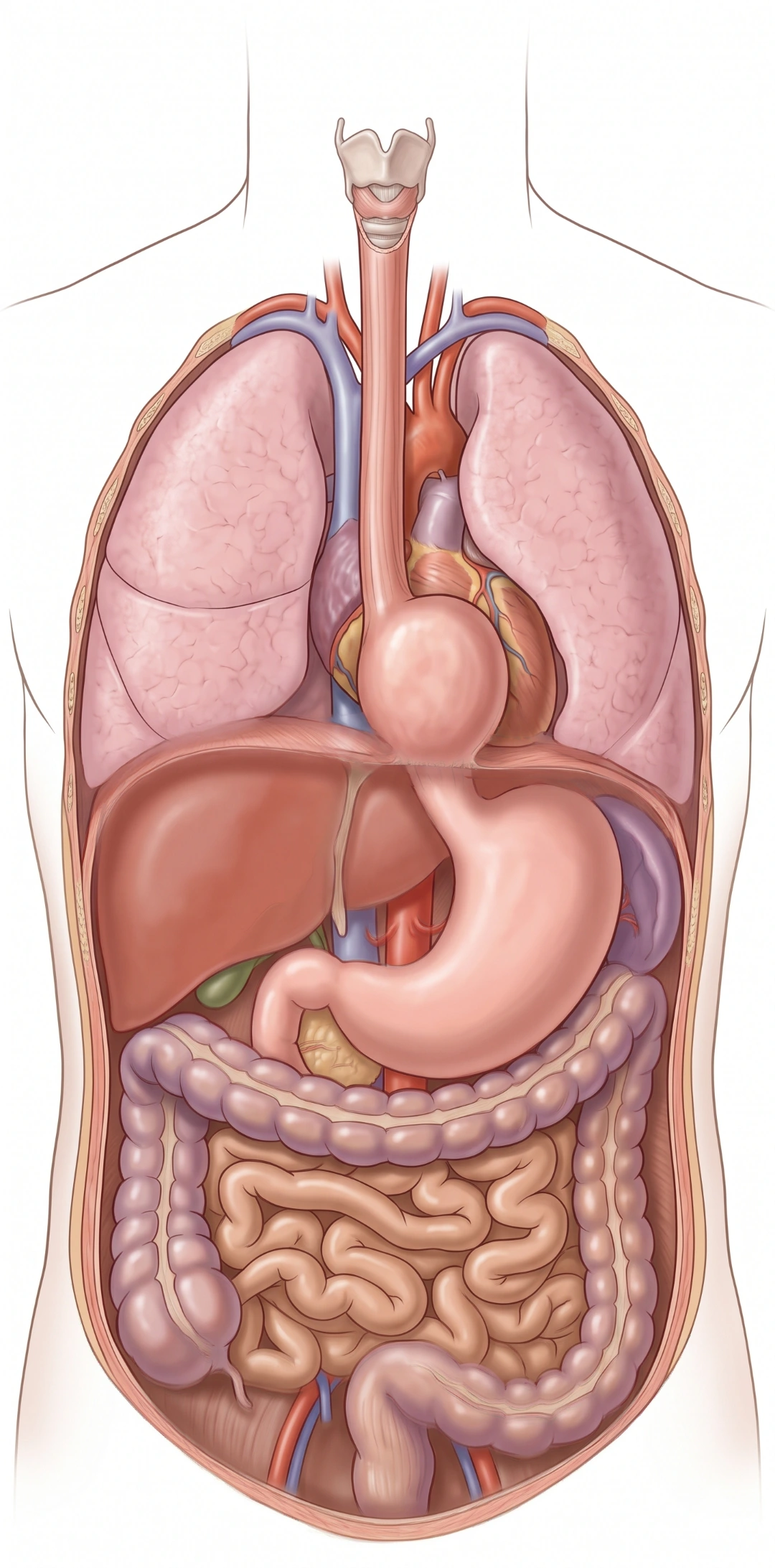
Dr. Grandhige recommends surgical repair in three situations: any hiatal hernia larger than 3 centimeters, any hernia paired with significant reflux symptoms (regurgitation especially), and any hernia alongside complications of reflux such as severe esophagitis, Barrett’s esophagus, or a peptic stricture.
Above 3 centimeters, a hernia is almost always contributing mechanically, and medication can’t reach the problem. These also tend to grow. Large hernias carry a real risk of gastric volvulus, and the longer one sits, the more likely the stomach becomes atonic, which may or may not improve after repair.
The harder half of this is who shouldn’t have surgery. Repair is not offered to patients with untreated severe motility disorders, or to patients whose reflux-like symptoms turn out to be driven by esophageal hypersensitivity, functional chest pain, rumination, achalasia, or an ENT or pulmonary cause. And it isn’t offered when testing fails to prove reflux is happening, however convincing the symptoms sound.
That decision is unpopular in the room. The patients told no are frequently the most frustrated ones who walk out of this office. They’re also the patients who would be far unhappier after an operation that left their actual problem untouched.
The numbers differ by symptom type. Among patients with silent reflux, roughly 50 to 60 percent have testing that supports an operation. Among patients with typical heartburn and regurgitation, the majority do. If you’ve been cycling through escalating doses of medication, the page on GERD covers where medication stops being the answer.
As Dr. Grandhige puts it: the most important skill in reflux surgery is knowing when not to operate, and which operation not to do.
The testing that has to come first
Upper endoscopy does not diagnose GERD. It looks for damage reflux has already caused. A normal endoscopy doesn’t mean reflux isn’t happening, and small hiatal hernias aren’t visible on every scope. Being told “your endoscopy is normal, so nothing is wrong” is the single most common reason patients arrive here after years of unexplained symptoms.
Each test answers a different question.
Endoscopy asks: has reflux caused damage? It finds esophagitis, Barrett’s esophagus, ulcers, strictures, and takes biopsies. It’s also how a pH probe gets placed.
pH monitoring asks: is reflux happening, how often, how long, when, and does it line up with what you feel? It runs 48 to 72 hours using either a wireless Bravo capsule or a catheter, recorded while you eat, work, exercise, and sleep normally. This is the test that actually diagnoses GERD.
Manometry asks: can your esophagus handle added resistance at the bottom? Weak motility points toward a partial wrap rather than a full one, and can rule out certain procedures entirely.
Barium swallow gets used selectively, and it produces one detail worth knowing. Where you feel food sticking matches the real anatomic location only about 60 percent of the time. Patients who swear food is caught in their throat often turn out to have the delay sitting in the lower esophagus.
For throat-dominant symptoms, Dr. Grandhige uses a customized 24-hour dual-channel pH impedance probe that measures reflux above the lower esophageal sphincter and above the upper esophageal sphincter. Standard testing only reads the lower level. Your larynx can produce symptoms from a single reflux episode a day, where your esophagus tolerates 40 to 50. Patients with silent reflux (LPR) are typically quoted about a 50 percent chance surgery helps. With dual-channel selection, symptom improvement runs closer to 80 percent, which comes from operating on fewer people rather than more.
Which repair goes with your hernia
Closing the hiatus is usually not the entire operation. What gets added depends on your anatomy and your motility.
The Society of American Gastrointestinal and Endoscopic Surgeons published updated hiatal hernia guidelines in 2024 that conditionally suggest routinely performing a fundoplication when a hernia is repaired, based on low-certainty evidence. On mesh, the panel found the evidence equivocal and declined to recommend for or against routine use. Mesh is a case-by-case call here, not a default.
Recovery, and what actually changes
Most patients go home the same day, walking and drinking liquids within hours of waking from anesthesia. Diet moves through structured stages over two to three months, from liquids to soft foods to regular textures.
One detail matters more than most patients realize. Vomiting in the early weeks is associated with significant early failure of a hiatal hernia repair. That’s why anesthesia is managed specifically to limit post-operative nausea, and why the diet stages aren’t a suggestion.
Swallowing changes while swelling settles are expected and temporary. Long term, most patients eat a wider range of food than before surgery, because the foods they’d been avoiding stop triggering symptoms.
Timing of relief splits by symptom type. Typical heartburn and regurgitation often settle fast, sometimes overnight. Throat symptoms take longer. Patients with silent reflux are counseled to expect four to six months before throat clearing, cough, and hoarseness fade.
Burping and vomiting depend on the procedure. Fundoplication may limit both. LINX usually preserves them. Worth knowing: adults tend to heave rather than vomit the way children do, and being unable to bring up solid food isn’t dangerous. It passes the other direction in time.
Dr. Grandhige asks patients to give it six months. At that point, whatever symptoms remain get addressed directly, which sometimes means a referral to ENT, pulmonology, allergy, or gastroenterology for the parts that were never reflux.
That’s the honest frame for success here. Success means your reflux-related symptoms resolve. Not every symptom on your intake list is reflux, and the operation fixes what it was built to fix.
Your surgeon, your team, and the trip from Wesley Chapel
Gopal Grandhige, MD is a board-certified general surgeon who has performed foregut and anti-reflux surgery since 2009 and treats only benign conditions of the esophagus, diaphragm, and stomach.
He completed a BS in Biology at Johns Hopkins University, his medical degree at the University of Michigan, and his general surgery residency at Yale-New Haven Hospital, followed by fellowships at Yale-New Haven in Burn and Critical Care and in Foregut and Minimally Invasive Surgery. He’s a Founding Member of the American Foregut Society, a member of SAGES, and a Fellow of the American College of Surgeons. More background is on the about Dr. Grandhige page.
The team stays constant. A physician assistant employed directly by the practice assists every case, knows your specific anatomy, and is reachable during office hours. Dr. Grandhige is reachable directly after hours.
Every operation happens at one hospital: HCA Florida South Tampa Hospital on West Swann Avenue, with the same anesthesia team, nurses, and surgical technologists each case. Small differences in positioning and in tension on the repair show up years later in swallowing and durability, which is why that team doesn’t rotate.

From Wesley Chapel the drive is I-75 south to I-275 south into South Tampa. The office sits at 1315 South Howard Avenue, Suite 101, in a yellow brick building next to Sally O’Neill’s Pizza, with parking behind the restaurant. It’s about two miles from the operating hospital, so your consultation, your testing, and your surgery all stay in one corner of town. For patients coming down from Pasco County, testing is grouped onto the fewest days possible, and any study that can be done closer to home gets done closer to home.
Timelines are predictable. New patients are usually seen within two weeks and always within four. If you arrive with endoscopy, pH testing, manometry, and imaging already done, one consultation is often enough and surgery lands around four weeks out. If testing is still needed, expect two visits about four weeks apart and roughly eight weeks to surgery. Insurance authorization runs four to six weeks and the office handles the submission.
Send records to info@tampareflux.com before your appointment: endoscopy and pathology reports, pH studies, manometry, imaging, plus office notes from gastroenterology, ENT, pulmonology, or allergy. Dr. Grandhige reviews every study personally beforehand, which turns a first visit into a decision rather than a data-gathering session.
Questions Wesley Chapel patients ask
You’ve already tried the medication. If reflux is mechanical, no dose gets you past it.
The consultation answers one question: is reflux actually happening, and is it causing what you feel? If surgery is right, you’ll understand exactly why. If it isn’t, you’ll understand that too, and you’ll leave with a plan either way.


An endoscopy cannot tell you if you have reflux. It can only tell you if you have complications of GERD.
If you are unhappy with your reflux symptoms, come in and we can discuss testing and treatments that can accurately diagnose your problem.
#reflux #gerd #hiatalhernia #gastroparesis #linx


CALL US AT 813-922-2920
www.tampareflux.com
If you have a hiatal hernia and fit one of these categories, you should know your options.
Dr. Grandhige is an expert in his field and performs 200 of these surgeries a year. He is the only surgeon in the Tampa Bay Area who offers all surgical options - LINX, Fundoplications, TIF and will be one of 20 surgeons in America introducing the latest procedure RefluxStop in 2026.
We accept most insurances but will verify yours before you come in. These procedures are considered medically necessary and covered by your insurance. You can expect to pay your in-network deductibles and nothing else.
#hiatalhernia #reflux #GERD #LINX #refluxstop

What causes reflux ?
1. Weak lower esophageal sphincter
2. Hiatal hernia
3. Flattening of the Angle of His
4. Poor esophageal motility
5. Gastroparesis (slow stomach)
NOT increased acid production


Don’t let GERD get in the way of living your life. Request your appointment with us today on the link below.
.
.
.
.
https://tampareflux.com/contact-us/

Anyone can be victim to GERD and though weight loss can help reduce GERD symptoms. Many athletes with high impact workouts may continue to have these symptoms. This may be a symptom of a hiatal hernia or other issue. We are more then happy to assist you in finding your solution, just click the link below.
.
.
.
https://tampareflux.com/contact-us/
##healthylifestyle #workout #athletereflux #PPIs #heartburn #LINX #fundoplication #TIF #GERD#tampaheartburn #linx #TIF #fundoplication #tampabayreflux #GERD #acidreflux #acidrefluxsurgery #stopreflux
#nonsurgicalweightloss #ESG #gastricballoon #weightlossjourney #vsg #vsgjourney #spatz3 #orbera #orberaballoon #grandhige #DrG
#tampabayrefluxinstitute #guthealth #roboticsurgery

Heartburn may seem like an annoyance. But if you find yourself having symptoms on a daily basis, it may be time to to talk to Dr. Grandhige as it could be a symptom of something worse.
.
.
.
#chronicheartburn #gerdsymptoms #heartburnrelief #reflux #PPIs #heartburn #LINX #fundoplication #TIF #GERD#tampaheartburn #linx #TIF #fundoplication #tampabayreflux #GERD #acidreflux #acidrefluxsurgery #stopreflux
#nonsurgicalweightloss #ESG #gastricballoon #weightlossjourney #vsg #vsgjourney #spatz3 #orbera #orberaballoon #grandhige #DrG
#tampabayrefluxinstitute #guthealth #roboticsurgery

If you are tired of avoiding your favorite foods or taking daily medications, we can help.
We are the Tampa experts in reflux ! With years of experience and thousands of patients treated successfully, we offer all FDA approved anti-reflux procedures.
Call 813-922-2920 to schedule your appointment
All major insurances accepted.

Not all patients need surgical intervention. Many patients are living a heartburn free life with their PPIs. However 40% of patients taking PPIs are not getting the relief they need. If you are one of those, you have options! Come in and find out more.
.
.
.
.
#letushelpyou #medsnotworking #reflux #PPIs #heartburn #LINX #fundoplication #TIF #GERD#tampaheartburn #linx #TIF #fundoplication #tampabayreflux #GERD #acidreflux #acidrefluxsurgery #stopreflux
#nonsurgicalweightloss #ESG #gastricballoon #weightlossjourney #vsg #vsgjourney #spatz3 #orbera #orberaballoon #grandhige #DrG
#tampabayrefluxinstitute #guthealth #roboticsurgery

#heartburn #stopreflux #hiatalherniarepair #severeheartburn #reflux #tampabayreflux #acidrefluxsurgery #tampaheartburn #GERD #PPIs #achalasia #LINX #TIF #tampareflux #fundoplication #stomach #digestivehealth #ESG #obesity #overweight #weightlossjourney #gastricballoon
