
The testing that decides whether a repair will help you
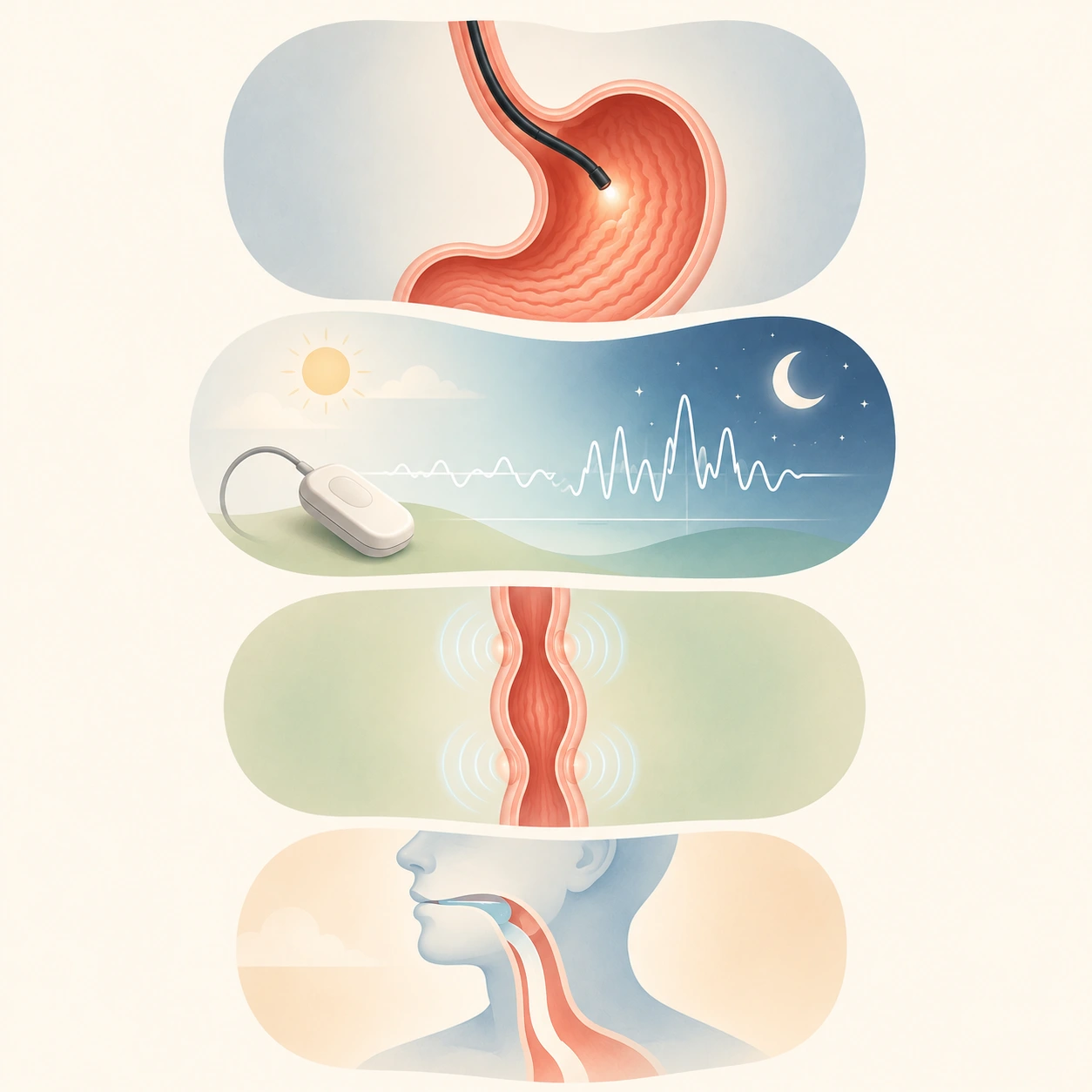
Four tests answer four different questions, and skipping any of them is how patients end up with the wrong operation.
pH monitoring measures reflux itself. A wireless Bravo capsule or a catheter probe records 48 to 72 hours of normal life, including sleep, meals, and exercise. It gives you the frequency of reflux events, the duration of each one, the acidity, the timing, and the correlation between events and the symptoms you logged. It’s the test that either proves reflux or rules it out.
Esophageal manometry measures whether your esophagus can push food through a repair. Every anti-reflux procedure adds resistance at the gastroesophageal junction. If your esophagus lacks the strength or coordination to overcome that resistance, you get dysphagia, food impaction, and chest pain that are much harder to fix after surgery than before it. Manometry also catches achalasia, esophageal spasm, and ineffective motility, all of which can look like reflux and none of which improve with reflux surgery.
Barium swallow shows how your esophagus behaves during an actual swallow, which is different from how it looks at rest. It’s used selectively, mainly for dysphagia, suspected strictures, revision cases, and patients who can’t tolerate manometry. One finding from this test is worth stating outright: when patients point to where food feels stuck, they’re anatomically correct only about 60 percent of the time. Someone who feels an obstruction in the throat often turns out to have delay in the distal esophagus.
Dual-channel pH impedance testing is the one that separates this practice from standard reflux workups. Most reflux testing measures only above the lower esophageal sphincter. Dr. Grandhige uses a customized 24-hour probe that measures above the lower sphincter and above the upper sphincter, and that captures non-acid reflux, which standard pH testing misses.
This matters because of a sensitivity difference most patients are never told about. The esophagus tolerates 40 to 50 reflux episodes a day without complaint. The larynx and pharynx can produce symptoms from a single episode. That’s why chronic throat clearing, hoarseness, cough, ear pressure, and globus sensation get attributed to allergies or asthma for years while the reflux tests come back “normal.”
Surgeons working from standard testing typically quote laryngopharyngeal reflux patients around a 50 percent chance of improvement. With dual-channel testing to identify who actually has reflux reaching the throat, that figure rises to roughly 80 percent in correctly selected patients. The tradeoff is that fewer patients qualify. More detail on the condition sits on the silent reflux and LPR page.
One expectation to set now: throat symptoms take 4 to 6 months to improve after a repair. Classic heartburn often resolves overnight. Patients who expect the same timeline for both get discouraged around month two.
The Six-Step Selection Process
Dr. Grandhige runs every candidate through the same six steps before any procedure is discussed. His own summary of it: the operation is the last step, and the decision-making is the surgery.
Step 1. Prove reflux is present. Objective pH testing, correlation of events with symptoms, and identification of whether the reflux is acid, non-acid, or bile. If reflux isn’t proven, no operation is recommended, regardless of how convincing the symptoms are.
Step 2. Map the anatomy. Presence and size of a hiatal hernia, esophageal length and position, and the relationship between stomach, diaphragm, and esophagus. Anatomy determines which procedures are even technically possible and how long a repair will last.
Step 3. Measure esophageal function. Manometry findings decide whether a full or partial wrap is safe, whether a magnetic device is appropriate, and whether surgery should be avoided outright. Ignoring motility is the most common route to permanent dysphagia.
Step 4. Match symptoms to physiology. Dr. Grandhige states explicitly which of your symptoms he expects to resolve, which may improve partially, and which are unlikely to be reflux at all. Reflux surgery fixes reflux. It does not fix every upper gastrointestinal symptom you’ve collected over the years.
Step 5. Weigh your priorities. Durability, medication elimination, the ability to burp and vomit, side-effect tolerance, and reversibility all differ by procedure. Preference refines the choice once medical appropriateness is settled. It never overrides anatomy.
Step 6. Choose a procedure, or choose none. Because multiple procedures are on the table, the decision is driven by fit rather than by whichever operation the surgeon performs most often. Continued medical management is a legitimate outcome of this process.
Four repair options and the tradeoffs that decide between them
There’s no best anti-reflux operation. There’s a right one for your anatomy, and the differences between them are not marketing distinctions.
Fundoplication wraps the upper stomach around the lower esophagus to reinforce a failing valve, and it repairs the diaphragm at the same time. It comes in four configurations: Nissen (360 degrees), Toupet (posterior 270), Watson (anterior 270), and Dor (anterior partial). The configuration is chosen from your manometry results, not from habit. Operative time runs 1.5 to 2 hours, performed robotically or laparoscopically, and most patients go home the same day. Diet progresses over 2 to 3 months. The honest cost: because a wrap makes it harder for stomach contents to travel up, it can also make it harder for air and food to come up. Depending on configuration, limits on burping and vomiting may be temporary or permanent. Fundoplication remains the most durable option and the one that handles large hernias and weak motility best. Details are on the fundoplication page.
LINX is a ring of magnetic titanium beads placed around the lower esophagus. It doesn’t raise resting sphincter pressure. It resists opening when pressure inside the stomach rises, then opens for a swallow, which is why most patients keep the ability to burp and vomit once early inflammation settles. Gas-bloat symptoms are less common than after a wrap. It requires good esophageal motility, and early swallowing difficulty is more frequent than with fundoplication. Current devices are MRI compatible up to 1.5 Tesla. Two things patients are usually told incorrectly: hernia size does not disqualify you from LINX, as long as the hernia is repaired during the same operation. And a small group of patients can perceive the device. In Dr. Grandhige’s experience, people who are unusually attuned to internal sensation are the ones who report feeling it, and patients who could feel a Bravo pH capsule during testing are the ones most likely to feel a LINX afterward. That’s a screening question worth asking before implantation, and it is not in the standard consent conversation. More on the LINX system.
TIF, or transoral incisionless fundoplication, is performed through the mouth with the EsophyX device in 45 to 60 minutes under general anesthesia. No abdominal incisions. Here is the number nobody puts in writing: Dr. Grandhige quotes patients a failure rate of 2 percent per year, or roughly 20 percent per decade. He describes it as the best endoscopic procedure available and as a solution that works for many years rather than permanently. TIF cannot repair a hiatal hernia, because the diaphragm can’t be reached from inside the esophagus. It’s therefore restricted to patients with no hernia or a very small one, mild to moderate reflux, no esophagitis, no Barrett’s, no strictures, and it isn’t offered to patients who are obese. TIF’s mixed reputation comes almost entirely from being used outside those limits. The TIF and EsophyX page covers candidacy in full.
RefluxStop is the newest option and the reason this page needed writing in 2026. The FDA granted Premarket Approval to Implantica for RefluxStop on August 21, 2026, opening the United States market, with the approval based on five-year safety and effectiveness data and roughly 1,800 patients treated across Europe. You can read Implantica’s approval announcement directly. The device restores the natural anatomy of the gastroesophageal junction without encircling or compressing the food passageway. Dr. Grandhige is adding it, which will make Tampa Bay Reflux Institute the only practice in the region offering all four major anti-reflux procedures. Most surgeons offer one. That’s the practical reason procedure selection here isn’t shaped by what’s familiar.
What the process looks like from Wesley Chapel
Two visits at most, and usually 4 to 8 weeks from first consultation to surgery.
Send your records before you drive down. Email prior endoscopy and pathology reports, pH testing results including Bravo studies, manometry results, barium swallow or imaging, and office notes from your gastroenterologist, ENT, pulmonologist, or allergist to info@tampareflux.com. Signed medical releases get filed immediately, but records requested through them arrive late and incomplete often enough that patients who gather their own get a far more definitive first visit. Studies from years ago still help, because they show progression.
New patients are typically seen within 2 weeks and always within 4.
If your testing is already complete, one visit is usually enough. The diagnosis gets confirmed, options get discussed, and authorization starts that week. Surgery can often be scheduled about 4 weeks out.
If testing isn’t complete, the first visit covers education, record review, and test planning. Studies get ordered and grouped onto as few days as possible. A second visit roughly 4 weeks later reviews the results and finalizes the plan. Where a test can be done near Wesley Chapel without loss of quality, it is, so you’re not driving south for every appointment.
Insurance authorization runs 4 to 6 weeks in complex cases and is handled entirely by the office, usually in parallel with testing. Patients who call their own insurer to speed it up generally slow it down.
Surgery is performed at HCA South Tampa Hospital, and only there. Dr. Grandhige previously operated at four local hospitals and consolidated deliberately, because the same operating room team, the same anesthesiologists, and his own physician assistant in every single case produce more predictable results than rotating staff. That physician assistant assists in every operation, knows your specific anatomy and repair, and is reachable afterward. Several of the office medical assistants have been with the practice for more than a decade. After hours, patients reach Dr. Grandhige directly.
About Dr. Grandhige, and how to verify any of this
Gopal Grandhige, MD, is a board-certified general surgeon and the founder and medical director of Tampa Bay Reflux Institute. He founded and ran Tampa Bay Reflux Center from 2009 to 2022 before the practice became the Institute.
His training: Bachelor of Science in Biology from Johns Hopkins University, medical degree from the University of Michigan in Ann Arbor, general surgery residency at Yale-New Haven Hospital, and two fellowships at Yale-New Haven, one in burn and critical care and one in foregut surgery and minimally invasive surgery.
He’s a Fellow of the American College of Surgeons, a member of the Society of American Gastrointestinal and Endoscopic Surgeons, and a founding member of the American Foregut Society, which exists specifically to bring gastroenterologists and surgeons together on foregut disease. He holds privileges at St. Joseph’s Main Hospital, St. Joseph’s South Hospital, HCA Brandon Hospital, and HCA South Tampa Hospital.
You can confirm his active Florida license and any disciplinary history yourself through the Florida Department of Health license verification portal, and his board certification through the American Board of Surgery physician lookup. Verify any surgeon you’re considering, not just this one.

Scope, stated honestly: the practice treats benign foregut disease only. That includes GERD, hiatal hernias, silent reflux, achalasia treated with Heller myotomy, gastroparesis treated with endoscopic pyloromyotomy, esophageal motility disorders, functional foregut conditions, and complications from foregut surgery performed elsewhere. It does not treat esophageal or gastric cancer, and it does not operate on patients whose symptoms are unlikely to be reflux, including esophageal hypersensitivity and functional chest pain. Background on the practice and its approach is on the About Us page.
In patients with objectively documented reflux, workable anatomy, and normal esophageal motility, Dr. Grandhige reports symptom relief and elimination of daily reflux medication in more than 90 percent of cases. That number describes that selected group. It does not describe everyone who walks in with heartburn, and he’ll tell you which group you’re in before you decide anything.
Frequently asked questions
Find out what’s actually causing your symptoms
If you’ve been on a proton pump inhibitor for years, if your endoscopy came back clean while your symptoms didn’t, or if you’ve been told your throat problems are allergies, you have not yet had a complete evaluation. The goal of the first visit is clarity, not a surgery date. Many patients drive down expecting an operation and leave with a non-surgical plan and an explanation that finally fits.


An endoscopy cannot tell you if you have reflux. It can only tell you if you have complications of GERD.
If you are unhappy with your reflux symptoms, come in and we can discuss testing and treatments that can accurately diagnose your problem.
#reflux #gerd #hiatalhernia #gastroparesis #linx


CALL US AT 813-922-2920
www.tampareflux.com
If you have a hiatal hernia and fit one of these categories, you should know your options.
Dr. Grandhige is an expert in his field and performs 200 of these surgeries a year. He is the only surgeon in the Tampa Bay Area who offers all surgical options - LINX, Fundoplications, TIF and will be one of 20 surgeons in America introducing the latest procedure RefluxStop in 2026.
We accept most insurances but will verify yours before you come in. These procedures are considered medically necessary and covered by your insurance. You can expect to pay your in-network deductibles and nothing else.
#hiatalhernia #reflux #GERD #LINX #refluxstop

What causes reflux ?
1. Weak lower esophageal sphincter
2. Hiatal hernia
3. Flattening of the Angle of His
4. Poor esophageal motility
5. Gastroparesis (slow stomach)
NOT increased acid production


Don’t let GERD get in the way of living your life. Request your appointment with us today on the link below.
.
.
.
.
https://tampareflux.com/contact-us/

Anyone can be victim to GERD and though weight loss can help reduce GERD symptoms. Many athletes with high impact workouts may continue to have these symptoms. This may be a symptom of a hiatal hernia or other issue. We are more then happy to assist you in finding your solution, just click the link below.
.
.
.
https://tampareflux.com/contact-us/
##healthylifestyle #workout #athletereflux #PPIs #heartburn #LINX #fundoplication #TIF #GERD#tampaheartburn #linx #TIF #fundoplication #tampabayreflux #GERD #acidreflux #acidrefluxsurgery #stopreflux
#nonsurgicalweightloss #ESG #gastricballoon #weightlossjourney #vsg #vsgjourney #spatz3 #orbera #orberaballoon #grandhige #DrG
#tampabayrefluxinstitute #guthealth #roboticsurgery

Heartburn may seem like an annoyance. But if you find yourself having symptoms on a daily basis, it may be time to to talk to Dr. Grandhige as it could be a symptom of something worse.
.
.
.
#chronicheartburn #gerdsymptoms #heartburnrelief #reflux #PPIs #heartburn #LINX #fundoplication #TIF #GERD#tampaheartburn #linx #TIF #fundoplication #tampabayreflux #GERD #acidreflux #acidrefluxsurgery #stopreflux
#nonsurgicalweightloss #ESG #gastricballoon #weightlossjourney #vsg #vsgjourney #spatz3 #orbera #orberaballoon #grandhige #DrG
#tampabayrefluxinstitute #guthealth #roboticsurgery

If you are tired of avoiding your favorite foods or taking daily medications, we can help.
We are the Tampa experts in reflux ! With years of experience and thousands of patients treated successfully, we offer all FDA approved anti-reflux procedures.
Call 813-922-2920 to schedule your appointment
All major insurances accepted.

Not all patients need surgical intervention. Many patients are living a heartburn free life with their PPIs. However 40% of patients taking PPIs are not getting the relief they need. If you are one of those, you have options! Come in and find out more.
.
.
.
.
#letushelpyou #medsnotworking #reflux #PPIs #heartburn #LINX #fundoplication #TIF #GERD#tampaheartburn #linx #TIF #fundoplication #tampabayreflux #GERD #acidreflux #acidrefluxsurgery #stopreflux
#nonsurgicalweightloss #ESG #gastricballoon #weightlossjourney #vsg #vsgjourney #spatz3 #orbera #orberaballoon #grandhige #DrG
#tampabayrefluxinstitute #guthealth #roboticsurgery

#heartburn #stopreflux #hiatalherniarepair #severeheartburn #reflux #tampabayreflux #acidrefluxsurgery #tampaheartburn #GERD #PPIs #achalasia #LINX #TIF #tampareflux #fundoplication #stomach #digestivehealth #ESG #obesity #overweight #weightlossjourney #gastricballoon
