
The testing that decides everything
Every recommendation here is built on objective physiologic testing, not on symptoms or medication response. The SAGES multi-society guideline on the treatment of GERD treats preoperative evaluation as one of the four questions that determine surgical outcomes, and this practice treats it the same way.
pH monitoring: is reflux actually happening?
pH monitoring measures how often reflux occurs, how long each episode lasts, how acidic it is, when it happens, and whether your symptoms line up with reflux events. It runs over 48 to 72 hours using either a wireless Bravo capsule or a catheter-based probe while you eat, sleep, work, and exercise normally.
Symptoms alone are unreliable. Esophageal hypersensitivity, functional chest pain, motility disorders, and anxiety-related symptoms all imitate reflux. pH testing separates them.
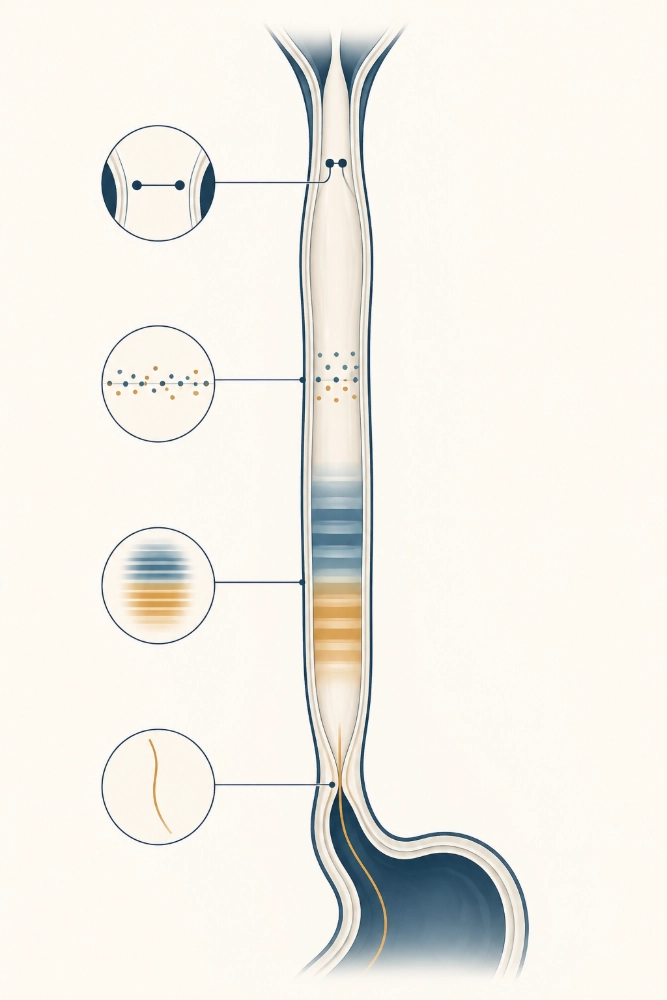
Manometry: can your esophagus handle a procedure?
Every anti-reflux procedure adds resistance at the gastroesophageal junction. Manometry measures whether your esophagus has the strength and coordination to push food through it. It identifies achalasia, esophageal spasm, ineffective motility, and hypertensive LES, all of which can present like reflux and none of which improve with reflux surgery.
Motility findings determine whether a full or partial wrap is safe, whether a magnetic device is appropriate, and whether surgery should be avoided entirely. Skipping this test is the most predictable cause of postoperative swallowing problems.

Dual-channel testing for silent reflux
This is where the evaluation departs most sharply from standard practice. Standard reflux testing measures acid exposure above the lower esophageal sphincter only. For silent reflux (LPR), that is the wrong measurement in the wrong place.
The esophagus tolerates 40 to 50 reflux episodes a day. The larynx and pharynx can produce symptoms from a single episode. They also react to non-acid reflux, which standard pH testing does not capture at all.
Dr. Grandhige uses a customized 24-hour pH impedance dual-channel probe that measures reflux above the lower esophageal sphincter and above the upper esophageal sphincter, including the bile and digestive enzymes only impedance detects. The testing is technically demanding and is not routinely performed in most practices.
The consequence is direct. LPR patients are commonly quoted a 50 percent chance that surgery helps. With dual-channel testing to identify who is genuinely refluxing into the throat, Dr. Grandhige reports symptom improvement near 80 percent in the patients he selects. He also operates on fewer of them.
Manometry: can your esophagus handle a procedure?
Every anti-reflux procedure adds resistance at the gastroesophageal junction. Manometry measures whether your esophagus has the strength and coordination to push food through it. It identifies achalasia, esophageal spasm, ineffective motility, and hypertensive LES, all of which can present like reflux and none of which improve with reflux surgery.
Motility findings determine whether a full or partial wrap is safe, whether a magnetic device is appropriate, and whether surgery should be avoided entirely. Skipping this test is the most predictable cause of postoperative swallowing problems.
The four anti-reflux procedures and who each one fits
There is no best reflux operation. There is a correct operation for a specific anatomy and a specific esophagus, and in many cases the correct answer is no operation. Because Dr. Grandhige performs all of them, the recommendation is not limited by what he happens to be comfortable with.
Fundoplication
The most durable option and the one that handles complex anatomy. The upper stomach is wrapped around the lower esophagus to reinforce the failing sphincter, after the hernia is reduced and the diaphragm repaired. He performs Nissen (360 degree), Toupet (posterior 270), Watson (anterior 270), and Dor (anterior partial) configurations, chosen from manometry results before the operation starts.
Robotic or laparoscopic, typically 1.5 to 2 hours, usually outpatient, with diet advancing over 2 to 3 months. The honest trade-off: because the wrap makes it harder for acid to come up, it also makes it harder for air and food to come up. Bloating and limited ability to vomit are the two most common complaints, and depending on the configuration they may be temporary or permanent. More on the types of fundoplication and how they differ.
LINX
A ring of magnetic titanium beads placed around the lower esophagus. It does not raise resting sphincter pressure. It resists opening when stomach pressure rises and opens when you swallow, which is why most patients keep the ability to burp and vomit once early inflammation settles. Gas-bloat is less of a problem than after a wrap, and the device can be removed without closing off future options.
Hernia size does not disqualify a patient, as long as the hernia is repaired during the same operation. Poor esophageal motility does. LINX carries a higher rate of early swallowing difficulty and a small but real risk of longer-term dysphagia, and current devices are MRI compatible up to 1.5 Tesla.
One selection detail Dr. Grandhige has observed across more than 600 cases and does not see written down anywhere: patients who can feel the Bravo pH capsule while it is in place often go on to feel the LINX device after placement. People unusually attuned to internal sensation are worth flagging before surgery, not after.
TIF (EsophyX)
Performed entirely through the mouth with an endoscope, typically 45 to 60 minutes under general anesthesia, no abdominal incisions. It rebuilds a partial internal valve at the gastroesophageal junction and recreates the angle of His.
What it cannot do is repair a hiatal hernia, because there is no access to the diaphragm from inside. That is the whole story of TIF’s mixed reputation. Used in patients with no or minimal hernia, mild to moderate reflux, and no complications, it works. Used outside those criteria it does not, and it has historically been marketed as an easier alternative to surgery without that caveat attached.
Dr. Grandhige quotes a failure rate of about 2 percent per year, roughly 20 percent per decade. He calls it the best endoscopic procedure that exists and tells patients to treat it as a solution that works for many years rather than a permanent one. He does not offer TIF to patients who are obese or who have more than a minimal hernia, even when they ask for it. Heavy lifting is restricted for six weeks afterward.
RefluxStop
The FDA granted Premarket Approval for RefluxStop on August 21, 2026, after reviewing five-year safety and effectiveness data. Unlike a fundoplication wrap or a magnetic ring, the implant is designed to restore and hold the natural anatomy of the gastroesophageal junction without encircling or compressing the food passageway. Before US approval it had been used in close to 1,800 patients across more than 60 centers in nine European countries.
Two details from that approval matter for anyone reading this from Wesley Chapel. The initial US rollout is deliberately limited to selected reflux centers and surgeons, pacing behind required training and site activation. And the FDA indication itself is written for patients diagnosed with GERD by abnormal impedance pH or pH testing. The newest device on the market requires exactly the testing this practice has required all along.
Dr. Grandhige will be among the first surgeons in the United States to offer it, making him the only surgeon in the Tampa Bay area providing all four current anti-reflux options.
When surgery is the wrong answer
A surgeon who never advises against operating is not exercising judgment. Dr. Grandhige turns patients down regularly, and he is direct about what that costs him.
In patients with typical heartburn and regurgitation, testing supports intervention in the majority of cases. In LPR patients, testing warrants surgery in roughly 50 to 60 percent. The rest have symptoms driven by something reflux surgery cannot fix.
The findings that most often disqualify a patient: severe esophageal motility disorders, reflux-like symptoms with no objective reflux on testing, esophageal hypersensitivity, functional chest pain, rumination, achalasia, and symptoms originating in the ENT or pulmonary systems. Several of those produce heartburn, chest pain, and regurgitation that look identical to GERD from the outside.
He is also blunt about the human side of it. The patients he declines to operate on are often the least happy leaving the office, because they arrived wanting a definitive answer and left without one. They are also the same patients who would be far less happy after an unnecessary operation that changed nothing.
When surgery is not the answer, patients are pointed to the right specialist. He keeps personal relationships with local physicians specifically so that hand-off does not turn into duplicated testing or a lost diagnosis.
About Dr. Gopal Grandhige

Gopal Grandhige, MD is a board-certified general surgeon and the founder and medical director of Tampa Bay Reflux Institute. He founded and ran Tampa Bay Reflux Center from 2009 to 2022 before the practice took its current form.
He completed a Bachelor of Science in Biology at Johns Hopkins University, his medical degree at the University of Michigan, and his general surgery residency at Yale-New Haven Hospital, followed by fellowships there in Burn and Critical Care and in Foregut and Minimally Invasive Surgery. He is a Fellow of the American College of Surgeons, a member of the Society of American Gastrointestinal and Endoscopic Surgeons, and a founding member of the American Foregut Society. Board certification can be verified through the American Board of Surgery physician lookup and active licensure through the Florida Department of Health license search. More on his training and approach to foregut disease.
All foregut and reflux surgeries are performed at a single facility, HCA South Tampa Hospital, with the same operating room team and the same anesthesiologists. He holds privileges at St. Joseph’s Main, St. Joseph’s South, and HCA Brandon as well, and consolidated operating to one site deliberately. There is a specific reason for that in foregut surgery: postoperative vomiting is associated with early failure of a hiatal hernia repair, so anesthesia management that minimizes nausea is part of the repair holding.
His physician assistant, whom he employs directly, assists in every case and handles postoperative questions. Several of his medical assistants have worked with him for over a decade. After hours, patients reach Dr. Grandhige directly.
Common questions from Wesley Chapel patients
Get an answer instead of another prescription
If you have been on daily or twice-daily acid suppression for years without objective testing, you do not know what you are treating. Neither does anyone else. Bring your records, get the testing, and find out whether reflux is the problem before deciding what to do about it.


An endoscopy cannot tell you if you have reflux. It can only tell you if you have complications of GERD.
If you are unhappy with your reflux symptoms, come in and we can discuss testing and treatments that can accurately diagnose your problem.
#reflux #gerd #hiatalhernia #gastroparesis #linx


CALL US AT 813-922-2920
www.tampareflux.com
If you have a hiatal hernia and fit one of these categories, you should know your options.
Dr. Grandhige is an expert in his field and performs 200 of these surgeries a year. He is the only surgeon in the Tampa Bay Area who offers all surgical options - LINX, Fundoplications, TIF and will be one of 20 surgeons in America introducing the latest procedure RefluxStop in 2026.
We accept most insurances but will verify yours before you come in. These procedures are considered medically necessary and covered by your insurance. You can expect to pay your in-network deductibles and nothing else.
#hiatalhernia #reflux #GERD #LINX #refluxstop

What causes reflux ?
1. Weak lower esophageal sphincter
2. Hiatal hernia
3. Flattening of the Angle of His
4. Poor esophageal motility
5. Gastroparesis (slow stomach)
NOT increased acid production


Don’t let GERD get in the way of living your life. Request your appointment with us today on the link below.
.
.
.
.
https://tampareflux.com/contact-us/

Anyone can be victim to GERD and though weight loss can help reduce GERD symptoms. Many athletes with high impact workouts may continue to have these symptoms. This may be a symptom of a hiatal hernia or other issue. We are more then happy to assist you in finding your solution, just click the link below.
.
.
.
https://tampareflux.com/contact-us/
##healthylifestyle #workout #athletereflux #PPIs #heartburn #LINX #fundoplication #TIF #GERD#tampaheartburn #linx #TIF #fundoplication #tampabayreflux #GERD #acidreflux #acidrefluxsurgery #stopreflux
#nonsurgicalweightloss #ESG #gastricballoon #weightlossjourney #vsg #vsgjourney #spatz3 #orbera #orberaballoon #grandhige #DrG
#tampabayrefluxinstitute #guthealth #roboticsurgery

Heartburn may seem like an annoyance. But if you find yourself having symptoms on a daily basis, it may be time to to talk to Dr. Grandhige as it could be a symptom of something worse.
.
.
.
#chronicheartburn #gerdsymptoms #heartburnrelief #reflux #PPIs #heartburn #LINX #fundoplication #TIF #GERD#tampaheartburn #linx #TIF #fundoplication #tampabayreflux #GERD #acidreflux #acidrefluxsurgery #stopreflux
#nonsurgicalweightloss #ESG #gastricballoon #weightlossjourney #vsg #vsgjourney #spatz3 #orbera #orberaballoon #grandhige #DrG
#tampabayrefluxinstitute #guthealth #roboticsurgery

If you are tired of avoiding your favorite foods or taking daily medications, we can help.
We are the Tampa experts in reflux ! With years of experience and thousands of patients treated successfully, we offer all FDA approved anti-reflux procedures.
Call 813-922-2920 to schedule your appointment
All major insurances accepted.

Not all patients need surgical intervention. Many patients are living a heartburn free life with their PPIs. However 40% of patients taking PPIs are not getting the relief they need. If you are one of those, you have options! Come in and find out more.
.
.
.
.
#letushelpyou #medsnotworking #reflux #PPIs #heartburn #LINX #fundoplication #TIF #GERD#tampaheartburn #linx #TIF #fundoplication #tampabayreflux #GERD #acidreflux #acidrefluxsurgery #stopreflux
#nonsurgicalweightloss #ESG #gastricballoon #weightlossjourney #vsg #vsgjourney #spatz3 #orbera #orberaballoon #grandhige #DrG
#tampabayrefluxinstitute #guthealth #roboticsurgery

#heartburn #stopreflux #hiatalherniarepair #severeheartburn #reflux #tampabayreflux #acidrefluxsurgery #tampaheartburn #GERD #PPIs #achalasia #LINX #TIF #tampareflux #fundoplication #stomach #digestivehealth #ESG #obesity #overweight #weightlossjourney #gastricballoon
