
A normal endoscopy does not rule out reflux
Upper endoscopy answers one question: has reflux already caused visible damage? It does not answer whether reflux is occurring, how often, how long each episode lasts, or whether your symptoms line up with those episodes. Plenty of people with significant GERD have a completely normal endoscopy, especially while taking acid suppression. Small hiatal hernias are not visible on every endoscopy either.
That single misunderstanding is the most common reason patients arrive here after years of being told nothing is wrong.
What each test actually answers
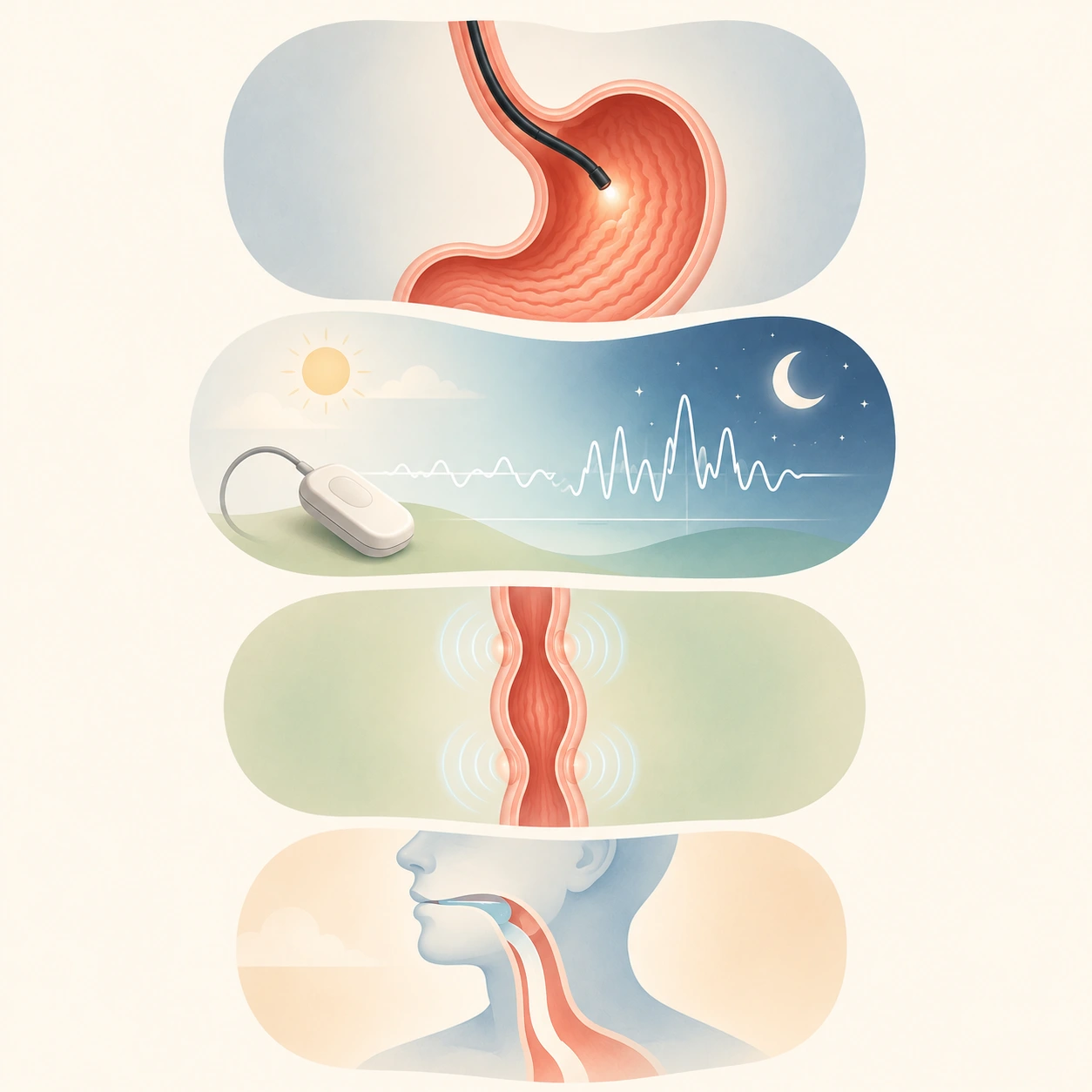
Upper endoscopy (EGD) shows anatomy and complications: esophagitis, Barrett’s esophagus, ulcers, strictures, and biopsies. It is a damage report, not a reflux measurement.
pH and pH-impedance monitoring is the test that diagnoses reflux. It records how often reflux happens, how long each episode lasts, how acidic it is, when it occurs, and whether your symptoms correlate with actual reflux events. It also picks up non-acid reflux, which matters because bile, pepsin, and trypsin reach the esophagus whether or not acid is suppressed.
Esophageal manometry measures the strength and coordination of your swallowing muscle. Every anti-reflux procedure adds resistance at the gastroesophageal junction. If your esophagus can’t push through that resistance, the result is dysphagia. Manometry also catches achalasia, which mimics reflux and gets worse if treated as reflux.
Barium swallow shows the esophagus in motion. Dr. Grandhige uses it selectively, often when patients report food sticking. Here’s a detail worth knowing before you assume you know where your problem is: where a patient feels food catching matches the true anatomic location only about 60 percent of the time. People routinely point at their throat when the delay is at the bottom of the esophagus.
What medication does, and what it leaves untouched
Proton pump inhibitors block acid production for roughly 12 to 16 hours a day. H2 blockers like famotidine are less potent, last about four to six hours, and start working in about 30 minutes, which makes them useful on an as-needed basis rather than as a foundation. Neither strengthens a weak sphincter, repairs a hiatal hernia, or reduces the number of reflux events.
There is a newer class worth understanding. Vonoprazan (Voquezna) is the first potassium-competitive acid blocker approved in the United States, labeled for healing and maintenance of erosive esophagitis and for heartburn in non-erosive GERD. It doesn’t need an acidic stomach to activate and can be taken with or without food. It’s a better acid blocker. It is still an acid blocker, and it does the same thing to a hiatal hernia that omeprazole does, which is nothing.
Weight loss helps, and the first 15 pounds tend to matter most because that early loss shrinks the liver and reduces pressure at the hiatus. Thin patients still get severe reflux when a hernia or sphincter failure is present.
Four procedures, and what changed in August 2026
Dr. Grandhige has performed over 600 fundoplications, over 600 LINX procedures, and over 200 TIF procedures, and evaluates over 600 reflux patients a year. He is one of the busiest LINX surgeons in the country. Performing multiple procedures is the point: a surgeon who does one operation will find a reason to recommend it.
Silent reflux (LPR), and the testing most centers skip
If your symptoms are throat clearing, hoarseness, cough, postnasal drip, ear fullness, or a lump-in-the-throat sensation, standard reflux testing may have missed your diagnosis entirely. Laryngopharyngeal reflux isn’t milder reflux. It’s reflux reaching tissue that has no tolerance for it. Your esophagus may handle 40 to 50 reflux episodes a day without complaint. The larynx and pharynx can produce symptoms from a single episode.
Standard testing measures acid exposure above the lower esophageal sphincter. It does not tell you whether anything reached your throat. So patients get told their reflux test was normal, that it’s allergies or asthma, or that surgery has about a 50 percent chance of helping, and that last number is why many LPR patients are talked out of an evaluation that would have worked.
Dr. Grandhige uses a customized 24-hour dual-channel pH-impedance probe that measures above the lower esophageal sphincter and above the upper esophageal sphincter, capturing non-acid reflux as well. Bile, pepsin, and trypsin only show up on impedance. With that data, he reports selecting patients whose likelihood of symptom improvement rises to roughly 80 percent, and finds that only about 50 to 60 percent of LPR patients test as appropriate surgical candidates at all. These are practice-reported figures rather than independently audited results.
This testing is technically demanding, requires careful interpretation, and is reimbursed poorly, which is why most centers don’t offer it. One expectation to set now: LPR symptoms typically take four to six months to improve, while classic heartburn often resolves almost immediately.
Who Dr. Grandhige is, and who he declines to operate on

Gopal Grandhige, MD earned his bachelor’s degree at Johns Hopkins University and his MD at the University of Michigan, then completed general surgery residency and fellowship training in foregut and minimally invasive surgery at Yale New Haven Hospital. He is a board-certified general surgeon, a Fellow of the American College of Surgeons, a member of SAGES, and a founding member of the American Foregut Society. He has practiced in Tampa Bay since 2009 and limits his work to benign disease of the esophagus, diaphragm, and stomach. You can read more about his training and how the practice is structured before you book.
Now the part most practice pages leave out. He does not operate on patients with reflux-like symptoms and no objectively proven reflux, patients whose symptoms come from esophageal hypersensitivity or functional chest pain, patients with untreated severe motility disorders, or patients who fall outside the selection criteria for the procedure they want.
He’s candid that these patients are often the most frustrated people who walk out of his office. They came for a fix and left with a referral. His position is that they’d be considerably unhappier after an operation that didn’t change anything. When surgery isn’t the answer, he sends patients back to gastroenterology, ENT, pulmonology, or allergy through relationships he’s built over sixteen years in this market, so the handoff doesn’t restart the diagnostic process from zero.
For carefully selected patients with typical heartburn and regurgitation, proven reflux, workable anatomy, and good esophageal function, he reports greater than 95 percent symptom relief and elimination of daily reflux medication. That figure applies to that selected group, it’s practice-reported rather than independently audited, and it exists because a meaningful number of people get told no.
What the process looks like from Wesley Chapel
Most patients are seen within two weeks and always within four. From there the path splits based on what testing you already have.
If your testing is done, one consultation is usually enough. Dr. Grandhige personally reviews your endoscopy reports, pathology, pH studies, manometry, imaging, and the notes from your gastroenterologist, ENT, pulmonologist, or allergist before you walk in, so the visit is spent on explanation rather than data collection. Surgery can often be scheduled about four weeks out, depending on authorization.
If testing isn’t complete, the first visit covers education, record review, and test planning. A second visit about four weeks later reviews results and finalizes the plan. Consultation to surgery runs roughly eight weeks.
Send records ahead to info@tampareflux.com. Signed releases get started immediately, but records requested through releases arrive late, incomplete, or missing the actual data more often than not. Patients who bring their own reports get definitive answers on the first visit. Patients who don’t often need a second one.
For Pasco County patients, the office arranges testing close to home whenever a study can be run locally, so trips to South Tampa stay productive. Insurance authorization is handled entirely by the office and typically takes four to six weeks. It’s started as soon as the diagnosis and plan are set, and it runs in parallel with testing rather than after it.
All surgery is performed at HCA South Tampa Hospital, and only there. Dr. Grandhige previously operated at four hospitals and consolidated deliberately: same operating room team, same anesthesia group familiar with foregut physiology, same equipment setup, same physician assistant in every case. That PA also handles your follow-up questions and knows your specific anatomy, so you’re not explaining your operation to a stranger. After hours and on weekends, Dr. Grandhige is reachable directly.
Frequently asked questions
Get an answer instead of another prescription.
Tampa Bay Reflux Institute 1315 South Howard Avenue, Suite 101 Tampa, FL 33606 Phone: (813) 922-2920 Office hours: 9:00 AM to 6:00 PM, Monday through Friday Records: info@tampareflux.com
Surgery is performed at HCA South Tampa Hospital. Dr. Grandhige’s board certification can be verified through the American Board of Surgery physician lookup and the American College of Surgeons directory, and his Florida license through the Florida Department of Health medical license lookup.


An endoscopy cannot tell you if you have reflux. It can only tell you if you have complications of GERD.
If you are unhappy with your reflux symptoms, come in and we can discuss testing and treatments that can accurately diagnose your problem.
#reflux #gerd #hiatalhernia #gastroparesis #linx


CALL US AT 813-922-2920
www.tampareflux.com
If you have a hiatal hernia and fit one of these categories, you should know your options.
Dr. Grandhige is an expert in his field and performs 200 of these surgeries a year. He is the only surgeon in the Tampa Bay Area who offers all surgical options - LINX, Fundoplications, TIF and will be one of 20 surgeons in America introducing the latest procedure RefluxStop in 2026.
We accept most insurances but will verify yours before you come in. These procedures are considered medically necessary and covered by your insurance. You can expect to pay your in-network deductibles and nothing else.
#hiatalhernia #reflux #GERD #LINX #refluxstop

What causes reflux ?
1. Weak lower esophageal sphincter
2. Hiatal hernia
3. Flattening of the Angle of His
4. Poor esophageal motility
5. Gastroparesis (slow stomach)
NOT increased acid production


Don’t let GERD get in the way of living your life. Request your appointment with us today on the link below.
.
.
.
.
https://tampareflux.com/contact-us/

Anyone can be victim to GERD and though weight loss can help reduce GERD symptoms. Many athletes with high impact workouts may continue to have these symptoms. This may be a symptom of a hiatal hernia or other issue. We are more then happy to assist you in finding your solution, just click the link below.
.
.
.
https://tampareflux.com/contact-us/
##healthylifestyle #workout #athletereflux #PPIs #heartburn #LINX #fundoplication #TIF #GERD#tampaheartburn #linx #TIF #fundoplication #tampabayreflux #GERD #acidreflux #acidrefluxsurgery #stopreflux
#nonsurgicalweightloss #ESG #gastricballoon #weightlossjourney #vsg #vsgjourney #spatz3 #orbera #orberaballoon #grandhige #DrG
#tampabayrefluxinstitute #guthealth #roboticsurgery

Heartburn may seem like an annoyance. But if you find yourself having symptoms on a daily basis, it may be time to to talk to Dr. Grandhige as it could be a symptom of something worse.
.
.
.
#chronicheartburn #gerdsymptoms #heartburnrelief #reflux #PPIs #heartburn #LINX #fundoplication #TIF #GERD#tampaheartburn #linx #TIF #fundoplication #tampabayreflux #GERD #acidreflux #acidrefluxsurgery #stopreflux
#nonsurgicalweightloss #ESG #gastricballoon #weightlossjourney #vsg #vsgjourney #spatz3 #orbera #orberaballoon #grandhige #DrG
#tampabayrefluxinstitute #guthealth #roboticsurgery

If you are tired of avoiding your favorite foods or taking daily medications, we can help.
We are the Tampa experts in reflux ! With years of experience and thousands of patients treated successfully, we offer all FDA approved anti-reflux procedures.
Call 813-922-2920 to schedule your appointment
All major insurances accepted.

Not all patients need surgical intervention. Many patients are living a heartburn free life with their PPIs. However 40% of patients taking PPIs are not getting the relief they need. If you are one of those, you have options! Come in and find out more.
.
.
.
.
#letushelpyou #medsnotworking #reflux #PPIs #heartburn #LINX #fundoplication #TIF #GERD#tampaheartburn #linx #TIF #fundoplication #tampabayreflux #GERD #acidreflux #acidrefluxsurgery #stopreflux
#nonsurgicalweightloss #ESG #gastricballoon #weightlossjourney #vsg #vsgjourney #spatz3 #orbera #orberaballoon #grandhige #DrG
#tampabayrefluxinstitute #guthealth #roboticsurgery

#heartburn #stopreflux #hiatalherniarepair #severeheartburn #reflux #tampabayreflux #acidrefluxsurgery #tampaheartburn #GERD #PPIs #achalasia #LINX #TIF #tampareflux #fundoplication #stomach #digestivehealth #ESG #obesity #overweight #weightlossjourney #gastricballoon
