
A normal endoscopy does not rule out a hiatal hernia
Endoscopy answers one question: has reflux already caused visible damage? It does not answer whether reflux is happening, how often, or why. Those are different questions and they require different tests.
Almost every patient with reflux has a hiatal hernia, even when it’s small enough that endoscopy doesn’t pick it up. Small sliding hernias are missed on a routine scope more often than most patients realize. So a report that reads “normal EGD” tells you the lining looks intact. It doesn’t tell you the diaphragm is doing its job.
There’s a second misconception underneath the first one. Most people assume reflux means the stomach makes too much acid. Patients with GERD usually make a normal amount of acid. The problem is mechanical: the lower esophageal sphincter is weak, the diaphragm has stopped supporting it, or both. That’s why acid-blocking medication can reduce the burn while reflux events keep happening. Proton pump inhibitors suppress acid roughly 12 to 16 hours a day. They don’t strengthen a sphincter and they don’t repair a diaphragm.
The gold standard for diagnosing reflux is pH monitoring, which records reflux events over 48 to 72 hours while you eat, sleep, and work normally. You can read a plain-language overview of reflux mechanics at NIDDK’s page on acid reflux in adults, and more detail on how the two structures fail together on our hiatal hernia page.
When a hiatal hernia actually needs repair
Dr. Grandhige recommends surgical repair for any hiatal hernia larger than 3 centimeters, any hernia paired with significant reflux symptoms (especially regurgitation), and any hernia found alongside complications like severe esophagitis, Barrett’s esophagus, or a peptic stricture.
The 3 centimeter threshold isn’t arbitrary. At that size the hernia almost always contributes mechanically to reflux, medication can’t correct it, and it tends to enlarge over time. Large hernias also carry risks patients rarely hear about. Gastric volvulus, where the stomach twists, is a life-threatening possibility. The larger the hernia grows, the more likely the stomach becomes atonic, and that may not fully recover even after repair. In the largest hernias, other organs can migrate into the chest along with the stomach, including portions of intestine, the spleen, and rarely part of the pancreas.
Think of the reflux barrier as a two-part door. One part is the lower esophageal sphincter. The other is the diaphragm, which tightens around the esophagus when you bend, lift, or engage your core. When one part fails, reflux happens. When both fail, reflux is close to inevitable. Repairing one component while ignoring the other is the most common reason reflux treatment falls apart later.
You didn’t cause this. Hiatal hernias develop from ordinary wear on the diaphragm: pregnancy, weight changes, chronic cough, straining, heavy lifting, physically demanding work, repetitive core loading from weightlifting. Anything that raises pressure inside the abdomen over years can stretch that opening.
The testing that decides which repair you get, or whether you need one
Four tests answer four separate questions, and skipping any of them is how patients end up with the wrong operation.
pH monitoring confirms whether reflux is actually occurring, how often, how long each episode lasts, when it happens, and whether your symptoms line up with the events. It runs 48 to 72 hours using either a wireless Bravo capsule or a catheter-based probe. Without it, surgery is a guess.
Esophageal manometry measures the strength and coordination of your esophagus. This is the test that dictates which operation is safe for you. A patient with strong peristalsis can tolerate a full wrap. A patient with weak motility needs a partial wrap or a different approach entirely, because adding resistance to a weak esophagus produces food sticking, chest pain, and regret. Manometry also catches achalasia, which mimics reflux and gets worse with reflux surgery.
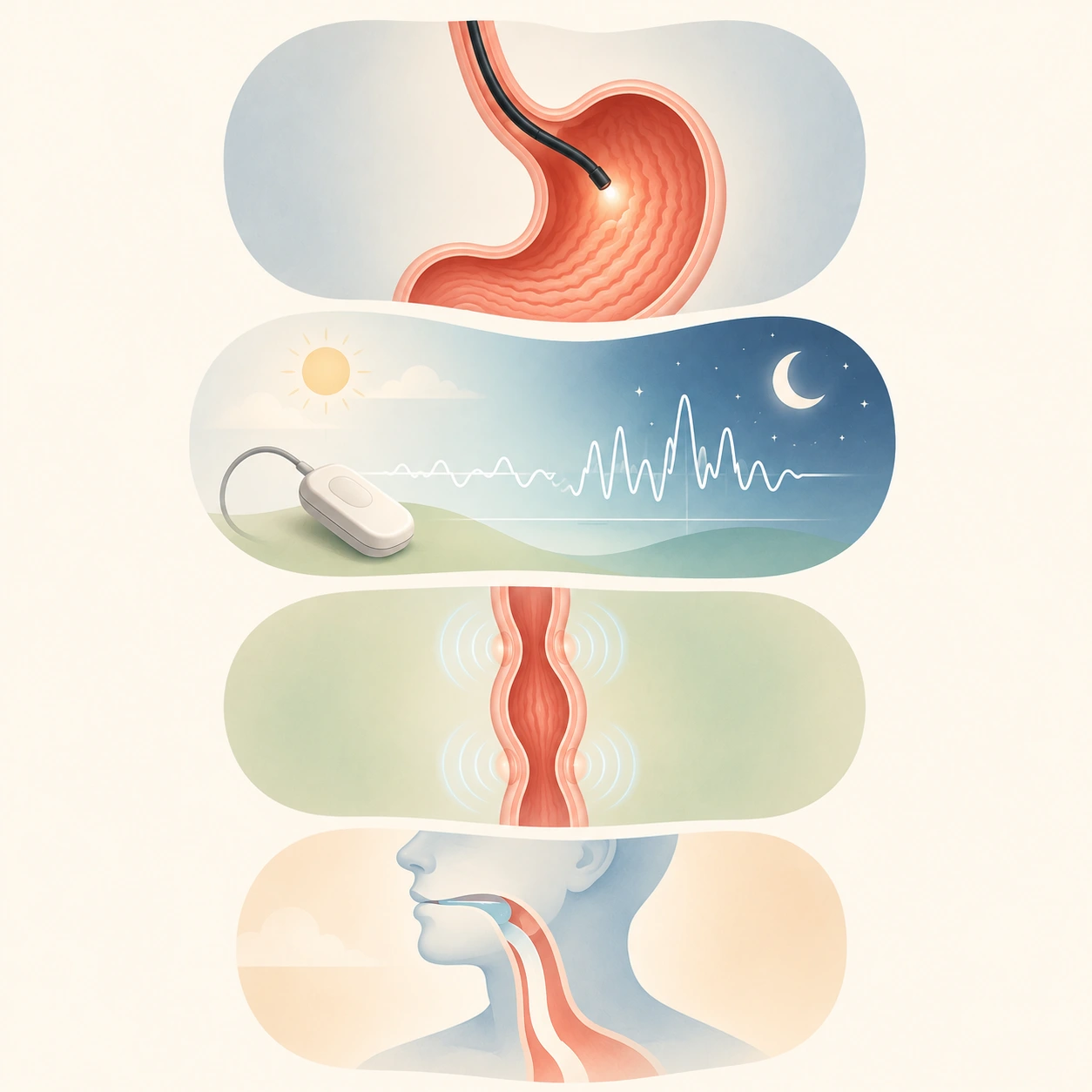
Barium swallow shows how the esophagus behaves during an actual swallow rather than at rest. Here’s a detail worth knowing: when patients point to where food gets stuck, they’re anatomically correct only about 60 percent of the time. Someone who feels food catching in the throat often turns out to have delay in the lower esophagus. Endoscopy can’t show you that. A swallow study can.
Dual-channel pH impedance testing is the one most practices don’t do. Standard reflux testing measures only above the lower esophageal sphincter. Dr. Grandhige uses a customized 24-hour probe that measures above both the lower and the upper esophageal sphincter, and it captures non-acid reflux including bile, pepsin, and trypsin. That matters because the tissue tolerances are wildly different. The esophagus can absorb 40 to 50 reflux episodes a day. The larynx and pharynx can become symptomatic from a single episode a day.
This is why silent reflux gets mishandled so often. Surgeons working from standard testing typically quote laryngopharyngeal reflux patients around a 50 percent chance of improvement. With dual-channel testing to select the right candidates, Dr. Grandhige reports symptom improvement closer to 80 percent, and only 50 to 60 percent of LPR patients test into surgery at all. He operates on fewer of them on purpose. More on the condition itself is on our silent reflux page.
Do you need a foregut specialist, or will a general surgeon closer to home do?
For a straightforward sliding hernia, a high-volume general surgeon may do fine. The risk isn’t technique. It’s the decision that gets made before the first incision.
Most general surgeons refer reflux patients out rather than operate. Among the smaller number who do operate, decisions are frequently based on symptoms and medication history without full physiologic testing. That works until the patient has an esophageal motility disorder, esophageal hypersensitivity, or a non-reflux cause of heartburn. All three present like reflux. None of them respond well to reflux surgery, and a wrap placed on a weak esophagus creates a new problem that’s harder to fix than the original one.
Dr. Grandhige works through a fixed sequence: confirm reflux is objectively present, map the anatomy, measure esophageal function, match symptoms to physiology, weigh your priorities, then choose a procedure or choose none. Because he performs all of them, the choice isn’t constrained by what he’s most comfortable with. As he puts it to patients, the operation is the last step. The decision-making is the surgery.
If you’re interviewing surgeons anywhere, ask three questions. How will you confirm reflux is actually causing my symptoms? What testing do you require before recommending an operation? How often do you decide not to operate? A surgeon who never advises against surgery isn’t exercising judgment. A surgeon who recommends the same operation to everyone isn’t selecting one. You can verify any Florida physician’s license, board status, and disciplinary history through the Florida Department of Health license verification portal.

What the trip from Wesley Chapel actually involves
Most Wesley Chapel patients make one or two trips to the South Tampa office before surgery, not five or six.
Which one depends on your records. If you arrive with a completed endoscopy, pH study, manometry, and relevant imaging, diagnosis is usually confirmed at the first visit, options are discussed that day, and insurance authorization starts immediately. Surgery can be scheduled as early as four weeks out. If your testing isn’t complete, the first visit covers education, records review, and test planning, and a second visit about four weeks later reviews results and finalizes the plan. Total time from first visit to surgery runs four to eight weeks.
Two things shorten the drive count. Testing that can be done near your home is arranged near your home wherever possible, so you’re not making a separate trip down I-75 for every study. And Dr. Grandhige personally reviews every record you send before you arrive, including notes from your gastroenterologist, ENT, pulmonologist, allergist, and primary care physician, so the visit is spent on explanation rather than data gathering. Send records ahead to info@tampareflux.com. Signed releases alone tend to move slowly, and incomplete records are the most common reason a first visit accomplishes less than it should.
Consultations are typically scheduled within two weeks and always within four. Insurance authorization is handled entirely by the office and generally takes four to six weeks, and surgery is only scheduled after coverage is confirmed. All surgery is performed at HCA South Tampa Hospital, where Dr. Grandhige operates exclusively with the same anesthesia team, nursing staff, and his own physician assistant on every case. He consolidated to one facility on purpose after years of operating at four. Most patients go home the same day. After surgery you have direct access to his physician assistant and to Dr. Grandhige himself, including after hours.
The office is at 1315 South Howard Avenue, Suite 101, in the yellow brick building next to Sally O’Neill’s Pizza. Parking is behind the restaurant.
Frequently asked questions
About the surgeon
Gopal Grandhige, MD, FACS is a board-certified general surgeon and the founder and medical director of Tampa Bay Reflux Institute. He has practiced in the Tampa Bay area since 2009 and limits his practice to benign foregut disease: the esophagus, diaphragm, and stomach.
He completed his Bachelor of Science in Biology at Johns Hopkins University and his medical degree at the University of Michigan, Ann Arbor. He completed his general surgery residency at Yale-New Haven Hospital, followed by fellowships there in Burn and Critical Care and in Foregut and Minimally Invasive Surgery.
He is a Fellow of the American College of Surgeons, a member of the Society of American Gastrointestinal and Endoscopic Surgeons, and a founding member of the American Foregut Society. He holds privileges at St. Joseph’s Main Hospital, St. Joseph’s South Hospital, HCA Brandon Hospital, and HCA South Tampa Hospital, and performs all foregut surgery at HCA South Tampa. Alongside hiatal hernia and reflux work, he treats GERD, achalasia, and gastroparesis.
Written and medically reviewed by Gopal Grandhige, MD, FACS. Last reviewed August 2026.


An endoscopy cannot tell you if you have reflux. It can only tell you if you have complications of GERD.
If you are unhappy with your reflux symptoms, come in and we can discuss testing and treatments that can accurately diagnose your problem.
#reflux #gerd #hiatalhernia #gastroparesis #linx


CALL US AT 813-922-2920
www.tampareflux.com
If you have a hiatal hernia and fit one of these categories, you should know your options.
Dr. Grandhige is an expert in his field and performs 200 of these surgeries a year. He is the only surgeon in the Tampa Bay Area who offers all surgical options - LINX, Fundoplications, TIF and will be one of 20 surgeons in America introducing the latest procedure RefluxStop in 2026.
We accept most insurances but will verify yours before you come in. These procedures are considered medically necessary and covered by your insurance. You can expect to pay your in-network deductibles and nothing else.
#hiatalhernia #reflux #GERD #LINX #refluxstop

What causes reflux ?
1. Weak lower esophageal sphincter
2. Hiatal hernia
3. Flattening of the Angle of His
4. Poor esophageal motility
5. Gastroparesis (slow stomach)
NOT increased acid production


Don’t let GERD get in the way of living your life. Request your appointment with us today on the link below.
.
.
.
.
https://tampareflux.com/contact-us/

Anyone can be victim to GERD and though weight loss can help reduce GERD symptoms. Many athletes with high impact workouts may continue to have these symptoms. This may be a symptom of a hiatal hernia or other issue. We are more then happy to assist you in finding your solution, just click the link below.
.
.
.
https://tampareflux.com/contact-us/
##healthylifestyle #workout #athletereflux #PPIs #heartburn #LINX #fundoplication #TIF #GERD#tampaheartburn #linx #TIF #fundoplication #tampabayreflux #GERD #acidreflux #acidrefluxsurgery #stopreflux
#nonsurgicalweightloss #ESG #gastricballoon #weightlossjourney #vsg #vsgjourney #spatz3 #orbera #orberaballoon #grandhige #DrG
#tampabayrefluxinstitute #guthealth #roboticsurgery

Heartburn may seem like an annoyance. But if you find yourself having symptoms on a daily basis, it may be time to to talk to Dr. Grandhige as it could be a symptom of something worse.
.
.
.
#chronicheartburn #gerdsymptoms #heartburnrelief #reflux #PPIs #heartburn #LINX #fundoplication #TIF #GERD#tampaheartburn #linx #TIF #fundoplication #tampabayreflux #GERD #acidreflux #acidrefluxsurgery #stopreflux
#nonsurgicalweightloss #ESG #gastricballoon #weightlossjourney #vsg #vsgjourney #spatz3 #orbera #orberaballoon #grandhige #DrG
#tampabayrefluxinstitute #guthealth #roboticsurgery

If you are tired of avoiding your favorite foods or taking daily medications, we can help.
We are the Tampa experts in reflux ! With years of experience and thousands of patients treated successfully, we offer all FDA approved anti-reflux procedures.
Call 813-922-2920 to schedule your appointment
All major insurances accepted.

Not all patients need surgical intervention. Many patients are living a heartburn free life with their PPIs. However 40% of patients taking PPIs are not getting the relief they need. If you are one of those, you have options! Come in and find out more.
.
.
.
.
#letushelpyou #medsnotworking #reflux #PPIs #heartburn #LINX #fundoplication #TIF #GERD#tampaheartburn #linx #TIF #fundoplication #tampabayreflux #GERD #acidreflux #acidrefluxsurgery #stopreflux
#nonsurgicalweightloss #ESG #gastricballoon #weightlossjourney #vsg #vsgjourney #spatz3 #orbera #orberaballoon #grandhige #DrG
#tampabayrefluxinstitute #guthealth #roboticsurgery

#heartburn #stopreflux #hiatalherniarepair #severeheartburn #reflux #tampabayreflux #acidrefluxsurgery #tampaheartburn #GERD #PPIs #achalasia #LINX #TIF #tampareflux #fundoplication #stomach #digestivehealth #ESG #obesity #overweight #weightlossjourney #gastricballoon
