
What hiatal hernia repair with LINX actually involves
LINX is a ring of magnetic titanium beads placed around the lower esophagus, and in nearly every case it is placed during the same operation that repairs your hiatal hernia. The two go together because reflux has two failure points, not one.
Dr. Grandhige explains it to patients as a two-part door. The first part is the lower esophageal sphincter, a muscular valve. The second is the diaphragm, which wraps around the esophagus and pinches it during breathing, bending, and lifting. If one fails, reflux happens. If both fail, reflux is close to unavoidable. A hiatal hernia is the second failure: the opening in the diaphragm stretches, the stomach slips upward into the chest, and the angle of His opens up.
The LINX Reflux Management System does not clamp the esophagus shut and does not raise the resting pressure of your sphincter. It resists opening when pressure inside your stomach rises, and it opens when you swallow or when gas needs to come up. That is why it tends to preserve burping and vomiting in a way a wrap often does not.
The operation runs laparoscopically or robotically, takes about 1.5 to 2 hours, and is outpatient. The hernia is reduced first, the diaphragm is repaired, and the esophagus is then measured so a custom-sized device can be selected. Repairing only the sphincter and leaving the diaphragm alone is one of the most common reasons reflux procedures fail years later.
The six checks before any procedure is chosen
Dr. Grandhige runs the same six-step selection process on every patient, and roughly a third of the people who come in expecting surgery leave with a non-surgical plan instead.
Two findings surprise patients most. The first is that hernia size does not disqualify you from LINX. Patients with no hernia, a small one, or even a large one can be candidates, as long as the hernia is repaired at the time of surgery. What matters is whether the anatomy gets restored, not the centimeters on the report.
The second is a pattern Dr. Grandhige has seen repeatedly and rarely sees written down anywhere: patients who are unusually aware of internal sensation often sense the device after placement. The practical marker is the Bravo pH capsule. Patients who could feel the capsule while it was in place tend to be the same patients who later report feeling their LINX. That does not rule them out, but it changes the conversation before surgery rather than after.
LINX is generally not the right answer for severe esophageal motility disorders, reflux-like symptoms without objective reflux, primary esophageal hypersensitivity, or symptoms driven by something other than reflux.
The testing that decides the answer, including one probe most centers do not run
Endoscopy does not diagnose reflux. It looks for damage caused by reflux. A normal endoscopy is one of the most common reasons Pinellas patients are told nothing is wrong when reflux is still occurring, especially in patients already taking acid suppression. Small hiatal hernias are also missed on routine endoscopy.
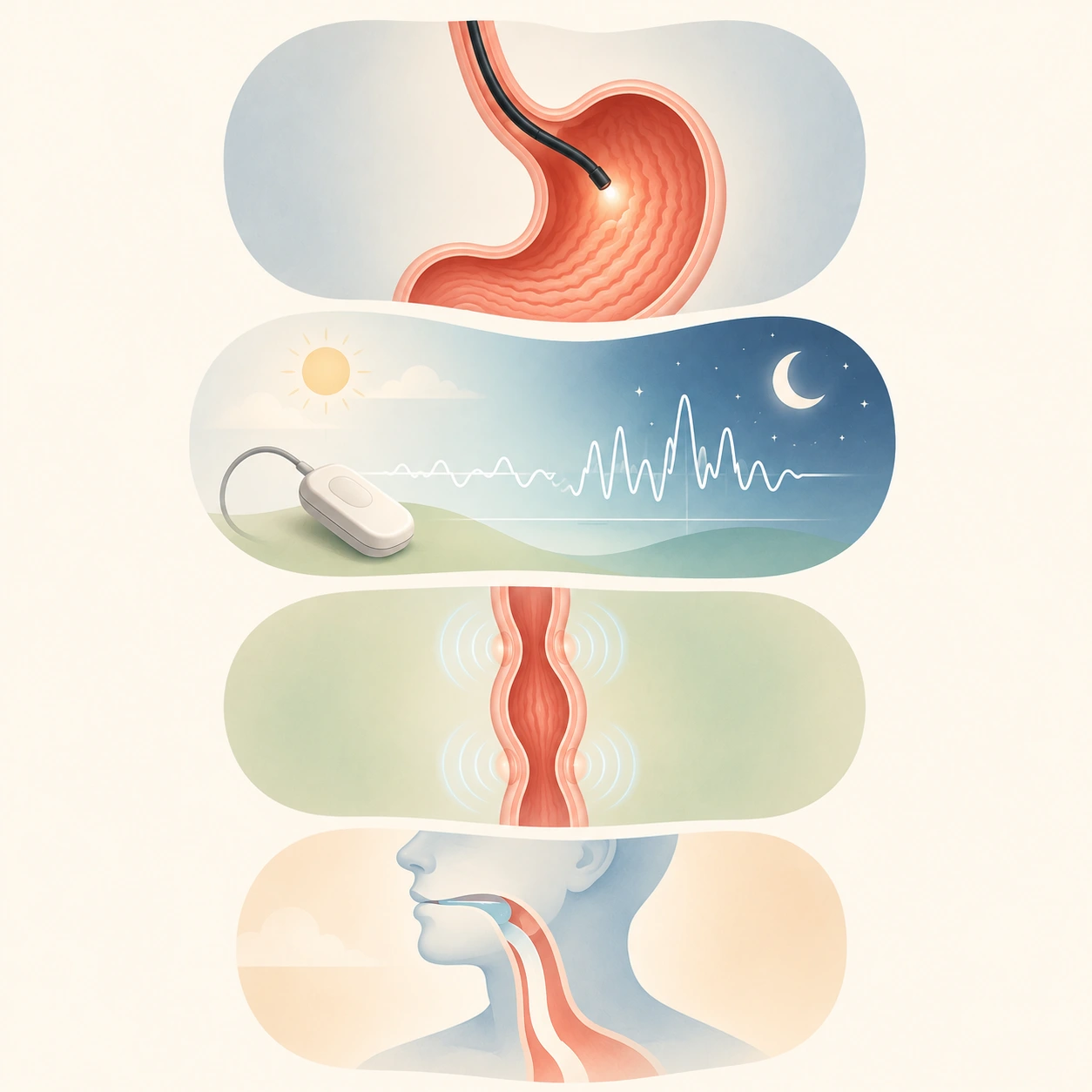
Four tests carry the decision, each answering a different question:
- Upper endoscopy shows anatomy and complications: esophagitis, Barrett’s esophagus, strictures. It is also how a pH probe gets placed.
- pH or pH-impedance monitoring measures whether reflux is happening, how often, how long, and whether your symptoms line up with actual reflux events. Recording runs 48 to 72 hours during normal life.
- Esophageal manometry measures whether your esophagus is strong enough to push food through an augmented sphincter.
- Barium swallow shows swallowing in motion, used selectively. One finding worth knowing: where a patient feels food sticking matches the actual anatomic location only about 60 percent of the time. People point at their throat when the delay is in the distal esophagus.
The largest gap in standard testing shows up in silent reflux (LPR). Standard probes measure above the lower esophageal sphincter only. They do not measure whether reflux is reaching the throat and voice box, which is exactly where LPR symptoms occur. The esophagus tolerates 40 to 50 reflux episodes a day. The larynx can produce symptoms from a single one.
Dr. Grandhige uses a customized 24-hour pH-impedance dual-channel probe that measures at two levels: above the lower esophageal sphincter and above the upper esophageal sphincter. It also captures non-acid reflux, which matters because bile, pepsin, and trypsin irritate laryngeal tissue and acid-only testing cannot see them.
The difference is measurable. Patients with throat symptoms are routinely quoted around a 50 percent chance that surgery helps. With dual-level testing to identify who actually has reflux reaching the larynx, that figure rises to roughly 80 percent in this practice, and only about 50 to 60 percent of LPR patients test as surgical candidates at all. The probe rules people out as often as it rules them in.
Most centers do not run it. It is technically demanding and reimbursed poorly.
Coming from Clearwater: the drive, local testing, and your timeline
Most Clearwater and Pinellas patients make two trips to South Tampa, and a fair number make only one.
The office is at 1315 South Howard Avenue, Suite 101, Tampa, Florida 33606, in a yellow brick building next door to Sally O’Neill’s Pizza. Parking is behind the restaurant. From downtown Clearwater it is about 25 miles across the Courtney Campbell Causeway, and Pinellas patients regularly come from Clearwater, Largo, Dunedin, Safety Harbor, and St. Petersburg.
Wherever possible, testing is arranged near your home rather than in Tampa, and out-of-area patients have their studies consolidated so a single trip does the work of three. Sending records ahead to info@tampareflux.com is the single biggest factor in whether one consultation is enough.
The actual timeline:
- New patients are usually seen within two weeks, and always within four.
- If your testing is already complete (endoscopy, pH study, manometry, relevant imaging), one consultation is typically all that is needed. Surgery can often be scheduled as early as four weeks from that first visit.
- If testing is not complete, the first visit covers education, record review, and test planning. A second visit about four weeks later reviews results and finalizes the plan. Surgery generally follows within about eight weeks of the first visit.
- Insurance authorization runs four to six weeks and is handled entirely by the office, usually in parallel with testing rather than after it. Patients who call their own insurer to help typically slow the process down rather than speed it up.
Bring or send prior endoscopy and pathology reports, pH studies including Bravo, manometry results, barium swallow or other imaging, and office notes from your gastroenterologist, ENT, pulmonologist, or allergist. Studies from years ago are still useful because they show progression.
Your surgeon and the team in the room

Dr. Gopal Grandhige has practiced foregut surgery in Tampa Bay since 2009. He earned his bachelor’s degree at Johns Hopkins University and his MD at the University of Michigan, then completed general surgery residency and fellowship training in foregut and minimally invasive surgery at Yale New Haven Hospital. He founded Tampa Bay Reflux Center in 2009 and Tampa Bay Reflux Institute in 2022, and he evaluates and treats over 600 reflux patients a year. More background is on the about Tampa Bay Reflux Institute page.
He is board certified by the American Board of Surgery, a Fellow of the American College of Surgeons, a member of SAGES, and a founding member of the American Foregut Society. Licensure and board status can be verified independently through the Florida Department of Health and the American Board of Surgery.
Every operation is performed at HCA South Tampa Hospital. He holds privileges at several other area hospitals and deliberately does not use them for foregut cases. The same anesthesiologists, nurses, and surgical technologists work these procedures case after case, which matters here specifically because postoperative vomiting threatens a fresh hernia repair.
He employs his own physician assistant, who assists in every case and handles postoperative care. Several medical assistants have been with the practice for over a decade. When you call with a question about your recovery, you reach someone who was in the room. Referrals arrive from gastroenterologists, ENT physicians, pulmonologists, and allergists across the region, and from other surgeons who perform only fundoplication and whose patients start asking about LINX.
Frequently asked questions
Get a real answer before you decide anything
You do not need to commit to surgery to find out what is happening. A consultation here is built to end with clarity: whether reflux is proven, why it is happening, which of your symptoms it explains, and which options fit your anatomy. Continued medical management of GERD is a legitimate outcome here, and it is the recommendation in a meaningful share of cases.
Send your prior testing to info@tampareflux.com, and bring your questions.


An endoscopy cannot tell you if you have reflux. It can only tell you if you have complications of GERD.
If you are unhappy with your reflux symptoms, come in and we can discuss testing and treatments that can accurately diagnose your problem.
#reflux #gerd #hiatalhernia #gastroparesis #linx


CALL US AT 813-922-2920
www.tampareflux.com
If you have a hiatal hernia and fit one of these categories, you should know your options.
Dr. Grandhige is an expert in his field and performs 200 of these surgeries a year. He is the only surgeon in the Tampa Bay Area who offers all surgical options - LINX, Fundoplications, TIF and will be one of 20 surgeons in America introducing the latest procedure RefluxStop in 2026.
We accept most insurances but will verify yours before you come in. These procedures are considered medically necessary and covered by your insurance. You can expect to pay your in-network deductibles and nothing else.
#hiatalhernia #reflux #GERD #LINX #refluxstop

What causes reflux ?
1. Weak lower esophageal sphincter
2. Hiatal hernia
3. Flattening of the Angle of His
4. Poor esophageal motility
5. Gastroparesis (slow stomach)
NOT increased acid production


Don’t let GERD get in the way of living your life. Request your appointment with us today on the link below.
.
.
.
.
https://tampareflux.com/contact-us/

Anyone can be victim to GERD and though weight loss can help reduce GERD symptoms. Many athletes with high impact workouts may continue to have these symptoms. This may be a symptom of a hiatal hernia or other issue. We are more then happy to assist you in finding your solution, just click the link below.
.
.
.
https://tampareflux.com/contact-us/
##healthylifestyle #workout #athletereflux #PPIs #heartburn #LINX #fundoplication #TIF #GERD#tampaheartburn #linx #TIF #fundoplication #tampabayreflux #GERD #acidreflux #acidrefluxsurgery #stopreflux
#nonsurgicalweightloss #ESG #gastricballoon #weightlossjourney #vsg #vsgjourney #spatz3 #orbera #orberaballoon #grandhige #DrG
#tampabayrefluxinstitute #guthealth #roboticsurgery

Heartburn may seem like an annoyance. But if you find yourself having symptoms on a daily basis, it may be time to to talk to Dr. Grandhige as it could be a symptom of something worse.
.
.
.
#chronicheartburn #gerdsymptoms #heartburnrelief #reflux #PPIs #heartburn #LINX #fundoplication #TIF #GERD#tampaheartburn #linx #TIF #fundoplication #tampabayreflux #GERD #acidreflux #acidrefluxsurgery #stopreflux
#nonsurgicalweightloss #ESG #gastricballoon #weightlossjourney #vsg #vsgjourney #spatz3 #orbera #orberaballoon #grandhige #DrG
#tampabayrefluxinstitute #guthealth #roboticsurgery

If you are tired of avoiding your favorite foods or taking daily medications, we can help.
We are the Tampa experts in reflux ! With years of experience and thousands of patients treated successfully, we offer all FDA approved anti-reflux procedures.
Call 813-922-2920 to schedule your appointment
All major insurances accepted.

Not all patients need surgical intervention. Many patients are living a heartburn free life with their PPIs. However 40% of patients taking PPIs are not getting the relief they need. If you are one of those, you have options! Come in and find out more.
.
.
.
.
#letushelpyou #medsnotworking #reflux #PPIs #heartburn #LINX #fundoplication #TIF #GERD#tampaheartburn #linx #TIF #fundoplication #tampabayreflux #GERD #acidreflux #acidrefluxsurgery #stopreflux
#nonsurgicalweightloss #ESG #gastricballoon #weightlossjourney #vsg #vsgjourney #spatz3 #orbera #orberaballoon #grandhige #DrG
#tampabayrefluxinstitute #guthealth #roboticsurgery

#heartburn #stopreflux #hiatalherniarepair #severeheartburn #reflux #tampabayreflux #acidrefluxsurgery #tampaheartburn #GERD #PPIs #achalasia #LINX #TIF #tampareflux #fundoplication #stomach #digestivehealth #ESG #obesity #overweight #weightlossjourney #gastricballoon
