
Written By: Jeffrey Atlas, Health Content Writer
Medically Reviewed By: Dr. Gopal Grandhige, MD, FACS, Board-Certified Surgeon
Last Reviewed: August 10, 2026
Menopause and heartburn are linked, and the connection is far stronger than most women get told. A large population analysis in the American Journal of Gastroenterology found GERD in 6.4% of postmenopausal women versus 2.0% of premenopausal women, putting postmenopausal women at roughly 3.5 times the risk. Menopause outranked smoking, alcohol, asthma, emphysema, and diabetes in that same dataset. If your heartburn showed up when your cycle went unpredictable, that timing isn’t random.
Menopause heartburn is burning chest pain caused by stomach acid rising into the esophagus during or after the menopause transition. Shifting estrogen and progesterone affect the muscular valve at the base of the esophagus, changing body composition raises pressure inside the abdomen, and the stomach empties more slowly. More acid gets through, more often.
I’m Dr. Gopal Grandhige, a board-certified surgeon in Tampa. I operate on the anatomy behind this problem. What I see almost weekly at Tampa Bay Reflux Institute is a woman in her early fifties, four years into a daily acid blocker, told to skip tomatoes and coffee, who has never had one test done on the valve that’s actually failing.
One thing this article skips: reflux during pregnancy and in infants. Different mechanisms, different playbook.
What Does Menopause Heartburn Actually Feel Like?
Burning behind the breastbone that gets worse after meals and worse lying flat. That’s the classic version, and it’s common at midlife. Research presented at the 2025 Annual Meeting of The Menopause Society surveyed 564 women aged 44 to 73 and found 49% reporting acid reflux, 77% bloating, and 50% stomach pain. Across the board, 82% said symptoms began or worsened during the transition.
Heartburn is the symptom. Reflux is the event that causes it.
That distinction matters more than it sounds. Acid escapes upward through a valve called the lower esophageal sphincter, a ring of muscle where your esophagus meets your stomach. When that ring stops sealing properly, acid goes where it shouldn’t.
Other signs show up too:
- A sour or bitter taste, especially on waking
- A cough or throat clearing that never resolves
- Hoarseness, or a voice that fades by afternoon
- Bad breath despite good dental habits
- Feeling full after a few bites
- Nausea or bloating after normal meals
Some women never get the burn at all. They get the raspy voice and the nagging cough, spend eighteen months bouncing between an ENT and an allergist, and get treated for post-nasal drip. That pattern has a name. It’s silent reflux, and in the 45-plus age group it gets missed constantly.
Why Do Hormones Make Reflux Worse After 45?
Estrogen and progesterone both relax smooth muscle, and the valve at the bottom of your esophagus is smooth muscle. Less sealing pressure, more reflux.
But the hormone story alone doesn’t explain the numbers, and this is where a lot of menopause content ties itself in knots. Symptoms get worse after menopause, when hormone levels are lowest. If high estrogen were the whole answer, that pattern would run backward.
Actually, framing it as a hormone problem isn’t quite right. It’s a pressure and anatomy problem that hormones accelerate. Three things stack up during the transition:
- Fat redistributes to the abdomen. More pressure pushing up from below, against a valve already losing tone.
- Gastric emptying slows. Food sits longer, so there’s more volume available to reflux.
- A hiatal hernia becomes more likely. The opening in the diaphragm stretches, the top of the stomach slides up through it, and the valve loses its anatomical backup.
That third one is the piece almost nobody explains to patients. A hiatal hernia is a structural defect. No hormone, no diet, and no pill closes it.
Do Trigger Foods Really Cause Reflux?
Mostly, no. And this is where I break with almost every article you’ll read on this topic.
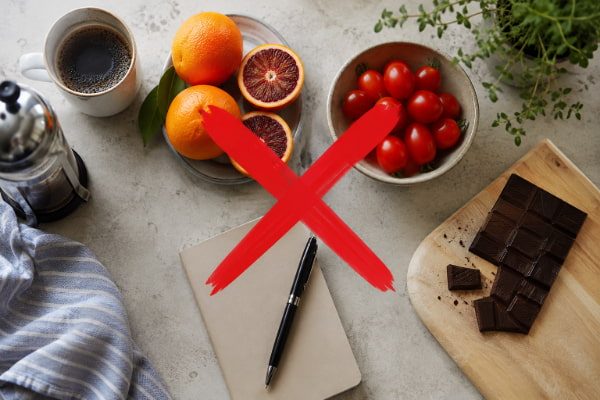
The American College of Gastroenterology’s 2022 GERD guideline states that routine global elimination of trigger foods, including chocolate, caffeine, alcohol, and acidic or spicy foods, is not recommended for treating GERD. That’s the governing body for gastroenterology in this country, and they looked at the trials.
The trial data is worth seeing plainly. In the systematic review the ACG evaluated, chocolate (2 trials) and carbonated beverages (2 trials) did lower valve pressure. Alcohol (16 trials), coffee and caffeine (14 trials), spicy foods (2 trials), citrus (3 trials), and fatty foods (9 trials) showed no effect on it. Alcohol, chocolate, and fatty foods did raise the time acid spent sitting in the esophagus.
So the famous villain list is roughly half folklore.
| What you’ve been told | What the trials show |
| Cut citrus and tomatoes | No measured effect on valve pressure |
| Cut spicy food | No measured effect on valve pressure |
| Cut coffee | No measured effect on valve pressure |
| Cut chocolate | Lowers valve pressure, raises acid exposure |
| Cut carbonated drinks | Lowers valve pressure |
| Cut alcohol | Raises acid exposure |
| Lose weight | Strongest evidence of any lifestyle change |
So the practical version. Blanket elimination diets make women miserable for little return, and I’ve watched patients give up half the foods they enjoy while their reflux marches on unchanged. Individual triggers are real. Population-wide triggers are mostly not. Track your own symptoms for two weeks, find your two or three actual culprits, and stop punishing yourself over oranges.
What Else Is Driving Your Symptoms
Smoking is the one item on the classic list with strong, consistent trial support. Twelve trials showed tobacco lowering valve pressure, and it raises acid exposure time. If you smoke and you have reflux, that’s the highest-yield change available to you.
Weight matters, and the evidence is good. The Nurses’ Health Study found that women who dropped their BMI by more than 3.5 points cut their risk of frequent reflux symptoms by roughly 40%. The Norwegian HUNT study of 29,610 people found the same dose-dependent pattern.
Stress doesn’t create more acid. It lowers your pain threshold, so the same amount of reflux hurts more.
Medications get overlooked. NSAIDs like ibuprofen, some antibiotics, certain blood pressure drugs, and bisphosphonates all irritate the esophageal lining or loosen the valve.
And then there’s anatomy, which is where most of my patients eventually land.

What Actually Works for Menopause and Heartburn in 2026
Start with the changes that have real evidence behind them, give them a fair trial, and get objective testing if they fall short. That order matters.
Fix Your Eating Window First
Stop eating three hours before you lie down. Not two, not “a snack is fine.” Three.
This is the single change I’d pick if a patient would only make one, because it costs nothing and the physics are simple. A stomach with food in it, plus a body lying flat, plus a valve under pressure equals reflux. Smaller meals help for the same reason.
Sleep on a Slope, and on Your Left
Raise the head of your bed four to six inches with blocks or a wedge. Randomized trials support this for nighttime symptoms.
Pillows don’t work. Stacking pillows bends you at the waist and increases abdominal pressure, which makes things worse. You need the whole upper body on an incline.
Sleep left side down. Lying on your right puts the junction between esophagus and stomach in a dependent position relative to pooled stomach contents, which is exactly the geometry you don’t want.
Weight Loss Does Something. It Doesn’t Do Everything.
Losing ten to fifteen pounds cuts frequent heartburn by around 40% in the Nurses’ Health Study data. That’s a real result and I recommend it.
But I want to be honest about the ceiling. Weight loss reduces the pressure driving acid upward. It does not repair a stretched diaphragm or restore a valve that’s lost its tone. I’ve had patients lose 40 pounds, feel proud, and still reflux every night, then blame themselves. That’s not a willpower failure. It’s an anatomy problem that weight loss was never going to fix.
For women whose weight is the primary driver, procedures that address weight and reflux together can solve both problems at once.
Stress Turns Up the Volume
Regular movement, breathing work, and real conversation with someone who listens all reduce how much the reflux bothers you. None of it changes what’s happening at the valve.
Medication, Supplements, and the Ceiling Nobody Mentions
Antacids and alginates are fine for occasional flares. Proton pump inhibitors work well for many women and I prescribe them.
The problem is what happens at year three, year five, year eight.
Long-term PPI use in postmenopausal women carries specific concerns. The Women’s Health Initiative followed 161,806 postmenopausal women and found no increase in hip fracture with PPI use, but a modest increase in spine, wrist, and total fractures. Among women with no prior fracture history, risk ran 32% higher. A 2022 systematic review of menopausal women found every included study showed higher fracture rates. Estrogen loss is already thinning your bones. Layering acid suppression on top is a conversation worth having with your doctor.
Which brings me to supplements. The original wave of menopause content pushes probiotics hard for reflux, and I’d pump the brakes. A 2020 systematic review found 11 of 14 comparisons reported some benefit, but only 5 of 13 studies rated high quality and 6 rated low. A 2022 meta-analysis found a shortage of solid interventional evidence for probiotic treatment of GERD. Probiotics may help general gut comfort. They will not close a hernia.
The ASGE’s updated GERD guideline recommends PPIs at the lowest dose for the shortest duration, and the guideline’s lead author put it bluntly: prescribing acid blockers forever is no longer defensible as a management strategy. When symptoms persist past six months on medication, the guideline points toward evaluation for repair. For confirmed GERD with a small hiatal hernia of 2 cm or less, an incisionless repair done through the mouth is suggested as an alternative to indefinite medication. For larger hernias, magnetic sphincter augmentation or a tailored surgical wrap restores the valve mechanically.
Will HRT Fix Your Reflux?
No, and the data suggests it may do the opposite.
A systematic review and meta-analysis published in Menopause pooled five studies covering more than one million participants. Hormone therapy use was associated with 29% higher odds of GERD. Estrogen alone came in at 41% higher odds, progestogen at 39%, combined therapy at 16%. The authors flagged high heterogeneity, so treat the exact figures with appropriate caution, but the direction is consistent.
I’m not telling you to stop HRT. Hot flashes and bone protection are real considerations and that decision belongs to you and your prescriber. What I am saying is that nobody should hand you a prescription for vasomotor symptoms without mentioning that reflux may intensify. That conversation almost never happens.

Does Menopause Heartburn Go Away on Its Own?
Rarely. Postmenopausal women report reflux more often than perimenopausal women, not less, which tells you the problem doesn’t resolve as hormones settle.
Waiting has a cost. That same American Journal of Gastroenterology analysis found postmenopausal women with GERD had more esophageal strictures, erosive esophagitis, and Barrett’s esophagus than premenopausal women. Tissue damage accumulates while you wait for improvement that isn’t coming.
Six months of daily symptoms despite treatment is the point where guessing stops and testing starts.
When Reflux Stops Being an Annoyance
Chronic acid exposure damages the esophageal lining over time. The progression runs from inflammation to erosive esophagitis to strictures that make swallowing hard, and in a minority of cases to Barrett’s esophagus, where the lining cells change into a type carrying cancer risk.
Most women with reflux never reach that point. But “most” is doing real work in that sentence, and the postmenopausal group sits at higher risk than average.
See someone promptly if food sticks going down, if you’re vomiting persistently, if you’re losing weight without trying, or if you’re anemic without explanation. Those aren’t wait-and-see symptoms.
The One Thing I’d Want You to Take From This
Nobody has looked at your valve.
That’s the gap in almost every case of menopause and heartburn I see. Years of medication, years of dietary restriction, a stack of internet advice about tomatoes, and zero objective information about the anatomy causing the problem. A pH study and manometry tell us what’s actually happening. Without them, everyone is guessing, including your doctor.
If you’ve been managing this for more than six months and still reaching for medication daily, you’ve earned a real answer. Understanding what’s driving your GERD is where treatment should have started. Our team in Tampa can start that evaluation.
FAQs
Does menopause cause heartburn, or is it just aging?
Menopause is an independent risk factor, separate from age. A population analysis in the American Journal of Gastroenterology found GERD in 6.4% of postmenopausal women compared with 2.0% of premenopausal women, roughly 3.5 times the risk. In that same data, menopause outranked smoking, alcohol, asthma, and diabetes as a risk factor.
Will hormone therapy make menopause and heartburn better or worse?
Worse, based on current evidence. A meta-analysis in Menopause pooling more than one million participants found hormone therapy associated with 29% higher odds of GERD. Estrogen-only therapy showed 41% higher odds. This doesn’t mean you should stop HRT, but you should discuss reflux monitoring with your prescriber before starting.
Do I really need to cut out coffee, citrus, and spicy food?
Probably not all of them. The American College of Gastroenterology’s 2022 guideline advises against routine global elimination of trigger foods. In the trials they reviewed, coffee, citrus, spicy foods, and fatty foods showed no measured effect on valve pressure, while chocolate and carbonated drinks did. Individual triggers vary, so track your own symptoms rather than eliminating everything.
Is long-term acid blocker use risky after menopause?
It warrants discussion. The Women’s Health Initiative followed 161,806 postmenopausal women and found PPI users had 32% higher fracture risk among those with no prior fracture history, though hip fracture specifically was not increased. Estrogen loss already reduces bone density, which makes the combination worth reviewing with your physician.
How do I know if I have a hiatal hernia causing my reflux?
You can’t know without testing. A hiatal hernia is diagnosed through upper endoscopy, barium swallow, or imaging, and it’s frequently present in women whose reflux worsens during the menopause transition. Symptoms alone don’t distinguish a hernia from other causes of reflux.
When should I stop taking medication and consider surgery?
The ASGE guideline suggests evaluating for repair after roughly six months of confirmed GERD on chronic medication, particularly for patients who want to avoid indefinite PPI use. Candidacy depends on hernia size and valve grade, which requires objective testing including pH monitoring and manometry.
Can weight loss alone fix menopause heartburn?
Sometimes, but not always. Nurses’ Health Study data shows a BMI reduction of more than 3.5 points cuts frequent reflux symptoms by roughly 40%. Weight loss lowers abdominal pressure, but it cannot repair a stretched diaphragm or a valve that has lost tone, which is why some women improve substantially and others don’t improve at all.


An endoscopy cannot tell you if you have reflux. It can only tell you if you have complications of GERD.
If you are unhappy with your reflux symptoms, come in and we can discuss testing and treatments that can accurately diagnose your problem.
#reflux #gerd #hiatalhernia #gastroparesis #linx

CALL US AT 813-922-2920
www.tampareflux.com
If you have a hiatal hernia and fit one of these categories, you should know your options.
Dr. Grandhige is an expert in his field and performs 200 of these surgeries a year. He is the only surgeon in the Tampa Bay Area who offers all surgical options - LINX, Fundoplications, TIF and will be one of 20 surgeons in America introducing the latest procedure RefluxStop in 2026.
We accept most insurances but will verify yours before you come in. These procedures are considered medically necessary and covered by your insurance. You can expect to pay your in-network deductibles and nothing else.
#hiatalhernia #reflux #GERD #LINX #refluxstop
What causes reflux ?
1. Weak lower esophageal sphincter
2. Hiatal hernia
3. Flattening of the Angle of His
4. Poor esophageal motility
5. Gastroparesis (slow stomach)
NOT increased acid production
Don’t let GERD get in the way of living your life. Request your appointment with us today on the link below.
.
.
.
.
https://tampareflux.com/contact-us/
Anyone can be victim to GERD and though weight loss can help reduce GERD symptoms. Many athletes with high impact workouts may continue to have these symptoms. This may be a symptom of a hiatal hernia or other issue. We are more then happy to assist you in finding your solution, just click the link below.
.
.
.
https://tampareflux.com/contact-us/
##healthylifestyle #workout #athletereflux #PPIs #heartburn #LINX #fundoplication #TIF #GERD#tampaheartburn #linx #TIF #fundoplication #tampabayreflux #GERD #acidreflux #acidrefluxsurgery #stopreflux
#nonsurgicalweightloss #ESG #gastricballoon #weightlossjourney #vsg #vsgjourney #spatz3 #orbera #orberaballoon #grandhige #DrG
#tampabayrefluxinstitute #guthealth #roboticsurgery
Heartburn may seem like an annoyance. But if you find yourself having symptoms on a daily basis, it may be time to to talk to Dr. Grandhige as it could be a symptom of something worse.
.
.
.
#chronicheartburn #gerdsymptoms #heartburnrelief #reflux #PPIs #heartburn #LINX #fundoplication #TIF #GERD#tampaheartburn #linx #TIF #fundoplication #tampabayreflux #GERD #acidreflux #acidrefluxsurgery #stopreflux
#nonsurgicalweightloss #ESG #gastricballoon #weightlossjourney #vsg #vsgjourney #spatz3 #orbera #orberaballoon #grandhige #DrG
#tampabayrefluxinstitute #guthealth #roboticsurgery
If you are tired of avoiding your favorite foods or taking daily medications, we can help.
We are the Tampa experts in reflux ! With years of experience and thousands of patients treated successfully, we offer all FDA approved anti-reflux procedures.
Call 813-922-2920 to schedule your appointment
All major insurances accepted.
Not all patients need surgical intervention. Many patients are living a heartburn free life with their PPIs. However 40% of patients taking PPIs are not getting the relief they need. If you are one of those, you have options! Come in and find out more.
.
.
.
.
#letushelpyou #medsnotworking #reflux #PPIs #heartburn #LINX #fundoplication #TIF #GERD#tampaheartburn #linx #TIF #fundoplication #tampabayreflux #GERD #acidreflux #acidrefluxsurgery #stopreflux
#nonsurgicalweightloss #ESG #gastricballoon #weightlossjourney #vsg #vsgjourney #spatz3 #orbera #orberaballoon #grandhige #DrG
#tampabayrefluxinstitute #guthealth #roboticsurgery
#heartburn #stopreflux #hiatalherniarepair #severeheartburn #reflux #tampabayreflux #acidrefluxsurgery #tampaheartburn #GERD #PPIs #achalasia #LINX #TIF #tampareflux #fundoplication #stomach #digestivehealth #ESG #obesity #overweight #weightlossjourney #gastricballoon


