
What a hiatal hernia actually is, and why medication does not fix it
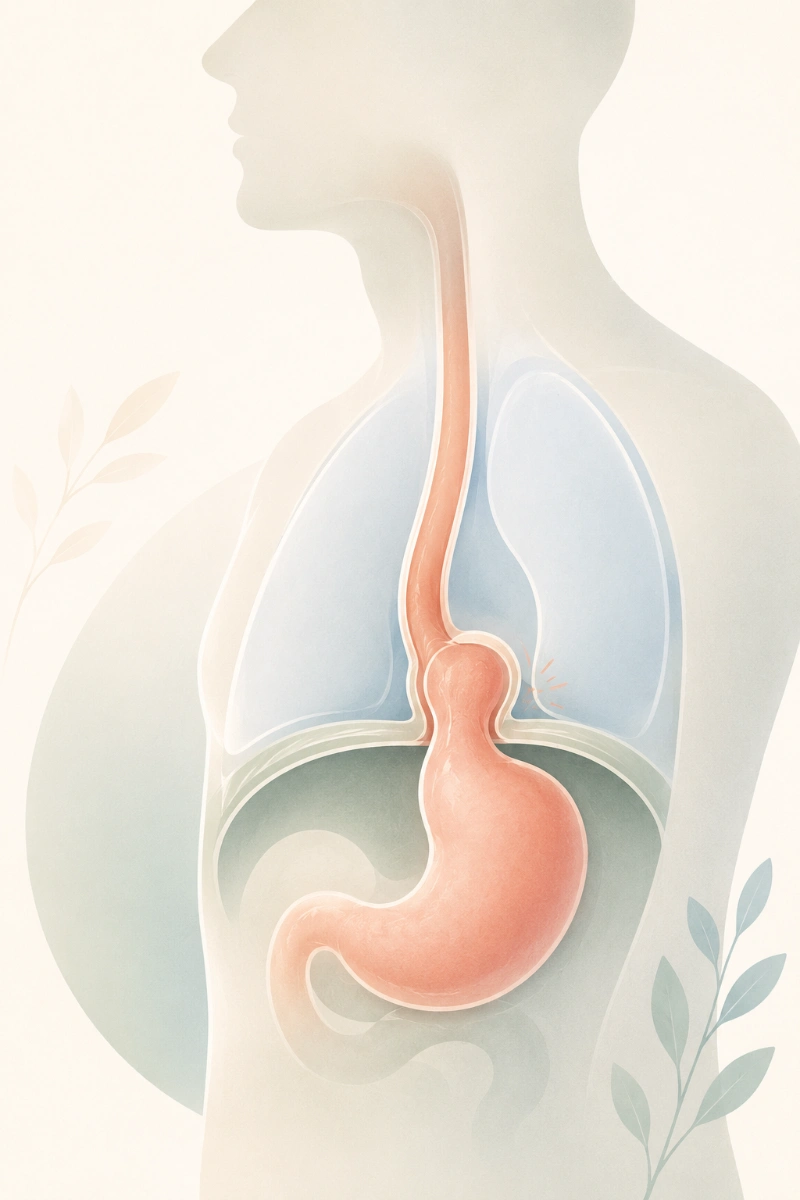
A hiatal hernia is a stretched or weakened opening in your diaphragm, the hiatus, where the esophagus passes through to meet the stomach. When that opening widens, the stomach slips up into the chest, the lower esophageal sphincter loses the diaphragm’s support, and the reflux barrier fails mechanically.
Reflux is rarely just an acid problem. It is usually a mechanical and functional one. That single idea explains why acid-suppressing medication so often disappoints: a proton pump inhibitor reduces how acidic your stomach contents are, but it does not strengthen a weak sphincter, repair the diaphragm, or stop reflux events. The leak continues. It is simply less acidic. Bile, pepsin, and other digestive enzymes still travel upward, and tissue damage can continue silently even when symptoms feel better.
Almost everyone with significant reflux has a hiatal hernia, even when it is small enough to be missed on endoscopy. You did not cause it. Hernias develop from normal pressure on the diaphragm over years: pregnancy, weight changes, chronic cough, heavy lifting, straining, physically demanding work. It is wear, not a personal failure. For a fuller explanation of the condition, see our page on hiatal hernias.
How the diagnosis is confirmed: testing, not guesswork
Surgery is never recommended on symptoms alone here. Every patient is tested objectively to confirm reflux is real, find the mechanical cause, and determine which treatment will last. This is the line that separates a foregut specialist from an occasional reflux surgeon.
Before you arrive, Dr. Grandhige personally reviews your prior endoscopy, pH testing, manometry, imaging, and the notes from your gastroenterologist, ENT, pulmonologist, or primary care doctor. That preparation lets the visit focus on explaining your condition rather than gathering basics. He draws the anatomy out by hand during the consultation, and patients mention those drawings more than almost anything else.
The tests answer different questions, and skipping one leads to the wrong operation:
- Upper endoscopy shows what the lining looks like and catches complications like esophagitis or Barrett’s. It does not measure reflux or diagnose GERD. A normal endoscopy does not rule reflux out, which is why so many people are wrongly told nothing is wrong.
- Esophageal pH monitoring is the test that proves whether reflux is actually happening, how often, and whether it lines up with your symptoms. It records over 48 to 72 hours during normal daily life.
- Esophageal manometry measures whether your esophagus is strong and coordinated enough to handle a repair safely. Ignore it, and you risk dysphagia and a poor result. Patients with weak motility often need a partial wrap rather than a full one, or no surgery at all.

This is also how surgery gets avoided when it should be. Many patients arrive expecting an operation and leave with reassurance and a non-surgical plan. Conditions like esophageal hypersensitivity, motility disorders, and functional chest pain mimic reflux but are not improved by reflux surgery, and testing is what tells them apart.
Treatment options, matched to your anatomy
Not every hiatal hernia needs surgery. When repair is right, every procedure here is done minimally invasively, laparoscopically or robotically, which means smaller incisions, less pain, and faster recovery than open surgery. The decision follows a fixed order: confirm reflux is real, study the anatomy, measure esophageal function, match symptoms to physiology, weigh your priorities, then choose, sometimes choosing not to operate at all.
Fundoplication rebuilds the reflux barrier by wrapping part of the stomach around the lower esophagus and repairing the diaphragm at the same time. Dr. Grandhige tailors the configuration, Nissen, Toupet, Dor, or Watson, to your esophageal motility rather than using one wrap for everyone. It is durable, handles large hernias, and has decades of outcome data. The honest trade-off: depending on the wrap, it can make it harder to burp or vomit, and some patients feel bloating. Most swallowing changes are temporary. Details are on our fundoplications page.
LINX is a ring of magnetic titanium beads placed around the lower esophagus. It resists reflux when stomach pressure rises but opens to let food down and, once early swelling settles, usually preserves the ability to burp and vomit, which lowers the risk of gas-bloat. It preserves your natural anatomy and can be removed if necessary. It is compatible with MRI up to 1.5 Tesla. The trade-off: it needs adequate esophageal strength and carries a somewhat higher rate of early, occasionally lasting, swallowing difficulty. Hernia size alone does not disqualify you, as long as the hernia is repaired at the same time.
TIF (transoral incisionless fundoplication) is done entirely through the mouth with no incisions, using the EsophyX device to build a partial internal valve. Recovery is easier, but ease of recovery is not durability. TIF cannot repair the diaphragm or a hiatal hernia, so it is only for carefully selected patients with mild to moderate reflux and minimal or no hernia, and who are not obese. Dr. Grandhige is direct about it: he quotes a failure rate of about 2 percent per year, roughly 20 percent over a decade. He calls it the best endoscopic option that exists and a strong solution for years, not a permanent fix, and he declines it for patients outside its narrow criteria even when they want it.
RefluxStop, beginning in 2026, restores the natural barrier without fully encircling the esophagus, which may reduce wrap-related side effects like dysphagia and gas-bloat. European data shows strong long-term symptom improvement. Adding it makes this the only Tampa Bay practice offering all four anti-reflux procedures.
The reason outcomes hold up is selection, not volume of surgery. When patients have proven reflux, suitable anatomy, and good esophageal function and a standard repair is used, results are consistently strong. Cases with weak motility, very large or recurrent hernias, or prior foregut or bariatric surgery are more complex, and expectations are set individually before any decision.
Why Tampa Bay Reflux Institute
Outcomes in this surgery depend more on diagnostic judgment and procedure selection than on the technical act of operating. Dr. Grandhige founded Tampa Bay Reflux Institute in 2022, building on Tampa Bay Reflux Center, which he ran from 2009.
His training: biology at Johns Hopkins, medical degree at the University of Michigan, general surgery residency at Yale-New Haven, and fellowship training in foregut and minimally invasive surgery at Yale. He is a Founding Member of the American Foregut Society, a Fellow of the American College of Surgeons, and a member of SAGES. You can verify any surgeon’s standing through the American Board of Surgery and the Florida Department of Health license lookup, and a careful surgeon welcomes that scrutiny.
The structure behind the results matters as much as the credentials:
- Foregut disease is the whole practice. Hiatal hernia repair, reflux surgery, achalasia, and gastroparesis are the daily work, not occasional procedures. That repetition builds the pattern recognition to read borderline test results correctly and to spot the patient who should not have surgery.
- One hospital, one team. Every operation is performed at HCA South Tampa Hospital with a consistent OR team and anesthesiologists experienced in foregut surgery. Dr. Grandhige used to operate across four hospitals and deliberately consolidated, because a familiar team anticipates problems instead of reacting to them.
- A dedicated physician assistant on every case. The same PA assists in your surgery and stays reachable through recovery, so you are not handed to an unfamiliar provider. Several medical assistants have been with the practice for over a decade.
- You can reach the surgeon after hours. Patients have direct access to Dr. Grandhige after hours when needed, which heads off unnecessary ER visits.
Gastroenterologists, ENT physicians, pulmonologists, and primary care doctors across the region refer here because their patients come back educated and well-selected, whether or not they had surgery.
FAQS
Take the first step toward relief
If you are living with persistent reflux, regurgitation, trouble swallowing, or a hiatal hernia and you want certainty before any decision, a complete evaluation is the place to start, whether or not it ends in surgery. From St. Petersburg, Dr. Grandhige’s foregut-focused practice is a short drive across the bay, with testing that pins down the real cause and four procedure options when one is needed.
Contact Tampa Bay Reflux Institute to schedule your consultation with a hiatal hernia doctor specialist serving St. Petersburg, FL.


An endoscopy cannot tell you if you have reflux. It can only tell you if you have complications of GERD.
If you are unhappy with your reflux symptoms, come in and we can discuss testing and treatments that can accurately diagnose your problem.
#reflux #gerd #hiatalhernia #gastroparesis #linx


CALL US AT 813-922-2920
www.tampareflux.com
If you have a hiatal hernia and fit one of these categories, you should know your options.
Dr. Grandhige is an expert in his field and performs 200 of these surgeries a year. He is the only surgeon in the Tampa Bay Area who offers all surgical options - LINX, Fundoplications, TIF and will be one of 20 surgeons in America introducing the latest procedure RefluxStop in 2026.
We accept most insurances but will verify yours before you come in. These procedures are considered medically necessary and covered by your insurance. You can expect to pay your in-network deductibles and nothing else.
#hiatalhernia #reflux #GERD #LINX #refluxstop

What causes reflux ?
1. Weak lower esophageal sphincter
2. Hiatal hernia
3. Flattening of the Angle of His
4. Poor esophageal motility
5. Gastroparesis (slow stomach)
NOT increased acid production


Don’t let GERD get in the way of living your life. Request your appointment with us today on the link below.
.
.
.
.
https://tampareflux.com/contact-us/

Anyone can be victim to GERD and though weight loss can help reduce GERD symptoms. Many athletes with high impact workouts may continue to have these symptoms. This may be a symptom of a hiatal hernia or other issue. We are more then happy to assist you in finding your solution, just click the link below.
.
.
.
https://tampareflux.com/contact-us/
##healthylifestyle #workout #athletereflux #PPIs #heartburn #LINX #fundoplication #TIF #GERD#tampaheartburn #linx #TIF #fundoplication #tampabayreflux #GERD #acidreflux #acidrefluxsurgery #stopreflux
#nonsurgicalweightloss #ESG #gastricballoon #weightlossjourney #vsg #vsgjourney #spatz3 #orbera #orberaballoon #grandhige #DrG
#tampabayrefluxinstitute #guthealth #roboticsurgery

Heartburn may seem like an annoyance. But if you find yourself having symptoms on a daily basis, it may be time to to talk to Dr. Grandhige as it could be a symptom of something worse.
.
.
.
#chronicheartburn #gerdsymptoms #heartburnrelief #reflux #PPIs #heartburn #LINX #fundoplication #TIF #GERD#tampaheartburn #linx #TIF #fundoplication #tampabayreflux #GERD #acidreflux #acidrefluxsurgery #stopreflux
#nonsurgicalweightloss #ESG #gastricballoon #weightlossjourney #vsg #vsgjourney #spatz3 #orbera #orberaballoon #grandhige #DrG
#tampabayrefluxinstitute #guthealth #roboticsurgery

If you are tired of avoiding your favorite foods or taking daily medications, we can help.
We are the Tampa experts in reflux ! With years of experience and thousands of patients treated successfully, we offer all FDA approved anti-reflux procedures.
Call 813-922-2920 to schedule your appointment
All major insurances accepted.

Not all patients need surgical intervention. Many patients are living a heartburn free life with their PPIs. However 40% of patients taking PPIs are not getting the relief they need. If you are one of those, you have options! Come in and find out more.
.
.
.
.
#letushelpyou #medsnotworking #reflux #PPIs #heartburn #LINX #fundoplication #TIF #GERD#tampaheartburn #linx #TIF #fundoplication #tampabayreflux #GERD #acidreflux #acidrefluxsurgery #stopreflux
#nonsurgicalweightloss #ESG #gastricballoon #weightlossjourney #vsg #vsgjourney #spatz3 #orbera #orberaballoon #grandhige #DrG
#tampabayrefluxinstitute #guthealth #roboticsurgery

#heartburn #stopreflux #hiatalherniarepair #severeheartburn #reflux #tampabayreflux #acidrefluxsurgery #tampaheartburn #GERD #PPIs #achalasia #LINX #TIF #tampareflux #fundoplication #stomach #digestivehealth #ESG #obesity #overweight #weightlossjourney #gastricballoon
