

Written By: Jeffrey Atlas, Health Content Writer
Medically Reviewed By: Dr. Gopal Grandhige, MD, FACS, Board-Certified Surgeon
Last Reviewed: May 4, 2026
A hiatal hernia is a condition in which part of the stomach pushes upward through the hiatus, a small opening in the diaphragm, into the chest cavity. There are four types of hiatal hernias: Type I (Sliding), Type II (Rolling/Paraesophageal), Type III (Mixed), and Type IV (Complex), each differing in how the stomach and surrounding organs displace through the diaphragm. Type I sliding hernias account for roughly 95% of all cases, while Types III and IV together make up only about 5%.
Hiatal hernias most commonly affect adults over 50, but they can develop at any age in both men and women. Common risk factors include obesity, smoking, and pregnancy, all of which increase pressure inside the abdominal cavity. Many people with a hiatal hernia experience no symptoms at all, while others develop GERD-related issues such as heartburn, acid reflux, bloating, and chest discomfort, generally more pronounced in larger hernias.
Treatment depends on the type and severity. Smaller sliding hernias are typically managed with lifestyle changes and medication, while rolling, mixed, and complex hernias may require surgical repair through open, laparoscopic, or robotic techniques. Below, we break down each of the four types of hiatal hernias and the treatment options available for each.
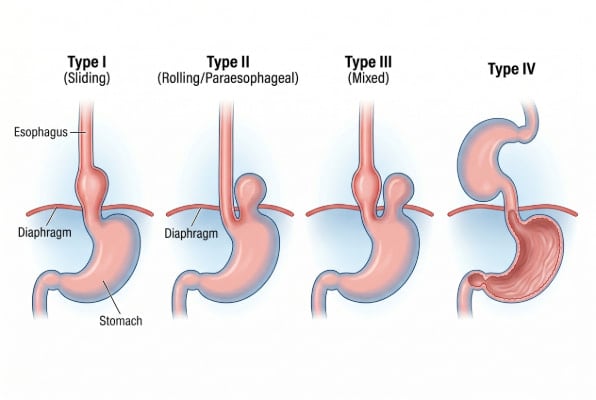
Categories of Hiatal Hernias
Hiatal hernias break down into four separate categories:
Type I (Sliding): A sliding hernia happens when the gastroesophageal junction, the meeting point between the esophagus and stomach, plus a section of the stomach, glides upward into the chest by passing through a gap in the diaphragm. The term “sliding” describes how the displaced section can shift back and forth between the chest cavity and its normal position. Making up roughly 95% of cases, this variation stands as the most widespread form of hiatal hernia.
Type II (Rolling): Sometimes referred to as a paraesophageal hernia, a rolling hernia happens when a piece of the stomach pushes through the diaphragm alongside the esophagus, sitting right next to the gastroesophageal junction. While they show up far less frequently than sliding hernias, they bring a greater chance of complications that may result in strangulation of the herniated tissue.
Type III (Mixed): Blending features of both Type I Sliding and Type II Rolling, a Type III Mixed hernia develops when the portion of your esophagus connecting to your stomach slides up through the hiatus on occasion, while a separate section of your stomach pushes through at other moments.
Type IV: As an extremely uncommon paraesophageal hernia, Type IV essentially involves the whole stomach moving up into the thorax (resulting in an upside-down stomach arrangement). Additional organs such as the colon, pancreas, or small bowel may also become trapped.
Combined, Types III and IV represent around 5% of all hernia cases.

Treatment Options for Hiatal Hernias
The exact treatment plan for each form of hiatal hernia will be decided by your physician and hinges on several considerations, such as how intense your symptoms are, your overall health condition, and where the hernia sits. Conditions like silent reflux, achalasia, and gastroparesis can also influence the recommended approach.
Medication and Lifestyle Adjustments
Type I Sliding hernias are normally handled through medications, lifestyle adjustments, or both, including:
- Keeping your body weight in a healthy range. For patients who struggle with weight management, incisionless weight loss procedures may also be considered.
- Staying away from acidic foods (tomatoes, citrus, juice, and the like).
- Cutting back on fatty, fried, and caffeinated products (carbonated beverages, alcohol, condiments, and similar items).
- Building a healthier evening routine by:
- Cutting out snacks within at least 3 hours of bedtime.
- Propping your head up 6 inches above body level when lying down.
- Giving up smoking.
- Easing off pressure on the abdomen by avoiding:
- Lifting items that are too heavy.
- Wearing clothing that’s overly tight around the midsection.
Type II Rolling and Type III Mixed hernias might call for surgery once they start producing symptoms. With Type IV, when organs like the pancreas, colon, or small bowel get stuck in the chest, surgery often becomes necessary. You can learn more about related conditions on our blog.
Surgical Procedures
Surgery may come into play for individuals with a hiatal hernia who suffer from chronic, severe esophageal reflux when medications and lifestyle modifications fail to bring relief.
Three primary surgical methods exist for repairing hiatal hernias: open, laparoscopic, and robotic. Which approach suits you best may depend on the hernia’s size, severity, and placement. Have a conversation with the best hiatal hernia doctors in Tampa about which choice fits your circumstances.
- Open: Standing as the traditional route for hernia repair, the open procedure requires your surgeon to create an incision in the abdominal area directly over the hernia.
- Laparoscopic: Recognized as a minimally invasive technique, this method has your surgeon create several tiny half-inch incisions. Through one of these “key-hole” openings, a slim tube with a mounted video camera is inserted, while repairs are completed through the remaining incisions using narrow instruments directed by the camera. Procedures like fundoplications are commonly performed this way.
- Robotic: Closely resembling laparoscopic repair, robotic hernia surgery is another minimally invasive procedure that uses small incisions, but the surgeon directs the entire operation from a specialized robotic console. Patients may also benefit from quicker recovery after robotic surgery in comparison to open surgery. Advanced options such as the LINX reflux management system and TIF (EsophyX) procedures may also be considered.
Surgery may become necessary if the hernia is choking off your blood supply or if severe GERD-style symptoms refuse to respond to medical treatment. Make a point to talk with your doctor about diagnosis and treatment routes if hiatal hernia symptoms are affecting you.

Get Expert Hiatal Hernia Care at Tampa Bay Reflux Institute
If you’re dealing with hiatal hernia symptoms or persistent acid reflux, the team at Tampa Bay Reflux Institute is ready to help. Led by Dr. Gopal Grandhige, a nationally recognized expert in the diagnosis and surgical treatment of GERD, hiatal hernias, and related conditions, our practice focuses exclusively on reflux management and advanced anti-reflux procedures. Dr. Grandhige performs hiatal hernia repairs both robotically and laparoscopically, customizing each treatment plan around the patient’s anatomy, symptoms, and personal preferences. With extensive experience completing hundreds of fundoplications, LINX procedures, and TIF (EsophyX®) treatments, he is the only board-certified surgeon in the Tampa Bay area who routinely performs all three of these cutting-edge anti-reflux procedures. Visit us at 1315 South Howard Ave., Suite 101, Tampa, Florida 33606, give us a call at 813.922.2920, or schedule an appointment online to start your journey toward lasting relief from hiatal hernia and reflux symptoms.
Conclusion
Hiatal hernias are a common condition that can range from completely unnoticeable to significantly disruptive, depending on the type and severity. While Type I Sliding hernias make up the vast majority of cases and often respond well to lifestyle changes and medication, the less common Types II, III, and IV may require surgical intervention to prevent serious complications. Understanding which type you have is the first step toward effective treatment, whether that means simple dietary adjustments, prescribed medications, or advanced surgical procedures like laparoscopic or robotic repair.
If you’re experiencing persistent heartburn, acid reflux, or other GERD-related symptoms, don’t ignore them. Early diagnosis allows for more treatment flexibility and better long-term outcomes. The expert team at Tampa Bay Reflux Institute, led by Dr. Gopal Grandhige, offers personalized care backed by extensive experience in advanced anti-reflux procedures. Reach out today to take the first step toward lasting relief.
FAQs
Can a hiatal hernia heal on its own without treatment?
No, a hiatal hernia cannot heal on its own and will not go away without medical intervention. However, many small hernias cause no symptoms and may not require any treatment beyond monitoring.
What foods should I avoid if I have a hiatal hernia?
You should avoid acidic foods like tomatoes and citrus, as well as fatty, fried, and caffeinated items, including carbonated drinks and alcohol. These foods can trigger acid reflux and worsen GERD-style symptoms associated with the hernia.
Is surgery always required for a hiatal hernia?
Surgery is not always required, especially for Type I Sliding hernias, which are usually managed with medications and lifestyle changes. However, larger hernias or those causing severe symptoms and complications may need surgical repair.
How long is the recovery time after hiatal hernia surgery?
Recovery time varies based on the surgical method used, with minimally invasive options like laparoscopic and robotic procedures typically offering faster healing than open surgery. Most patients return to normal activities within a few weeks following minimally invasive repair.
Can a hiatal hernia come back after surgery?
Yes, there is a possibility of recurrence after hiatal hernia surgery, though it is relatively uncommon with modern surgical techniques. Following your surgeon’s post-operative guidelines and maintaining healthy lifestyle habits can significantly reduce the risk of recurrence.


An endoscopy cannot tell you if you have reflux. It can only tell you if you have complications of GERD.
If you are unhappy with your reflux symptoms, come in and we can discuss testing and treatments that can accurately diagnose your problem.
#reflux #gerd #hiatalhernia #gastroparesis #linx

CALL US AT 813-922-2920
www.tampareflux.com
If you have a hiatal hernia and fit one of these categories, you should know your options.
Dr. Grandhige is an expert in his field and performs 200 of these surgeries a year. He is the only surgeon in the Tampa Bay Area who offers all surgical options - LINX, Fundoplications, TIF and will be one of 20 surgeons in America introducing the latest procedure RefluxStop in 2026.
We accept most insurances but will verify yours before you come in. These procedures are considered medically necessary and covered by your insurance. You can expect to pay your in-network deductibles and nothing else.
#hiatalhernia #reflux #GERD #LINX #refluxstop
What causes reflux ?
1. Weak lower esophageal sphincter
2. Hiatal hernia
3. Flattening of the Angle of His
4. Poor esophageal motility
5. Gastroparesis (slow stomach)
NOT increased acid production
Don’t let GERD get in the way of living your life. Request your appointment with us today on the link below.
.
.
.
.
https://tampareflux.com/contact-us/
Anyone can be victim to GERD and though weight loss can help reduce GERD symptoms. Many athletes with high impact workouts may continue to have these symptoms. This may be a symptom of a hiatal hernia or other issue. We are more then happy to assist you in finding your solution, just click the link below.
.
.
.
https://tampareflux.com/contact-us/
##healthylifestyle #workout #athletereflux #PPIs #heartburn #LINX #fundoplication #TIF #GERD#tampaheartburn #linx #TIF #fundoplication #tampabayreflux #GERD #acidreflux #acidrefluxsurgery #stopreflux
#nonsurgicalweightloss #ESG #gastricballoon #weightlossjourney #vsg #vsgjourney #spatz3 #orbera #orberaballoon #grandhige #DrG
#tampabayrefluxinstitute #guthealth #roboticsurgery
Heartburn may seem like an annoyance. But if you find yourself having symptoms on a daily basis, it may be time to to talk to Dr. Grandhige as it could be a symptom of something worse.
.
.
.
#chronicheartburn #gerdsymptoms #heartburnrelief #reflux #PPIs #heartburn #LINX #fundoplication #TIF #GERD#tampaheartburn #linx #TIF #fundoplication #tampabayreflux #GERD #acidreflux #acidrefluxsurgery #stopreflux
#nonsurgicalweightloss #ESG #gastricballoon #weightlossjourney #vsg #vsgjourney #spatz3 #orbera #orberaballoon #grandhige #DrG
#tampabayrefluxinstitute #guthealth #roboticsurgery
If you are tired of avoiding your favorite foods or taking daily medications, we can help.
We are the Tampa experts in reflux ! With years of experience and thousands of patients treated successfully, we offer all FDA approved anti-reflux procedures.
Call 813-922-2920 to schedule your appointment
All major insurances accepted.
Not all patients need surgical intervention. Many patients are living a heartburn free life with their PPIs. However 40% of patients taking PPIs are not getting the relief they need. If you are one of those, you have options! Come in and find out more.
.
.
.
.
#letushelpyou #medsnotworking #reflux #PPIs #heartburn #LINX #fundoplication #TIF #GERD#tampaheartburn #linx #TIF #fundoplication #tampabayreflux #GERD #acidreflux #acidrefluxsurgery #stopreflux
#nonsurgicalweightloss #ESG #gastricballoon #weightlossjourney #vsg #vsgjourney #spatz3 #orbera #orberaballoon #grandhige #DrG
#tampabayrefluxinstitute #guthealth #roboticsurgery
#heartburn #stopreflux #hiatalherniarepair #severeheartburn #reflux #tampabayreflux #acidrefluxsurgery #tampaheartburn #GERD #PPIs #achalasia #LINX #TIF #tampareflux #fundoplication #stomach #digestivehealth #ESG #obesity #overweight #weightlossjourney #gastricballoon


